Microeconomics Ch 13-16 Review
0.0(0)
Studied by 1 person Call Kai
 Learn
Learn Practice Test
 Spaced Repetition
 Match
Match Flashcards
 Knowt Play
Card Sorting
1/70

Earn XP
Description and Tags
Last updated 12:18 AM on 12/1/22
Name | Mastery | Learn | Test | Matching | Spaced | Call with Kai | Chat |
|---|
No analytics yet
Send a link to your students to track their progress
71 Terms
1
New cards
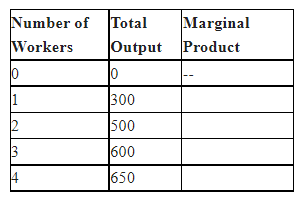
What is the marginal product of the first worker?
300 units
2
New cards
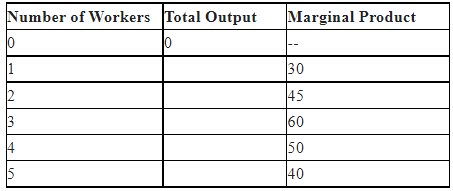
What is total output when 1 worker is hired?
30
3
New cards
Katya owns a math-tutoring business. Her accountant most likely includes which of the following costs on her financial statements?
(i) workbooks containing practice problems
(ii) rent for the storefront
(iii) wages Katya could earn as a bookkeeper
(iv) interest that Katya’s money was earning before she spent her savings to set up the tutoring business
(i) workbooks containing practice problems
(ii) rent for the storefront
(iii) wages Katya could earn as a bookkeeper
(iv) interest that Katya’s money was earning before she spent her savings to set up the tutoring business
(i) and (ii) only
4
New cards
Gwen has decided to start her own photography studio. To purchase the necessary equipment, Gwen withdrew $2,000 from her savings account, which was earning 3% interest, and borrowed an additional $4,000 from the bank at an interest rate of 7%. What is Gwen's annual opportunity cost of the financial capital that has been invested in the business?
$340
5
New cards
The Three Amigo’s company produced and sold 500 dog beds. The average cost of production per dog bed was $50. Each dog bed was sold for a price of $65. The Three Amigo’s total costs are
$25,000
6
New cards
If a production function shows declining marginal product of an input as the quantity of the input increases, then the production function exhibits
decreasing marginal product.
7
New cards
Which of the following is an example of an implicit cost?
(i) the owner of a firm forgoing an opportunity to earn a large salary working for a Wall Street brokerage firm
(ii) interest paid on the firm's debt
(iii) rent paid by the firm to lease office space
(iii) rent paid by the firm to lease office space
(i) the owner of a firm forgoing an opportunity to earn a large salary working for a Wall Street brokerage firm
(ii) interest paid on the firm's debt
(iii) rent paid by the firm to lease office space
(iii) rent paid by the firm to lease office space
(i) only
8
New cards
Billy’s Bean Bag Emporium produced 300 bean bag chairs but sold only 275 of the units it produced. The average cost of production for each unit of output produced was $100. The price for each of the 275 units sold was $95. Total profit for Billy’s Bean Bag Emporium would be
-$3,875
9
New cards
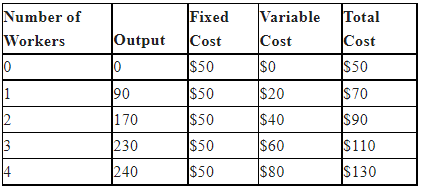
If the firm can sell its output for $1 per unit, what is the profit-maximizing level of output?
230 units
10
New cards
Carol Anne makes candles. If she charges $20 for each candle, her total revenue will be
$500 if she sells 25 candles
11
New cards
Economists normally assume that the goal of a firm is to
(i) sell as much of its product as possible.
(ii) set the price of the product as high as possible.
(iii) maximize profit.
(i) sell as much of its product as possible.
(ii) set the price of the product as high as possible.
(iii) maximize profit.
(iii) only
12
New cards
The amount of money that a firm pays to buy inputs is called
total cost
13
New cards
When adding another unit of labor leads to an increase in output that is smaller than the increases in output that resulted from adding previous units of labor, the firm is experiencing
diminishing marginal product
14
New cards
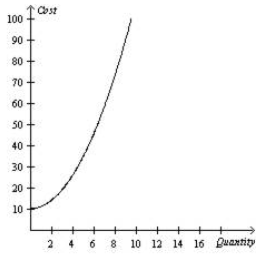
The graph illustrates a typical
total-cost curve
15
New cards
An example of an explicit cost of production would be the
lease payments for the land on which a firm's factory stands
16
New cards
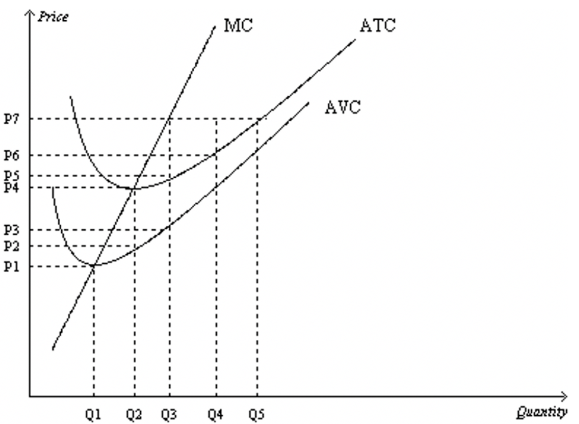
Suppose a firm operating in a competitive market has the following cost curves. In the short run, if the market price is P4, individual firms in a competitive industry will earn
zero profits
17
New cards
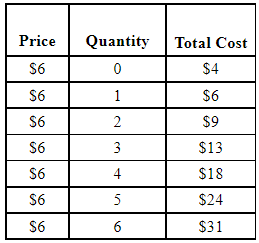
Suppose that a firm in a competitive market faces the following prices and costs. In order to maximize profits, the firm should stop producing after it makes the
fifth unit
18
New cards
Suppose a competitive market is comprised of firms that face identical cost curves. The firms experience an increase in demand that results in positive profits for the firms. Which of the following
events are then most likely to occur?
(i) New firms will enter the market.
(ii) In the short run, price will rise; in the long run, price will rise further.
(iii) In the long run, all firms will be producing at their efficient scale.
events are then most likely to occur?
(i) New firms will enter the market.
(ii) In the short run, price will rise; in the long run, price will rise further.
(iii) In the long run, all firms will be producing at their efficient scale.
(i) and (iii) only
19
New cards
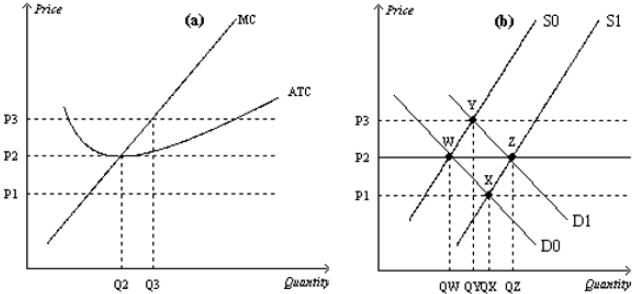
Assume that the market starts in equilibrium at point W in panel (b). An increase in demand from D0 to D1 will result in
an eventual increase in the number of firms in the market and a new long-run
20
New cards
Roger owns a small health store that sells vitamins in a perfectly competitive market. If vitamins sell for $12 per bottle and the average total cost per bottle is $11.50 at the profit-maximizing output level, then in the long run
more firms will enter the market
21
New cards
A competitive market is in long-run equilibrium. If demand increases, we can be certain that price will
rise in the short run. Some firms will enter the industry. Price will then fall to reach the new long-run equilibrium.
22
New cards
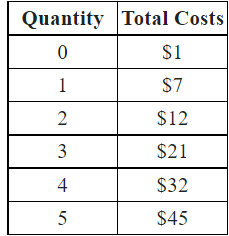
In the short run, a market consists of 100 identical firms. The market price is $6, and the total cost to each firm of producing various levels of output is given in the table below. What will total quantity supplied be in the market?
200 units
23
New cards
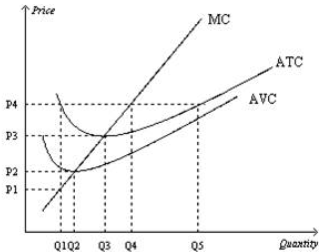
Suppose a firm operating in a competitive market has the following cost curves. When price rises from P2 to P3, the firm finds that
expanding output to Q4 would leave the firm with losses.
24
New cards
When firms in a competitive market have different costs, it is likely that
some firms will earn positive economic profits in the long run.
25
New cards
A study sponsored by the Food Consumer Safety Board found that consumption of irradiated tomatoes increased the health of laboratory rats. As a result of national press coverage of the report, the demand for irradiated tomatoes increased dramatically. Organic farmers were able to switch from organic production of tomatoes to irradiated production with no additional cost. Assume that the tomato market satisfies all of the assumptions of perfect competition.
As a result of the increase in the demand for tomatoes, we would predict that in the short run that the
As a result of the increase in the demand for tomatoes, we would predict that in the short run that the
price of tomatoes would rise.
26
New cards
In a competitive market the current price is $5. The typical firm in the market has ATC = $5.00 and AVC = $4.50.
The firm will earn zero profits in both the short run and long run.
27
New cards
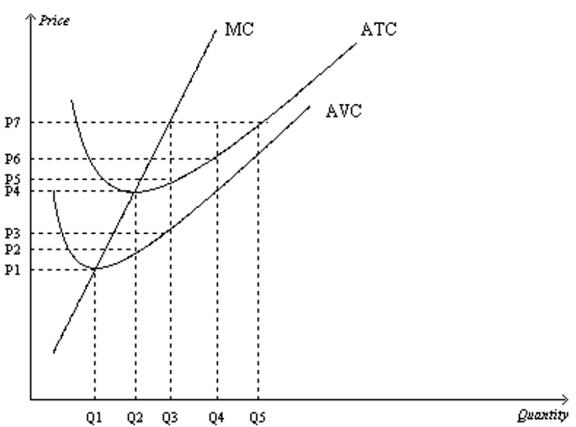
Suppose a firm in a competitive market has the following cost curves. In the short run, if the market price is higher than P4 but less than P6, individual firms in a competitive industry will earn
positive profits
28
New cards
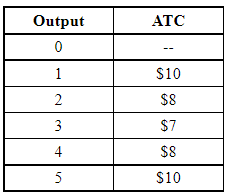
A firm in a competitive market has the following cost structure. If the firm's fixed cost of production is $3, and the market price is $10, how many units should the firm produce to maximize profit?
3 units
29
New cards
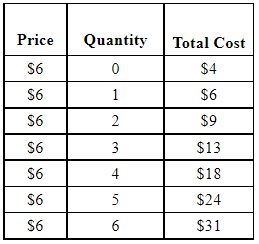
Suppose that a firm in a competitive market faces the following prices and costs. Marginal revenue equals marginal cost when the firm produces
5 units
30
New cards
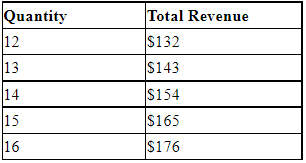
The table represents a demand curve faced by a firm in a competitive market. For this firm, the price of the product is
$11
31
New cards
A study sponsored by the Food Consumer Safety Board found that consumption of irradiated tomatoes increased the health of laboratory rats. As a result of national press coverage of the report, the demand for irradiated tomatoes increased dramatically. Organic farmers were able to switch from organic production of tomatoes to irradiated production with no additional cost. Assume that the tomato market satisfies all of the assumptions of perfect competition.
If the increased production of irradiated tomatoes caused a rise in the marginal transportation costs of moving irradiated tomatoes to market, the
If the increased production of irradiated tomatoes caused a rise in the marginal transportation costs of moving irradiated tomatoes to market, the
long-run market supply of irradiated tomatoes would be upward sloping.
32
New cards
A competitive market is in long-run equilibrium. If demand decreases, we can be certain that price will
fall in the short run. All, some, or no firms will shut down, and some of them will exit the industry. Price will then rise to reach the new long-run equilibrium.
33
New cards
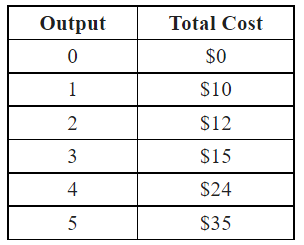
In the short run, there are 500 identical firms in a competitive market. The firms do not use any resources that are available in limited quantities, and each of them has the following cost structure. Which of the following is a point on the long-run supply curve?
P=$5, Q=1,500
34
New cards
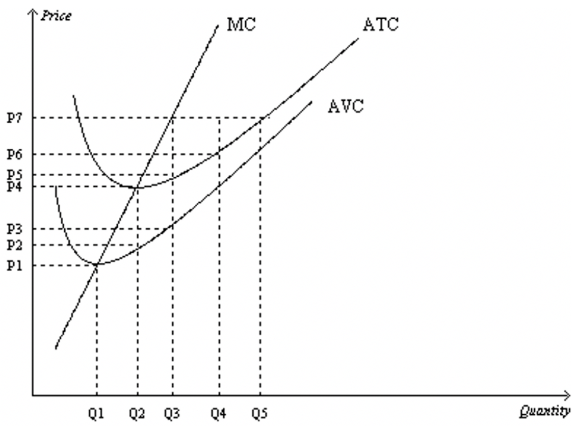
Suppose a firm operating in a competitive market has the following cost curves. When market price is P7, a profit-maximizing firm's short-run profits can be represented by the area
(P7 - P5) × Q3
35
New cards
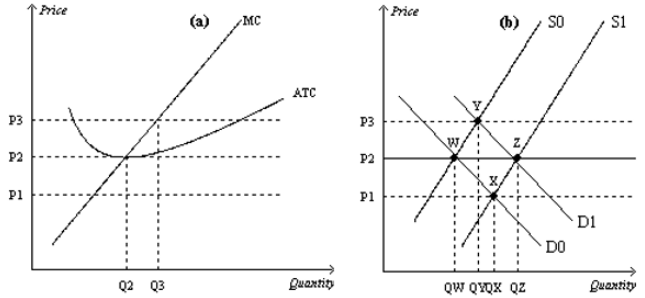
Suppose a firm in a competitive market, like the one depicted in panel (a), observes market price rising from P1 to P2. Which of the following could explain this observation?
An increase in market demand from D0 to D1
36
New cards
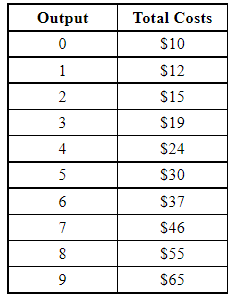
A firm in a competitive market has the following cost structure. If the market price is $8, how many units of output should the firm produce to maximize profit?
6 units
37
New cards
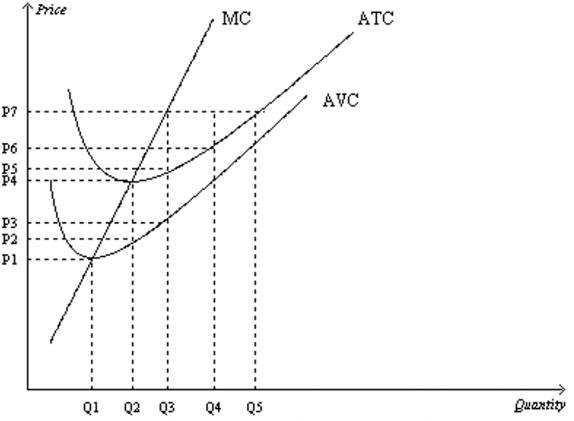
Suppose a firm operating in a competitive market has the following cost curves. In the short run, if the market price is higher than P1 but less than P4, individual firms in a competitive industry will earn
losses but will remain in business
38
New cards
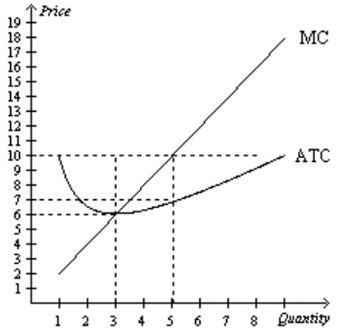
Suppose a firm operating in a competitive market has the following cost curves. If the market price is $10, what is the firm's short run economic profit?
$15
39
New cards
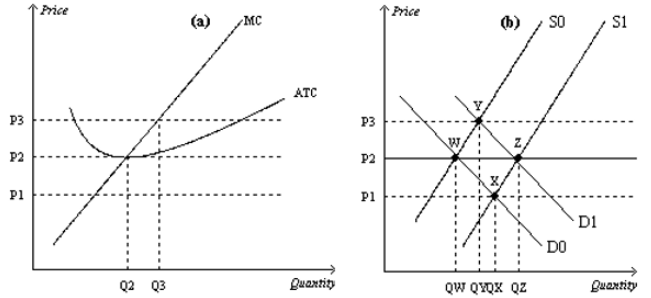
When the market is in long-run equilibrium at point W in panel (b), the firm represented in panel (a) will
have a zero economic profit
40
New cards
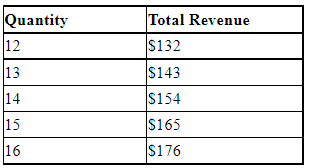
The table represents a demand curve faced by a firm in a competitive market. For this firm, the marginal revenue of the 12th unit is
$11
41
New cards
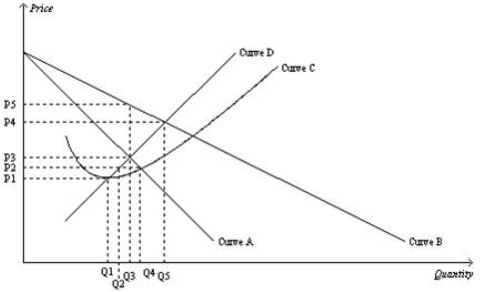
Profit will be maximized by charging a price equal to
P5
42
New cards
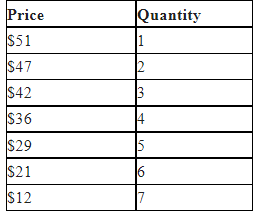
A monopolist faces the demand curve above. The monopolist has total fixed costs of $60 and has a constant marginal cost of $15. What is the profit-maximizing level of production?
4 units
43
New cards
Patents, copyrights, and trademarks
are examples of government-created monopolies
44
New cards
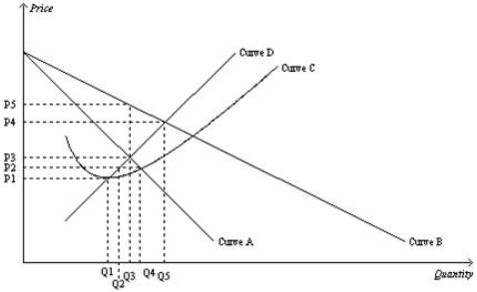
The average total cost curve for a monopoly firm is depicted by curve
C
45
New cards
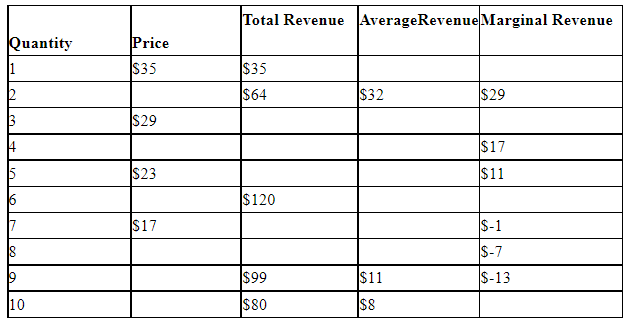
If the monopolist sells 8 units of its product, how much total revenue will it receive from the sale?
$112
46
New cards
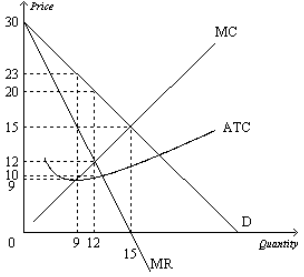
A profit-maximizing monopolist would incur total costs of
$120
47
New cards
Competitive firms differ from monopolies in which of the following ways?
(i) Competitive firms do not have to worry about the price effect lowering their total revenue.
(ii) Marginal revenue for a competitive firm equals price, while marginal revenue for a monopoly is less than the price it is able to charge.
(iii) Monopolies must lower their price in order to sell more of their product, while competitive firms do not.
(i) Competitive firms do not have to worry about the price effect lowering their total revenue.
(ii) Marginal revenue for a competitive firm equals price, while marginal revenue for a monopoly is less than the price it is able to charge.
(iii) Monopolies must lower their price in order to sell more of their product, while competitive firms do not.
(i), (ii), and (iii)
48
New cards
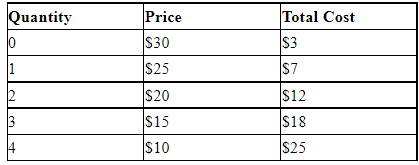
Consider the following demand and cost information for a monopoly. The marginal revenue of the 2nd unit is
$15
49
New cards
For a monopoly firm, the shape and position of the demand curve play a role in determining the
(i) profit-maximizing price.
(ii) shape and position of the marginal-cost curve.
(iii) shape and position of the marginal-revenue curve.
(i) profit-maximizing price.
(ii) shape and position of the marginal-cost curve.
(iii) shape and position of the marginal-revenue curve.
(i) and (iii) only
50
New cards
What is the shape of the monopolist's marginal revenue curve?
a downward-sloping line that lies below the demand curve
51
New cards
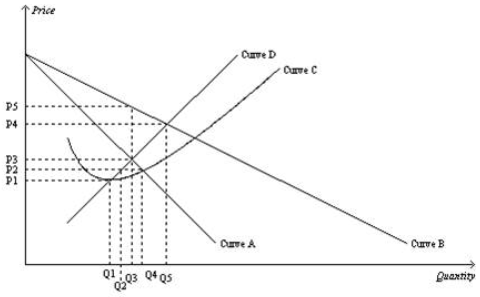
A profit-maximizing monopoly's total revenue is equal to
P5 x Q3
52
New cards
Allowing an inventor to have the exclusive rights to market her new invention will lead to
(i) a product that is priced higher than it would be without the exclusive rights.
(ii) desirable behavior in the sense that inventors are encouraged to invent.
(iii) higher profits for the inventor.
(i) a product that is priced higher than it would be without the exclusive rights.
(ii) desirable behavior in the sense that inventors are encouraged to invent.
(iii) higher profits for the inventor.
(i), (ii), and (iii)
53
New cards
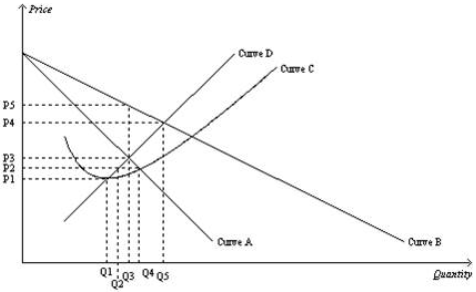
Bob's Butcher Shop is the only place within 100 miles that sells bison burgers. Assuming that Bob is maximizing his profit, which of the following statements is true?
The price of Bob's bison burgers will exceed Bob's marginal cost.
54
New cards
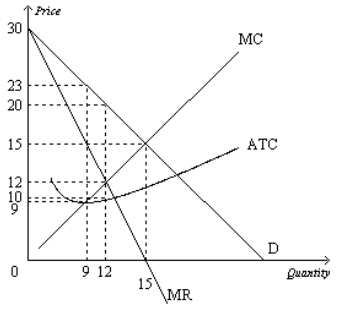
A profit-maximizing monopolist would earn total revenues of
$240
55
New cards
Which of the following statements is true?
(i) When a competitive firm sells an additional unit of output, its revenue increases by an amount less than the price.
(ii) When a monopoly firm sells an additional unit of output, its revenue increases by an amount less than the price.
(iii) Average revenue is the same as price for both competitive and monopoly firms.
(i) When a competitive firm sells an additional unit of output, its revenue increases by an amount less than the price.
(ii) When a monopoly firm sells an additional unit of output, its revenue increases by an amount less than the price.
(iii) Average revenue is the same as price for both competitive and monopoly firms.
(ii) and (iii) only
56
New cards
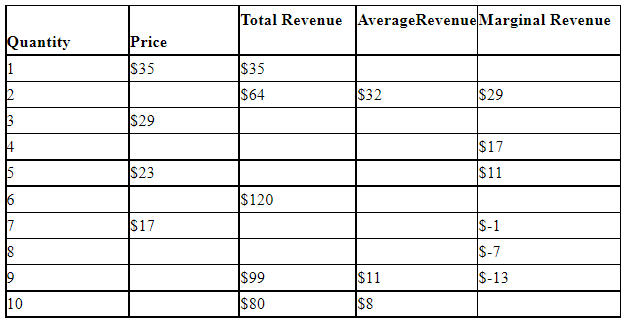
If the monopolist wants to maximize its revenue, how many units of its product should it sell?
6
57
New cards
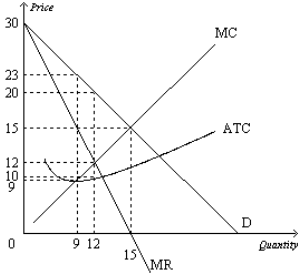
A profit-maximizing monopolist would earn profits of
$120
58
New cards
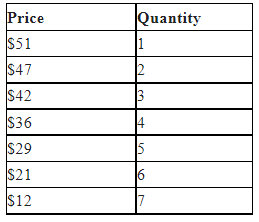
The table shows the demand curve a monopolist faces. The monopolist has total fixed costs of $60 and has a constant marginal cost of $15. What is the profit-maximizing price?
$36
59
New cards
A monopolist can sell 300 units of output for $45 per unit. Alternatively, it can sell 301 units of output for $44.60 per unit. The marginal revenue of the 301st unit of output is
-$75.40
60
New cards
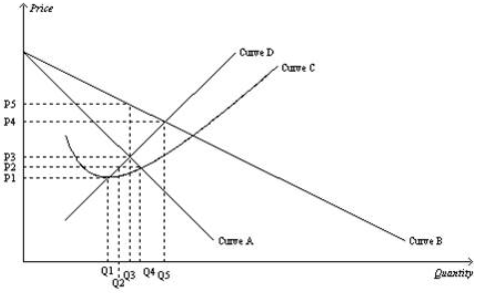
If the monopoly firm is currently producing Q3 units of output, then a decrease in output will necessarily cause profit to
decrease
61
New cards
Suppose most people regard emeralds, rubies, and sapphires as close substitutes for diamonds. Then DeBeers, a large diamond company, has
less market power than it would otherwise have
62
New cards
For a monopoly firm,
price always exceeds marginal revenue
63
New cards
Because monopoly firms do not have to compete with other firms, the outcome in a market with a monopoly is often
A) All of the above are correct.
B) inefficient.
C) not in the best interest of society.
D) one that fails to maximize total economic well-being.
A) All of the above are correct.
B) inefficient.
C) not in the best interest of society.
D) one that fails to maximize total economic well-being.
A) All of the above are correct
64
New cards
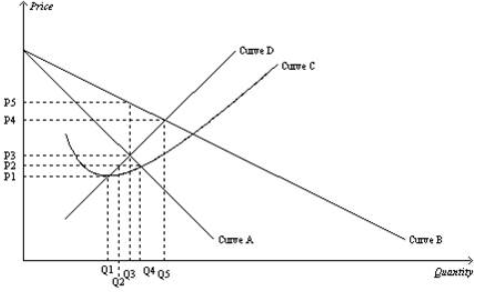
If the monopoly firm wants to maximize its profit, it should operate at a level of output equal to
Q3
65
New cards
A monopoly firm can sell 150 units of output for $10 per unit. Alternatively, it can sell 151 units of output for $9.98 per unit. The marginal revenue of the 151st unit of output is
$6.98
66
New cards
When a firm operates under conditions of monopoly, its price is
constrained by demand
67
New cards
The marginal revenue curve for a monopoly firm starts at the same point on the vertical axis as the
(i) average revenue curve.
(ii) marginal cost curve.
(iii) demand curve.
(i) average revenue curve.
(ii) marginal cost curve.
(iii) demand curve.
(i) and (iii) only
68
New cards
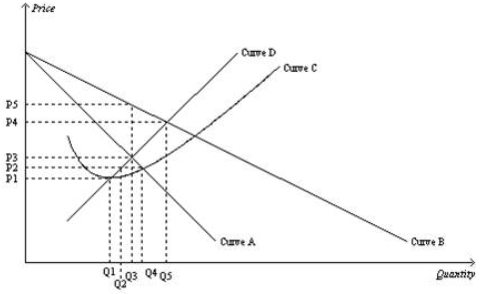
Profit can always be increased by increasing the level of output by one unit if the monopolist is currently operating at
(i) Q1.
(ii) Q2.
(iii) Q3
(iv) Q4.
(i) Q1.
(ii) Q2.
(iii) Q3
(iv) Q4.
(i) or (ii) only
69
New cards
Which of the following is not an example of a barrier to entry?
A college student starts a part-time tutoring business.
70
New cards
Because a monopolist is the sole producer in its market, it can necessarily alter the price of its good
(i) without affecting the quantity sold.
(ii) without affecting its average total cost.
(iii) by adjusting the quantity it supplies to the market.
(i) without affecting the quantity sold.
(ii) without affecting its average total cost.
(iii) by adjusting the quantity it supplies to the market.
(iii) only
71
New cards
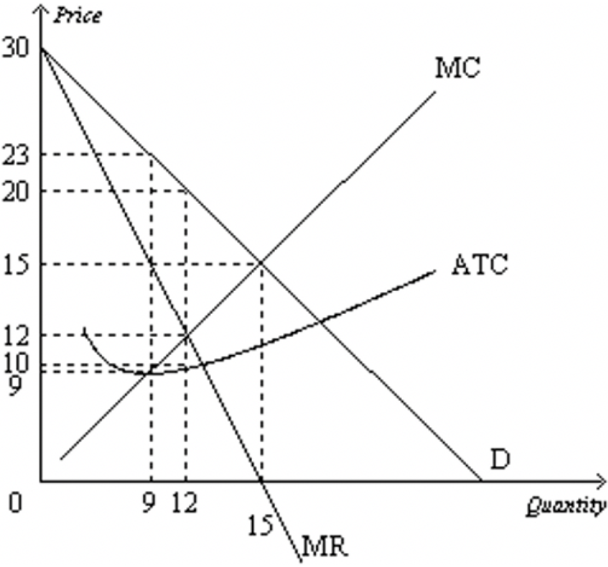
A profit-maximizing monopolist would earn profits of
$120