CHEM 2021 — Final Exam
 Call Kai
 Learn
Learn Practice Test
 Spaced Repetition
 Match
Match Flashcards
 Knowt Play
1/18

There's no tags or description
Looks like no tags are added yet.
Name | Mastery | Learn | Test | Matching | Spaced | Call with Kai | Chat |
|---|
No analytics yet
Send a link to your students to track their progress
19 Terms
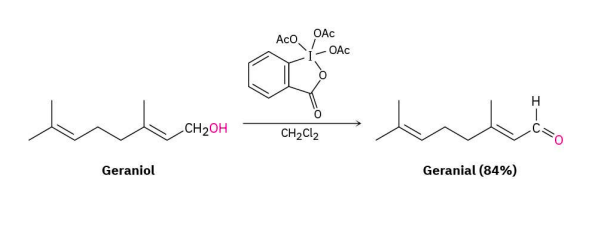
What are the different reactions that only produce aldehydes?
Oxidation reaction w/ DMP
DIBAL-H reaction
What are the starting materials, reagents, conditions (if application), products and by-products (if applicable) of the oxidation reaction of 1° alcohols with DMP?
Starting Material: 1° alcohol
Reagents: DMP/Dess-Martin Periodinane (oxidizing agent), CH2Cl2 (solvent)
Product: Aldehyde
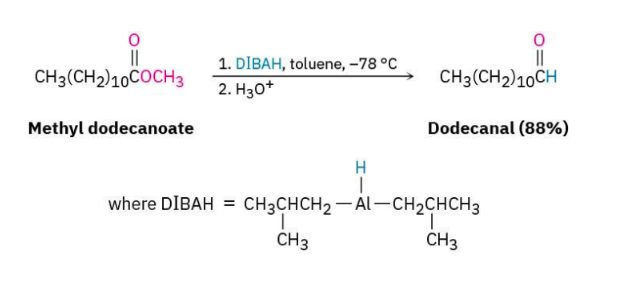
What are the starting materials, reagents, conditions (if application), products and by-products (if applicable) of the reductive reaction with DIBAL-H?
Starting Material: Ester
Reagents:
DIBAL-H (reducing agent), Toluene (solvent)
H3O+ (acid-workup step)
Conditions: -78°C (dry-ice temperature)
Product: Aldehyde
What are the different reactions that only produce ketones?
Oxidation reaction of 2° alcohols w/ DMP
Oxidation reaction of 2° alcohols w/ KMnO4
Oxidation reaction of 2° alcohols w/ CrO3
Oxidation reaction of 2° alcohols w/ Na2Cr2O7
Friedel-Crafts Acylation
Hydration of Alkynes w/ HgSO4
Acid chloride and Gilman Reagent Reaction
Grignard Addition to a Nitrile
What are the starting materials, reagents, conditions (if application), products and by-products (if applicable) of the oxidation reaction of 2° alcohols w/ DMP?
Starting Material: 2° alcohol
Reagents: DMP/Dess-Martin Periodinane (oxidizing agent), CH2Cl2 (solvent)
Product: Ketone
What are the starting materials, reagents, conditions (if application), products and by-products (if applicable) of the oxidation reaction of 2° alcohols w/ KMnO4?
Starting Material: 2° alcohol
Reagents: KMnO4 (oxidizing agent), H2O, NaOH (base)
Product: Ketone
What are the starting materials, reagents, conditions (if application), products and by-products (if applicable) of the oxidation reaction of 2° alcohols w/ CrO3?
Starting Material: 2° alcohol
Reagents: CrO3 (oxidizing agent), H2SO4 (acid), H2O
Product: Ketone
What are the starting materials, reagents, conditions (if application), products and by-products (if applicable) of the oxidation reaction of 2° alcohols w/ Na2Cr2O7?
Starting Material: 2° alcohol
Reagents: Na2Cr2O7 (oxidizing agent), H2SO4 (acid), H2O
Product: Ketone
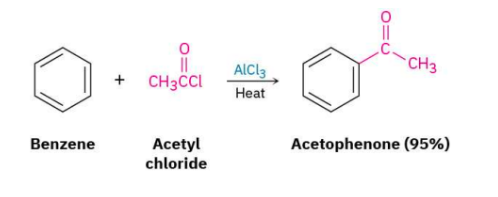
What are the starting materials, reagents, conditions (if application), products and by-products (if applicable) of Friedel-Crafts Acylation?
Starting Material: Aromatic ring, Acid chloride
Reagents: AlCl3 (Lewis acid catalyst)
Conditions: Heat
Product: Ketone
What are the starting materials, reagents, conditions (if application), products and by-products (if applicable) for hydration of alkynes w/ HgSO4?
Starting Material: Alkyne (terminal or internal alkyne)
Reagents: H2O, H2SO4 (acid), HgSO4
Product:
If starting material is terminal alkyne: methyl ketone is produced
If starting material is non-symmetrical, internal alkyne: a mixture of regioisomeric ketones
are produced
If starting material is symmetrical, internal alkyne: a single ketone product is produced
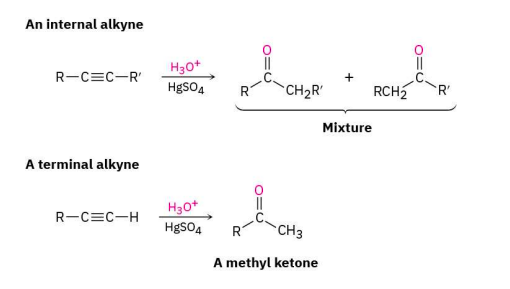
What are the starting materials, reagents, conditions (if application), products and by-products (if applicable) for hydroboration-oxidation of alkynes w/ BH3?
Starting Material: alkyne (terminal or internal)
Reagents:
BH3, THF (solvent)
H2O2 (oxidizing agent), H2O, NaOH (base)
Product:
If terminal alkyne: aldehyde is produced
If internal alkyne: ketone is produced
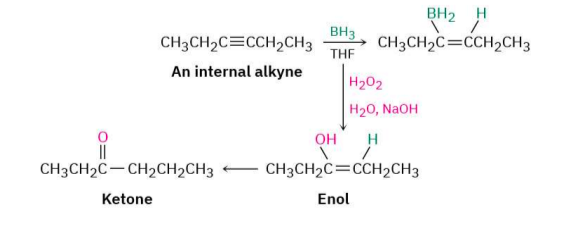
What are the starting materials, reagents, conditions (if application), products and by-products (if applicable) for the reaction between an acid chloride and Gilman reagent?
Starting Material: acid chloride
Reagents: R2’CuLi (Gilman reagent), Ether (solvent)
Product: Ketone
Note: Onlyonealkyl group is donated to the acid chloride
What are the starting materials, reagents, conditions (if application), products and by-products (if applicable) for the Grignard addition of nitriles?
Starting Material: nitrile compound
Reagents:
RMgX (Grignard reagent), ether (solvent)
H2O (acid-workup step)
Product: Ketone
By-Product: NH3
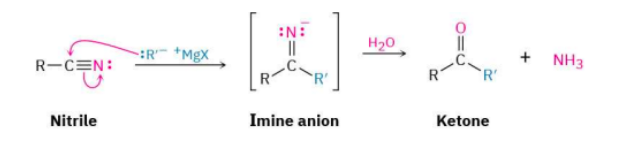
What are the different reactions that can make both aldehydes and/or ketones?
Ozonolysis of alkenes
Hydroboration-oxidation of alkynes w/ BH3
What are the starting materials, reagents, conditions (if application), products and by-products (if applicable) for the ozonolysis of alkenes?
Starting Material: alkene
Reagents:
O3
Zn/H3O+ (reducing agent)
Products:
Can be the following set of products:
2 aldehydes
1 ketone, 1 aldehyde
2 ketones
Depends on how substituted the alkene functional group is!
What are the different ways to make a nitrile compound?
SN2 substitution w/ cyanide
Dehydration of 1° amides
What are the starting materials, reagents, conditions (if application), products and by-products (if applicable) for the SN2 substitution w/ cyanide?
Starting Material: aldehyde or unhindered ketone
Reagents: HCN, base
Product: cyanohydrin (a type of nitrile)
Note: limited to steric hindrance due to SN2 mechanism
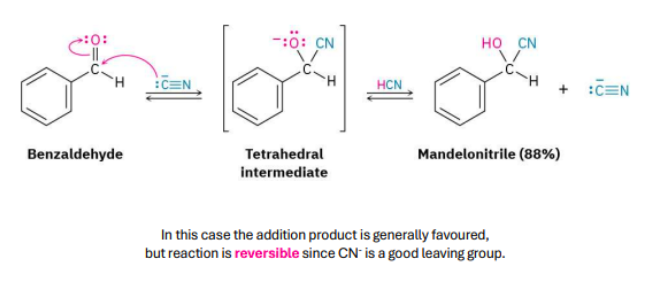
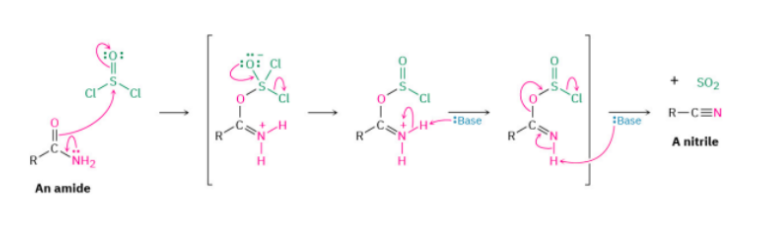
What are the starting materials, reagents, conditions (if application), products and by-products (if applicable) for the dehydration of 1° amides?
Starting Material: 1° amide
Reagents:
SOCl2, benzene
Base
Conditions: 80°C
Product: nitrile compound
By-Products: SO2
Note: not limited to steric hindrance (unlike SN2 substitution of CN)