[PHARMACOGNOSY] Volatile Oil
 Call Kai
 Learn
Learn Practice Test
 Spaced Repetition
 Match
Match Flashcards
 Knowt Play
1/194

There's no tags or description
Looks like no tags are added yet.
Name | Mastery | Learn | Test | Matching | Spaced | Call with Kai | Chat |
|---|
No analytics yet
Send a link to your students to track their progress
195 Terms
e. None
True about volatile oils except:
a. Do not become rancid, but resinified instead
b. Can be isolated by distillation
c. No permanent grease on paper
d. Cannot be saponified with alkali
e. None
f. All
Volatile oils that are heavier than water.
a. Sassafras
b. Clove oil
c. Cinnamon oil
d. a and b
e. b and c
f. All
c. Terpenes
Basic units of volatile oil.
a. Sterol
b. Fatty acid
c. Terpenes
d. Amino acid
f. None
True about fixed oil except:
a. Cannot be distilled and leave permanent grease on paper
b. Undergo saponification with alkali
c. Becomes rancid upon oxidation
d. Glyceryl ester of fatty acid
e. Has bland odor and is generally lighter than water
f. None
b. Fixed oil
Glyceryl ester of fatty acid.
a. Waxes
b. Fixed oil
c. Volatile oil
d. Tannins
a. Hard soap
Fixed oil saponification with NaOH.
a. Hard soap
b. Soft soap
b. Soft soap
Fixed oil saponification with KOH.
a. Hard soap
b. Soft soap
e. None
Characteristics of volatile oils except:
a. They are odoriferous principles of plants and animals; also known as essential oil, essences, ethereals
b. Immiscible with water
c. They are optically active
d. Easily evaporate
e. None
a. Dextrorotatory
Form of natural camphor.
a. Dextrorotatory
b. Levorotatory
b. Levorotatory
Form of synthetic camphor
a. Dextrorotatory
b. Levorotatory
a. Lamiaceae
Has glandular hairs or trichomes.
a. Lamiaceae
b. Piperaceae
c. Apiaceae
d. Pinaceae
b. Piperaceae
Has modified parenchymal cells.
a. Lamiaceae
b. Piperaceae
c. Apiaceae
d. Pinaceae
c. Apiaceae
Dillweed. Oil tubers or vittae.
a. Lamiaceae
b. Piperaceae
c. Apiaceae
d. Pinaceae
d. Pinaceae
Has lysigenous or schizogenous passages.
a. Lamiaceae
b. Piperaceae
c. Apiaceae
d. Pinaceae
d. Rutaceae
Has lysigenous or schizogenous passages.
a. Lamiaceae
b. Piperaceae
c. Apiaceae
d. Rutaceae
b. Ecuelle method
General method for obtaining citrus oils by rolling the fruit over through line by sharp projections, which are long enough to puncture oil glands in the epidermis.
a. Enfleurage
b. Ecuelle method
c. Distillation
d. Extraction
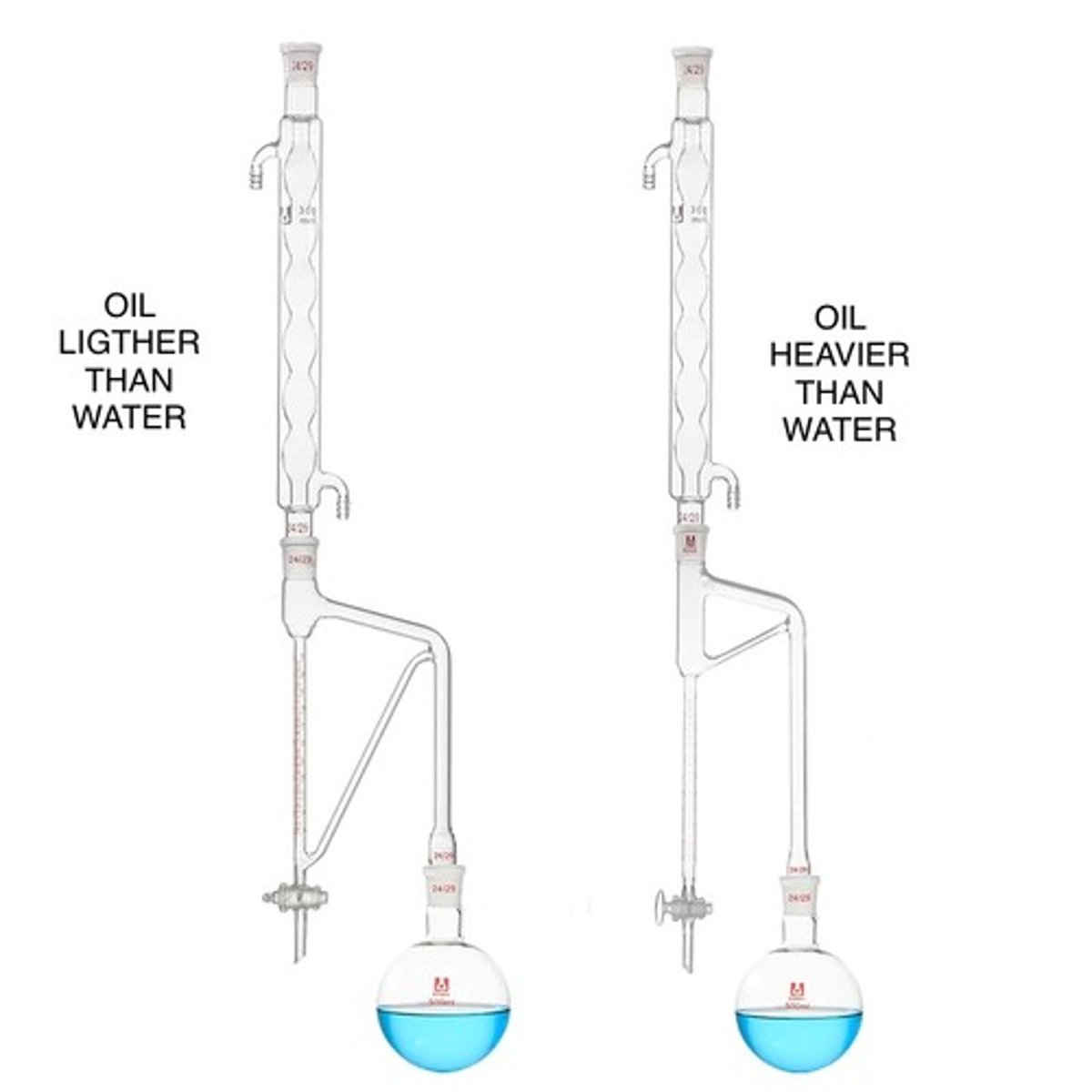
a. Distillation
Performed using Clevenger apparatus.
a. Distillation
b. Enzymatic actions
c. Expression
d. Extraction
a. Water distillation
For those not injured by boiling, dried form.
a. Water distillation
b. Water and steam distillation
c. Steam distillation
d. Destructive distillation
a. Turpentine oil
Can be extracted by water distillation.
a. Turpentine oil
b. Clove oil
c. Cinnamon oil
d. a and b
e. b and c
f. All
b. Water and steam distillation
Distillation for those injured by boiling.
a. Water distillation
b. Water and steam distillation
c. Steam distillation
d. Destructive distillation
e. b and c
Clove oil
Cinnamon oil
Extracted through water and steam distillation.
a. Turpentine oil
b. Clove oil
c. Cinnamon oil
d. a and b
e. b and c
f. All
c. Steam distillation
Extraction for fresh plant drugs.
a. Water distillation
b. Water and steam distillation
c. Steam distillation
d. Destructive distillation
d. a and b
Peppermint oil
Spearmint oil
Extracted with steam distillation.
a. Peppermint
b. Spearmint
c. Empyreumatic oils
d. a and b
e. b and c
f. All
d. Destructive distillation
Distillation through heat without the access of air.
a. Water distillation
b. Water and steam distillation
c. Steam distillation
d. Destructive distillation
c. Empyreumatic oils
Extracted through destructive distillation.
a. Peppermint
b. Spearmint
c. Empyreumatic oils
d. a and b
e. b and c
f. All
d. a and b
Pinaceae
Cupressaceae
Empyreumatic oils are from wood and resins of family:
a. Pinaceae
b. Cupressaceae
c. Rosaceae
d. a and b
e. b and c
f. All
d. a and b
Oil of cade
Oil of tar
Empyreumatic oil.
a Oil of cade
b. Oil of tar
c. Turpentine oil
d. a and b
e. b and c
f. All
b. Enzymatic actions
Mustard oil is extrated thrrough
a. Distillation
b. Enzymatic actions
c. Expression
d. Extraction
c. Expression
Ecuelle and piquer and enfleurage are examples of which type of extraction?
a. Distillation
b. Enzymatic actions
c. Expression
d. Extraction
a. Ecuelle and Piquer
Rolling the fruit over a trough lined with sharp projections.
a. Ecuelle and Piquer
b. Enfleurage
a. Ecuelle
Extraction for citrus oils.
a. Ecuelle and Piquer
b. Enfleurage
b. Enfleurage
Expression with the use of cold fat; formerly used in the perfume industry.
a. Ecuelle
b. Enfleurage
b. Enfleurage
Flower petals or small plant part on a fatty pomade is extracted by EtOH. Only works for tiny pieces of crude drug.
a. Ecuelle
b. Enfleurage
d. Extraction
Uses solvent systems based on volatile solvents; uses lower temperature.
a. Distillation
b. Enzymatic actions
c. Expression
d. Extraction
e. Refrigeration
Best extraction method for menthol from Japanese peppermint.
a. Distillation
b. Enzymatic actions
c. Expression
d. Extraction
e. Refrigeration
c. Both
Petroleum ether
Benzene
Common solvent/s for extraction of volatile oils.
a. Petroleum ether
b. Benzene
c. Both
d. None of these
d. a and b
Terpene derivative
Aromatic compound
Classes of volatile oil can be
a. Terpene derivative
b. Aromatic compound
c. Sugar derivative
d. a and b
e. b and c
f. All
a. Terpene derivatives
Formed via acetate-mevalonic acid pathway.
a. Terpene derivatives
b. Aromatic compounds
b. Aromatic compounds
Formed via shikimic acid-phenylpropanoid route.
a. Terpene derivatives
b. Aromatic compounds
e. None
Counterirritant such as methyl salicylate
Antipruritic such as camphor
Medicinal uses of volatile oils except:
a. Carminative
b. Antiseptic
c. Counterirritant (methyl salicylate)
d. Antipruritic (camphor)
e None
a. Camphor
Antipruritic volatile compound.
a. Camphor
b. Methyl salicylate
b. Methyl salicylate
Counterirritant volatile compound.
a. Camphor
b. Methyl salicylate
a. Isoprene
Building block of terpenes.
a. Isoprene
b. Monoprene
c. Uniprene
d. Alloprene
b. Monoterpene
Class of terpene mostly found in volatile oil.
a. Hemiterpene
b. Monoterpene
c. Diterpene
d. Sesquiterpene
e. Diterpene
b. 5 carbons
1 isoprene units is equal to how many carbons?
a. 3 carbons
b. 5 carbons
c. 10 carbons
d. 15 carbons
a. Hemiterpene
1 isoprene, 5C
a. Hemiterpene
b. Monoterpene
c. Diterpene
d. Sesquiterpene
e. Diterpene
b. Monoterpene
2 isoprene, 10C
a. Hemiterpene
b. Monoterpene
c. Diterpene
d. Sesquiterpene
e. Diterpene
b. Monoterpene
Limonene
a. Hemiterpene
b. Monoterpene
c. Diterpene
d. Sesquiterpene
e. Diterpene
d. Sesquiterpene
3 isoprene; 15C
a. Hemiterpene
b. Monoterpene
c. Diterpene
d. Sesquiterpene
e. Diterpene
d. Sesquiterpene
Abscisic acid
a. Hemiterpene
b. Monoterpene
c. Diterpene
d. Sesquiterpene
e. Diterpene
c. Diterpene
4 isoprenes, 20C
a. Hemiterpene
b. Monoterpene
c. Diterpene
d. Sesquiterpene
e. Diterpene
c. Diterpene
Gibberellin
a. Hemiterpene
b. Monoterpene
c. Diterpene
d. Sesquiterpene
e. Diterpene
c. Sesterterpene
5 isoprenes, 25C.
a. Sesquiterpene
b. Diterpene
c. Sesterterpene
d. Triterpene
e. Tetrapene
d. Triterpene
6 isoprenes, 30C
a. Sesquiterpene
b. Diterpene
c. Sesterterpene
d. Triterpene
e. Tetrapene
d. Triterpene
Brassinosteroids
a. Sesquiterpene
b. Diterpene
c. Sesterterpene
d. Triterpene
e. Tetrapene
e. Tetrapene
8 isoprenes, 40C
a. Sesquiterpene
b. Diterpene
c. Sesterterpene
d. Triterpene
e. Tetrapene
e. Tetrapene
Carotenoid
a. Sesquiterpene
b. Diterpene
c. Sesterterpene
d. Triterpene
e. Tetrapene
a. Geranyl pyrophosphate
C-10 precursor of the terpenes and is believed to play a key role in the formation of monoterpenes.
a. Geranyl pyrophosphate
b. Isopentyl pyrophosphate
c. Dimethylally pyrophosphate
d. b and c
e. All
d. b and c
Isopentyl pyrophosphate
Dimethylally pyrophosphate
Synthetically active isoprene units.
a. Geranyl pyrophosphate
b. Isopentyl pyrophosphate
c. Dimethylally pyrophosphate
d. b and c
e. All
c. Both
Cinnamic acid
p-hydroxycinnamic acid
Primary precursor of volatile oil with aromatic compounds.
a. Cinnamic acid
b. p-hydroxycinnamic acid
c. Both
d. None of these
a. True
Kinds of volatile oil
Hydrocarbons
Alcohols
Aldehydes
Ketones
Phenols
Phenolic esters
Oxides
Esters
a. True
b. False
e. None
True about stearoptene except:
a. Solid portion of HC
b. Oxidized HC
c. Present in smaller quantities
d. Imparts the characteristic odor
e. None
a. Stearoptene
Water soluble portion of volatile oil.
a. Stearoptene
b. Eleoptene
c. Terpinol
d. Limonene
b. Eleoptene
Liquid hydrocarbon portion of volatile oil.
a. Stearoptene
b. Eleoptene
c. Terpinol
d. Limonene
f. None
Stearoptene except:
a. Menthol
b. Anethol
c. Thymol
d. Camphor
e. Methyl salicylate
f. None
e. Methyl salicylate
The only liquid stearoptene:
a. Menthol
b. Anethol
c. Thymol
d. Camphor
e. Methyl salicylate
d. a and b
Encalyptol
Eugenol
Eleoptene
a. Encalyptol
b. Eugenol
c. Thymol
d. a and b
e. b and c
f. All
c. Terpinol
Product formed by the action of nitric acid on rectified turpentine oil in the presence of alcohol.
a. Stearoptene
b. Eleoptene
c. Terpinol
d. Limonene
c. Terpinol
Aka terpin hydrate.
a. Stearoptene
b. Eleoptene
c. Terpinol
d. Limonene
a. Top notes
Most volatile component of perfume thus leave the skin readily.
a. Top notes
b. Middle notes
c. Base notes
b. Middle notes
Intermediate volatility and intermediate tenacity.
a. Top notes
b. Middle notes
c. Base notes
c. Base notes
The lowest volatility
High tenacity
Fixatives
a. Top notes
b. Middle notes
c. Base notes
a. Top notes
Lemon oil
Lavender oil
Anise oil
a. Top notes
b. Middle notes
c. Base notes
b. Middle notes
Thyme oil
Rose oil
Neroli oil
a. Top notes
b. Middle notes
c. Base notes
c. Base notes
Vanilla
a. Top notes
b. Middle notes
c. Base notes
e. All
Fixatives:
a. Musk
b. Civet
c. Ambergris
d. a and b
e. All
a. Musk
Dried secretion from the preputial follicles of the male musk deer of Asia, Moschus spp which contains muskane.
a. Musk
b. Civet
c. Ambergris
b. Civet
From secretion of civet cat, Paradoxurus hermaproditus which contain civeton.
a. Musk
b. Civet
c. Ambergris
c. Ambergris
Most valuable material which contains ambrein.
a. Musk
b. Civet
c. Ambergris
c. Ambergris
Pathologic product formed in stomach of sperm whale when it feeds on squid or cuttlefish.
a. Musk
b. Civet
c. Ambergris
a. I, II, III
HYDROCARBON VOLATILE OILS:
I. Turpentine oil
II. Rectified turpentine oil
III. Terpin hydrate or Terpinol
a. I, II, III
b. I, II
c. II, III
d. I, III
a. Turpentine oil
Spirit of turpentine
From Pinus palustris
Disinfectant, deodorant, counterirritant in Vicks Vaporub
a. Turpentine oil
b. Rectified turpentine oil
c. Terpin hydrate or Terpinol
b. Rectified turpentine oil
Distilled from an aqueous solution of NaOH
Expectorant for cough
a. Turpentine oil
b. Rectified turpentine oil
c. Terpin hydrate or Terpinol
c. NaOH
Used for rectifying by distillation of rectified turpentine oil.
a. KOH
b. MgOH
c. NaOH
d. CaOH
c. Terpin hydrate or Terpinol
cis-p-menthane-1,8-diol hydrate
Formed by action of nitric acid on rectified turpentine oil in the presence of alcohol
Used as expectorant
a. Turpentine oil
b. Rectified turpentine oil
c. Terpin hydrate or Terpinol
b. Rectified turpentine oil
Turpentine oil + NaOH.
a. Turpentine oil
b. Rectified turpentine oil
c. Terpin hydrate or Terpinol
c. Terpin hydrate or Terpinol
Turpentine oil + HNO3.
a. Turpentine oil
b. Rectified turpentine oil
c. Terpin hydrate or Terpinol
a. Saigon cinnamon
Cinnamomum lourerri
a. Saigon cinnamon
b. Cassia cinnamon
c. Ceylon cinnamon
b. Cassia cinnamon
Cinnamomum cassia
a. Saigon cinnamon
b. Cassia cinnamon
c. Ceylon cinnamon
c. Ceylon cinnamon
Cinnamomum zeylanicum
Most marketed
a. Saigon cinnamon
b. Cassia cinnamon
c. Ceylon cinnamon
b. Terebinthinate
Disagreeable odor from volatile oil.
a. Resin
b. Terebinthinate
c. Phlobaphene
d. Phloroglucinol
a. True
Cassia, ceylon, and saigon cinnamon are used as carminatives and flavorants.
a. True
b. False
a. I, II, III, IV, V
ALDEHYDE VOLATILE OILS:
I. Lemon peel
II. Lemon balm
III. Orange oil
IV. Citronella oil
V. Hamamelis water
a. I, II, III, IV, V
b. I, II, III, IV
c. II, III, IV, V
d. I, II, III
e. III, IV, V
a. Lemon peel
Citrus limon
Contain limonene and citral
a. Lemon peel
b. Lemon balm
c. Orange oil
d. Citronella oil
e. Hamamelis water
b. Lemon balm
Melissa officinalis
Contain citral
a. Lemon peel
b. Lemon balm
c. Orange oil
d. Citronella oil
e. Hamamelis water
c. Orange oil
Citrus aurantium
Contain decanal, limonene
a. Lemon peel
b. Lemon balm
c. Orange oil
d. Citronella oil
e. Hamamelis water
d. Citronella oil
Cymbopogon winterianus, Cymbopogon nardus
Contain citronellal
a. Lemon peel
b. Lemon balm
c. Orange oil
d. Citronella oil
e. Hamamelis water
e. Hamamelis water
Hamamelis virginia
Astringent in the OTC hemorrhoid preparations
a. Lemon peel
b. Lemon balm
c. Orange oil
d. Citronella oil
e. Hamamelis water
a. I, II, III
PHENOL VOLATILE OILS:
I. Eugenol
II. Thymol
III. Carvacrol
a. I, II, III
b. I, II
c. II, III
d. I, III
a. Eugenol
Volatile oil in Eugenia caryophyllus
Used as carminative, toothache drops, dental analgesics
a. Eugenol
b. Thymol
c. Carvacrol