Bio 1108 - Unit 2
 Call Kai
 Learn
Learn Practice Test
 Spaced Repetition
 Match
Match Flashcards
 Knowt Play
1/69

There's no tags or description
Looks like no tags are added yet.
Name | Mastery | Learn | Test | Matching | Spaced | Call with Kai | Chat |
|---|
No analytics yet
Send a link to your students to track their progress
70 Terms
Ecology
study of relationships of organisms to one another (biotic factors) and the environment (abiotic factors)
biotic + abiotic factors with organisms produce
ecosystems
abiotic factors (organism with environment)
determine the type and number of speices that live in region → leads to biomes
Terrestrial biomes are
characterized by the plants present
Primary production
the synthesis of organis compunds from CO2
sunlight and precipitation explain most of global variation
High plant diversity =
high animal diversity
Similar biomes on differen continets
leads to convergent evolution in plants (EX. succulent)
In aquatic system
differences in nutrient availibility drive variation in primary production. Ex. oxygen, and sunlight
coastal waters are more productive
1st law of thermodynamics
amount of avalible energy is infinite
2nd lay of thermodynamics
explains that energy loss is a problem for biological organisms (entropy)
Autotrophs (Producers)
carry out primary production → transform energy and chemicals to a useable form
Consumers
eat food produced by primary production and pass it up through the tropic pyramid
Dead organisms produce
detritus
Decomposer of detritivors
consume detritus → breaks down organic compunds and return them back into the environment
Trophic(relating to nutrition) Pyramids
view into trophic levels as a function of the amount of energy at each level
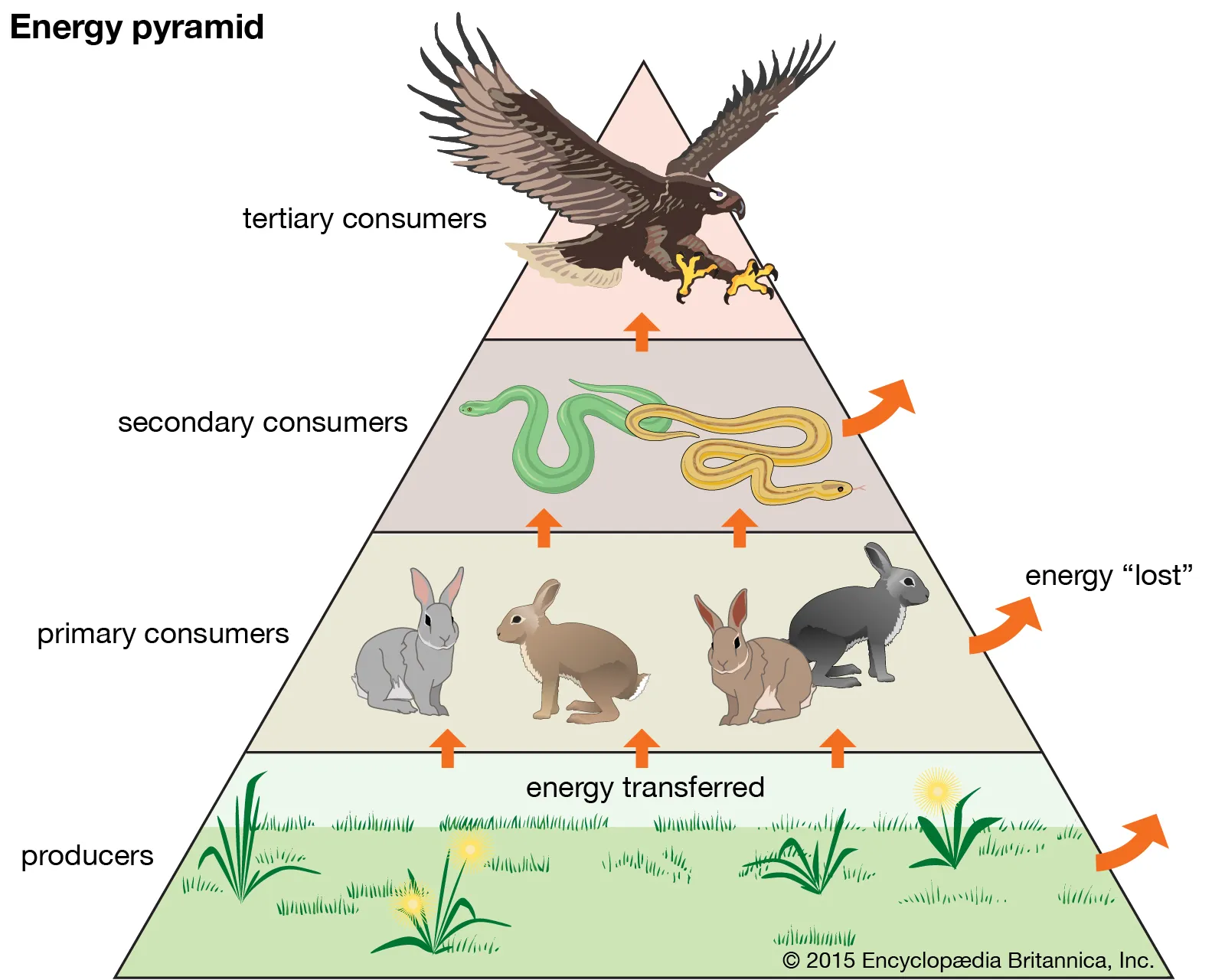
Trophic level
an indivisuals place in the food web based on it’s distance from the energy input into the system
Biofeochemical cycles…
link the abiotic and biotic componets of every ecosystem
Chemicals Cycles in an ecosystem
cycles includes organsims and non-living componets
reservoirs are critical (carbon and nitrogen cycle)
Carbon Cycle
how carbon moves throughout an environment
Bacteria and Archea are critical to many ecosystems
have greater duversuty in ways of acquiring energy and carbon
often make up the primary producers and consuer in ecosystems in “harsh”/”extreme” environments
Bacteria and Archea can
transform chemical from forns that most organisma cannot use to froms that most organisms can use
ex. nitrogen cycle
some plants cultivate nitrogen fixing bacteria in special root nodes
Competition
arises from needed but limited resources.
Ecological niches
species role + physical requirements
what they do and where they occur
Fundamental niche
full range of conditions and resources that a speices can live within
climate condition, food resources etc
theoretical maximum
Realized niche
the ACTUAL range that species can occupy
product of competition with other speices (biotic)
reduces interspeices comeptition
Competitive exclusion
prevents 2 speices from occupying that same niche at the same time
animals may be forces to move from their fudamental niches to a realized niche
Resources partitioning
(reduces competition) - similar species diverging (in response to competitive exclusion)
results: overlap between closely related groups is minimalize
Think: sympatric speciation, day and night (temporal).
Community
composed of local populations of multiple species that my interact with one another
Antagonistic interactions
can shape a species’ ecological niche
Predation (one of antagonistic interations)
consumer (predator) eats anothr consumer (prey)
has possiblity to overexploit prey and drive extinction
The risk of predation are mitigated by:
prey adaptation
big population size in comparison
prey variety
Predators shape communities
directly
influencing competition amoung prey
Herbivory (antagonistic)
producer (typically plants and other photosynthetic auto trophs) eaten by consumer
herbivores generally need to eat nore (plants have less nutrition/not easy to digest)
exert similar population affects on plants that predetors do prey
How plants prevent/mitigate herbivory
thorns, latex, chemical toxins, mutualisms with other predators (ex. bullhorn acacia)
Parasitism (antagonistic)
benefit by living in close association at the cost of their host’s fitness
usually does not kill: reduces fitness
pathogentic diseases are parasitic relationships
Mutualism
benefits BOTH participants
benefits include: access to nutrients, shelter, heling reproduction, protection from predators
Symbiosis
Mutualism’s important implications for species evolution and communities
tight evolutionary relationships
Commensalism
in the middle of parasitism and mutualism (spectrum)
one species benefits while the other is unaffected.
Parasitism, commensalism and mutualism are
not fixed and can evolve into different interactions
further study will often show full spectrum of species interations (ex. oxpecker birds + herbivore: thought to be mutalism but is more parasitic)
Aspergillus fungi
growth is usually small and harmless but can turn into serious infection in immunocompromised people
Charater Displacement
evidence of past competition
Biodiversity
can refer to:
genetic sequences
species
phylogenetic groups
communities
Ecosystems
each can be quantified in diff. ways
People often refrence species/taxonomic measures as:
look at slides
Keystone species
have stronger influence on communities than other speices
often through predation or altering abiotic enviornment
when it alters physical ecosystem: ecosystem engineer
Ecosystem engineer
When a speices alters the physical ecosystem.
Climate and other abiotic factors
also influence species interations
Ex. In the Artic, changing climate: distributiong of snowy owls, foxes anf lemmings to move north (more cold) → changes in species interations occur
Ecological succession
represents a predictable series of changes a community goes through following distrubances.
physical disturbances have effect of communities independent of their densities
most environments: some disturbance is necessary to maximize species diversity
abiotic and biotic factors
influecne th edistribution of populations → influcence evolutionary trajectory
Populations
made up by 3 things:
size
range
density
Affects on population
survival
mortality
migration
birth and immigraton increase
mortality and migration decrease
Constant Per Capita Growth Rate r o]Over Time
(dN/dt)/N = r
Exponetial Growth Equation
Nt= N1(1+r)^t
Competiton (intraspecific and interspecific)
limits population growth
Carrying Capacity
Finite resources limits population growth past a certain point
Population equation with carrying capacity
dN/dt = r[K-N/K]N
Density Independent
abiotic factors - cannot regulate population size consistently
Density Dependent
biotic factors -