Biopsychology
 Call Kai
 Learn
Learn Practice Test
 Spaced Repetition
 Match
Match Flashcards
 Knowt Play
1/18

There's no tags or description
Looks like no tags are added yet.
Name | Mastery | Learn | Test | Matching | Spaced | Call with Kai | Chat |
|---|
No analytics yet
Send a link to your students to track their progress
19 Terms
Divisions of the Nervous system
The Nervous system is broken down into two subsystems: the peripheral and central nervous system. The peripheral nervous system then divides into the autonomic and somatic nervous system, and the central nervous system is made up of the brain and spinal cord. The ANS is also made up of the sympathetic and parasympathetic NS.
Peripheral nervous system
Consists of all the neurons outside the CNS. It relays impulses to and from the CNS and the rest of the body.
Autonomic nervous system
Governs internal vital functions e.g. homeostasis, and controls smooth muscle and glands. Dictates involuntary/unconscious actions
Somatic nervous system
Carries sensory info into the brain, and motor info from the CNS to the skeletal muscles. Controls some voluntary/conscious control
Brain
Provides conscious awareness, and is involved in all psychological processes
Spinal cord
Transfers messages to and from the brain, and is responsible for simple reflex actions
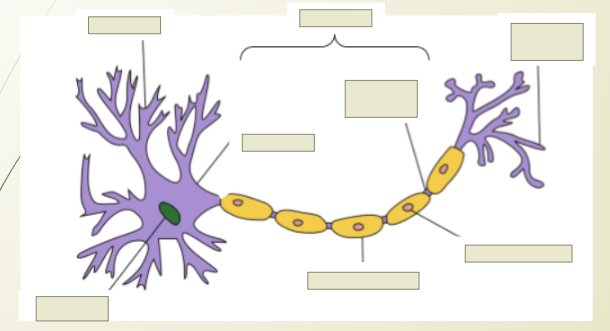
Label from left to right
Dendrites
Axon
Axon terminal
Cell body
Nodes of Ranvier
Nucleus
Myelin sheath
Shwann cells

Dendrites
Carry electrical impulses towards cell body + are the location of neurotransmitter receptor sites
Axon
Carry impulses over distance, can be myelinated, end in terminals where neurotransmitters are stored
Nodes of Ranvier
Allow for further transmission of impulses
Terminal buttons
Neurotransmitters (stored in vesicles) are released from here
Sensory neurons: Function, connections to cell body, myelinated?
Detect impulses from a receptor, 2, yes
Relay neurons: Function, connections to cell body, myelinated?
Relay signal from sensory neuron to motor neuron, 1, no
Motor neurons: Function, connections to cell body, myelinated?
Signal from CNS to effector, 1, yes
Path of an impulse through the nervous system
Sensory neuron » cell body » Axon/nodes of ranvier » Relay neuron » cell body » Dendrites » Motor neuron » Axon/nodes of ranvier » Synapse with effector
Main differences between nervous and endocrine system
Messages: NS travel in neurons electrically, ES in bloodstream chemically
Reaction: NS is fast and short, ES is slow and long
NS messages target cells, EC messages target organs
Fight or flight (FoF) explained
In dangerous situations the amygdala gets activated, which responds to sensory input and connects it with emotions associated with FoF. If the situation is deemed as stressful, the amygdala sends a distress signal to the hypothalamus, which communicates with the body through the sympathetic nervous system. If the situation required a short-term response the sympathomedullary (SAM) pathway is activated, triggering FoF. This pathway activates the adrenal glands to produce adrenaline (hormone) and noradrenaline (NT).
Physiological changes of FoF
HR increases and coronary blood vessels dilate so more blood gets pumped around the body
BR increases and bronchi dilate so muscles receive more oxygen
Increased conversion of glycogen to glucose so more energy
Pupils dilate to allow more light into eyes
Research against FoF
Gray (1998) - suggests the first response to danger is to avoid confrontation altogether, which is shown by a freeze response. This is a problem for FoF as it suggests the theory is inaccurate because it doesn’t explain this.
Taylor et al. (2000) - women are more likely to tend and befriend rather than FoF. So the FoF theory is androcentric