(1) Hypothalamus and Pituitary
0.0(0)
Studied by 0 people Call Kai
 Learn
Learn Practice Test
 Spaced Repetition
 Match
Match Flashcards
 Knowt Play
Card Sorting
1/50

There's no tags or description
Looks like no tags are added yet.
Last updated 2:54 AM on 7/30/26
Name | Mastery | Learn | Test | Matching | Spaced | Call with Kai | Chat |
|---|
No analytics yet
Send a link to your students to track their progress
51 Terms
1
New cards
The hypothalamus and pituitary is the —- center of the endocrine system
main control center
2
New cards
hypothalamus
part of the CNS. almond-sized region at the base of the brain that regulates body temperature, hunger, and hormone release. Connected to the pituitary by the infundibulum
3
New cards
The pituitary is connected to the hypothalamus by the —-
infundibulum
4
New cards
Pituitary gland
small, pea-sized gland located at the base of your brain below the hypothalamus. It sits in its own little chamber under the brain known as the sella turcica. The pituitary gland is divided into two main sections
5
New cards
Posterior vs anterior pituitary
posterior is composed of nervous tissue and anterior is composed of epithelial cells.
6
New cards
Describe the tissue composition of hypothalamus, posterior pituitary and anterior pituitary
hypothalamus is composed of CNS tissue, posterior pituitary is composed of nervous tissue (not CNS) and anterior is composed of epithelial cells
7
New cards
What part of the skull does the pituitary sit in?
sella turcica (or pituitary fossa)
8
New cards
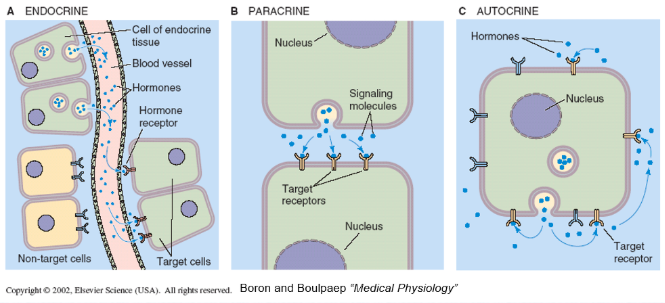
Endocrine signaling pathway
signaling molecules travel throughout the body
9
New cards
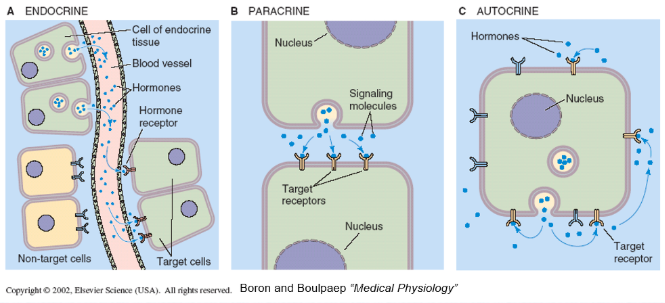
Paracrine signaling pathway
signaling molecules act on neighbouring or nearby cells
10
New cards
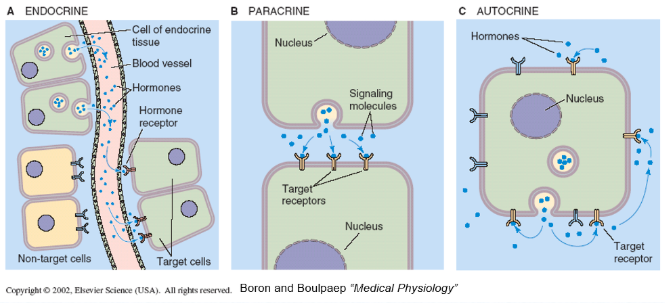
Autocrine signaling pathway
signaling molecules act on the cell that secretes it (acts on itself). Seen mainly in negative feedback.
11
New cards
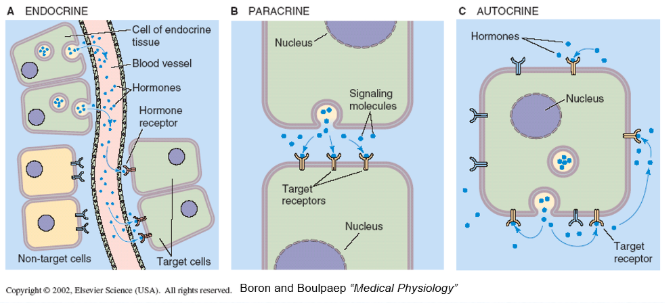
Neuroendocrine signaling pathway
endocrine (signaling molecules that travel throughout the body) hormone produced in the central nervous system
12
New cards
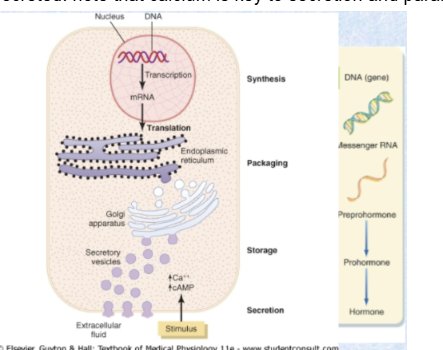
Protein and peptide hormones
examples include growth hormone and ACTH. Synthesized as a preprohormone. Stored in secretory vesicles; Rise in intracellular Ca2+ is required for exocytosis
13
New cards
Amines (hormone type)
derived from tyrosine. Unlike protein hormones, amines are not synthesized as a preprohormone and not stored long term. They are made as needed. Examples include catecholamines and thyroid hormones.
14
New cards
Steroids(hormone type)
derived from cholesterol. Synthesized in cytoplasm and mitochondria; also not stored. Examples include cortisol and testosterone
15
New cards
Show the pathway of how protein/peptide hormones are produced, processed then secreted
note that calcium is key to secretion and parallels in increase to cAMP
16
New cards
peptide/protein receptors mostly bind to what type of receptor?
G-protein coupled receptors
17
New cards
Hormones exert their effects through binding to various types of —-
receptors
18
New cards
Gq
type of G-alpha subunit that activates phospholipase C-beta
19
New cards
T/f, when the GPCR is actuated, G-beta/gamma may transduce the signal
true, both it and G-alpha can transduce signals
20
New cards
G proteins are classified based on their —
G-alpha subunits
21
New cards
Gs
type of G-alpha subunit. stimulatory, activates adenylyl cyclase when active. Increases cAMP production and Ca2+ in cell
22
New cards
Gi
type of G-alpha subunit. inhibitory, inhibits adenylyl cyclase when active. Decreases cAMP production and Ca2+ in cell
23
New cards
Gq
type of G-alpha subunit. causes rise in intracellular calcium via release of calcium from intracellular stores (golgi/ER). Activates PKC which can turn on action of proteins/enzymes
24
New cards
How are insulin receptors different from other receptors?
there are intrinsic tyrosine kinases that start a lot of phosphorylation events
25
New cards
All steroid hormones are produced from —
cholesterol
26
New cards
Steroid hormones are released via —-
passive diffusion
27
New cards
Steroid hormones are located where?
intracellular (nuclear receptors that are transcription factors
28
New cards
How are steroid hormones transported in blood
by being bound to a protein
29
New cards
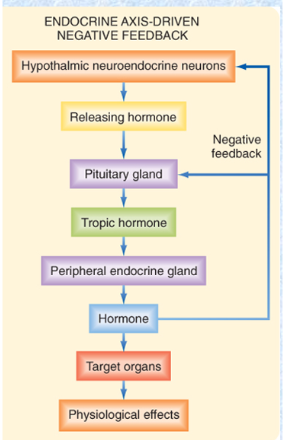
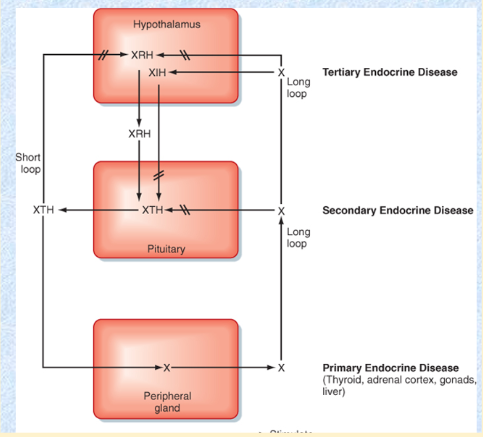
Show the endocrine axis-driven negative feedback loop
hypothalamus secreted releasing hormone that acts on the pituitary which then releases a tropic hormone to act on a peripheral endocrine gland which releases a hormone. This hormone acts on target organs as well as inhibit the hypothalamus and pituitary
30
New cards
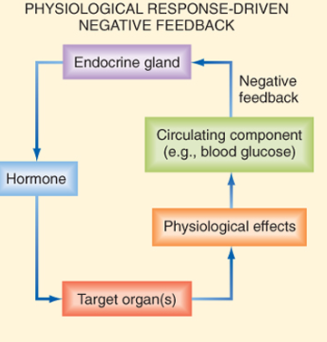
Show the physiological response driven negative feedback loop using blood glucose as an example
as blood glucose lowers, glucagon is released to raise it and when more glucose is in the blood stream, glucagon release from the pancreas is inhibited
31
New cards
Short loop negative feedback is from — to —-
pituitary to hypothalamus
32
New cards
Long loop negative feedback is from —- to —-
peripheral endocrine gland and back to pituitary or hypothalamus( or both)
33
New cards
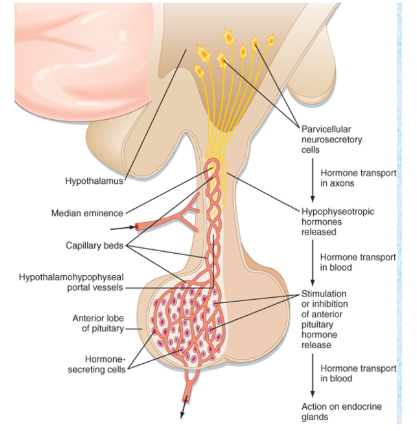
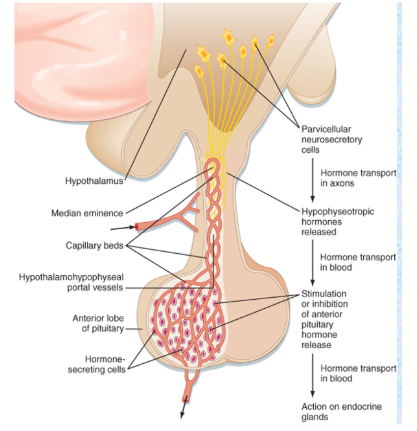
Median eminence
the middle of the pituitary stalks where neurosecretary cells of the hypothalamus end and releasing hormones are secreted. These hormones are picked up by the Hypothalamohypophyseal portal system
34
New cards
Hypothalamohypophyseal portal system
a network of blood vessels that directly connects the hypothalamus to the anterior pituitary gland. This is how releasing hormones from neurosecretory cells of the hypothalamus is released into the anterior pituitary (starting at the median eminence).
35
New cards
Lactotropes
cell type in the anterior pituitary. Release prolactin.
36
New cards
Thyroid tropes
cell type in the anterior pituitary. Release thyroid stimulating hormone.
37
New cards
Gonadotropes
cell type in the anterior pituitary. Release Luteinizing hormone and follicle stimulating hormone.
38
New cards
Corticotropes
cell type in the anterior pituitary. Release ACTH which act on adrenal glands
39
New cards
Somatotropes
cell type in the anterior pituitary. Release Growth hormone which affects both linear growth and blood glucose
40
New cards
Hypothalamic Releasing hormones
produced by neural cells in the hypothalamus. Act on cells in the anterior pituitary and are secreted in pulses. Stimulates synthesis and release of target anterior pituitary hormones.
41
New cards
What is the 1 anterior pituitary hormone that is always suppressed? How is it suppressed?
prolactin. suppressed by dopamine release by hypothalamus. Prevents everyone from lactating all the time.
42
New cards
Circadian rhythm
24-hour cycles that are part of the body’s internal clock, running in the background to carry out essential functions and processes. physical, mental, and behavioral changes that follow a 24-hour cycle. These natural processes respond primarily to light and dark
43
New cards
Suprachiasmatic nucleus
main part of the hypothalamus that control circadian rhythm
44
New cards
Melatonin
hormone from the pineal gland that helps prepare the body for sleep. Only works when the body is getting ready for sleep (ie when its getting darker)
45
New cards
Tertiary endocrine disease
disorder is caused by the hypothalamus. (over or underproduction of the releasing hormone.
46
New cards
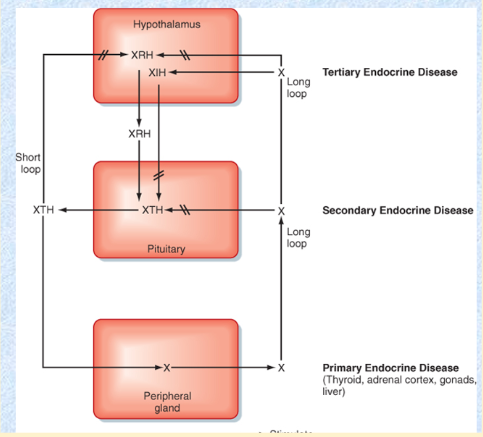
Secondary endocrine disease
disorder is caused by the pituitary gland.
47
New cards
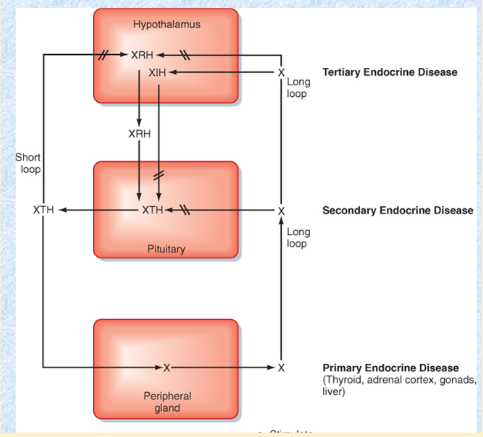
Primary endocrine disease
disorder within a peripheral endocrine gland.
48
New cards
What hormones does the posterior pituitary synthesize?
none, it's mainly a holding point for hormones released directly by the hypothalamus
49
New cards
Hypothalamohypophyseal track
a nerve bundle connecting the hypothalamus to the posterior pituitary gland, carrying oxytocin and antidiuretic hormone (ADH) for storage and release
50
New cards
2 hormones released through the posterior pituitary
ADH/vasopressin and oxytocin
51
New cards
Why is pulsatility of hypothalamic releasing hormones important?
it helps with receptor turnover in the anterior pituitary