Unit 8: Photosynthesis
 Call Kai
 Learn
Learn Practice Test
 Spaced Repetition
 Match
Match Flashcards
 Knowt Play
1/68

Earn XP
Description and Tags
A set of flashcards covering key terms and concepts related to photosynthesis.
Name | Mastery | Learn | Test | Matching | Spaced | Call with Kai |
|---|
No analytics yet
Send a link to your students to track their progress
69 Terms
Photosynthesis
Process where green plants, algae, and cyanobacteria transform light energy into chemical energy.
Photoautotrophs
Organisms capable of producing their own organic compounds from sunlight.
Heterotrophs
Organisms that consume organic substances or other organisms for food.
Chemoautotrophs
Organisms that build organic molecules using energy derived from inorganic chemicals.
Photosynthetic Reactants
CO2, H2O, and sunlight that are needed for photosynthesis.
Photosynthetic Products
O2 and G3P, which are produced during photosynthesis.
Mesophyll
The middle layer of chlorophyll-rich cells in a leaf where photosynthesis primarily occurs.
Stomata
Openings in leaves that regulate gas exchange and water evaporation.
Chloroplast
Membrane-bound organelle with chlorophyll where photosynthesis takes place.
Thylakoids
Disc-shaped, membrane-bound structures inside chloroplasts where light-dependent reactions occur.
Light-dependent reactions
The first stage of photosynthesis where specific wavelengths of light are absorbed to form ATP and NADPH.
Light Independent Reactions
2nd photosynthetic stage where CO2 used to build carbs using energy from ATP + NADPH
Light Dependent Reactions
1st photosynthetic stage where certain visible light wavelengths absorbed forming ATP + NADPH
Kinetic Energy
Energy Object has due to its motion
Wavelength
Distance between consecutive crest points of wave
Examples of Heterotrophs (consumer other organisms)
Animals, Fungi and most bacteria
Chemoautotrophs
Organisms build organic molecules with energy derived from inorganic chemical vs sunlight
Examples of chemoautotrophs
Special group bacteria and archaea
Photosynthetic Reactants
CO2, H20 and Sunlight
Photosynthetic Products
O2 + G3P1
6CO2 (carbon Dioxide) + 6H2O (water) + Sunlight = C6H12O6 (glucose) + 6O2 (oxygen)
Photosynthesis Equation
Photosynthesis primarily occurs where?
In plant leaves
Mesophyll
Middle layer of chlorophyll rich cells in a leaf
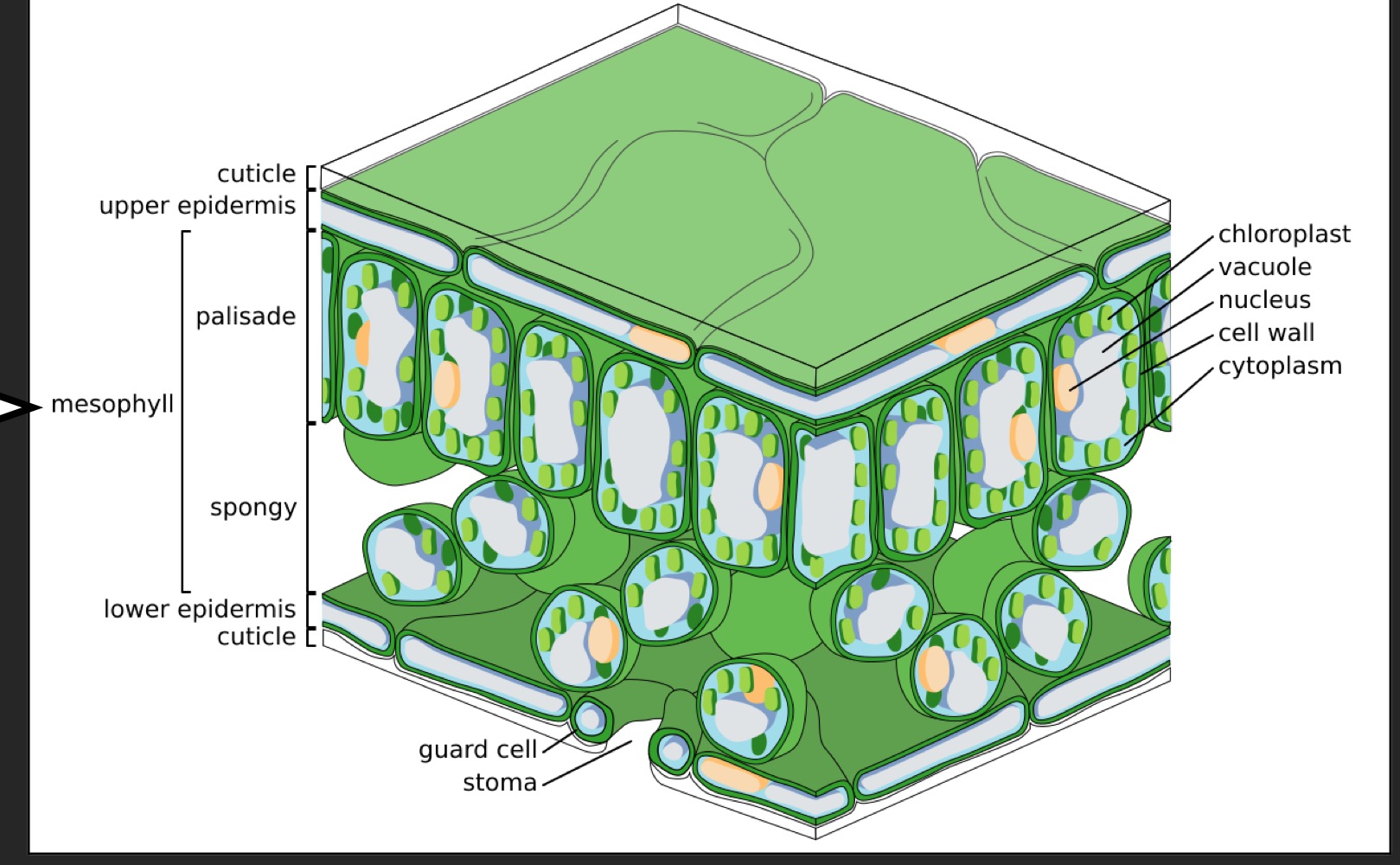
Stomata
Opening in leaf regulating gas exchange and H2O evaporation between leaves and environment
Chloroplast
Membrane bound organelle with chlorophyll where photosynthesis takes place
Chloroplasts mostly found in
The mesophyll
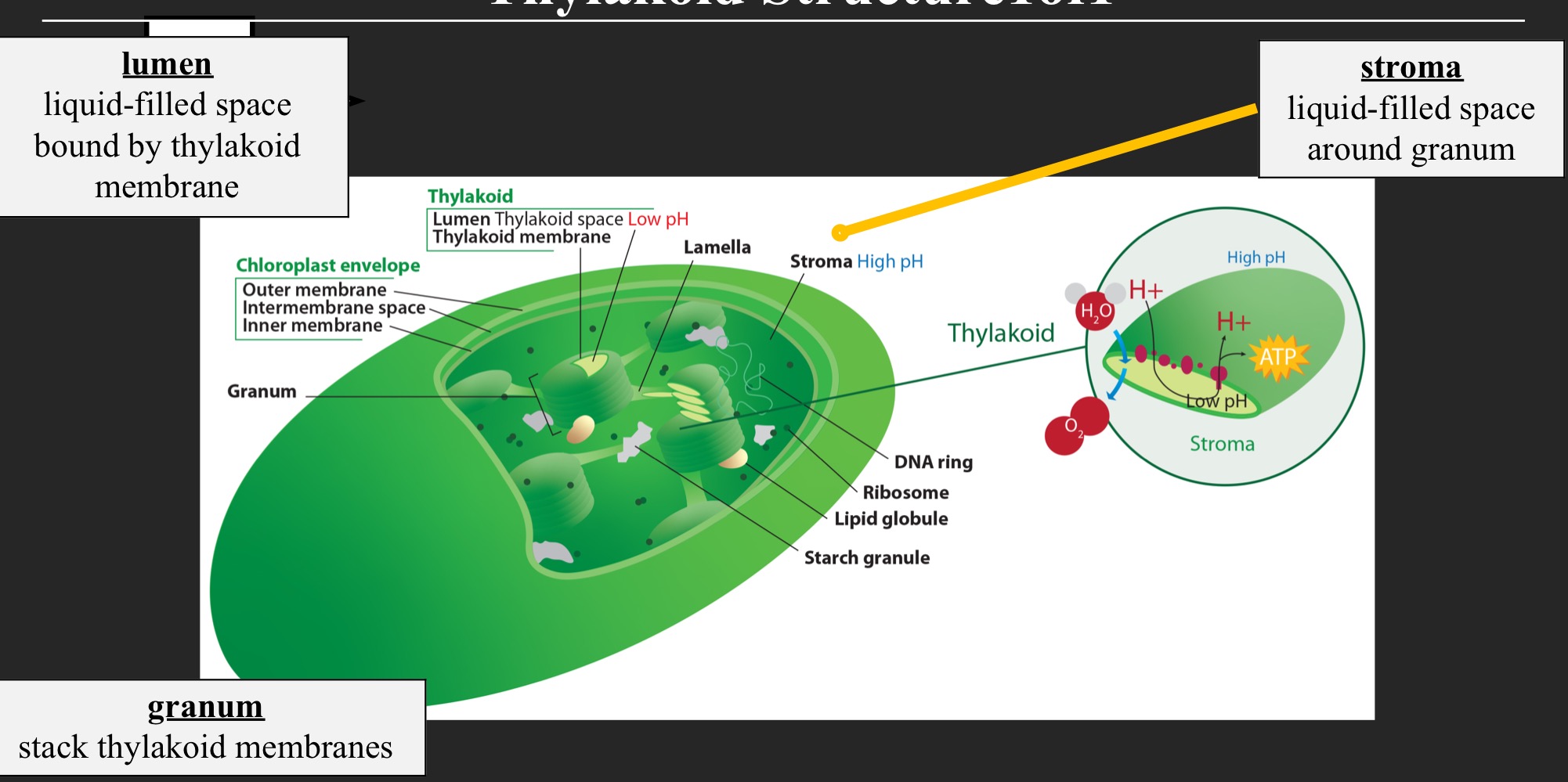
Thylakoids
Disc shaped, membrane bound structure inside chloroplast where light dependent reactions of photosynthesis takes place
Light dependent reactions occur in the _________
Thylakoids
Thylakoids Structure
Lumen, stroma and granum
Kinetic Energy
Energy object has due to its motion
Wavelength
Distance between consecutive crest points of wave
Light is ____ energy traveling in waves
Kinetic
Electromagnetic spectrum
Range of all possible frequencies of radiation
Photosynthesis converts light to ____ energy
Chemical
Photosynthetically active radiation (PAR)
400-700nm light used by plants for photosynthesis
Absorption Spectrum
Range of wavelengths of electromagnetic radiation absorbed by a substance
Different pigments absorb specific _______.
Wavelengths
Each chloroplast usually has many different _______.
Pigments
Chlorophyll A
Photosynthetic pigment abosorbing violet-blue and red light
Chlorophyll B
Photosynthetic pigment absorbing Blue and Red-Orange light
Carotenoids
Absorbs Blue Light
Light Dependent Reactions convert solar energy to ______ energy
Chemical
Photosystem
Proteins, chlorophyll, other pigments that absorb light and convert to chemical energy in light dependent reactions
Photosystems are reaction areas for _____ energy
Light Energy
What are they two photo systems in thylakoids membranes
Photosytem 1 and 2
Photosystem 2
Integral protein + pigments complex transporting electrons from H2O to electron transport chain; O2 product
Photosystem one
Integral pigment + protein complex using light energy to transport electrons from plastocyanin to NADP+
Antenna Proteins
Pigment molecule that directly absorbs light, transfers absorbed energy to other pigment molecules
Reaction center
Chlorophyll molecules + other organic molecules complex around special pair chlorophyll molecules and primary electron acceptors undergo oxidation reduction
Light Harvesting complex
Complex passes suns energy to reaction center (antenna proteins with mixture of 300-400 chlorophyll a and b molecules + carotenoids
Photoact
Ejection
What are the two primary steps in photosynthesis
Light dependent and light independent reactions
Calvin Cycle
The second stage of photosynthesis where CO2 is used to build carbohydrates using energy from ATP and NADPH.
RUBiSCO
Enzyme involved in the Calvin Cycle that helps fix carbon.
Carbon fixation
The process of converting inorganic CO2 to organic compounds during the Calvin cycle.
C3 pathway
The most common photosynthetic pathway in which CO2 is fixed directly by RUBiSCO.
C4 pathway
A photosynthetic process that minimizes photorespiration and is more efficient in hot, arid conditions.
CAM pathway
A photosynthetic adaptation in succulents that allows them to fix CO2 at night to reduce water loss.
Endosymbiotic theory
Theory explaining how chloroplasts evolved from free-living cyanobacteria engulfed by other cells.

