VCE Economics Unit 4: Monetary Policy
 Call Kai
 Learn
Learn Practice Test
 Spaced Repetition
 Match
Match Flashcards
 Knowt Play
1/35

There's no tags or description
Looks like no tags are added yet.
Name | Mastery | Learn | Test | Matching | Spaced | Call with Kai | Chat |
|---|
No analytics yet
Send a link to your students to track their progress
36 Terms
Counter-cyclical policy
Policy designed to lift demand during downturns and restrain demand during booms.
Monetary policy
The RBA's manipulation of interest rates to influence credit cost, availability, and demand.
Budgetary policy
Federal government manipulation of receipts and outlays to influence economic activity.
RBA's dual mandate
The joint pursuit of price stability and sustained full employment.
Price stability target (RBA)
Maintaining consumer price inflation at an average of 2-3% over the medium term.
Full employment (RBA definition)
The maximum level of employment consistent with low and stable inflation.
Monetary Policy Board
The dedicated RBA board that decides the cash rate target.
Statement on the Conduct of Monetary Policy
The agreement between RBA and Treasurer setting the inflation target and dual mandate.
Conventional monetary policy
The routine adjustment of the target cash rate to influence interest rates.
Cash rate
The interest rate on unsecured overnight loans between banks in the cash market.
Exchange Settlement Accounts (ESAs)
Accounts held by commercial banks at the RBA to settle daily interbank payments.
Effect of net government payments on ES balances
They inject cash and raise overall Exchange Settlement balances.
Effect of net government receipts on ES balances
They withdraw cash and lower overall Exchange Settlement balances.
Open market operations (OMOs)
RBA buying or selling of government securities to keep the market cash rate at target.
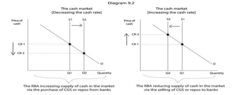
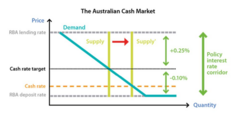
ESA corridor floor
The deposit rate paid by the RBA, set at 0.10% below target.
ESA corridor ceiling
The rate at which the RBA lends overnight repos, set at 0.25% above target.
Interest-rate pass-through
The process where cash rate changes are passed to lending and deposit rates.
Unconventional monetary policy
Non-cash rate tools used to influence interest rates, typically when cash rates near zero.
Forward guidance
Public communication about the likely future path of the cash rate.
Quantitative easing (QE)
Large-scale central bank purchases of government bonds to lower longer-term interest rates.
Term Funding Facility (TFF)
Low-cost three-year funding offered to banks to lower funding costs.
Monetary policy transmission mechanism
The process by which cash rate changes flow through channels to affect AD.
Savings and investment channel
How interest rates change the reward for saving versus the cost of borrowing.
Cash flow channel
How interest rate changes alter disposable income via variable-rate debt repayments.
Asset prices and wealth channel
How rate changes affect asset values, altering consumer spending through wealth effects.
Exchange rate channel
How rate changes affect capital flows, currency value, and net exports.
Expansionary policy stance
Setting the cash rate below the neutral rate to stimulate economic activity.
Restrictive policy stance
Setting the cash rate above the neutral rate to restrain demand.
Neutral stance of monetary policy
A cash rate setting that neither stimulates nor restrains the economy.
Cash rate movement in 2025
Eased from 4.35% to 3.60% as inflation returned to the target band.
Cash rate movement in 2026
Tightened from 3.60% back to 4.35% due to re-accelerating inflation.
Material living standards (short-run impact of tightening)
Decrease due to higher mortgage repayments and slower disposable income growth.
Political independence (monetary policy strength)
Insulates RBA rate decisions from electoral cycles, ensuring credible long-term focus.
Implementation lag of monetary policy
Very short; rate decisions take effect almost immediately without parliamentary approval.
Impact lag of monetary policy
Long; changes take roughly 12-18 months to flow fully through the economy.
Blunt instrument (monetary policy weakness)
It cannot target specific sectors or regions, affecting all borrowers equally.