Clue Case
 Call Kai
 Learn
Learn Practice Test
 Spaced Repetition
 Match
Match Flashcards
 Knowt Play
1/63

There's no tags or description
Looks like no tags are added yet.
Name | Mastery | Learn | Test | Matching | Spaced | Call with Kai | Chat |
|---|
No analytics yet
Send a link to your students to track their progress
64 Terms
differences in the rates of enzymes are due to differences in what two things?
how well they bind to the substrate
how fast they produce product
what two people described the first kinetic model for an enzyme
Adrian Brown
Victor Henri
what did Adrian Brown and Viktor Henri study?
invertase: an enzyme that converts sucrose to glucose to fructose

what was the experiment set up for Brown and Henri?
they ran a series of enzymatic assays where enzyme concentration is CONSTANT and substrate concentration varied
what is on the x and y axis of Michaelis-Menten graph
x: [substrate]
y: initial velocity
describe the behavior seen on a Michaelis-Menten graph?
the reaction begins as a first order (aka Vo is dependent on [substrate]), and it becomes zero order when it plateaus (aka rate does not depend on [substrate])
![<p>the reaction begins as a first order (aka Vo is dependent on [substrate]), and it becomes zero order when it plateaus (aka rate does not depend on [substrate]) </p><p></p>](https://assets.knowt.com/user-attachments/52a62be8-f19a-4ead-b212-f33f5f54bb79.png)
what is the hallmark behavior of a saturated catalyst
the reaction being first order with respect to S until it plateaus, becoming zero order with respect to S

label what is E, S, ES, and P
E= enzyme
S= substrate
ES= ES complex
P= product

what is k1, k2, and k-1? what about k-2?
k1=formation of ES complex
k-1=ES complex dissociates
k2= ES to product
k-2= we ignore this because we are only looking at initial rates (assume reaction has not had time to to go back to ES). we are only looking at product formation
why do we see a zero order behavior on a MM graph?
because this is the point where all E is in ES complex, so additional S has no affect on reaction rate (aka zero order)

describe general concentration of E, S, ES, and P at each of these three arrows
arrow 1: first step still forming where there is a lot of E and little S (being added). little ES and P has formed
arrow 2: more ES and more P as S increases and E decreases
arrow 3: NO ENZYME (its concentration never changes), all ES, excess S, and some P present

what three pieces of information do you find on a MM graph?
Vm and Vmax/2→Km

What is the Michaelis Menten equation
shows how vo depends on Vmax, [substrate], and Km
![<p>shows how vo depends on Vmax, [substrate], and Km</p>](https://assets.knowt.com/user-attachments/2bcdaa59-89fd-4235-970e-f47f1ec34dda.png)
when you are finding Vmax on a MM graph, how do you estimate it
add at least 0.1-0.2 to the last dot on the graph
do we ever fully approach Vmax
NEVERRR
what does Vmax represent and what does the reaction mixture look like/what is the only point at which is attained
Vmax is the fastest that the enzyme can turnover, and it represents the point when ALL enzyme have bound substrate (all E are in ES complex)
what is Vmax proportional to?
enzyme concentration
an MM is performed with enzyme concentration staying constant. what happens to Vmax and Km if [E] is tripled?
V max would triple (increasing E means increasing ES complex potential since E is the limiting component)
Km would not change (Vmax and Km are not connected)
Km represents the _____ of the ES complex
stability (but not direct measure of affinity)
what is the formula of Km in terms of Vmax?
Vmax / 2
what does Km represent in terms of catalysis?
it represents how much substrate is need for proper catalysis/how much substrate will saturate E/how well substrate binds to enzyme (not affinity)
true or false: Km is dependent on enzyme concentration
FALSE: Km is INDEPENDENT of enzyme concentration
what is the formula of Km in terms of rate constants?
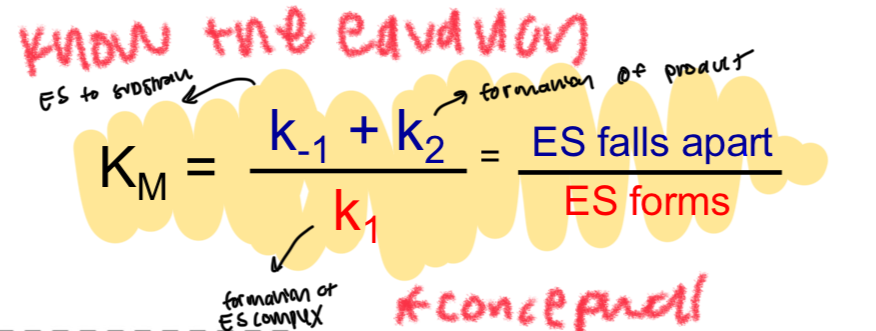
what does a lower Km mean?
more stable ES complex or less is needed for proper catalysis
k cat is the rate constant of the _____ step. what is another name?
rate-limiting
other name: turnover number
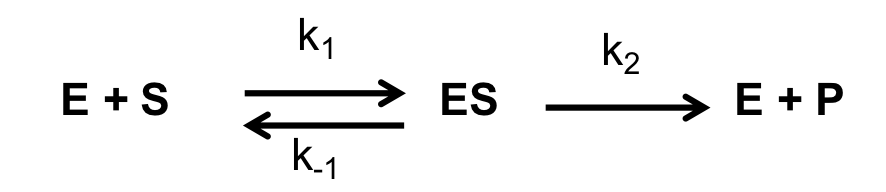
which rate constant is k cat equal to?
k2
what is the formula for Vmax in terms of k cat
V max = kcat x [Enzyme]
what does kcat/Km measure
catalytic efficiency
what is the formula for kcat
V max / [Enzyme]
what does kcat measure
the number of molecules of substrate to product converted per second
if you double [enzyme], what will happen to kcat and V max? what is the net change?
k cat will ½ and V max will double so ultimately there is not net change
what is the difference between Vmax and kcat
Vmax= when all enzymes are in ES complex/maximum speed of enzyme reaction
kcat= turnover number or how many substrate molecules one active site turns into product per second
what is the difference between kcat and Km
kcat=turnover number (# substrate one active site turns into product per second)
Km=stability of ES complex (amount of substrate needed for proper catalysis)
k cat is how _____ the ES makes product and Km is how _____ ES is formed
kcat is how fast the ES makes product and Km is how easily ES is formed (stability)
the larger the kcat/Km value….
the more efficient the enzyme is
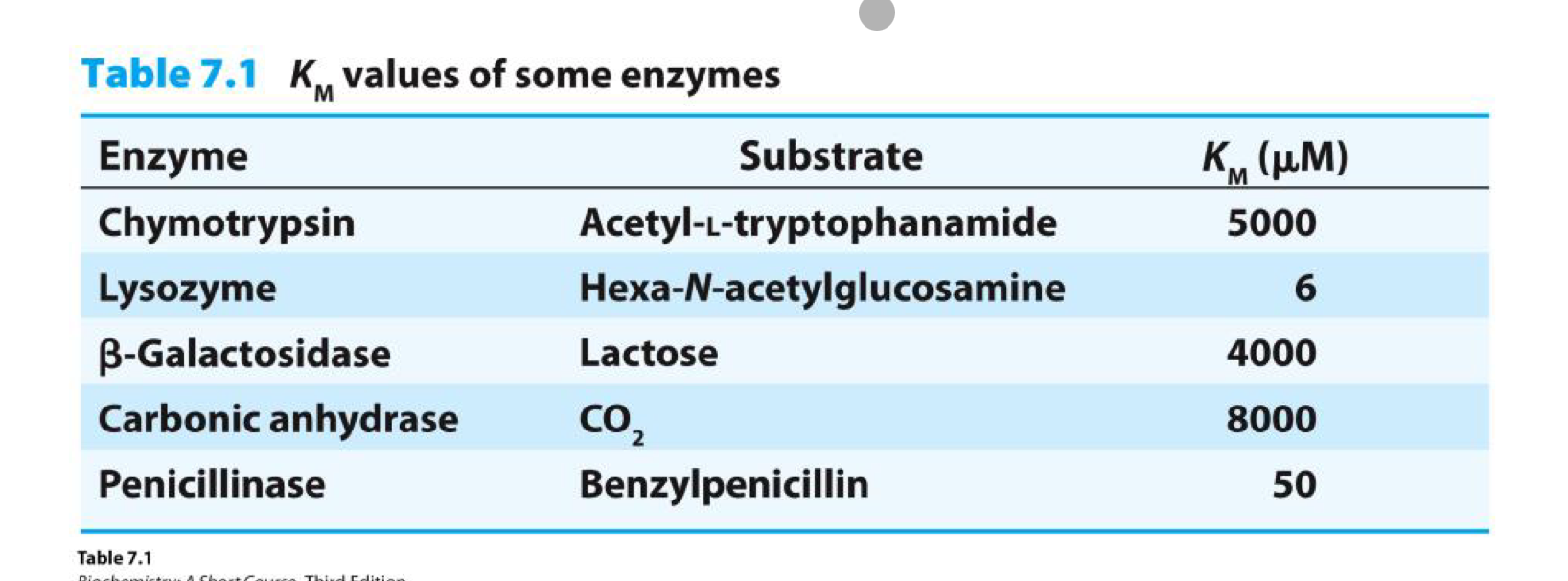
which enzyme has the most stable ES complex?
lysozyme (lowest Km→least mount of susbstrate needed for catalysis)
the higher the kcat, the _____ the turnover
faster the turnover (aka more substrate molecules converted to substrate by one active site per second)
if we had multiple enzymes with the same concentration, how would we determine which one has the highest Vmax
kcat because Vmax = kcat x [Enzyme]
why do we want some enzymes, like DNA polymerase I, to have lower k cat values
because there needs to be a balance between speed and accuracy. DNA polymerase must be accurate for proper DNA replication, slowing its turnover. other enzymes, like carbonic anhydrase, do not require as much accuracy→higher turnover number/kcat
Lineweaver-Burk plot is the inverse of the ______ equation
Michaelis-Menten plot
what is the Lineweaver-Burk equation?
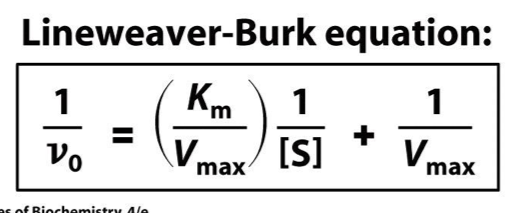
what is the x intercept for the Lineweaver Burk Plot
-1/Km
what is the y intercept for the Lineweaver Burk Plot
1/Vmax
what is the slope for the Lineweaver Burk Plot
Km/Vmax
how accurate is the MM plot for finding Vmax and Km
it is inaccurate because the plot never reaches Vmax, so we are just estimating a value for Vmax. because we use Vmax/2 to find Km, this also means Km will be just as inaccurate
why is the Lineweaver-Burk plot better to use than the MM plot
because we are using actual numerical values (linear equation) for the Lineweaver Burk while the MM plot is just an estimate
what is the best way to find Km and Vmax when using a Lineweaver-Burk plot
first find Vmax with y intercept (aka b in the linear equation)
then use the unrounded version of Vmax to find Km with slope
what is the difference between irreversible and reversible inhibitors
irreversible→bind very tightly (not forever) but does permanently abolish catalytic activity
reversible→non-covalently binds to enzyme and does not permanently abolish activity (returns back to normal once inhibitors is no longer bound)
what are three types of reversible inhibitors (just name them)
competitive, noncompetitive, and un-competitive
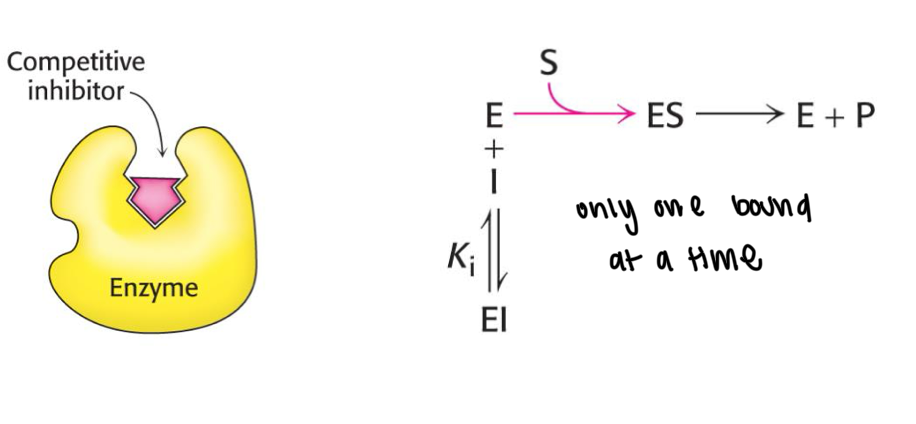
describe what a competitive inhibitor is (where it binds and what state of the enzyme it can bind to)
an inhibitor that binds to the active site
will only bind to E and not ES complex
describe what a non-competitive inhibitor is (where it binds and what state of the enzyme it can bind to)
will not bind to active site
can either bind to E or ES (equal affinity)

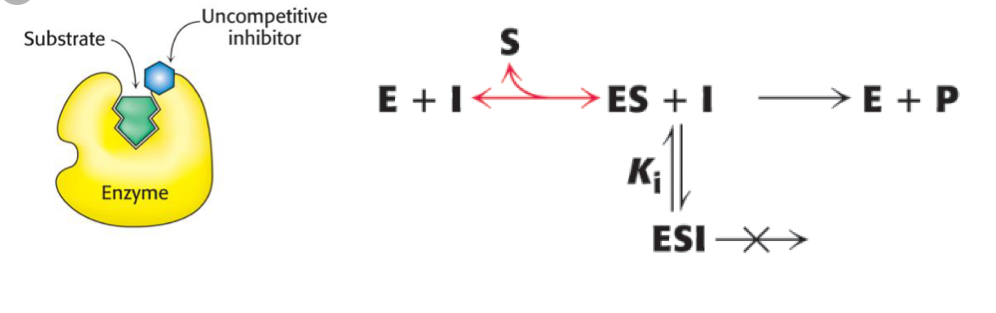
describe what a un-competitive inhibitor is (where it binds and what state of the enzyme it can bind to)
will NOT bind to active site but will only bind to ES complex
what is the effect of a competitive inhibitor on Vmax and Km (and why)
Vmax: unchanged
Km: increase
why: a competitive inhibitor can be overcome by increasing [S], and this will result in an increase in Km. Vmax is unchanged because this is where we look at when all of ES has formed, and competitive inhibitors do not affect ES complexes
what is the effect of a noncompetitive inhibitor on Vmax and Km (and why)
Vmax: decreased
Km: unchanged
why: Vmax decreases because ES is affected by this inhibitor, but Km is unchanged because the inhibitor does not prevent binding; it lowers concentration of functional enzyme
what is the effect of a uncompetitive inhibitor on Vmax and Km (and why)
Vmax: decreases
Km: decreases
why:
this inhibitor only binds to ES, and it will lower [ES]=lowering Vmax value. (ES inhibited)
Km decreases because Le Chatelier’s explains how a decrease in [ES] will result in a higher consumption of [S] (aka greater k1 value). with the formula of Km, the increase in k1 denominator→lower Km value; when ESI forms, the substrate cannot leave, so this lower [S] (plus better binding affinity/substrate will not leave once ESI forms)
![<p>Vmax: decreases</p><p>Km: decreases</p><p>why:</p><ul><li><p>this inhibitor only binds to ES, and it will lower [ES]=lowering Vmax value. (ES inhibited)</p></li></ul><ul><li><p>Km decreases because Le Chatelier’s explains how a decrease in [ES] will result in a higher consumption of [S] (aka greater k1 value). with the formula of Km, the increase in k1 denominator→lower Km value; when ESI forms, the substrate cannot leave, so this lower [S] (plus better binding affinity/substrate will not leave once ESI forms)</p></li></ul><p></p>](https://assets.knowt.com/user-attachments/8faaf758-772a-4149-8e96-665cd4f63f47.png)
what does a competitive inhibitor look like on Lineweaver Burk plot
steeper slope due to greater Km and unchanged Vmax

what does a non-competitive inhibitor look like on Lineweaver Burk plot
with decreased Vmax and unchanged Km

what does a uncompetitive inhibitor look like on Lineweaver Burk plot
decreased Vmax and Km

which inhibitor type can be overcome?
only competitve can be overcome by increasing [S] to win competition against inhibitor for active site. the other ones cannot be overcome by increasing [S] because the inhibitor can bind the the ES complex/will not bind to the active site (non: both un: only ES) so the substrate cannot prevent inhibitor binding
how does a competitive inhibitor effect an MM plot? noncompetitive? uncompetitive?
competitive: less drastic of a change compared to noncompetitve and uncompetitive. all exhibit a slight decrease in rate

what is on the x and y axis of the LIneweaker Burk plot
x: 1/[S]
y: 1/V
what is on the x and y axis of the MM plot
x: [substrate]
y: relative rate (vo)
how are Vmax and Km affected by an irreversible inhibitor
Km not affected because kinetics are not altered/the unaffected enzymes (the ones not permanently damaged) not still normally bind to substrate
Vmax: reduced because inhibitor reduces the number of functioning enzymes (aka less E to form ES)
how can inhibitors work as treatments?
they can inhibit a specific enzyme, preventing a certain function/underlying mechanism of the condition (think of methoxtrate example that inhibits an enzyme needed for DNA replication of cancer cells)