Wildlife Management- Habitat Sampling Guidance
 Call Kai
 Learn
Learn Practice Test
 Spaced Repetition
 Match
Match Flashcards
 Knowt Play
1/4

There's no tags or description
Looks like no tags are added yet.
Name | Mastery | Learn | Test | Matching | Spaced | Call with Kai | Chat |
|---|
No analytics yet
Send a link to your students to track their progress
5 Terms
Thoughts on sampling for habitat evaluation:
Sample to understand the nature of the stand
Enough sample sites to capture the variation of the stand
The more variable the stand, the more sites you needed
The bigger your sampling plots/sites, the less you need
Bigger stands tend to be more variable
Random locations are standard
Scale of what you’re measuring influences size of plots
Sampling trees requires bigger plots/sites than shrubs which require bigger plots/sites than understory
What you are sampling determines how you sample it
Line or point intercept
Plots (fixed or variable radius)
Basal area (requires size of trees (dbh) and number of trees)
Transects
Density estimates require an area (some value per area… 16 trees per hectare, 54 seedlings per sq. meter, etc.)
Common methods for measuring vegetation characteristics: Density, species occurrence, dominance, frequency
Quadrats, transects (set length and set width)
Size determined by what you are sampling:
Quadrats- Trees- 25m x 25m
Shrub- 10m x 10m
Herbaceous/Ground Layer- 1m x 1m
Transects- 5-10m wide for trees
Common methods for measuring vegetation characteristics: Canopy closure/coverage (vertical)
Line or point intercept, densiometer, quadrats for understory vegetation
Visual/ocular estimates
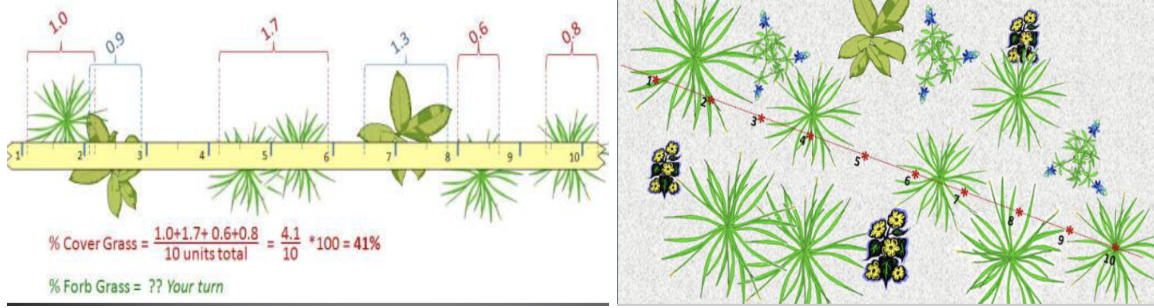
Ex. Line Intercept
1) Lay out tape measure
2) Walk the line and mark the start and end on the measure where plant canopy cover crosses above/intersects the line
3) Calculate percentage canopy cover based on how much of the total length of tape was under canopy
Common methods for measuring vegetation characteristics: Visual obstruction/cover (horizontal)
Visual obstruction board, robel pole, etc.
Ex. Robel Pole- record how much is above veg
Ex. Visual Obstruction Board- record how much is visible behind/through veg

Common methods for measuring vegetation characteristics: Tree Height, DBH, Basal Area
Tree Height- clinometer
Tree DBH- dbh tape (used in quadrat, along transect, etc.)
Basal Area- bitterlich prism (variable radius plots at sample points) or record dbhs and do the math at sample points
Requires dbh and number of trees