Hall Effect Part 1
 Call Kai
 Learn
Learn Practice Test
 Spaced Repetition
 Match
Match Flashcards
 Knowt Play
1/49

There's no tags or description
Looks like no tags are added yet.
Name | Mastery | Learn | Test | Matching | Spaced | Call with Kai | Chat |
|---|
No analytics yet
Send a link to your students to track their progress
50 Terms
Edward Herbert Hall
The American physicist who discovered the Hall effect
1879
Year when the Hall effect was discovered
The first experiment to demonstrate that the charge carriers in most metals are negative.
Historical significance of the Hall effect
metallic strip
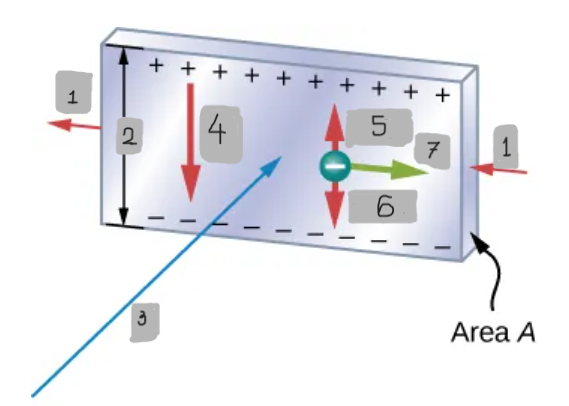
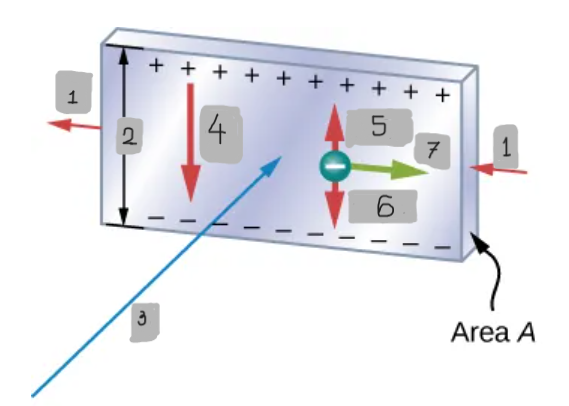
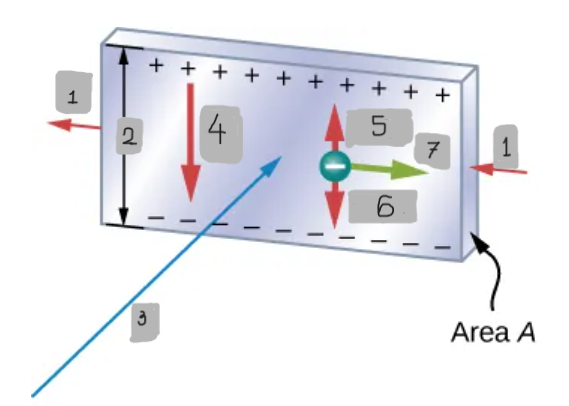
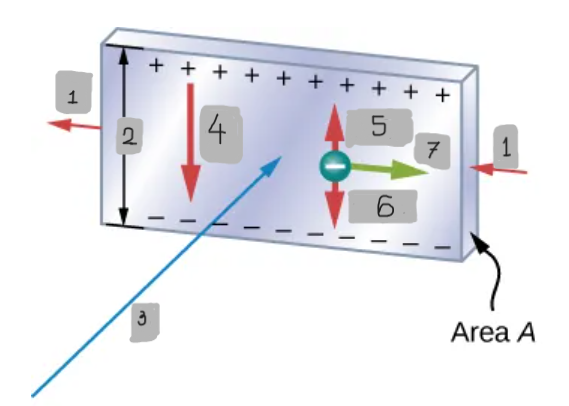
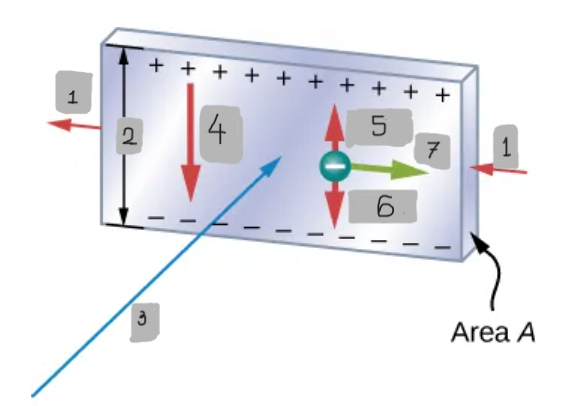
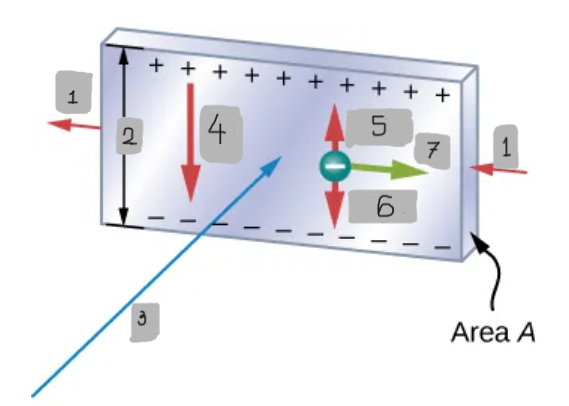
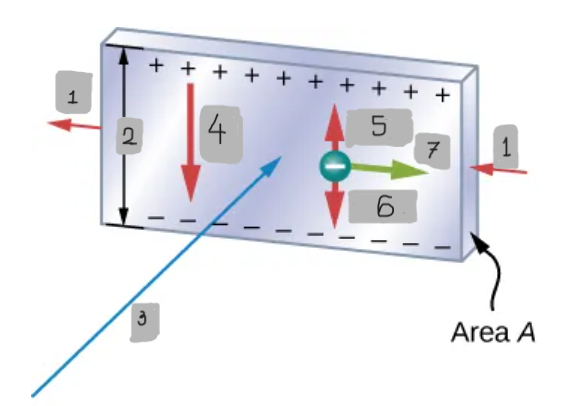
Hall effect is investigated by studying the motion of the free electrons along a ______________ of width l in a constant magnetic field
I
(1)
L
(2)
B
(3)
Eh
(4)
eEh
(5)
evdB
(6)
vd
(7)
pushes, bottom edge
The electrons are moving from left to right, so the magnetic force they experience ______ them to the __________ of the strip.
positive charge
The electrons being pushed to the bottom edge of the strip, leaves as excess of ______________ at the top edge of the strip.
From top to bottom
How is the electric field directed when the excess of positive charge is at the tip of the top of the metallic strip and the excess of the negative charge is at the bottom of the tip?
electric force, magnetic force
The charge concentration on the metallic field builds up until the _____________ on the electrons in one direction is balanced by the ______________ on them in the opposite direction.
eE = evdB
Mathematical representation of the metallic field reaching the equilibrium.
E
The symbol that represents the magnitude of the Electric field created by the separated charge; inside the equilibrium equation of the metallic strip.
vd = E/B
Solving the equilibrium equation for the drift speed.
Also the only appropriate form of the velocity for the velocity selector
Crossed-field situation
A scenario where the electric and magnetic fields are perpendicular to one another.
Velocity selector
An apparatus that uses perpendicular electric and magnetic field to allow only particles with a specific velocity, where the electric and magnetic forces cancel, to pass through undeflected.
I = nevdA
Formula for the current inside the metallic strip
I = ne(E/B)A
Substituting the appr. drift velocity formula inside the “Current in the metallic strip” formula
E = V/L
Formula for the electrical field related to the potential difference between the edges of the strip.
V
Symbol that represents the quantity of Hall potential
Voltmeter
Instrument utilized to measure the Hall potential
V = (IBL)/(neA)
Formula to calculate the magnitude of Hall potential when the upper edge of the metallic strip is positive with respect to the lower edge.
V = BLvd
Equation of the hall voltage purely in terms of the magnetic field.
Positive hall potential
The top of the metallic strip is positively charged, and bottom of it is negatively charged, therefore, the metallic strip has a…
Negative hall potential
The top of the metallic strip is negatively charged, and bottom of it is positively charged, therefore, the metallic strip has a…
Hall potential
The measurement of the quantity inside the Hall effect that shows that electrons are the dominant charge
Beryllium, Aluminium, Gallium, Zinc, Cadmium, Indium, Tin, Thallium, and Lead
Exceptional metals, where it is indicated (by the Hall Potential) that the majority of charge carriers are positive.
Fermi level
The highest energy that electrons fill at absolute 0 temperature. It marks the “cut-off” between filled and empty states in a solid
Momentum space (k-space)
A way of mapping electron states by their momentum (wave vector k) instead of their position.
In solids, it is easier to describe electrons as waves, so this is like the map of all possible electron motions in the crystal.
Fermi Surface
The 3D boundary in a momentum space that separates filled electron states from the empty ones at the Fermi level. It controls how electrons move in a metal.
Band structures
The allowed ranges of electron energies in a solid, formed when atomic orbitals overlap and split into continuous energy bands
Valence Band (in solids)
The highest band of energies that is fully or almost filled with electrons tied to atoms.
Conduction Band (in solids)
The band next and higher to the valence band where the electrons can move freely and carry current if the band is partly filled.
Band gap
The energy difference between the valence band and conduction band.
In metals: None;
In semiconductors: small;
In insulators: large.
Density of States (DOS)
A measure of how many electron states are available at each energy level in a solid
Electron state
The full description of an electron in quantum mechanics.
Free electron
An electron not bound to an atom, moves as a particle with its natural mass of 9.11 × 10^-31 kg
Conduction electron
Electrons inside the solids, that behave almost like the free ones, moving in conduction bands.
Vacuum electron
An electron specifically in an empty space like the ones in electron beams and/or cathode ray tubes.
Free electron gas
The model where many electrons are treated as an ideal gas.
Hole
A missing electron in a filled band. It behaves like a new particle with a positive charge, that can move and carry current.
It’s like the absence of that missing negative charge is creating this positive effect.
A convenient way to describe the collective behavior of a missing electron.
Hole movement
When electrons shift to fill the missing spot, the hole appears to move in the opposite direction; like an empty seat sliding through a row when people shuffle.
Effective mass
An electron or hole inside a crystal responding to forces, often behaving as if it were lighter or heavier than a free electron.
Intrinsic semiconductor
A pure semiconductor with no doping, where both electrons and holes are created only by heat or light.
Doping
Adding a tiny amount of impurity atoms into a semiconductor to change whether it conducts with electrons (n-type) or holes (p-type)
Band overlap
When the conduction band dips down enough to touch or overlap with the valence band, so electrons and holes both exist without needing extra energy.