neuropharmacology (Andrew Young)
 Studied by 0 people
 Call Kai
 Learn
Learn Practice Test
 Spaced Repetition
 Match
Match Flashcards
 Knowt Play
1/48

There's no tags or description
Looks like no tags are added yet.
Name | Mastery | Learn | Test | Matching | Spaced |
|---|
No study sessions yet.
49 Terms
Examples of endogenous chemicals
neurotransmitters
Examples of exogenous chemicals
drugs
Neurotransmitter synthesis, release, and clearance
arrival of action potential
calcium influx
vesicles Fues with presynaptic membrane and release transmitter
transmitter in synaptic cleft
transmitter binds to receptors in postsynaptic membrane
response in postsynaptic neurone
transmitter unbinds from receptors in postsynaptic membrane
active re-uptake into presynaptic terminal
re-packaging in vesicles
breakdown by enzymes
removal of inactive metabolites
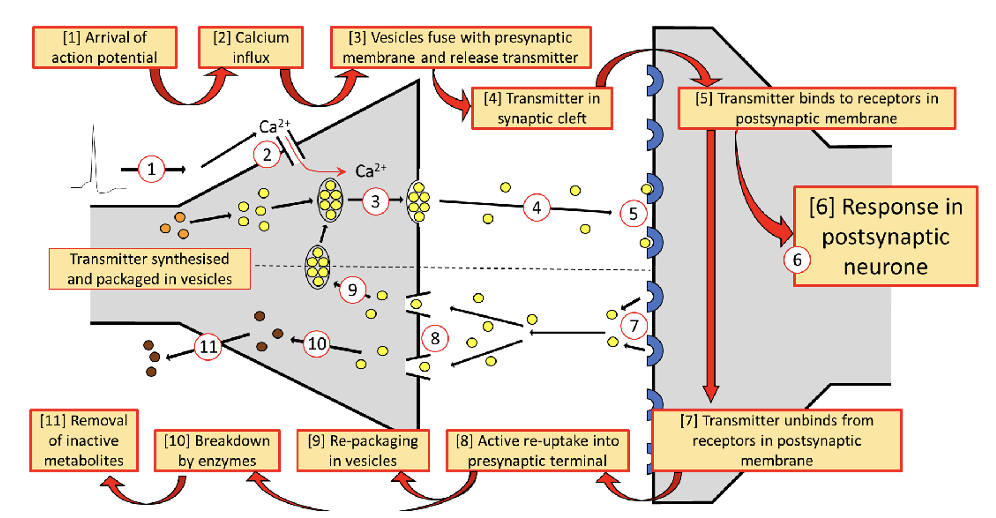
The postsynaptic neurone is located
on the dendrite
The postsynaptic receptors are primarily responsible for
signal transmission
Explain what happens when a neurotransmitter binds to its receptor
neurotransmitter binds to receptors
receptor activated
signal transmitted to post-synaptic neurone
causes either excitation or inhibition
Where can presynaptic receptors be found
on neurone terminals where they modulate transmitter release
What are the two types of presynaptic receptors
auto receptors - on the terminals of the same neurone as released the transmitter
Responds to the same neurotransmitter the neurone releases
Provides negative feedback (self-regulation)
heteroreceptors - on terminals of a different neurone
Responds to a different neurotransmitter released by another neurone
Can increase or decrease neurotransmitter release
Heteroreceptors activation modulates release of
transmitters from the second terminal (also synthesis/storage)
can be excitatory (enhances release) or inhibitory (reduces release) from the second terminal
What are the several mechanisms by heteroreceptors
increases/decreases calcium channel opening
increases/decreases vesicles binding to membrane and releasing transmitter
may also affect synthesis by modulating enzyme function
What is considered to be an auto receptor a presynaptic or postsynaptic
only presynaptic neurones because they respond to the same neurotransmitter that this neurone releases, whereas postsynaptic neurones respond to the sender’s neurotransmitter, not their own, so they cannot be called “auto.”
Where can you find auto receptors
on neurone terminals
What happens during auto receptor activation
reduces release, synthesis and/or storage of transmitters from that terminal, either by blocking the calcium channels of the release
Auto receptors act as a
negative feedback mechanism
What is a negative feedback mechanism
reduces the release of the transmitter from the terminal
makes the presynaptic neurone less excitable, which reduces the chance of neurotransmitter release in response to action potential
decreases calcium channel opening (reduces calcium influx)
prevents vesicles binding to membrane and releasing transmitter
reduce synthesis by modulating enzyme function
If there is an agonist it acts as a…
key to turn on the receptors function, similar to the body’s natural signals
What does an antagonist do
it binds to the same receptor but blocks it from being activated, preventing a response
If there is a reduced release then
there is a reduced postsynaptic effect
Describe how the agonist work
agonist binds to receptor
receptor activated
causes the same change as the native transmitter in the post-synaptic neurone
How long does the agonist remain bound to the receptor
much longer than the native transmitter
When the agonist binds to the receptor it still creates…
an excitation or an inhibition
Describe how the antagonist works
antagonist binds to receptor
receptor occupied but no action
no change in post-synaptic neurone (block)
When the antagonist binds to the receptor there is… (about the effect and state of the neurone)
no effect and the neurone is stuck in a resting state
What are agonists used for
used to treat conditions involving under activity of neurotransmitters
e.g. dopamine agonists in treatment of Parkinson’s disease
What are antagonists used for
used to treat conditions involving overactivity of neurotransmitters
e.g. dopamine antagonists in treatment of schizophrenia
Where is nicotine from and what does it do (plant derivatives)
from tobacco
agonist at acetylcholine receptors
Where is muscarine from and what does it do (plant derivatives)
from fungus
agonist at acetylcholine receptors
Where is atropine from and what does it do (plant derivatives)
belladonna: from deadly nightshade
antagonist at acetylcholine receptors
first pharmacological treatment for Parkinson’s disease
Where is curare from and what does it do (plant derivatives)
from frogs
antagonist at acetylcholine receptors
Where is bungarotoxin from and what does it do (venom toxins)
from cobras
antagonist at acetylcholine receptors
Where is batrachotoxin from and what does it do (venom toxins)
from poison dart frogs
prevents action potentials leads to paralysis
Where is tetrodotoxin from and what does it do (venom toxin)
from puffer fish
prevents action potentials leads to paralysis
What is allosteric modulators
its the response to the native transmitters (or an agonist) by a substance binding to a second binding site of the receptor which is separate from the main transmitter binding site
What effect does the allosteric modulator have on the postsynaptic signal
it has no effect
Describe the process of the allosteric modulator
modulator binds to allosteric binding site
receptor ‘potentiated’
no change in postsynaptic potential
Describe the process when both the modulator and transmitter are bound
modulator and transmitter both bound
action ‘potentiated’
enhanced postsynaptic resposnse
What happens when Barbiturates or Benzodiazepines bind to the modulator
enhances the action of GABA, through allosteric modulation of the GABA-A receptor
What are barbiturates used for now
mainly used only as anticonvulsants and anaesthetics
could cause fatal respiratory depression high potential to produce dependence
Introduction of … reduced the use of barbiturates
benzodiazepines
What is benzodiazepines used in now
widely used in treatment of anxiety disorders, anaesthesia, insomnia
What are the drugs that affect clearance
reuptake inhibitors
breakdown enzyme inhibitors
How does reuptake inhibitors work
prevents the active uptake of transmitter from the synaptic cleft into the terminal, by blocking the uptake transporter molecules
as a result, the transmitter remains in the synaptic cleft for longer, and is available to bind to receptors for longer
therefore, enhances the effect of the transmitter
How do breakdown inhibitors work
prevent enzymes from breaking down the neurotransmitter
leads to the transmitter remains in the synaptic cleft for longer, and is available to bind to receptors for longer
therefore, enhances the effect of the transmitter
What is the aim of reuptake inhibitors and breakdown inhibitors
the drugs increase the amount of neurotransmitter in the synaptic cleft, therefore increasing binding of the transmitter to the receptors, and enhancing the signal
What do the drugs (reuptake inhibitor and breakdown inhibitor) do not bind to
to the postsynaptic receptors
What is a precursor
its a starting material/building block
Increasing the amount of precursors enables more…
transmitters to be synthesised
What do synthesis enzyme inhibitors do
blocks the conversion of precursors to transmitters in the terminals
decreases the amount of transmitter available for release
What does the disruption of storage in vesicles do
prevents the storage of neurotransmitters in vesicles in the terminal
decreases the amount of transmitter available for release, since only transmitter packaged in vesicles is available for release