SLPA 486 Exam 1
 Call Kai
 Learn
Learn Practice Test
 Spaced Repetition
 Match
Match Flashcards
 Knowt Play
1/158

There's no tags or description
Looks like no tags are added yet.
Name | Mastery | Learn | Test | Matching | Spaced | Call with Kai | Chat |
|---|
No analytics yet
Send a link to your students to track their progress
159 Terms
What is a motor impairment?
the partial or total loss of function or control in a body part, which limits a person's ability to move and perform everyday physical tasks.
What is an example of motor impairment?
Handwriting trouble
What governs movement?
Motor systems
What do motor systems do?
Get us from desire to move to actual muscle movement
What is speech?
- the physical act of producing sounds and spoken words
- motor act that allows us to exchange the code
What is language?
- the broader, rule-based system used to share meaning through words, symbols, signs, or written text
- the CODE for exchanging ideas about the world!
Example of Speech
using your tongue to spit at someone
Example of Language
waving hi but not saying anything
What are the 5 components of language?
1. semantics
2. syntax
3. morphology
4. phonemes
5. pragmatics
semantics
meaning - CONTENT
syntax
word order and its associated meaning - FORM
morphology
the smallest unit of meaning Dog vs Dog + s (s changed the meaning)
phonemes
the sounds that make up the words - these can be converted into graphemes for reading and writing but the word has a set of phonemes whether they are spoken or not - FORM
pragmatics
the way we USE words
expressive language
how we ENCODE our ideas
- we can say them
- we can write them
- we could sign them
receptive language
knowing what another's ideas are - understanding what another has communicated through language
auditory comprehension
listening and knowing what was said by the speaker
reading comprehension
reading and knowing the author's ideas
cognition
incorporates a range of processes underlying factors such as knowledge, comprehension, problem-solving, imagining, planning, attention, memory, judgement, following directions
executive functioning
ability to control cognitive processes to complete a task/goal
example of cognitive factors
1. attention
2. memory
What is AAC?
attempts that compensate for temporary or permanent impairments, activity limitations, and participation restrictions of individuals with severe disorders of speech-language production and or comprehension
Who uses AAC?
those who cannot use speech as their primary form of communication
What does augmentative do?
boost their speech
What does alternative do?
replaces their speech
Who benefits from AAC?
one in 89 school-aged children who find speech communication challenging due to disabilities
What percent of children with autism display some form of challenging behavior, with AAC intervention helping lower their occurrence?
50%
Who relies on AAC?
- inadequate abilities to meet communication needs
- common developmental disorders and acquired conditions
What are the 4 purposes of communication?
1. express our wants/needs
2. information transfer
3. social closeness
4. social etiquette
Express our needs/wants
the ability to regulate the behavior of another as a means to fulfill needs/wants
information transfer
to share information
social closeness
- to establish or maintain personal relationships
- feelings of connectedness, closeness, and intimacy are most important
social etiquette
to social conversations that contain politeness (please & thank you)
What 4 competences do people need to use AAC?
1. social competence
2. linguistic (language) competence
3. operational
4. strategic
social competence
not knowing how to start, maintain, or end a conversation
ex. knowing to wait for the partner to answer before you ask another question
linguistic (language) competence
difficulty forming sentences, or trouble using grammar appropriately, understand symbols
ex. knowing how to combine symbols (syntax) on an AAC device
operational
difficulty turning the device on/off, adjusting volume, charging the device or navigating between pages
ex. a person with AAC skills knows how to program their own messages in the device they are usings
strategic
difficulty communicating when the device fails, fixing communication breakdowns, or knowing when extra strategies are needed
ex. preprogramming answers to anticipated questions so that not all the messages have to be typed out letter by letter
What does a symbol represent in communication?
- a symbol is a picture, letter, object, or other visual that represents an idea or meaning
- we start with an idea, then we use a symbol to express it
- we all use symbols to communicate (words, letters, pictures)
Spoken Language vs. Symbol-Based
- spoken language uses verbal (spoken) code, while AAC uses symbol-based codes (pictures, letters, objects, icons) to represent language when speech is not sufficient.
What is unaided AAC?
communication without external tools
What are some example of unaided AAC?
- vocalizations = sounds (laughs, squeals, moans)
- speech = words
- facial expressions & gestures = intentional movements to communicate (hands, arms, face, posture, eye movement)
- baby signs = small set of early concepts (drink, milk)
- manual signs = American sign language - rarely used due to limited communication partners
What are some advantages of unaided AAC?
- always accessible
- fast and easy to use
- minimal equipment or fine motor demands
- some gestures widely understood
- some modes are highly generative (infinite messages)
What are some disadvantages of unaided AAC?
- many have a limited range of messages
- rarely sufficient to meet all communication needs
- many are highly dependent on communication partner understanding and thus not effective for unfamiliar partners
What is aided AAC?
communication with external tools
What is an example of aided AAC?
communication symbols on a board - I need something beyond what I have to communication (board, picture, symbol)
What are different types of aided AAC?
- real objects
- partial associated objects
- orthography
- photographs
- black and white line drawings
real objects
- people use real objects to represent meaning
- used with infants, older beginning communicators with developmental disabilities, learners just starting to use symbols
What is an advantage of real-objects?
can be used with lower cognitive or language levels and provides concrete, tangible representation
What is a disadvantage of using a real-object?
- limited range of messages
- bulky and not portable
partial associated objects
associated - things that are connected, related, or joined to another item
partial object - part of the item you are trying to represent
What is an example of an associated object?
- leash to represent the family dog
- sponge for cleaning
- book for reading
- headband for gym
- spoon for lunch
What is an example of a partial object?
- front of a cereal box
- top of a spray bottle (washing windows)
What is a disadvantage of partial associated objects?
- limited in range of concepts they represent
- bulky, not portable, and inconvenient
What is an advantage of a photgraph?
- more accurate than drawings (easier to use)
- easier to get (phones and tablets with cameras everywhere)
What is a disadvantage of a photograph?
- limited concepts presented
- often story based
black and white line drawings
- picture Communication Symbols (the symbols on Boardmaker)
- pix for Pecs
- symbol Stix- (Lesson Pix software)
- bliss symbols
What is a disadvantage of black and white line drawings?
not everyone responds the same way to the same symbol set
Aided AAC may be what?
1. high-tech
2. low-tech
3. static/fixed
4. dynamic
5. hybrid
high-tech
- tablets, computers, or speech-generating devices
- uses AAC apps or software
low-tech
- printed pictures on paper
- communication boards or books
- for instance, a line-drawn picture can be used on a computer or tablet, or the same picture can be printed on paper and used on a communication board or in a book
static/fixed
low tech is always static/fixed
dynamic screen
changes when something is touched
hybrid
some elements are fixed and some are dynamic
symbol iconicity
how much a symbol looks like what it represents
- pictorial symbols are more abstract in comparison to and written spoken language
iconicity
association that an individual forms between a symbol and a referent
transparent symbol
easy, guessable, obvious
opaque
harder, not sure at all what the symbol meant/was referring to
translucent
middle, kind of an idea or slight guess, but unsure
What are the general factors to consider when selecting line drawings?
- iconicity
- wholeness - whole body compared to just an arm (complexity)
- color - bright colors
- focus - good size
- nouns easier than adjectives and actions
What happens at age 3 with symbol development?
- start to realize the picture is not the real object. Before 2 they may try to grasp them, eat them...
- we start to understand pictures can stand for objects or concepts (symbols)
What age does iconicity facilitate meaning?
26 months old
Referents can be depicted in many ways (photograph, line drawing)
Knowing a tv is a tv in multiple different formats
What happens at age 4 with symbol development?
they still struggle to symbolize emotions
- happy is usually learned first
What is a grid display?
symbols arranged in rows or columns
What is something to consider with grid display?
- there are few too many symbols
- hard to remember the location for some
- they will need to turn the page
- too much or too little spacing
- attention
- demands more memory
- may include text with symbols to promote literacy
What are some positives to consider with grid displays?
- they include an array of language concepts and options
What are the different types of grid displays?
- taxonomic
- semantic syntactic
- schematic/activity
- PODD
- alphabetic
- idiosyncratic
- chronological (visual schedules)
- keyboards
- hybrid
What is a taxonomic grid display?
organized by categories: people, places, feelings, foods, drinks, action words, etc
- working memory
What is a pro of using taxonomic displays?
helps older children find vocabulary efficiently and understand relationships between words
What is a con to using taxonomic displays?
- research does not recommend using this with children with CCN who are younger developmentally than the age of 6
- could be multiple cateogires
- have to remember where all the different folders are
- have to have LANGUAGE SKILS & WORKING MEMORY
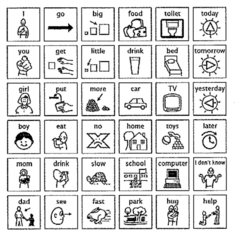
What is a semantic syntactic grid display?
- symbols are arranged by vocabulary and word order
- order: nouns - verbs - modifers
- frequently used phrases at the bottom for quick access
- supports generative communication - "don't want apples" or "do want apples"
What is a pro to using semantic syntactic displays?
- facilitates language learning
- encourages flexible, creative communication
What is a con to using semantic syntactic displays?
can be hard for early or low-tech users
What is a schematic/activity grid display?
- grid arrangement with items organized around an activity
- contains only vocabulary relevant to the activity
ex. science class on plants
ex. lego/play activity
ex. birthday party
- NOT romantic syntactic
How does QuickPic benefit schematic/activity displays?
quickly creates activity-specific displays from photos to support communication and language learning
ex. trip to a farm
What is a pro of using a schematic/activity display?
- young children and those with lower language levels naturally tend to organize concepts in a schema/context, especially familiar events, using a small number of symbols, making them easier to understand
- quick to develop new boards for new activities, as there is no need to rearrange existing vocabulary
- easy to navigate/quick
What is a con to using schematic/activity displays?
- there are so many different activities. You are going to have to have so many different activity displays for just one day alone
- repeated vocabulary across many different boards
What is a PODD grid display - Pragmatic Organization Dynamic Display
- initial pages include items such as those that need to be said quickly or in response to partner
- ex. I have something to say, I like this. - Pragmatically organized
- includes navigational strategies such as; telling the partner to turn the page, go to page...telling the partner that was not correct or do not understand, conversation starter
- predictable vocabulary on tabbed pages - taxonomic, some semantic syntactic possibly
- exact content changes per person
What is a dynamic display?
- it changes/has different pages, computers and low-tech books
What is an alphabetic grid display?
- vocabulary arranged like a personal dictionary, A-Z
- requires literacy skills
- starts with words starting with a...
- navigational burdens, book reports some adults with TBI did better with this format but still preferred topics organization
What is an idiosyncratic grid display?
- unique organization per the individual
- ex. colors of items, songs, holidays
- ex. waving your elbow as a form of saying yes, rather than shaking your head
- they put vocabulary in a folder where we don't think it belongs
- CONSIDER THE INDIVIDUAL
What is a chronological grid display?
- visual schedules
- activities, represented by symbols arranged in order of events
- ex. school arrival
- this is a more receptive language than expressive
What is a Keyboard grid display?
- consider personal preference
- ABCDEF keyboard
- QWERTY keyboard (this is ours)
- background color cues
- larger groupings, smaller groupings
What are hybrid grid displays?
- more than one type of display mixed together
- not just one or the other
- could be both semantic syntactic and taxonomic display
ex. having core words like I, YOU, IT, HE, SHE in a category
taxonomic grid display

semantic syntactic grid display
chronological (visual schedules)

keyboard grid display
What are grid displays?
AAC displays that use rows and columns