Chem/Phys discrete questions
 Call Kai
 Learn
Learn Practice Test
 Spaced Repetition
 Match
Match Flashcards
 Knowt Play
1/244

There's no tags or description
Looks like no tags are added yet.
Name | Mastery | Learn | Test | Matching | Spaced | Call with Kai | Chat |
|---|
No analytics yet
Send a link to your students to track their progress
245 Terms
What is the approximate isoelectric point of the C-terminal amide-capped tripeptide Asp–Ala–Cys–NH2?
(Note: pKa of N-terminus = 9.8; pKa of Asp side chain = 3.9; pKa of Cys side chain = 8.4.)
A. 9.8
B. 6.9
C. 6.1
D. 3.9
C
What is the maximum number of full α-helical turns in a protein monomer composed of 4428 amino acid residues?
A. 1080
B. 1230
C. 1476
D. 1640
B
What is the approximate molecular weight in kDa of a protein composed of 90 amino acid residues?
A. 7.2 kDa
B. 8.1 kDa
C. 9.0 kDa
D. 9.9 kDa
D
Which type of turn in a protein has a hydrogen bond between the i and i + 5 end residues of the turn?
A. π
B. Y
C. β
D. α
A
What is the percentage of the Vmax attained for a single-substrate enzyme following Michaelis–Menten kinetics at [S]0 = 4 × KM?
A. 83% Vmax
B. 80% Vmax
C. 75% Vmax
D. 67% Vmax
B
What is the enzyme classification of lysozyme?
A. Hydrolase
B. Isomerase
C. Lyase
D. Oxidoreductase
A
Which type of enzyme catalyzes a reaction that directly activates or deactivates enzyme activity by covalent enzyme modification?
A. Adenylyl cyclase
B. ATP synthase
C. Glycogen phosphorylase
D. Protein kinase
D
Vector A has the reciprocally orthogonal components Ax = +3, Ay = +4, and vector B has Bx = –6, By = –8. What is the magnitude of vector S = A + B?
A. 5
B. 7
C. 14
D. 21
A

The equation describes a transverse wave that propagates along the x-axis.
What is the propagation speed of the wave?
A. 24 cm/s
B. 12 cm/s
C. 4 cm/s
D. 3 cm/s
C
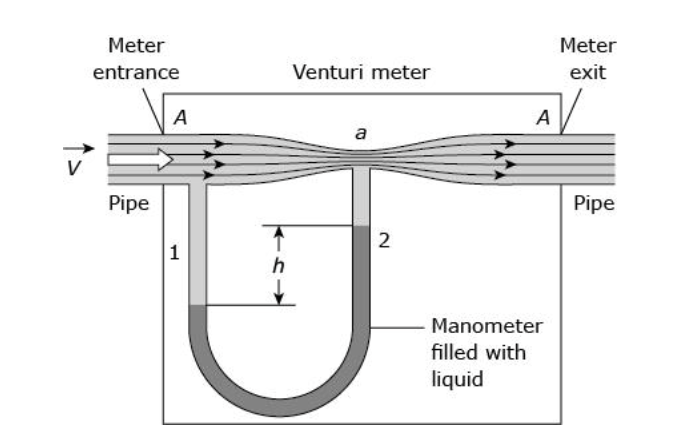
Which single modification to this Venturi meter increases the maximum air flow speed at the entrance that can be measured?
A. Shortening the manometer tube
B. Increasing the manometer liquid density
C. Increasing the amount of manometer liquid
D. Decreasing the amount of manometer liquid
B
Momentum is defined as mass multiplied by speed. If a large mass object and a small mass object have the same momentum, which object has the larger kinetic energy?
A. The small mass object
B. The large mass object
C. Either object, depending on their speeds
D. Both objects have the same kinetic energy
A
An object is moved up with constant speed on an inclined plane that makes angle θ with the horizontal. The coefficient of kinetic friction is μ. What is the expression of the mechanical advantage MA?
A. MA = μ + sinθ•cosθ
B. MA = μ•sinθ + cosθ
C. MA = μ•sinθ•(cosθ)–1
D. MA = (sinθ + μ•cosθ)–1
D
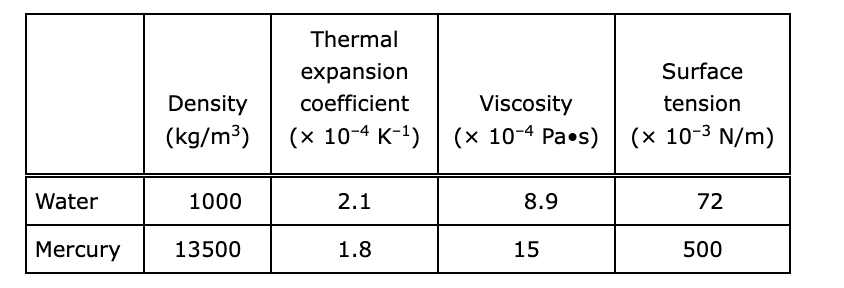
Values for physical properties of water and mercury are given.
Which property makes mercury better suited than water for use in clinical capillary thermometers?
A. Density
B. Viscosity
C. Surface tension
D. Thermal expansion coefficient
C
One mole of ideal gas undergoes a thermodynamic process in which pressure doubles and volume halves. What is the value of the molar heat capacity of the gas during the process?
A. 0
B. ∞
C. Undetermined
D. Ideal gas constant
B

An electrically isolated thin spherical shell of radius 3 cm is made of a metal of work function 5 eV. What is the maximum number of photoelectrons that the sphere can emit when exposed to a beam of photons of energy 7 eV each?
A. 2 × 10⁵
B. 3 × 10⁶
C. 4 × 10⁷
D. 5 × 10⁸
C
A hollow cube floats half submerged in oil of density 800 kg/m3. The cube edges are marked every 1 cm. What is the minimum density of a liquid that can be determined by reading the mark at which the cube floats?
A. 100 kg/m3
B. 200 kg/m3
C. 400 kg/m3
D. 600 kg/m3
C
An electrically charged particle enters a uniform magnetic field at a speed of 500 km/s. What is the quantity, if any, whose magnitude must be known in order to calculate the speed of the particle in the magnetic field?
A
None
B
The charge of the particle
C
The magnitude of the magnetic field
D
The angle between the particle velocity and the magnetic field lines
A
What is the balanced half-reaction that produces succinic acid (C4H6O4) from fumaric acid (C4H4O4)?
A
C4H4O4 + 4H+ + 4e– → C4H6O4
B
C4H4O4 → C4H6O4 + 2H+ + 2e–
C
C4H4O4 + 2H+ + 2e– → C4H6O4
D
C4H6O4 → C4H4O4 + 2H+ + 2e–
C
What is the ideal bond angle of a molecule with an sp2-hybridized central atom?
A
90°
B
109.5°
C
120°
D
180°
C
What is the ideal bond angle of a molecule with an sp3-hybridized central atom?
A
90°
B
109.5°
C
120°
D
180°
B
How much heat must be added to 200. g of liquid water to increase its temperature by 5.00 K?
(Note: The specific heat capacity of liquid water is 4.18 J•g–1•K–1.)
A
4180 J
B
2090 J
C
836 J
D
418 J
A
According to the Arrhenius equation, how does an increase in temperature affect the rate constant of a reaction?
A
It remains unchanged as temperature does not affect molecular collisions.
B
It decreases due to a reduced frequency of effective reactant collisions.
C
It increases as more molecular collisions exceed the activation energy.
D
It increases while the reaction rate decreases with rising concentrations.
C
Which characteristic is most important when choosing an indicator for an acid–base titration?
A. The molecular weight of the indicator
B. The volume of indicator solution used
C. The color of the indicator in a neutral solution
D. The pH range over which the indicator changes color
D
According to Charles’s law, what happens to the volume of an ideal gas when the absolute temperature is doubled while the pressure and moles remain constant?
A. The volume remains constant.
B. The volume quadruples.
C. The volume is halved.
D. The volume doubles.
D
Which trend in electronegativity is observed when moving from the bottom of a group to the top of the periodic table?
A. Electronegativity decreases due to increased atomic size.
B. Electronegativity increases due to decreased atomic size.
C. Electronegativity decreases as valence electrons are closer to the nucleus.
D. Electronegativity remains unchanged as the number of valence electrons remains constant.
B
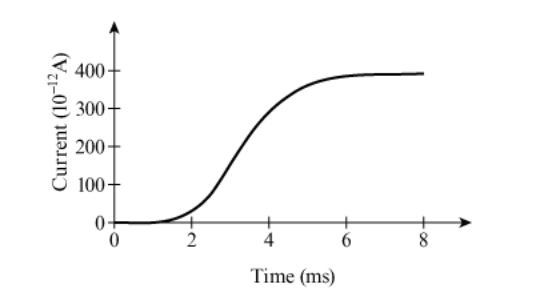
The time dependence of the potassium current through a cell membrane channel subject to a constant 80-mV depolarization voltage is shown.
What is the minimum electrical resistance of the ion channel during the time interval shown?
A
120 kΩ
B
160 kΩ
C
200 MΩ
D
240 MΩ
C
Which extraction procedure will completely separate an amide from the by-product of the reaction between an amine and excess carboxylic acid anhydride?
A
Add 0.1 M NaOH(aq) to quench unreacted anhydride. Then add diethyl ether and separate the layers. The amide can be obtained from the ether layer by evaporating the solvent.
B
Add 0.1 M HCl(aq) to quench unreacted anhydride. Then add diethyl ether and separate the layers. The amide can be obtained from the ether layer by evaporating the solvent.
C
Add 0.1 M NaOH(aq) to quench unreacted anhydride. Then add diethyl ether and separate the layers. The amide can be obtained from the aqueous layer by neutralizing with HCl(aq).
D
Add 0.1 M HCl(aq) to quench unreacted anhydride. Then add diethyl ether and separate the layers. The amide can be obtained from the aqueous layer by neutralizing with NaOH(aq).
A
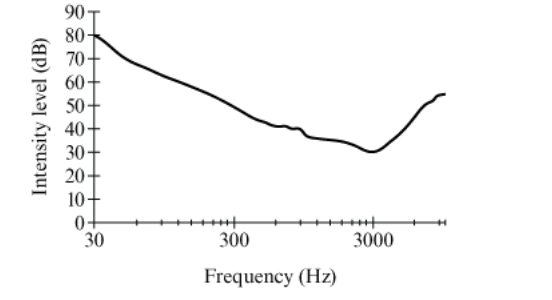
The relationship between the frequencies and the intensity levels of sounds perceived by the human ear as having a particular loudness is shown.
What is the ratio between the maximum and the minimum sound intensities that produce this particular loudness?
A. 106
B. 105
C. 104
D. 103
B
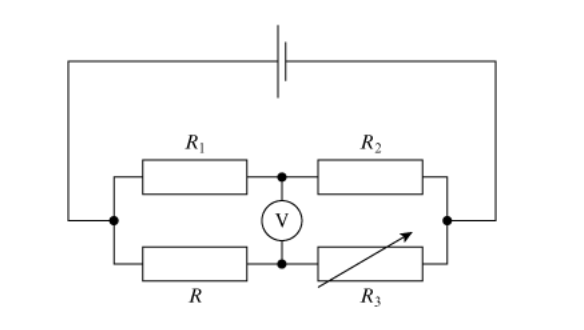
An experimental setup designed to measure the resistance of an unknown resistor R using two known resistors R1 and R2, the variable resistor R3, a voltage source, and a voltmeter is shown.
Which relationship gives the value of R when R3 is adjusted so that the voltmeter reading is zero?
A. R = R3 × R1/R2
B. R = R3 + R2 – R1
C. R = R3 – R2 + R1
D. R = R3 × R2/R1
A
Assume the hydrolysis of ATP proceeds with ΔG′° = –30 kJ/mol.
ATP + H2O → ADP + Pi
Which expression gives the ratio of ADP to ATP at equilibrium, if the [Pi] = 1.0 M? (Note: Use RT = 2.5 kJ/mol.)
A. e2
B. e3
C. e6
D. e12
D
What is the electronic configuration of the Co(II) center found in vitamin B12?
A. [Ar] 3d7
B. [Ar] 4s2 3d5
C. [Ar] 4s2 3d7
D. [Ar] 4s2 4d5
A
In a certain kinetics experiment, the enzymatically catalyzed hydrolysis of ATP proceeds at a constant rate of 2.0 µM•s–1. If the volume of solution is 1.0 mL, what is the total number of ATP molecules that hydrolyzed after 1 min?
A
1.2 × 10⁻⁷ mol
B
3.3 × 10⁻⁶ mol
C
3.3 × 10⁻⁵ mol
D
1.2 × 10⁻⁴ mol
A
Which cation is most likely to be found in place of Fe(II) in the square planar binding domain of hemoglobin?
A. Mg2+
B. Li+
C. Co2+
D. Na+
C
The ATP-dependent phosphorylation of a protein target is catalyzed by which class of enzyme?
A
Oxidoreductase
B
Transferase
C
Hydrolase
D
Ligase
B
The idea that enzymes undergo conformational changes upon substrate binding in order to bring specific functional groups into the correct catalytic orientation is described as the:
A
transition-state model.
B
active-site model.
C
lock-and-key model.
D
induced-fit model.
D
When performing experiments to measure the kcat of an enzyme, the substrate concentration should be:
A. limiting.
B. equal to 1/2 KM.
C. equal to KM.
D. saturating.
D
When experiments are performed on enzymes that display traditional Michaelis–Menten kinetics, what shape does the graph of V0 versus substrate concentration [S] have?
A
A hyperbolic dependence on [S]
B
A linear dependence on [S]
C
A sigmoidal dependence on [S]
D
A parabolic dependence on [S]
A
Which experimental results confirm that Compound 1 is an uncompetitive inhibitor of a particular enzyme? In the presence of Compound 1:
A. the KM increases and Vmax decreases.
B. the KM decreases and Vmax increases.
C. both the KM and Vmax decrease.
D. both the KM and Vmax increase.
C
At pH 7, which of the following peptides will bind to an anion-exchange column and require the lowest concentration of NaCl for elution?
A
AVDEKMSTRGHKNPG
B
YPGRSMHEWDIKAQP
C
HIPAGEATEKALRGD
D
EAPDTSEGDLIPEVS
C
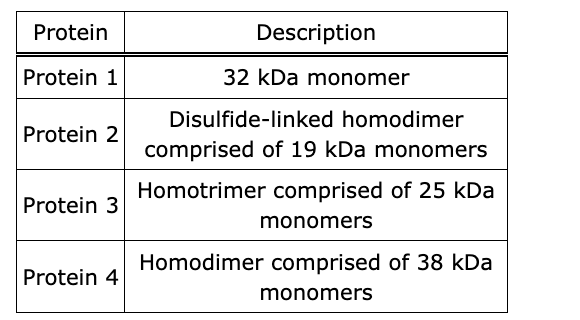
A description of the structures of four proteins is shown in the table.
Which protein has the highest electrophoretic mobility in SDS-PAGE under non-reducing conditions? (Note: There are no disulfide interactions unless stated in the table.)
A. Protein 1
B. Protein 2
C. Protein 3
D. Protein 4
C
A protein contains four disulfide bonds. In order to break these bonds researchers added a minimum of:
A
2 moles of NADH for each mole of protein.
B
4 moles of NADH for each mole of protein.
C
2 moles of NAD+ for each mole of protein.
D
4 moles of NAD+ for each mole of protein.
B
The relationship between the steroid hormone, estrogen, and the peptide hormone, insulin, is being investigated. In order to quantify levels of each of these hormones, tissue samples were homogenized and then placed in a mixture of 2:1 hexane/water. What is the expected result from this extraction method?
_
A. Estrogen would be in the hexane phase; insulin would be in the aqueous phase.
B. Both estrogen and insulin would be in the aqueous phase.
C. Insulin would be in the hexane phase; estrogen would be in the aqueous phase.
D. Both estrogen and insulin would be in the hexane phase.
A
A protein with which properties will most likely have the largest negative net charge at pH 7?
_
A. A protein that binds to an anion-exchange column at pH 7 and requires a high concentration of NaCl for elution
B. A protein that binds to an anion-exchange column at pH 7 and requires a moderate concentration of NaCl for elution
C. A protein that binds to a cation-exchange column at pH 7 and requires a high concentration of NaCl for elution
D. A protein that binds to a cation-exchange column at pH 7 and requires a moderate concentration of NaCl for elution
A
Thermal denaturation experiments can be used to follow the transition of double-stranded DNA into single-stranded DNA. Which of the following parameters affects the Tm of dsDNA in this experiment?
I. pH of solution
II. Ionic strength of solution
III. Length of DNA strands
_
A
I and II only
B
I and III only
C
II and III only
D
I, II, and III
D
Which nucleoside has the largest molecular weight?
_
A
Adenosine
B
Guanosine
C
Deoxyadenosine
D
Deoxyguanosine
B
The side chain of which amino acid can form a bond that is similar to a peptide bond?
_
A. Gly
B. Phe
C. Lys
D. Ala
C
Substituting residues in a peptide with which amino acid will most likely result in a peptide with an increased pI?
_
A. Lys
B. Glu
C. Gln
D. Val
A
Which of the following peptides is most likely to form a covalently bonded dimer?
_
A
AVTSYWP
B
GHICEPN
C
NFMNELI
D
ELIPWQN
B
To determine a protein’s thermodynamic stability, chemical denaturation studies can be performed. Assuming that only the native and unfolded states can be observed under experimentally available conditions, what is the most likely shape of the curve for the dependence of the fraction of folded protein upon denaturant concentration?
_
A. Hyperbolic
B. Linear
C. Sigmoidal
D. Exponential
C
A combination of KM and kcat with which relative values is indicative of the lowest catalytic efficiency for an enzymatically catalyzed reaction?
_
A
A high KM and a low kcat
B
A high KM and a high kcat
C
A low KM and a high kcat
D
A low KM and a low kcat
A
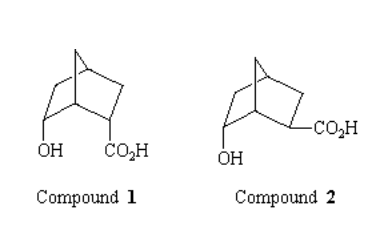
Compound 1 is a stronger acid than Compound 2 because the anion of Compound 1 is better stabilized by:
A
resonance effect.
B
dehydration.
C
an inductive effect.
D
hydrogen bonding between OH and CO2–.
D
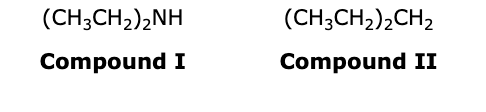
Which of the compounds shown below is more soluble in water?
A. Compound I
B. Compound II
C. They are about equally soluble.
D. Neither has appreciable water solubility.
A
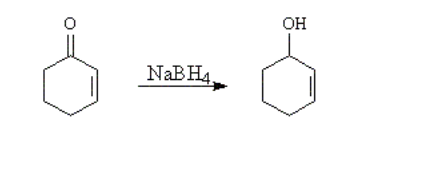
A student uses thin layer chromatography on silica plates to monitor the progress of the reaction below. Does the product have a higher or lower Rf than the starting material?
A. Higher, because the product is more polar than the starting material
B. Higher, because the product is less polar than the starting material
C. Lower, because the product is less polar than the starting material
D. Lower, because the product is more polar than the starting material
D
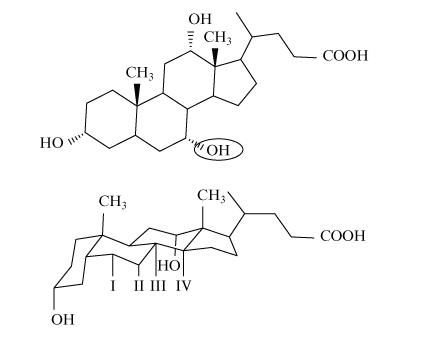
The structure of cholic acid is shown below in 2 different views. The circled hydroxyl group in the top figure would be located at which position in the bottom figure?
A. I
B. II
C. III
D. IV
B
Alcohols generally require acid catalysis in order to undergo substitution by nucleophiles. The acid catalyst enhances the reaction by:
_
A. increasing the solvent polarity.
B. creating a better leaving group.
C. neutralizing basic impurities.
D. protecting the alcohol group.
B
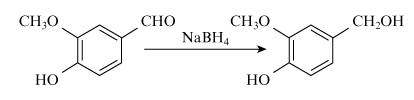
Which of the following observations about the infrared spectrum of the reaction mixture would indicate that the reaction shown above occurred?
_
A
The disappearance of an O–H stretch
B
The disappearance of a C=O stretch
C
The appearance of an aliphatic C–H stretch
D
The appearance of an aldehyde C–H stretch
B
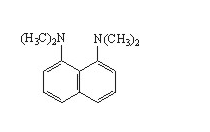
The compound below is sold under the name Proton-Sponge®. Is this compound likely to be a good nucleophile?
A. Yes, because it is a strong base
B. Yes, because the nitrogens have high electron density
C. No, because it is aromatic
D. No, because the nitrogens are sterically hindered
D

Ignoring stereochemistry, how many different tripeptides may exist that contain the same three amino acids as the molecule shown below?
A. 1
B. 3
C. 6
D. 9
C
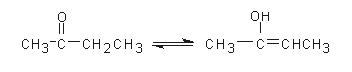
The phenomenon exemplified in the equilibrium equation below is called:
A
reduction.
B
resonance.
C
tautomerism.
D
mutarotation.
C
Which of the following properties is associated with the existence of glycine as a dipolar ion in aqueous solution?
_
A. High dipole moment
B. High molecular weight
C. Low dielectric constant
D. Low solubility in water
A
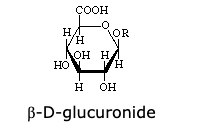
The compound shown above is the β-derivative of the D-glucuronic acid. The α-D-glucuronide differs in configuration from the β-derivative at:
_
A. C-1.
B. C-2.
C. C-3.
D. C-4.
A
Na2CO3 + HCl → CO2 + H2O + NaCl
Consider the above unbalanced equation. For this reaction, how many mL of a 2 M solution of Na2CO3 are required to produce 11.2 L of CO2 at STP?
A
125 mL
B
250 mL
C
375 mL
D
500 mL
B
What are the oxidizing and reducing agents, respectively, in the reaction below?
2HCl + H2O2 + MnO2 → O2 + MnCl2 + 2H2O
A
H2O2; HCl
B
H2O2; MnO2
C
MnO2; HCl
D
MnO2; H2O2
D
A compound was analyzed and found to contain 12.0 g carbon, 2.0 g hydrogen, and 16.0 g oxygen. What is the empirical formula for this compound?
_
A
CH2O
B
C6HO8
C
C6H12O6
D
C12H2O16
A
What is the molar concentration of Na+(aq) in a solution that is prepared by mixing 10 mL of a 0.010 M NaHCO3(aq) solution with 10 mL of a 0.010 M Na2CO3(aq) solution?
_
A
0.010 mole/L
B
0.015 mole/L
C
0.020 mole/L
D
0.030 mole/L
B
Which of the compounds shown below can form hydrogen bonds with water?
CH3–CH2–CH3 | CH3–CH2–NH2 |
_
A. Compound 1 only
B. Compound 2 only
C. Both compounds
D. Neither compound
B
Which of the bromomethanes is LEAST polar?
_
A
CBr4
B
CHBr3
C
CH2Br2
D
CH3Br
A
Which of the following shows the electron configuration of chlorine in NaCl?
_
A
1s22s22p63s23p4
B
1s22s22p63s23p5
C
1s22s22p63s23p6
D
1s22s22p63s23p44s2
C
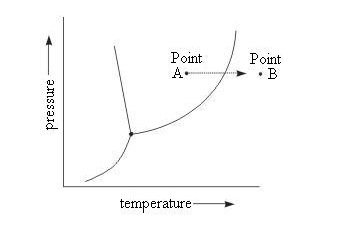
Consider the phase diagram of water below.
The arrow proceeding from Point A to Point B represents:
A. melting.
B. sublimation.
C. condensation.
D. vaporization.
D
In the Bohr model of the atom, radiation is emitted whenever electrons:
_
A
change orbits.
B
undergo acceleration.
C
move to orbits of lower energy.
D
move to orbits of larger radius.
C
A sparingly soluble metal hydroxide, M(OH)2 has a molar solubility of S mol/L at 25°C. Its Ksp value is:
_
A
S2.
B
2S2.
C
2S3.
D
4S3.
D
H2O is liquid at room temperature, whereas H2S, H2Se, and H2Te are all gases. Which of the following best explains why H2O is liquid at room temperature?
_
A
Hydrogen bonds form between H2O molecules.
B
Oxygen lacks d orbitals.
C
H2O has a lower molecular weight.
D
H2O is more volatile.
A
Suppose that CH4(g) reacts completely with O2(g) to form CO2(g) and H2O(g) with a total pressure of 1.2 torr. What is the partial pressure of H2O(g)?
_
A
0.4 torr
B
0.6 torr
C
0.8 torr
D
1.2 torr
C
Which one of the following general characteristics is shared by all catalysts?
_
A. They induce more collisions among reactant molecules
B. They transfer kinetic energy to the reactant molecules.
C. They increase the reaction rate but do not change the Keq of a reversible reaction.
D. They increase both the reaction rate and the Keq of a reversible reaction.
C
What is the conjugate base of the bisulfate ion (HSO4–)?
_
A
H+
B
OH–
C
SO42–
D
H2SO4
C
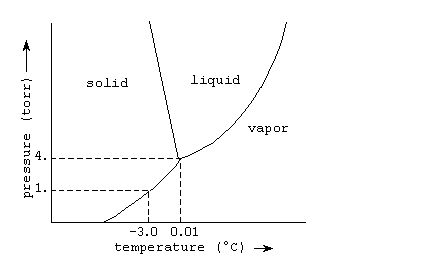
Below is a phase diagram for water
As the pressure applied to a sample of water at –0.1°C is increased from 1.0 torr to 200 atm at constant temperature, the:
A
vapor will become a solid and then a liquid.
B
vapor will become a liquid and then a solid.
C
vapor will become and remain a solid.
D
solid will become a liquid.
A
What is the pH of a .001 M NaOH solution?
_
A. .001
B. 3
C. 7
D. 11
D
The term “ideal gas” refers to a gas for which certain assumptions have been made. Which one of the following assumptions applies to an ideal gas?
_
A
The law PV = nRT2 is strictly obeyed.
B
Intermolecular forces are infinitely large.
C
Individual molecular volume and intermolecular forces are negligible.
D
One mole occupies a volume of 22.4 L at 25°C and 1 atm pressure.
C
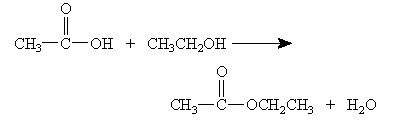
Acetic acid and ethanol react to form an ester product as shown below.
In determining which reactant loses the –OH group, which of the following isotopic substitutions would be most useful?
A. Replace the acidic H of acetic acid with D.
B. Replace the alcoholic H of ethanol with D.
C. Replace the carbonyl oxygen of acetic acid with O-18.
D. Replace the hydroxyl oxygen of ethanol with O-18.
D
A person, whose eye has a lens-to-retina distance of 2.0 cm, can only clearly see objects that are closer than 1.0 m away. What is the strength S of the person’s eye lens? (Note: Use the thin lens formula 1/O + 1/I = S .)
A.
–50 D
B.
–10 D
C.
51 D
D.
55 D
C
Which statement correctly describes how enzymes affect chemical reactions? Stabilization of:
A.
the substrate changes the free energy of the reaction.
B.
the transition state changes the free energy of the reaction.
C.
the substrate changes the activation energy of the reaction.
D.
the transition state changes the activation energy of the reaction.
D
Which of the following will decrease the percentage ionization of 1.0 M acetic acid, CH3CO2H(aq)?
A.
Chlorinating the CH3 group
B.
Diluting the solution
C.
Adding concentrated HCl(aq)
D.
Adding a drop of basic indicator
C
Why is the velocity of blood flow slower in capillaries than in arteries?
A. Capillary walls are more elastic than arterial walls.
B. Capillaries have less resistance to blood flow than arteries.
C. The total cross-sectional area of capillaries exceeds that of arteries.
D. Blood pressure is higher in the capillaries than in arteries.
C
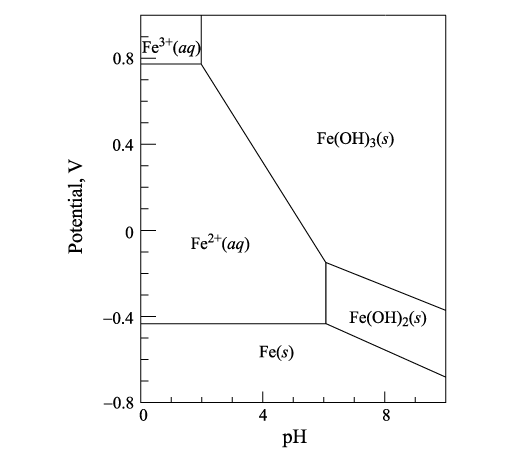
The graph below shows the relationship between the predominant form of iron as a function of solution pH and applied potential. Based on the graph, which of the following statements is tru
A.
At a potential of –0.4 V, as pH increases, Fe2+ is reduced and precipitates as Fe(OH)3.
B.
At a potential of –0.44 V, the equilibrium between Fe and Fe2+ is independent of solution pH below pH 6.
C.
At pH = 1, as the potential is changed from –0.2 to +0.8, Fe3+ is reduced to Fe2+.
D.
At pH = 8 and V = –0.1 V, Fe(OH)2 is the predominant form of iron.
B
Which of the following types of orbitals of the central atom are involved in bonding in octahedral compounds?
A. sp
B. sp3
C. p
D. d2 sp3
D
The term “ideal gas” refers to a gas for which certain assumptions have been made. Which of the following is such an assumption?
A.
The law PV = nRT2 is strictly obeyed.
B.
Intermolecular molecular forces are infinitely large.
C.
Individual molecular volume and intermolecular forces are negligible.
D.
One gram-mole occupies a volume of 22.4 L at 25°C and one atmosphere pressure.
C
Each of the following equations shows the dissociation of an acid in water. Which of the reactions occurs to the LEAST extent?
A. HCl + H2O → H3O+ + Cl−
B. HPO42− + H2O → H3O+ + PO43−
C. H2SO4 + H2O → H3O+ + HSO4−
D. H3PO4 + H2O → H3O+ + H2PO4−
B
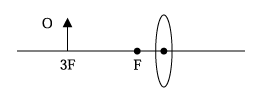
In the above figure, an object O is at a distance of three focal lengths from the center of a convex lens. What is the ratio of the height of the image to the height of the object?
A. 1/3
B. 1/2
C. 2/3
D. 3/2
B
Gamma decay occurs when a nucleus emits:
A. a photon.
B. a positron.
C. a neutron.
D. an electron.
A

When a 0.1 M H2SO4 solution is added to pulverized blackboard chalk, the following reaction takes place.
At 25°C, the reaction is spontaneous and has:
A.
negative ΔG° and positive ΔS°.
B.
negative ΔG° and negative ΔS°.
C.
positive ΔG° and negative ΔS°.
D.
positive ΔG° and positive ΔS°.
A

The equilibrium
exists in a saturated aqueous solution of BaCrO4. Dissolution of Na2CrO4 in a saturated aqueous BaCrO4 solution would:
A. have no effect on the position of this equilibrium.
B. shift this equilibrium left.
C. shift this equilibrium right.
D. shift this equilibrium first right and then left.
B
What volume of a 0.120 M CaI2 solution would contain 0.078 mol of the solute?
A.
35.0 mL
B.
65.0 mL
C.
350 mL
D.
650 mL
D
Which measurement unit CANNOT be used to express power?
A. kg•m2 •s2
B. J•s-1
C. ft•lb •s-1
D. W
A
Absorption of ultraviolet light by organic molecules always results in what process?
A. Bond breaking
B. Excitation of bound electrons
C. Vibration of atoms in polar bonds
D. Ejection of bound electrons
B
Four organic compounds: 2-butanone, n-pentane, propanoic acid, and n-butanol, present as a mixture, are separated by column chromatography using silica gel with benzene as the eluent. What is the expected order of elution of these four organic compounds from first to last?
A.
n-Pentane → 2-butanone → n-butanol → propanoic acid
B.
n-Pentane → n-butanol → 2-butanone → propanoic acid
C.
Propanoic acid → n-butanol → 2-butanone → n-pentane
D.
Propanoic acid → 2-butanone → n-butanol → n-pentane
A
The half-life of a radioactive material is:
A.
half the time it takes for all of the radioactive nuclei to decay into radioactive nuclei.
B.
half the time it takes for all of the radioactive nuclei to decay into their daughter nuclei.
C.
the time it takes for half of all the radioactive nuclei to decay into radioactive nuclei.
D.
the time it takes for half of all the radioactive nuclei to decay into their daughter nuclei.
D
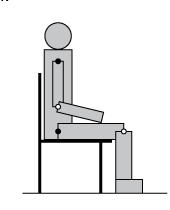
A person is sitting on a chair as shown.
Why must the person either lean forward or slide their feet under the chair in order to stand up?
A.
To increase the force required to stand up
B.
To use the friction with the ground
C.
To reduce the energy required to stand up
D.
To keep the body in equilibrium while rising
D
A patient puts on a mask with lateral openings and inhales oxygen from a tank as shown.
What phenomenon causes static air to be drawn into the mask when oxygen flows?
A.
Doppler effect
B.
Venturi effect
C.
Diffusion
D.
Dispersion
B
What causes duplex DNA with a certain (A + T):(G + C) ratio to melt at a higher temperature than comparable length duplex DNA with a greater (A + T):(G + C) ratio?
A. Stronger van der Waals forces of pyrimidines
B. Stronger van der Waals forces of purines
C. Increased π- stacking strength
D. Reduced electrostatic repulsion of phosphates
C
Which property of a substance is best used to estimate its relative vapor pressure?
A. Melting point
B. Boiling point
C. Molecular weight
D. Dipole moment
B