micro lab exam 3
 Call Kai
 Learn
Learn Practice Test
 Spaced Repetition
 Match
Match Flashcards
 Knowt Play
1/74

There's no tags or description
Looks like no tags are added yet.
Name | Mastery | Learn | Test | Matching | Spaced | Call with Kai |
|---|
No analytics yet
Send a link to your students to track their progress
75 Terms
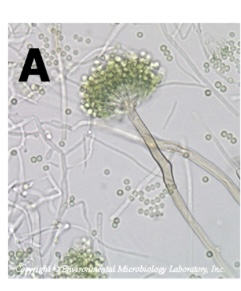
Aspergillus niger (Mold)
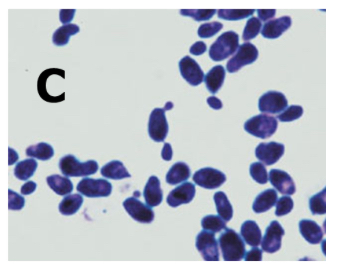
Candida albicans (Yeast)
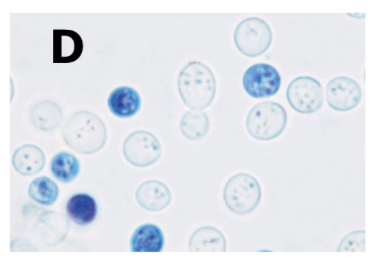
Saccharomyces cervisiae (Yeast)
Methylene blue stain
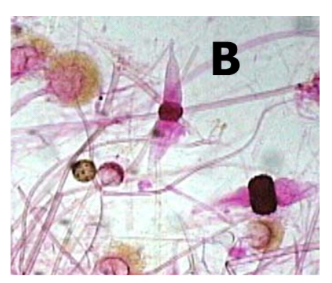
Rhizopus stolonifor (Mold)
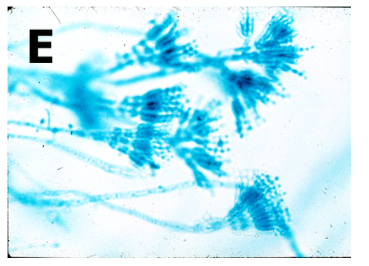
Penicillium chrysogenum (Mold)
Lactophenol Cotton Blue Stain
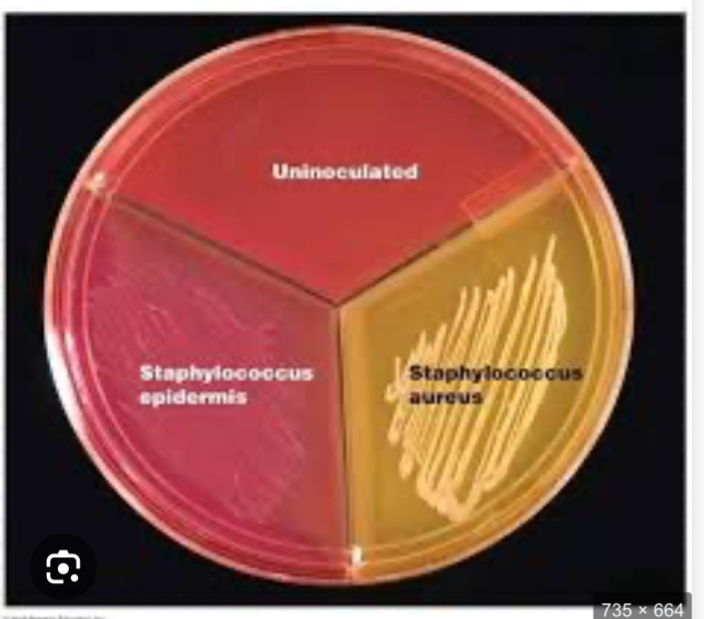
MSA Analysis
Yellow- Halophile/ Ferments Mannitol
Hot Pink- Halophile/ Does not ferment mannitol
MSA
both a selective medium and a differential medium
MSA selects for organisms that tolerate the 7.5% NaCl (Halotolerant)
MSA differentiates organisms on their ability to ferment the sugar mannitol.
pH indicator phenol red.
Scolex
suckers and hooks for attachment.
Proglottids
reproductive segments that make up the body
Protozoa Classification
Protozoa are organized based on locomotion (motility)
Amoeba - move via pseudopods
Flagellates - move via flagella
Ciliates - move via cilia
Apicomplexans/sporozoa - do not move or may have an undulating membrane, glide, or attach
Obligate or strict aerobes
require O2 to make ATP through aerobic cellular respiration and will only grow in the O2-rich layer at the surface of the broth.
Obligate anaerobes
obtain energy through anaerobic respiration or fermentation, will be killed by O2
will only grow below the pink band, where there is no O2.
Facultative anaerobes
thrive in the presence of O2, but also grow in its absence by relying on fermentation or anaerobic respiration,
will grow throughout but better on top
Microaerophiles
require minimal amounts of O2 for growth
will grow in a thin layer just below the pink band.
Aerotolerant anaerobe
do not use O2 - usually have a fermentative metabolism, are not harmed by the presence of O2,
will grow evenly all throughout the medium.
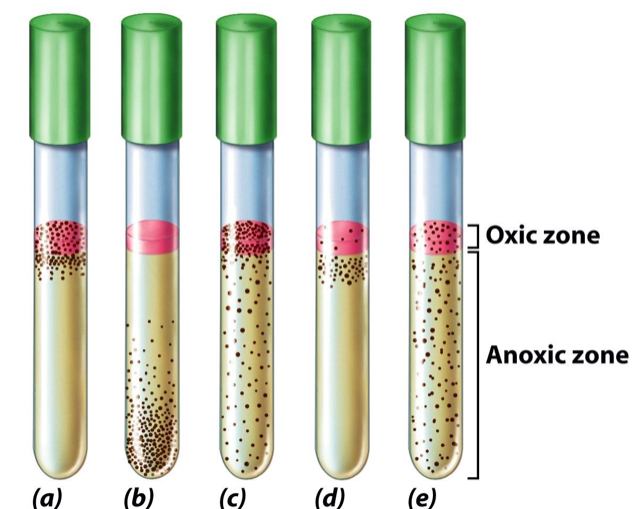
(a) Obligate or strict aerobes
(b) Obligate anaerobes
(c) Facultative anaerobes
(d) Microaerophiles
(e) Aerotolerant anaerobes
Acidophiles
prefer a pH less than 5.5
Neutrophiles
grow best in a pH between 5.5-8.5
Alkaliphiles
thrive in a pH above 8.5
KB Test
diameter of the inhibition zone (in millimeters) around each individual antibiotic to determine the species susceptibility or resistance.
MAC
both selective and differential.
selects for Gram-negative bacteria.
differentiaties based on their ability to ferment the sugar lactose
contains crystal violet and bile salts,
MAC Analysis
Growth: Gram-negative
No Growth: Gram-positive
Pink/ Red- Lactose Fermenter
Yellow- Non Lactose Fermenter
Oxidase Test
detect for enzyme cytochrome c oxidase
reangant- -tetramethyl-p-phenylenediamine dihydrochlorid
oxidation- purple
Catalase Test
tests for catalase enzyme
reangent- hydrogen peroxcide
bubbles- catalase enzyme is present
Phenol Red Test
determines if a microorganism can ferment a specific carbohydrate ( lactose, sucrose, or glucose) to produce acid or acid and gas
pH indicator phenol red
Phenol Red Test Analysis
A+ for acid production (yellow)
Weak A+ for small acid production (bright orange)
A– if no acid was produced (red, red orange)
G+ for gas production
G- if no gas was produced
P+ for peptonization (bright pink color)
Nitrate Reduction Test
tests for ability to produce nitrate reductase
reangants Sulfanilic acid, -dimethyl-1-naphthylamine, and zinc
Gas in Durnham tube and if the bacterium is a non-fermenter, this indicates denitrification
Immediatly Red : Positive for Nitrate Reductase (Nitrate reduced to Nitrite).
No Color Change : Preliminary negative or further reduction.
Red Color (After Zinc Powder): Negative for Nitrate Reduction
No Color Change (After Zinc Powder): Positive for Nitrate Reduction
Phenyl Ethyl Alcohol Agar (PEA)
undefined medium that is selective for Gram-positive bacteria
more growth than control: gram Postitive
less growth/no growth: gram negative
Blood Agar
differential
blood=extra nutrients
if an organism produces hemolysin (degrade hemoglobin) it will be able to lyse the blood cells
yellow- Beta hemolysins (completely lyse the red blood cell and degrade the hemoglobin)
green/brown- Alpha (partially degrade the hemoglobin producing biliverdin)
no change- Gamma (no hemolysin produced)
Temp effect on microbial growth
Cold temperatures slow enzymatic reactions
Excessive heat causes irreversible damage, including denaturation, cell death
UV effect
damages DNA/RNA (pyrimidine dimers) leading to mutations or cell death
pH effect
enzymes denature in very basic or acidic
membrane integrity
cell wall integrity
ATP production ( respiration)
Psychrophiles
0°C to 15°C
Cold
Psychrotrophs
4°C to 25°C
Cold/ Moderate
Food spoilage
Mesophiles
20°C to 45°C
Moderate
human pathogens
Thermophiles
50°C to 80°C
Heat
Hyperthermophiles
80°C to 110°C
Extreme heat
Halophile
love extremly salty enviornments
Pyrimidine
bonds between two cytosines
a cytosine and a thymine
or two thymines
Disinfection
eliminates many or all pathogenic microorganisms, except bacterial spores, on inanimate objects
Antisepsis
eliminates transient and many pathogenic microorganisms that could cause infection on animate living tissue by arresting their growth or killing
Sterilization
kills all living organisms
Sanitization
prepares surfaces or living tissue for public health or food preparation standards by lowering the number of microbes to an acceptable level
fungal spores
reproductive particles
Conidia Spores
spores are produced and freely released
Sporangia Spores
spores are contained in a sac-like head
Endospores
used for survival in extreme conditions
flatworm vs parasitic worm reproduction
flatworms can produce sexually or asexually (break into fragments)
parasitic worms require multiple hosts for dif life stages
Selective Media
suppress unwanted microbes while allowing target organisms to grow,
Differntial Media
differentiate between closely related organisms based on visual characteristics
Enriched Media
support the growth of fastidious organisms
Enzymes needed for oxygen enviornment
Catalase
Speroxide dismutase
(break down the toxic oxygen products)
Types of organisms grown in anaerobic chamber
obligate anaerobes oxygen free
aerotolerant anaerobes dont use oxygen but can survive with
some microaerophiles require low oxygen
What are the Autoclave Conditions?
121°C for 3-60 minutes
15 PSI for 15-20 minutes
what are the two oxygen indicators?
methylene blue oxygen indicator strip
resazurin
Anaerobic Chamber
used to grow bacteria that can thrive, or survive, without O2
gas pack removes the oxygen
methylene blue oxygen indicator strip is also used to show that the oxygen has been removed
blue- presence of O2
white- all O2 removed
Purpose of Durham tube
detect gas production by microorganisms during fermentation
PR
NR
Serial Dilution Set Up
spread dilution on plate
incubate
use dilution plate which grew 30-300 colonies to calculate the CFU/mL
Bacteria Stains
Gram stains or acid-fast stains
to highlight cell wall differences (peptidoglycan)
Fungal Stains
Lactophenol Cotton Blue Stain detect chitin in cell walls
Methylene Blue Stain encourages budding and increases contrast
Dimorphic Fungi
found as a mold in the environment, but takes on yeast form in the lungs once inhaled.
Dermatophytes
fungi that cause infections of the hair, skin, and nails
Pseudohyphae
chains of elongated yeast cells formed by incomplete budding,
Halotolerant
microorganisms (bacteria, archaea, fungi) that can survive and grow in high-salt environments
Fungicide
pesticides that kill or prevent the growth of fungi
Sporocide
powerful chemical agents designed to eliminate highly resilient microbial spores
Bacteriostatic
prevent bacteria from reproducing and growing, rather than killing them outright
which temp class causes disease
mesophiles
aerotolernace of psychrophiles,
low oxygen habitats
Aerotolernace of mesophiles
obligate aerobes to anaerobes
Aerotolerance of thermophiles and hyperthermophiles
obligate aerobes or anaerobes
Protists
Eukaryotic
unicelluar
motile
heterotrophic, phototrophic, photosynthsis
protozoans, algea
Fungi
cell walls contain chitin,
multicellular
heterotroph (feed on dead)

