Protein Structure & Function Review Set (BIOL 203 Module 1)
 Call Kai
 Learn
Learn Practice Test
 Spaced Repetition
 Match
Match Flashcards
 Knowt Play
1/13

There's no tags or description
Looks like no tags are added yet.
Name | Mastery | Learn | Test | Matching | Spaced | Call with Kai | Chat |
|---|
No analytics yet
Send a link to your students to track their progress
14 Terms
Amino acids
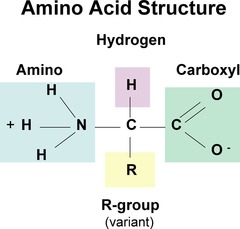
The *monomers of proteins*; consist of a central alpha carbon atom, lone hydrogen atom, a carboxyl group, an amino group, and side chain / R group
Amino and carboxyl groups can act as a base and an acid, respectively, in water
Only 20 amino acids comprise most proteins, and these 20 amino acids can be *categorized* based on their *side chain / R group*: acidic, basic, hydrophobic, hydrophilic
Acidic amino acids
*Hydrophilic, polar, likely charged*^ amino acid whose side chain contains a *carboxyl group*
^Side chain may be *negatively charged* / contain a deprotonated carboxyl group; carboxyl groups act as an acid in water and increase [H+]
![<p>*Hydrophilic, polar, likely charged*^ amino acid whose side chain contains a *carboxyl group*</p><p>^Side chain may be *negatively charged* / contain a deprotonated carboxyl group; carboxyl groups act as an acid in water and increase [H+]</p>](https://assets.knowt.com/user-attachments/8cc32538-4d52-4f88-b000-76422677468c.png)
Basic amino acids
*Hydrophilic, polar, likely charged*^ amino acid whose side chain contains an *amino group*
^Side chain may be *positively charged* / contain a protonated amino group as amino groups act as a base in water and decrease [H+]
![<p>*Hydrophilic, polar, likely charged*^ amino acid whose side chain contains an *amino group*</p><p>^Side chain may be *positively charged* / contain a protonated amino group as amino groups act as a base in water and decrease [H+]</p>](https://assets.knowt.com/user-attachments/a7365530-4ca9-4094-a4a3-284bc728cbd3.png)
Nonpolar amino acids
*Hydrophobic, neutral* amino acids whose side chain is comprised *primarily of bonds between S, C, H atoms (mostly C-H bonds)* and has little oxygen and nitrogen

Polar amino acids
*Hydrophilic, neutral* amino acids whose side chain is made of *other functional groups (e.g., hydroxyl)* or whose side chain has *abundant oxygen and nitrogen* (relative to rest of side chain)

Peptide bonds
Bonds formed between the carboxyl group and amino group of two different amino acids through dehydration synthesis
Amino acids are linked through peptide bonds to form polypeptides (polymers of proteins)
Polypeptides are therefore read from their N-terminus to their C-terminus
*Electron sharing between the N and C atoms of a peptide bond give the peptide bond its stability and planar nature

Proteins' primary structure
The *unique sequence of amino acids* that comprise the flexible polypeptide chain
Proteins' primary structure (amino acid sequence) ultimately determines their unique structure / shape and their characteristic function!
*Peptide bonds* hold together the primary structure

Proteins' secondary structure
Structures *(alpha helices and beta-pleated sheets)* held together by *hydrogen bonds* forming between functional groups on the *polypeptide chain / backbone* (not between side chains)
The hydrogen bonds are specifically between the carbonyl group of one amino acid and the amino group of another amino acid

Proteins' tertiary structure
Twists and folds in peptide backbone that results from various interactions between *side chains and backbone*, resulting in overall *3D functional shape* of polypeptide
Interactions in tertiary structure:
- *Hydrogen bonding* between polar side chains or backbone
- *Hydrophobic interactions / van der Waals interactions* between nonpolar side chains
- *Disulfide (covalent) bonds* between sulfhydryl groups (cysteine)
- Ionic bonds between acidic and basic side chains

Proteins' quaternary structure
Structure formed when *2+ polypeptide subunits* come together to form a single functional structure
Various quaternary structures exist:
- Heterodimer: 2 different polypeptide subunits aggregate
- Homodimer: 2 of the same polypeptide subunits aggregate
- Trimer: 3 polypeptide subunits aggregate
- Tetromer: 4 polypeptide subunits aggregate
(not a complete list)

Protein function
Proteins are the "doers" of the cell, being involved in catalysis, structure, movement, signaling, transport, defense, and more!
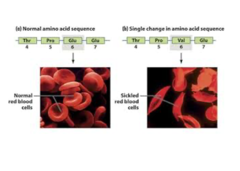
Proteins' primary structure dictate their function. *If you substitute an amino acid for another amino acid with different properties (e.g., acidic → nonpolar) inside a polypeptide chain, you could therefore drastically change its shape and function! If the substitution occurs between two similar amino acids (e.g., acidic → acidic), not much will change in shape or function.*
denaturation
A loss of 3D functional shape due to the disruption or loss of tertiary and secondary interactions
*In the case of proteins, denaturation does NOT break peptide bonds. Denaturation is reversible.*
Common denaturants include UV, heat, chemicals, a drastic change in pH

Molecular chaperonins
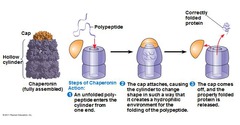
Proteins that facilitate folding or refolding of a new or denatured protein into its correct 3D shape
How do they facilitate folding? Chaperonins attach to nonpolar regions of the primary structure, disallowing hydrophobic interactions to occur prematurely before the rest of the polypeptide can fold.
prions
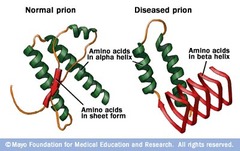
Proteins that can adopt alternative conformations to become self-propagating and infectious (can cause multiple proteins to clump together)