Learn: BMS 300 Exam 1 Colorado State
 Call Kai
 Learn
Learn Practice Test
 Spaced Repetition
 Match
Match Flashcards
 Knowt Play
1/111

There's no tags or description
Looks like no tags are added yet.
Name | Mastery | Learn | Test | Matching | Spaced | Call with Kai | Chat |
|---|
No analytics yet
Send a link to your students to track their progress
112 Terms
Electric Dipole Moment
Neutral molecule with uneven charge distributions (partial charges) e.g. H2O
Diffusion
Movement of molecules from areas of high to low concentrations e.g. Volatile Perfume distributing through the air
Osmosis
Diffusion of WATER through a membrane e.g. Aquaporins (biological proteins)
Hydrophilicity
"Water Loving" e.g. Charged ions that interact with the Electric Dipole Moment in water. (Soluble)
Hydrophobicity
"Water Fearing" e.g. molecules with equal distribution of charge such as Triglycerides (Insoluble)
Amphipathicity
Both Water "Fearing and Loving" e.g. Phospholipids in water
Glycerol
3 Carbon Alcohol (OH)

Triglycerides
3 Fatty Acid Chains on Glycerol formed by Ester Bonds
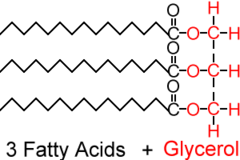
Ester Bond
Created from Dehydration Synthesis to make a C-O-C bond in Triglycerides (Leaves Behind a Water Molecule)
Dehydration Synthesis
Carboxylic end of Fatty Acid Chain attaches to Glycerol to create an Ester Bond and Water Molecule
Fatty Acids
Saturated-Single bond
Unsaturated-Double bond

Phospholipid
Remove a fatty acid chain and add a charged phosphate head group to make it Amphipathic

Micelle
Single layer of UNSTABLE phospholipids (Due to Dipole Moment)
Phospholipid Bi-layer
STABLE formation of Phospholipids

Transmembrane Protein
Provide pathways across the Phospholipid Bi-layer
Amino Acid
Molecule with Amine(NH2), Carboxylic(COOH), and an R group(20 varieties)

Protein
Polymers of Amino Acids
Peptide Bonds
Connecting N-terminus and C-terminus of Amino Acid through Dehydration synthesis to create C-N bond
Primary Structure
Determined by Peptide Bonds and the Amino Acid Sequence
Secondary Structure
Hydrogen Bonding of the two terminals can create Alpha Helices and Beta Pleated Sheets
Alpha Helix
Hydrogen bonding with backbone of molecule

Beta Pleated Sheets
Hydrogen bonding between adjacent amino acids

Tertiary Structure
Orientation of the R-groups makes 3D shape based on interactions with water (Will create the lowest thermodynamic state)
RNA
Ribonucleic Acid that is always synthesized in the nucleus as mRNA, tRNA, or rRNA. Each performs different functions
mRNA
Carries genetic code from the nucleus to the cytoplasm in order to make proteins
rRNA
Directs translation of mRNA into proteins
tRNA
Transfers amino acids to respective codon of rRNA to make proteins
Hydrophilic Pathway Channels
Made of at least 4 alpha Helices to allow certain molecules to pass through the membrane.
Central Dogma
DNA provides a template for RNA to translate into protein
Histone
DNA binding protein to allow chromosomes to tightly wrap like a spool.
Nuclear Pore
Regulates Access to the cytoplasm
Ribosomes
"Protein Builders" that are free to live in the cytoplasm or are attached to the ER.
3 Proteins from Rough ER
Secreted - Leaves the cell
Lysosomal - creates lysosomes
Transmembrane - on membrane
Glycosylation
Attaching sugars to proteins produce glycoproteins
Golgi Apparatus
Finalizes proteins by modifying 3D shape(Sent from ER to Golgi)
Vesicle
Small organelle that contains and transports materials within the cytoplasm. e.g. protein to the Golgi
Microtubules
Polymer of tubulin that assembles side to side with a negative end and positive end (Always assemble as 13 in a circle)
Filamentous Actin
Polymer of Globulin Actin (G-Actin) that can support vesicle transport
Intermediate Filament protein
polymers of small intermediate filament sub units
Kinesin
Molecular motor that turns chemical energy to kinetic (ATPase)

Dynein
(-) end directed motor on the microtubule (ATPase)
ATPase
Enzyme that releases energy stored in the terminal phosphate bonds of ATP molecules ATP->ADP + P_i
Myosin
Molecular motor for Actin (ATPase) that helps transport vesicles along the membrane
DNA
5 carbon sugar made up of bases (ATCG) that links together in a phospho-diester bond
Purines
Adenine and Guanine Bases that
Pyrimidines
Thymine and Cytosine
Number 5 Carbon
5th carbon on DNA that has a triphosphate attached. It can then be removed to create a bond on the 3rd carbon
Anti-Parallel Organization of DNA
A-T
C-G

DNA Replication
Basis of life on the planet that is "Semi conserved"
Always read from 3' to 5' end

Helicase
breaks down H-bonding and unwinds the helix
DNA Polymerase
Adds a base pair to each base on newly broken strand in 3' to 5' direction
Leading Strand
The first new strand to be created in 3' to 5' end
Lagging Strand
Second strand created after Leading and goes in 3' to 5' end but reverse direction
Primers
Bits of RNA that stick to DNA
Promoter
Sequence of bases that provides the "Start Here Signal"
Transcription Factor
Binds to promoter and says it is the start of a gene
RNA Polymerase
Enzyme that links together the growing chain of ribonucleotides during transcription.
Introns
Cut Out sections of the sequence of Pre-mRNA
exons
Expressed regions of the sequence
tRNA
molecule that binds to an amino acid and attaches to protein chain
AUG
always the start codon that is a 3 base set
Anti Codon
3 bases on the tRNA that bind to the mRNA
Stop Codon
UAA, UAG, UGA
codon that signals to ribosomes to stop translation
Termination factor
Protein that enters cytoplasm and the AA sequence is cut from the mRNA.
SRP
Signal Recognition Protein attaches to hydrophobic series of amino acids

Tissue
Group of similar cells performing a similar function. Epithelium, Muscle, Nerve, Connective
Epithelium
Sheet of cells that form lining that is continuous to the outside world
Basal Lamina
bottom side of the epithelium (Apical is top side)
Stratified Epithelium
Epidermis, multi-layered epithelial cells
Integrin
transmembrane protein that binds to extracellular proteins
Hemidesmosome
Anchors E cells to Basal Lamina
Desmosome
Symmetrical and holds the adjacent cells together
Keratin
Fibrous protein found in Epithelial Cells
Cadherin
A joining protein which spans the gap between Occluding junction, and desmosome junction
Occluding Junction
Block/dam spaces in between the epithelial cells
Communicating Junction (Gap)
provides a bridge between cells made out of proteins called connexons. formed with six in a circle, R groups face inward, Hydrophobic outside
Glandular Epithelium
Duct of cells in the layers of epithelial cells
Carcinomas
cancerous epithelial cells
Connective tissue proper
Made of Fibrocytes, which secrete extracellular matrix. e.g. Tendons, ligaments, Dermis.
Cartilage
Consists of Fibro, elastic, and Hyaline cartilage. They are proteins created by Chondrocytes
Bone
Mineralized as Calcium phosphate with extracellular Collagen. Created by osteocytes.
Blood
Hematopoietic stem cell embedded in protein matrix
Melanocytes
Cells that secrete pigment that is absorbed by keratinocytes. The melanin is determined by UV light
Organ
two or more tissue types working in concert
Bone

Long bone growth
Occurs at interface between epiphysis and diaphysis
Growth Plate
Made of chondrocytes, which cells push away and will eventually die and be replaced by Osteocytes
Osteoclast
Bone breaker with a low pH will remove bone stimulated by Parathyroid hormone. Releases Ca2+ from the bone.
Osteocyte
reconstructing Bones
Endocrine System
Cells that send chemical signals that other cells respond to
Autocrine
"Self" Releasing/Secreting hormones/chemicals to iteself
Paracrine
"Near" secretes Hormones so a nearby cell can take it with receptors
True Endocrine Response
"Far" Secretes Hormones that will pass through endothelium of blood vessels and travel to distant sites in the body
Hormones
Modified proteins and peptides(Hydrophilic), Modified Cholesterol(Steroid/hydrophobic), Modified Amino Acids(Tyrosine Growth factor), Modified Fatty Acids (Prostaglandins)
Hormone-Receptor Interaction
Based on the Dissociation constant, determines the likelihood that a receptor will bind to the hormone. Specificity(Choosy) and Affinity(Stickiness) also play a role
Dissociation Constant
Kd- concentration at which half of receptors are bound.
G-Protein Coupled Receptor
7-pass transmembrane proteins that binds to GDP binding protien. Binds to the hormone with a receptor end on N-terminus.
GDP binding protein
Composed of Alpha, Beta, Gamma. when a signal is present it will change to GTP and alpha will be cleaved off.
Adenylyl Cyclase
will activate the GTP attached to alpha. Converts ATP to cyclic AMP (CAmP)
CAmP
Activates protein kinase A (PKA)