Specimen Collection, Processing, and Microscopic Evaluation
 Call Kai
 Learn
Learn Practice Test
 Spaced Repetition
 Match
Match Flashcards
 Knowt Play
1/65

There's no tags or description
Looks like no tags are added yet.
Name | Mastery | Learn | Test | Matching | Spaced | Call with Kai | Chat |
|---|
No analytics yet
Send a link to your students to track their progress
66 Terms
Preanalytical is ___ performed by the micro lab. It is collected by the medical team.
Will just have to have faith that the ___ and ___ of specimen is valid.
not; quality; condition
Consequences of a poor specimen collection include the ___ to detect infectious agent and the administration of ___ therapy.
failure; inappropriate
Principles of Specimen Collection:
1) Collect during ___ phase of illness/symptoms
2) Anatomic ___ selection (need to know specific site and be able to ___ results to that site)
3) Correct collection ___ with minimal ____ (know that once sterile device is open, contamination events have already begun be fast and careful)
4) Quantity
5) Proper transport medium to maintain ___ and minimize leaks/spills
6) Label the specimen accurately
7) Transport in a ___ manner or store ___
8) Notify lab in advance if ___ pathogens are suspected (Determines if specialty media is needed or if molecular diagnostic testing (PCR) might need to be used)
acute
site; relate
device; contamination
viability
timely; appropriately
unusual
Specimen are collected using:
-___ containers
-Swabs
-Transport ___
-Wounds
Sterile; media
Generally every specimen in micro is collected in ___ containers. Exception: ___ specimens (we don’t worry about stool - its got everything anyways/not sterile)
sterile; stool
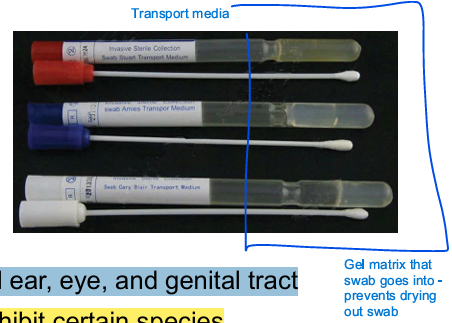
Swabs are typically used for the upper respiratory tract, external ear, eye, and genital tract.
It is important to know that ___ tipped swabs ___ certain species!
cotton; inhibit
Disadvantages of using a swab specimen includes:
-Quantity (Not enough of ___ on specimen)
-Contamination
-___ (gel/matrix/plug should prevent this)
pathogen; drying
For specimens from wounds, the ___ anatomic site is required! It is important to ___ the site prior to collection.
exact; cleanse
___ is preferred over swab specimens because swabs can only get ___ stuff off of wound, leading to various contamination.
Aspirate comes from the point ___ where causative agent is down in tissue and protects potential ___ collected into the syringe avoiding oxygen exposure.
Aspiration; superficial
source; anaerobe
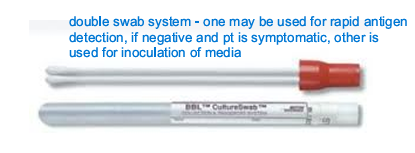
The double swab system is favored in microbiology - one is used for rapid ___ detection and the other is used for ___ of media.
antigen; inoculation
Patient-collected specimens include:
Urine, Sputum, and Stool
Urine specimens are either ___ catch midstream or ___ morning preferred.
clean; first
Sputum is material produced down in ___ respiratory that is coughed up into a cup (phlegm).
Patients must ___ mouth and expectorate with a deep ___.
Specimen is used for ___ or mycobacterial and require ___ separate early morning sputums.
lower; rinse; cough; fungal; 3
Sputum is one of the ___ clinically relevant specimens because:
1) hard to get ___ collection - likely to get ___ instead.
2) sample from down pulmonary cavity has to travel up through ___ cavity and upper resp. - may pick up ___ from these sites!
least; proper; spit; oral; contamination
Stool specimens can be collected with ___.
If collected for parasitology - ___ samples are collected over 10 days (parasites shed ___).
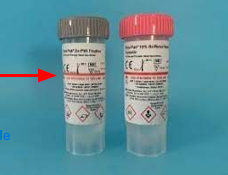
Commercial systems include preservative (___ ratio) - must be filled to line!
swab; 3; irregularly; 1:3
Specimens must be labeled with:
-Patient’s ___ and ___ number
-___ number
-physician
-culture ___
-___ and ___ of collection
name; identification
room; site; date; time
Specimen transport:
1) be in ___-proof secondary containers
2) do not transport syringes with ___
3) Wear appropriate ___ while handling
4) Use biological safety cabinets if respiratory of ___ hazard
5) Take consideration of specimens submitted for ___ (transport fast w/ little oxygen as possible)
Leak; needles; PPE; aerosolization; anaerobes
Any ___ specimens or specimens being sent ___ for special testing should be stored in the ___.
unpreserved; out; fridge
___ specimens or organisms that do not survive in ___ temps should be stored at room temperature.
preserved; cold
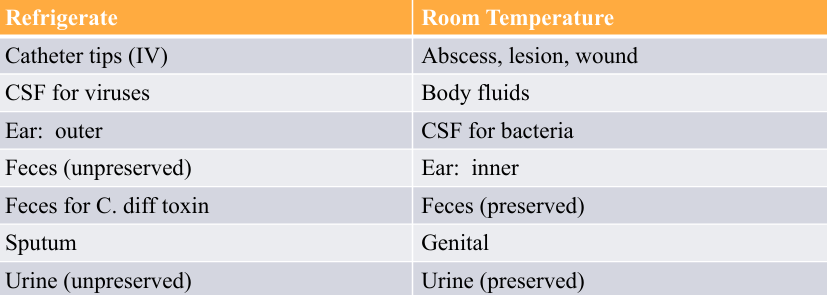
What two ways can urine be preserved for culture workup?
1) Unpreserved - refridge within ___ hrs of collection
2) ___ ___ - good at RT up to ___ hrs, best if refridgerated
2; Boric acid; 48

What two ways can stool be preserved for culture workup?
1) Cary-___ transport media - for delays longer than ___ hours (orange top)
2) O&P (Ova & Parasites)
-Formalin used to ___.
-Fixative used to make ___. Consists of polyvinyl alcohol with zinc.
Blair; 2; preserve; slides

Blood culture bottles contain an anticoagulant called Sodium polyanethol ___ (SPS). This additive may ___ Neisseria spp. and some ___.
This is why lab must be notified in advance because this specimen cannot be drawn w/ this bottle set if it inhibits this bacterium!
sulfonate; inhibit; anaerobes
The anticoagulant, Sodium Polyanethol Sulfonate, can be counteracted by addition of 1% ___, or use different collection methods that lack SPS.
gelatin
Blood culture bottles come in 2 sets and must be drawn from 2 ___ sites. Additionally, it must be filled at least ___ mL. (Exception: pediatric bottles)
independent; 10
Transport media is used to maintain ___ of specimen until processing and does not promote ___ of organisms.
(We want specimen to be ___ of what is going on in pt’s body at time of collection when it arrives in lab)
integrity; multiplication; reflective
The most common swab collection systems for transport are what?
What is the additional component added to gel matrix to absorb fatty acids/get rid of certain toxins that pathogen may make and prevent them from killing themselves?
Stuart’s and Amie’s
Charcoal
Bedside inoculation is associated with the increased risk of ___. It is ___ for hospitals do perform - except for blood cultures.
Includes:
-___ system (streak plate at bedside)
-Nasopharyngeal swabs for B. pertussis
-Corneal and Skin scrapings
contamination; rare; JEMBEC
Specimen prioritization level 1 are specimens that are critical/___.
Things we are not going to ___. It’s important not to contaminate, to store properly, and work up immediately!
invasive; recollect
Amniotic fluid, blood, brain, CSF, heart valves, and pericardial fluid are all examples of level __ priority specimens
1
Specimen prioritization level 2 are specimens that are ___.
Specimen must be done within certain amount of ___. Must be done soon or else find appropriate ___ to buy more time.
Unpreserved; time; preservative
Body fluids, bone, wound drainage, feces, sputum, and tissue are all examples of level __ priority specimens
2
Specimen prioritization level 3 are specimens that are requiring ___.
An example is if colonies need to be counted - the longer test is delayed, the more ___ the count is going to be.
quantitation; erroneous
Catheter tip, urine, tissue for quant are all examples of level __ priority specimens
3
Specimen prioritization level 4 are specimens that are ___.
Specimens have about ___ hrs to get to, no real rush.
preserved; 24
Feces, urine, swabs in holding medium (aerobic and anaerobic) are all examples of level __ priority specimens
4
The Analytical phase of testing begins when specimen is ___ by the laboratory.
received
Bad specimens lead to ___ culture results, misdiagnosis, and ___ therapy.
Examples include incorrectly ___ specimens, inappropriate ___ device or transport container/leaky container, duplicate specimens, and gram stain evaluation of ___.
misleading; inappropriate
labeled; collection; sputum
Macroscopic observation are things that can be seen to the naked eye to determine if this is a ___ specimen that can be worked up or are there certain things that I might want to ___ now with my workup based on what I see?
observations provide guidance on ___ laboratory workup.
good; consider; further
Macroscopic observations include ___ (overall) appearance of specimen:
-Swab or aspirate
-Stool consistency (formed or liquid)
-Blood or mucus present
-Volume of specimen
-Fluid (clear or cloudy)
-Foul smell (should always work under a hood!)
-Tapeworms, etc. visibly present
gross
Microscopic observation is generally a ___ stain. It guides therapy choices when therapy must be initiated ___ culture results are available.
gram; before
The purpose of microscopic observation is:
-to determine the ___ of a specimen and whether it is contaminated.
-indication of ___ process involved
-culture workup ___ by smear
-dictate the need for ___ or additional testing
quality; infectious; guided; non-routine
Situations in which useful info is not provided from microscopic observation:
1) Throat - tons of ___ flora expected from upper resp.
2) Stool - tons of bacteria not very ___ of anything on stain
3) N. gonorrhoeae on ___ specimens - vagina can have normal flora that look exactly like N. gonorrhoeae
normal; indicative; vaginal
What are the 3 forms of specimens?
Swab, tissue, fluid
Large volumes of sterile body fluid may need to be ___ in order to workup properly.
concentrated
The 2 swab collection device is ___, with one being used to ___ and the other used to make a direct ___.
preferred; plate; smear
Tissue specimens must go through ___- must be grinded up/mixed with saline into a ___ so that it can be plated properly.
homogenization; slurry
Media that allows the growth of everything
Ex. Sheep Blood Agar
Nonselective
Media that supports growth of one type of microbes but not the other
Ex. MacConkey agar, CNA agar
Selective
Media that shows macroscopic visual differences (can be diff and nonselective)
Ex. SBA and MAC
Differential
Media that has more nutrients in it for fastidious organisms
Ex. Chocolate agar
enriched

___ isolation technique involves a line down middle and streaked through top to bottom.
urine

Incubation temperature is ___-37C (our body temp is around the same) and is held for 48 to ___ hours.
Common pathogens demonstrate growth within ___ hrs, but slow growers can take within 72 hrs.
Anaerobes/broth can take from ___-7 days!
35; 72; 24; 5
Capnophiles are placed in a special incubator hooked up to a ___ tank maintaining 3-___% CO2 atmosphere.
CO2; 5
Microaerophiles are placed in an incubator with reduced oxygen levels <___-5% content.
3
The specimen source detects ___ suspect list.
usual
When working up a culture, observe:
1) specimen ___ (detects usual suspect list)
2) Contaminating normal flora, or is it from a ___ source? (If bacteria ___ in sterile site, it gets worked up)
3) What does ___ normal flora look like from this site?
4) Most ___ pathogens present?
5) Colonial ___ of pathogens?
6) Which medium demonstrates ___ and why?
7) Interpret antimicrobial ___ testing
source; sterile; found; expected; likely; morphology; growth; susceptibility
STAT/Critical results
-Positive ___ cultures
-Positive ___ gram stain or culture
-Positive ___ antigen test or culture
-Positive blood smear for ___
-S. pyogenes from a ___ site
-S. agalactiae or HSV from genital site of a ___ woman at term
-Detection of significant pathogen
blood; CSF; cryptococcal; malaria
sterile; pregnant
To prepare a slide from a swab specimen, ___ back and forth over slide to deposit ___ layer of sample. (do not ___).
roll; thin; smear
To prepare a slide from thick liquids or semi-solids, immerse sterile ___ in material and spread ___ layer on slide appropriately.
swab; thin
To prepare a slide from thick, granular, or mucoid material, flatten/___ material between two slides.
crush
To prepare a slide from thin fluids (CSF, urine), place one drop on slide and ___ dry - cytocentrifugation preferred to take a drop from ____ area.
air; concentrated
___ stain colors the form and shapes present.
Differential stain colors specific ___ of the elements present (ex. gram stain differentiates gp and gn).
Probe-mediating stains are directed specifically at ___ of an organism.
Simple; components; identification
Leifson stains for ___.
Methylene blue is for the metachromatic granules of C. ___.
Ziehl-Neelsen and Fluorochrome are ___ ___ stains for ___ sediments.
Kinyoun is an acid fast stain for ___ in stool.
Calcofluor white stain is a common ___ stain.
flagella; diphtheriae; acid fast; mycobacteria; parasites; fungi
Monomicrobial growth is the predominance of ___ colony type in an infection caused by a ___ species.
-S. pneumoniae pneumonia
-S. aureus abscesses
-H. influenzae tracheobronchitis or meningitis
Commonly seen in ___ and in UTIs with ___. ___ sites tend to only be monomicrobial when they get infected.
1; single
sepsis; e. coli; sterile
Polymicrobial infections are caused by ___ species. ___ are good examples of this type of infection since they are a mixture of anything that got implanted into the tissue from exterior environment.
Also found in ___ normal or altered flora from surgical wound infections and aspiration pneumonia (vomiting and then inhaling it - can get food contamination organisms that are in pulmonary cavity now).
multiple; wounds; disturbed
Systematic evaluation of slides includes:
1) Is there evidence of contamination by normal microbial flora?
Sterile body site w/ many different morphologies - suspicious for ___.
2) Is necrotic debris in the background?
If broken wbcs or degraded tissue present - indicative of ___ process!
3) Examine more than one area of the smear.
4) Evaluate organisms for shape, size, Gram reaction
5) Do NOT ___ the findings - only report what has been proven from testing!
overinterpret