PeopleCert Data Science Foundation Vocabulary Flashcards
 Call Kai
 Learn
Learn Practice Test
 Spaced Repetition
 Match
Match Flashcards
 Knowt Play
1/46

Earn XP
Description and Tags
A comprehensive vocabulary flashcard set covering key definitions, concepts, software tools, analytics types, measurement scales, and programming fundamentals from the PeopleCert Data Science Foundation Study Guide.
Name | Mastery | Learn | Test | Matching | Spaced | Call with Kai | Chat |
|---|
No analytics yet
Send a link to your students to track their progress
47 Terms

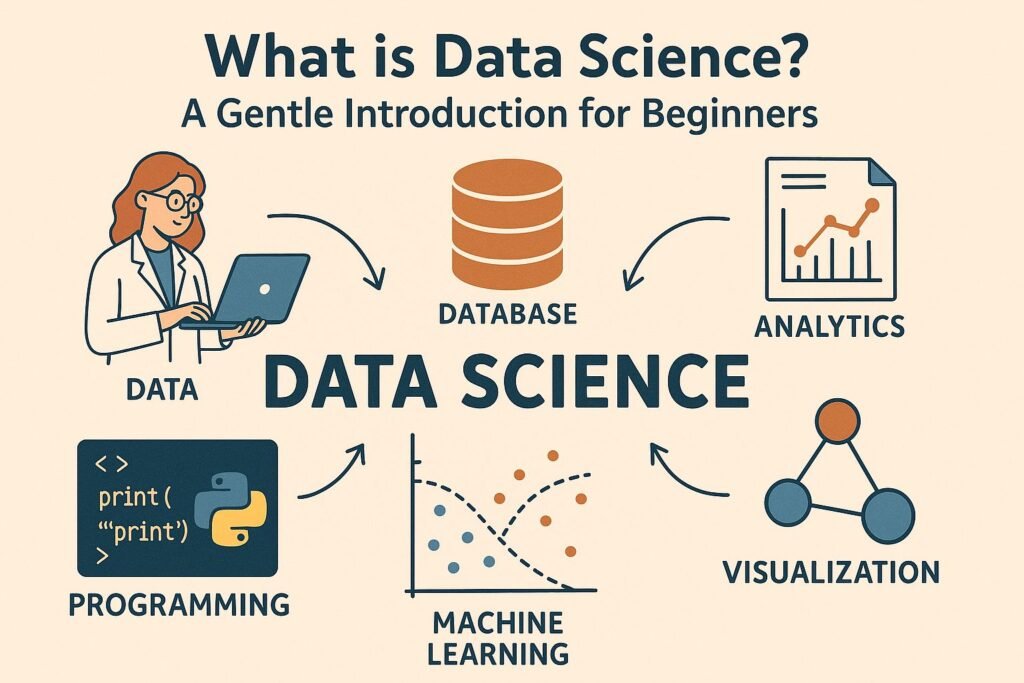
Data Science
A field that combines the scientific method, math and statistics, specialized programming, advanced analytics, AI, and storytelling to uncover and explain business insights buried in data.

Big Data
The 21st-century phenomenon of exponential growth of business data, and the challenges that come with it, including holistic collection, storage, management, and analysis of all data owned or used by a business.

Volume (Big Data)
Refers to the size of the data sets that need to be analysed and processed.
Velocity (Big Data)
Refers to the speed with which data is generated.
Variety (Big Data)
Refers to data coming from a great variety of sources, generally existing as structured, semi-structured, or unstructured data.
Veracity (Big Data)
Refers to the quality and trustworthiness of the data that is being analysed.
Value (Big Data)
Refers to the value of the insights gained from turning bulk data into something useful.
Online Transaction Processing (OLTP)
A system that captures, stores, and processes data from transactions in real time within operational applications.
Online Analytical Processing (OLAP)
A system that uses complex queries to analyse aggregated historical data from OLTP systems, such as a Data Warehouse.
Extract, Transform, Load (ETL)
The process through which data from one or more OLTP databases is ingested into OLAP systems.
Data Analytics
A discipline focused on extracting insights from data, comprising the processes, tools, and techniques of data analysis and management.
Descriptive Analytics
Analytics that uses historical and current data from multiple sources to describe the present state by identifying trends and patterns, answering 'What has happened and what is happening right now?'.
Diagnostic Analytics
Analytics that uses data to discover the factors or reasons for past performance, answering 'Why is it happening?'.
Predictive Analytics
Advanced analytics that applies statistical modelling, forecasting, and machine learning to predict future outcomes, answering 'What is likely to happen in the future?'.
Prescriptive Analytics
Advanced analytics that involves testing, algorithms, and business rules to recommend specific solutions that will deliver desired outcomes, answering 'What do we need to do?'.

CRISP-DM
Cross-Industry Standard Process for Data Mining; a systematic 6-phase iterative cycle consisting of Business understanding, Data understanding, Data preparation, Modelling, Evaluation, and Deployment.
Nominal Scale
A categorical measurement scale used to label variables that have no quantitative values.
Ordinal Scale
A categorical measurement scale used to label variables that have naturally occurring orders, but no quantifiable difference between values.
Interval Scale
A numerical measurement scale used to label variables that have a natural order and quantifiable difference between values, but no 'true zero' value.
Ratio Scale
A numerical measurement scale used to label variables that have a natural order, a quantifiable difference between values, and a 'true zero' value.
Quantitative Data
Numerical data that is countable or measurable, objective, and used to confirm or test hypotheses.
Qualitative Data
Descriptive data relating to words and language that can be observed but not measured, providing rich, in-depth context to understand concepts, thoughts, and experiences.
Data Lake
A central repository where data is stored in its raw, scalable form before structure is applied.
Data Swamp
An unmanaged, ungoverned data lake containing messy access, broken ingestion, and data of no value.
SAS (Statistical Analysis System)
A closed-source proprietary statistical software suite developed by SAS Institute specifically designed for statistical operations and modeling.
Apache Spark
A distributed computing tool developed by Apache Software Foundation designed to handle batch and stream processing with fast in-memory execution.
D3.js
A JavaScript client-side scripting library that allows the creation of interactive, animated data visualizations on web browsers.
MATLAB
A closed-source multi-paradigm numerical computing environment used for processing mathematical information and simulating neural networks and fuzzy logic.
Matplotlib
A popular plotting and visualization library developed for Python, using modules like Pyplot to plot complex graphs.
ggplot2
An advanced data visualization package in R (part of tidyverse) used for creating customized visualizations, annotating data, and generating maps.
TensorFlow
A free open-source toolkit developed by Google Brain team for building, training, and deploying machine learning and deep learning models.
R Language
A programming language developed by academics and statisticians specifically designed for statistical analysis and visualization.
RStudio
A customizable desktop integrated development environment (IDE) for R, developed in 2011, providing tools like consoles, syntax highlighting, and R Markdown editors.
Python
An interpreted, high-level, general-purpose programming language released in 1991 by Guido van Rossum that emphasizes code readability.
Jupyter Notebooks
An open-source web-application tool based on IPython developed in February 2015 for writing live code, statistical computations, visualizations, and presentations.
Computer Software
That part of a computer system consisting of encoded information or computer instructions, including computer programs, libraries, and related data.
Computer Program
A collection of instructions that performs a specific task when executed by a computer's central processing unit.
GPU (Graphics Processing Unit) Technology
Hardware technology that streamlines processes via parallel processing, allowing fast compute times for machine learning, image processing, and real-time language tasks.
Algorithm
A procedure, formula, or self-contained step-by-step set of operations for solving a problem or executing specified actions.
Machine Language
The native programming language of a computer, consisting of binary (1s and 0s) or hexadecimal instructions executed directly by the CPU.
Compiled Language
A language whose code is translated directly into machine code via a manual build step before execution by the processor.
Interpreted Language
A language where source code is read and executed line by line at runtime by an interpreter program rather than being directly translated ahead of time.
Variables (Python)
Reserved memory locations to store values, whose type and memory allocation occur automatically upon value assignment.
Conditional Statement
A decision-making statement that evaluates an expression as True or False to determine which action or block of code to execute.
Loop Statement
A control structure that allows a statement or group of statements to be executed multiple times.
range() Function
A Python built-in function that provides a sequence of numbers based on specified start, stop, and step arguments.
User-Defined Functions
Custom functions created by a programmer in Python using the 'def' keyword to perform a single, related action.