Bio Chapter 7 Questions
 Call Kai
 Learn
Learn Practice Test
 Spaced Repetition
 Match
Match Flashcards
 Knowt Play
1/19

Name | Mastery | Learn | Test | Matching | Spaced | Call with Kai |
|---|
No analytics yet
Send a link to your students to track their progress
20 Terms
What processes is cell division necessary for? And what do they each do?
cell division is necessary for organism growth, tissue repair, maintenance, and reproduction (sexual and asexual)
Mitosis: growth/development and tissue repair and maintenance
Binary fission
Meiosis: sexual reproduction
gametes
How do asexual and sexual reproduction differ? Describe each process
Sexual Reproduction: produces gametes (sperm and eggs) that are fused together through fertilization to produce offspring with genetic information
meiosis: two rounds of cell division to produce gametes
fertilization: fusion of two gametes produce via meiosis
offspring are genetically unique
Asexual Reproduction: directly produces offspring through cell division
binary fission: prokaryotes- unicellular bacteria
genetic variation is due to mutations or changes in DNA sequence caused by environmental factors or errors in DNA replication
Describe the two processes involved in sexual reproduction. How do these work together to produce offspring?
Meiosis: two rounds of cell division to produce gametes (sperm and eggs)
produces 4 genetically unique haploid gametes
Fertilization: fusion of two gametes produced via meiosis
the gametes are fused together through fertilization to produce offspring with genetic information
Describe the two forms of cell division that are used in asexual reproduction. Which groups of organisms use each
Binary Fission: daughter cells identical to mother cell
Cell division signals: prokaryotic cells divide constantly if environment is favorable
DNA replication: circular DNA passes through a replication matrix, beginning at ori site (origin) and moving toward ter site (terminus)
DNA segregation: as replication proceeds, ori regions move toward opposite ends of the cell by moving along cytoskeleton filaments
Cytokinesis: cytoplasm divides
used by prokaryotes bacteria and archaea
Mitosis— similar to binary fission, few differences
cell division signals depend on function of entire organism
DNA replication starts at mutliple sites on chromosome
eukaryotes have multiple chromosomes to be segregated
cytokinesis is similar, but plant cells have a cell wall
Describe the general series of events that occur during cell division.
cell division signals: initiate cell division
DNA replication: create a copy of cell’s genetic info
DNA segregation: distribute copies of DNA into two new cells
Cytokinesis: division of the cytoplasm to form two new cells
Describe what happens to the: cell membrane, nuclear envelope, centrosomes, and chromosomes during cell division.
Cell membrane: elongates and splits during cytokinesis
Nuclear Envelope: stays the same until it is eventually degraded and then re-formed into two new ones
Centrosomes: important for segregating the DNA
Chromosomes: contain the genetic info
List and describe the phases and sub-phases of the eukaryotic cell cycle
Interphase
Gap1 phase- cells carry out normal functions
S phase- DNA replicated
Gap2 phase- cells prepared for mitosis
M phase
mitosis- PPMAT
cytokinesis- division of cytoplasm, results in two daughter cells
Explain how meiosis and fertilization both work together to create genetically diverse offspring
Gametes are unique haploid cells that (when combined) form a genetically distinct zygote. Meiosis produces four unique cells through crossing over and independent assortment. Fertilization merges these unique gametes to form a new diploid individual.
Describe the parts and genetic makeup of a single unreplicated chromosome in contrast to a homologous pair of replicated chromosomes. How many chromosomes and chromatids are present in each?
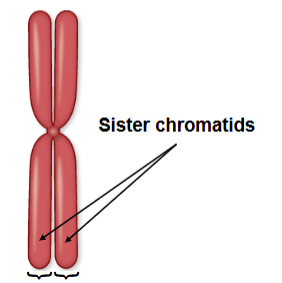
single, unreplicated chromosome: long strand of DNA
replicated chromosome: after S phase (meiosis), chromosomes are now composed of two identical copies called sister chromatids
homologous chromosomes: a pair of matching chromosomes, one inherited from each parent —> two pairs of sister chromatids
Describe the process of crossing over, and explain how it leads to genetic diversity in the gametes that are produced by meiosis.
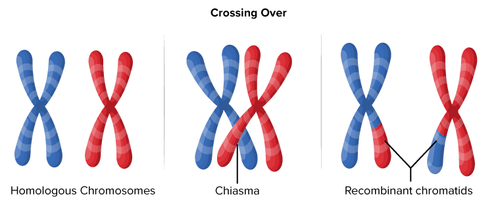
Crossing over occurs between homologs at chiasmata —> sections of DNA are exchanged which increases
Crossing over can occur at any point along the length of the homologous chromosomes
Genetic diversity —> genetic recombination: rearrangement of DNA sequences by breaking and rejoining chromosomes segments
Explain how the stages of mitosis, meiosis I, and meiosis II differ.
Meiosis: gametes are produced
four genetically distinct haploid gametes
Mitosis: somatic cells are produced
two identical cells
Mitosis is done and the cell undergoes cytokinesis. Meiosis II followed cytokinesis and is nearly identical to mitosis!
Describe how the chromosomal makeup of a parent cell is different from the four daughter cells produced through meiosis. Also, how do the daughter cells compare to each other?
Meiosis reduced the chromosomal makeuip of a parent cell by producing 4 daughter cells (gametes) that are haploid, but they contain only half of the chromosomes compared to the diploid parent cell —> the daughter cells are genetically unique, and possess new combinations of DNA
daughter cells are genetically unique to each other and the parent cells (in meiosis)
Explain how nondisjunction results in aneuploidy. Explain the process and the results of this error in cell division.
Nondisjunction happens when homologous chromosomes/sister chromatids fail to separate during Anaphase, which causes aneuploidy, or an abnormal number of chromosomes in the cell
daughter nucleus has an extra chromosome
daughter nucleus is missing a chromosome
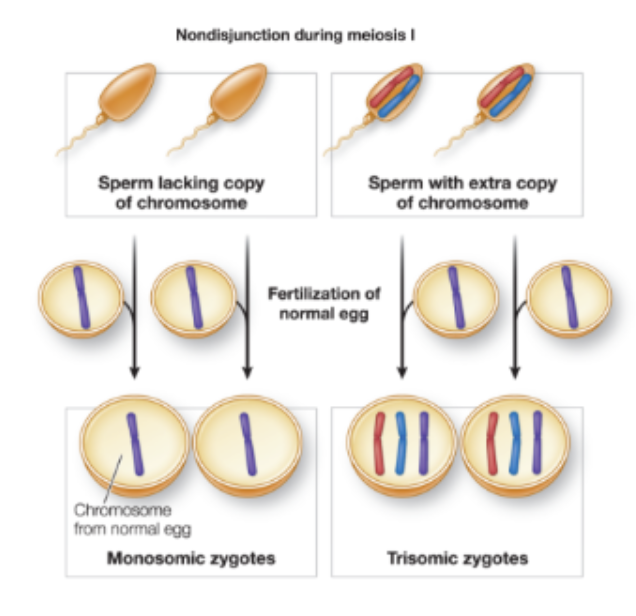
Nondisjunction in meiosis: homologous pair fails to separate in Anaphase I —> 4 gametes: two with chromosome missing, and two with extra copy
can also occur in Anaphase II with sister chromatids not separating
Nondisjunction in mitosis: sister chromatids fail to separate —> one cell lacks daughter chromosome, other cell has an extra
Describe the resulting karyotype of a trisomic individual compared to a monosomic individual. Explain what type of gametes were fused to produce each.
Trisomic zygotes: (2n+1) have an extra chromosome
sperm lacking copy of a chromosome fused with an egg
Monosomic zygote: (2n-1) missing a chromosome
sperm with an extra copy of chromosome fused with an egg
Describe polyploidy and explain the types of errors in cell division and fertilization that can result in polyploidy.
Polyploidy: organisms with triploid (3n), tetraploid (4n) and even higher numbered cells —> this is opposed to haploid and diploid with 1 and 2 unbound chromosomes
this can occur due to:
failure of the spindle to form
failure of cytokinesis
polyspermy (more than one sperm fertilizes the egg)
common in plants and fungi
rarely beneficial in animals (except fish, amphibians, and leeches)
Describe why the cell cycle must be regulated in unicellular organisms and contrast that with multicellular organisms.
Unicellular organisms: population growth and crash (overuse resources)
Multicellular organisms: cells might not benefit the organism as a whole
cancer or non-functional tissues
Describe what the cell cycle checkpoints are generally regulating
Four checkpoints
Gap1 checkpoint: progression through the restriction point requires sufficient resources within the cell, lack DNA damage, and external signals
S checkpoint: requires lack of DNA damage and completed replication
Gap2 checkpoint: requires lack of DNA damage
M checkpoint: will arrest if a chromosome is not attached to microtubules from both poles
Explain the process of eukaryotic cell cycle regulation via CDKs, cyclins, and checkpoint proteins
the four checkpoints are regulated by cyclin-dependent kinases (CDKs)
CDKs are protein kinases
CDKs are activated by binding to cyclin
cyclin are regulatory proteins synthesized when the cell receives signals telling it that it can pass through a checkpoint
CDKs phosphorylate checkpoint proteins that regulate these checkpoints
phosphorylate = add a phosphate group via kinases (uses ATP)
Regulation via CDKs
specific cyclin produced in response to cell signals
Cyclin binds to CDK
specific proteins attach are phosphorylated
phosphorylated proteins then regulate cell cycle
Compare/contrast necrosis and apoptosis. Think about the situations when each would occur.
Necrosis: cell is damaged or starved of oxygen
happens when an organism dies
Apoptosis: genetically programmed cell death if cell is malfunctioning, infected, no longer needed, or reached its Hayflick limit
stem cells lack a Hayflick limit: develop into many new specialized cells which are important for growth and repair of tissues
cancer cells lack a Hayflick limit: cells divide without restraint because they do not require external signals or respond to cell cycle checkpoints
Describe the various mutations that impact cell cycle regulation that can result in unregulated cell division (which could lead to cancer).
Cell cycle regulation mutations can lead to cancer
cells produce mutated CDKs that do not need cyclins
cells produce cyclins w/o cell division signals
cells lack functional checkpoint proteins
cells lack functional apoptosis machinery