L7v2-HTN Disorders in pregnancy
 Call Kai
 Learn
Learn Practice Test
 Spaced Repetition
 Match
Match Flashcards
 Knowt Play
1/33

There's no tags or description
Looks like no tags are added yet.
Name | Mastery | Learn | Test | Matching | Spaced | Call with Kai | Chat |
|---|
No analytics yet
Send a link to your students to track their progress
34 Terms
What is the criteria for diagnosis of gestational hypertension?
onset of hypertension after 20 weeks
BP > 140/90 (only one pressure needs elevation; systolic OR diastolic; or both can be elevated)
Need two elevated measures at least 4 hours apart
What is the criteria for diagnosis of preecelampsia?
hypertension & proteinuria that develop after 20 weeks gestation and one of the following:
Thrombocytopenia
Elevated liver enzymes
Renal insufficiency
Pulmonary edema
Cerebral or visual disturbances
RUQ pain
Epigastric pain
Pulmonary edema
What is the criteria for diagnosis of eclampsia?
preeclampsia + seizures
What is the criteria to be diagnosed with chronic hypertension?
hypertension that existed prior to pregnancy
OR
hypertension persisting longer than 12 weeks postpartum
What is the criteria to be diagnosed with chronic hypertension with superimposed preeclampsia?
sudden increase in BP that previously well controlled
OR
new-onset proteinuria or a sudden increase in proteinuria in a patient known to have proteinuria before conception or early in pregnancy
What are the risk factors for preeclampsia?
Nulliparity
Maternal age > 35yrs
Preeclampsia in previous pregnancy
Family hx (mother/sister)
First pregnancy with new partner
Partner who fathered a preeclamptic pregnancy in another woman
Multifetal gestation
obesity
chronic HTN
pregestational diabetes
What is the etiology of preeclampsia?
inadequate vascular remodeling
decreased placental perfusion and hypoxia
endothelial cell dysfunction
vasospasm / increased peripheral resistance / increased endothelial cell permeability
decreased tissue perfusion
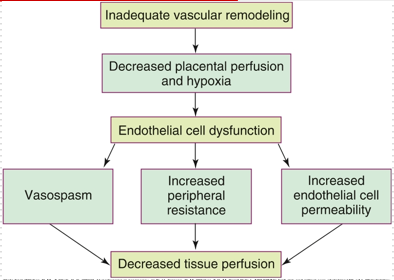
How does preeclampsia relate to IUGR (Intrauterine growth restriction) (PATHO)?
vasospasm cause increased BP
arteriolar vasospasms result in decreased perfusion of placenta, kidneys, liver, and brain
decreased perfusion in placenta leads to early degenerative aging of the placenta, and decreased oxyegn and nutrients to fetus resulting in IUGR
What is HELLP Syndrome and what are the signs?
life-threatening complication of preeclampsia
H — hemolysis of RBCs
EL — Elevated liver enzymes (AST, ALT, LDH) or history of hepatic damage
RUQ or epigastric pain; hyperbilirubinemia)
LP — low platelets and history of bleeding (<100,000)
What are the abnormal ranges for the elevated liver enzymes?
AST > 70 (normal 4-20)
LDH > 600 (normal 45-90)
ALT > 50 (normal 3-21)
What medication would a PT with preeclampsia take to prevent/treat seizures?
magnesium sulfate
What are the s/s of severe preeclampsia?
severe HAs
blurred vision
mental confusion
RUQ or epigastric pain
N/V
SOB
decreased UO
A nurse is preparing to administer a loading dose of magnesium sulfate to a client with severe preeclampsia. Which prescription should the nurse expect?
4–6 g IV over 15–30 minutes via IVPB
After receiving a magnesium sulfate loading dose, the nurse anticipates which maintenance infusion?
1–2 g/hr via IVPB
The therapeutic serum magnesium level for seizure prophylaxis is _____________
4–7 mEq/L.
What device should be used when administering magnesium sulfate?
infusion pump
After being administered magnesium sulfate what are some expected side effects?
will feel flushed and hot (systemic vasodilation) — cardiovascular
feels “heavy” and difficult to move extremities easily — musculoskeletal
What are the mild signs of magnesium sulfate toxicity?
Lethargy
muscle weakness
decreased/absent DTRs
double vision
slurred speech
What are the severe signs of magnesium sulfate toxicity?
Suppresses CNS
hypotension
bradycardia
bradypnea
cardiac arrest
If magnesium sulfate toxicity occurs, what is the nurse’s immediate action?
stop infusion and give calcium gluconate
What is magneisum sulfate contraindicated?
myasthenia gravis (respiratory failure)
heart block
myocardial insufficiency
renal disease
What drugs are used to treat severe hypertension (>160/110) in pregnancy?
hydralazine (apresoline)
labetalol (trandate)
nifedipine (procardia)
If a pregnant PT has a BP > 160/110 (severe hypertension), what are they at risk for?
stroke
placental disruption
seizures
A pregnant PT with a BP > 160/110 and asthma should avoid which BP medication?
labetolol (trandate)
beta blocker that causes bronchospasm
Which BP medication can help treat severe hypertension and can be taken orally?
nifedipine
A client with severe preeclampsia develops postpartum hemorrhage due to uterine atony. Which medication should the nurse question?
Methylergonovine (Methergine)
Methergine increases blood pressure through vasoconstriction and is contraindicated in clients with hypertension or preeclampsia.
A client with severe preeclampsia is receiving a magnesium sulfate infusion. The provider prescribes oral nifedipine. Which assessment finding should the nurse report immediately?
hypotension
Both medications cause vasodilation and can significantly lower blood pressure. Severe hypotension can decrease maternal and placental perfusion.
What is the priority of assessment for a women experiencing eclampsia?
Airway-breathing-pulse
Which complications are associated with chronic hypertension?
superimposed preeclampsua
placental abruption
IUGR
preterm birth
At which blood pressure is chronic hypertension diagnosed?
140/90
Which medications are used to help treat chronic hypertension in pregnant PTs?
methyldopa (aldomet)
labetalol (trandate)
nifedipine (procardia)
Which BP meds are contraindicated for pregnant PTs?
ARBs (-sartan) & ACEi (-pril)
These medications can cause serious fetal complications
What are the maternal complications of hypertensive disorders during pregnancy?
Placental abruption
Stroke, cerebral hemorrhage, seizures
Hepatic or renal failure, coagulopathies
Disseminated intravascular coagulation (DIC)
Pulmonary edema
What are the fetal complications of hypertensive disorders during pregnancy?
placental insufficiency
IUGR
prematurity
hypoxia/acidosis