Data Signal Combinations
 Call Kai
 Learn
Learn Practice Test
 Spaced Repetition
 Match
Match Flashcards
 Knowt Play
1/16

Earn XP
Description and Tags
Prelim topic
Name | Mastery | Learn | Test | Matching | Spaced | Call with Kai | Chat |
|---|
No analytics yet
Send a link to your students to track their progress
17 Terms
Transmit Analog Data with Analog Signals
To send analog data over an analog medium, you MODULATE the data onto a set of analog carrier signals
This MODULATION allows multiple different channels to coexist simultaneously at different frequencies.
Ex: AM/FM broadcast radio and older broadcast television are classic examples.
Transmitting Digital Data with Digital Signals
This process uses digital encoding schemes to convert digital data (1s and 0s) into digital signal voltage pulses
Rely on encoding techniques like:
- NRZ-L, NRZI, Manchester, Differential Manchester, Bipolar AMI, and 4B/5BBecause these signals degrade rapidly over long distances, these methods are USED in LANs
NZR-L (Nonreturn to zero-level)
This digital encoding scheme transmits a binary 1 as zero voltage and a binary 0 as a positive voltage
- 0 → + V
- 1 → - VIs susceptible to synchronization loss

NZRI (Nonreturn to zero inverted)
This digital encoding scheme creates a voltage change at the start of a 1 and no voltage change at the start of a 0
- 0 → No V change
- 1 → V changeBetter synchronization and improved reliability over NZR-L

Differential Manchester
In this digital encoding scheme, every single bit has at least one significant voltage change in the middle of the bit window
Ensures constant synchronization between the sender and receiver

Bipolar-AMI
This digital encoding scheme uses 3 unique voltage levels: positive, zero, and negative. A binary 0 is a zero voltage, while a binary 1 alternates back and forth between positive and negative voltages.

4B/5B Encoding
This digital encoding scheme translates 4 bits of data into a specific 5-bit quantity. This design ensures that no 5-bit code contains more than 2 consecutive zeroes
Once converted, the new code is transmitted using an NZRI encoded signal
Transmitting Digital Data with Analog Signals
To transmit digital data over analog mediums, the data must undergo SHIFT KEYING (modulation)
Ex: Amplitude Shift Keying, Frequency Shift Keying, Phase Shift Keying
Dial-up internet, DSL, and cable modems historically used these techniques to send digital traffic over traditional analog telephone or coaxial cable lines
Analog Shift Keying (ASK)
The simplest modulation technique where one specific amplitude encodes a binary 0, while a different amplitude encodes a binary 1, keeping frequency and phase constant
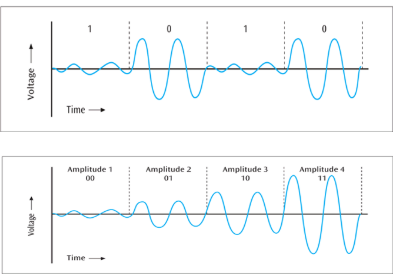
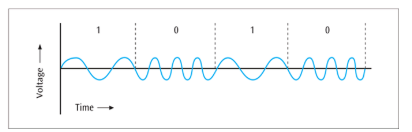
Frequency Shift Keying (FSK)
This technique modulates by changing the frequency of the carrier wave. One specific frequency modulates a 0, and another distinct frequency encodes a 1.
This modulation technique is generally less susceptible to noise than ASK
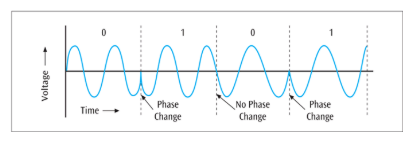
Phase Shift Keying (PSK)
This modulates by having one phase change representing a 0, while a different phase change represents a 1.
Transmitting Analog Data with Digital Signals
To safely send analog data across modern digital infrastructure, the continuous analog waveform must be digitized
2 Techniques: Pulse Code Modulation and Delta Modulation
Telephone networks use these techniques to digitize the human voice at the source, allowing it to be reliably routed through digital fiber-optic networks across the globe without degradation.
Pulse Code Modulation (PCM)
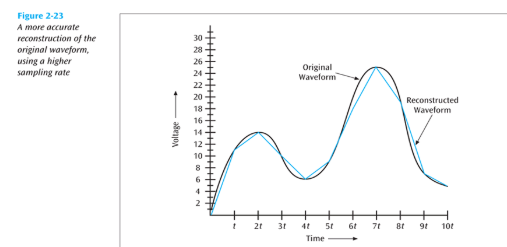
This modulation technique works by taking periodic “snapshots” (samples) of a continuous analog waveform at regular intervals
These physical voltage snapshots are then translated into standard binary values (quantization)
Taking more snapshots in a given time frame, or utilizing more quantization levels (more bits per sample) creates a significantly higher-resolution digital representation.
Delta Modulation
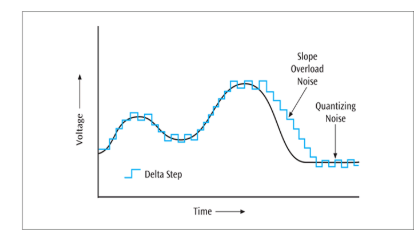
This modulation offers a simpler digitization technique that tracks the continuous analog waveform by logging relative changes rather than absolute values
It uses a single bit for tracking: a binary 1 signifies a rise in voltage from the previous sample, and a binary 0 signifies a drop in voltage
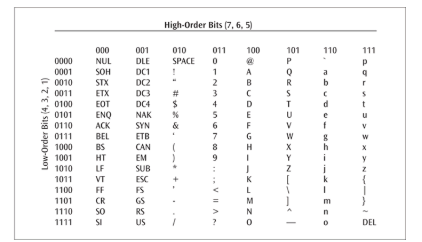
ASCII (American Standard Code for Information Interchange)
A widely used 7-bit (or 8-bit extended) code supporting foundational English characters and control symbols
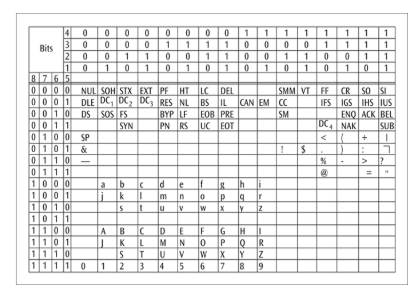
EBCDIC (Extended Binary Coded Decimal Interchange Code)
An 8-bit code primarily used on IBM mainframe and midrange computer systems for enterprise processing
Unicode
A massive encoding standard that assigns a unique number to every character across hundreds of different languages and scripts
Every basic character in this utilize 16 bits = allowing it to support a massive number of diverse character sets.
Ex:
- T equals 0000 0000 0101 0100
- r equals 0000 0000 0111 0010
- a equals 0000 0000 0110 0001