Plasmid
 Call Kai
 Learn
Learn Practice Test
 Spaced Repetition
 Match
Match Flashcards
 Knowt Play
1/18

There's no tags or description
Looks like no tags are added yet.
Name | Mastery | Learn | Test | Matching | Spaced | Call with Kai | Chat |
|---|
No analytics yet
Send a link to your students to track their progress
19 Terms
Plasmid
An independent piece of DNA not associated with the bacterial chromosome (circular and smaller)
carries genes just like bacterial chromosome does
the genes are nonessential
Conjugative Plasmid
Carries genes for s*x pili and transfer of the plasmid
Dissimilation plasmids
Encode enzymes for catabolism of unusual compounds
R factors
Encode antibiotic resistance
Transposon
“Jumping genes”
segments of DNA that can move from one region of DNA to another
mediated through an enzyme called transposase
Targets a sequence of DNA and cuts it, allowing for the incorporation of DNA into a different region
It reseals the DNA after
Plasmids and transposons…
allow bacteria to rapidly acquire, accumulate, and share resistance to drugs.
Transposons physically "cut and paste" antibiotic resistance genes from the main bacterial chromosome and insert them directly into plasmids.
Plasmids then transport these genes between different bacteria
Recombination
Exchange of DNA and incorporation of it into the host chromosome/genome
Transformation
Cell incorporates a piece of external DNA into the cell.
movement of “naked” DNA between cells
Transformation requires
receptors for DNA incorporation
Competent bacteria
bacteria that have the receptors required for transformation
Transformation in a laboratory sense
Holes in the cell membrane can induce cells to allow DNA in
laboratory setting through heat, electric shock, chemicals,
Conjugation requirements
Requires direct contact between cells
the cells have to be of opposing mating type (one carries the plasmid and the other doesn’t)
Requires pilis - allows for transfer of material
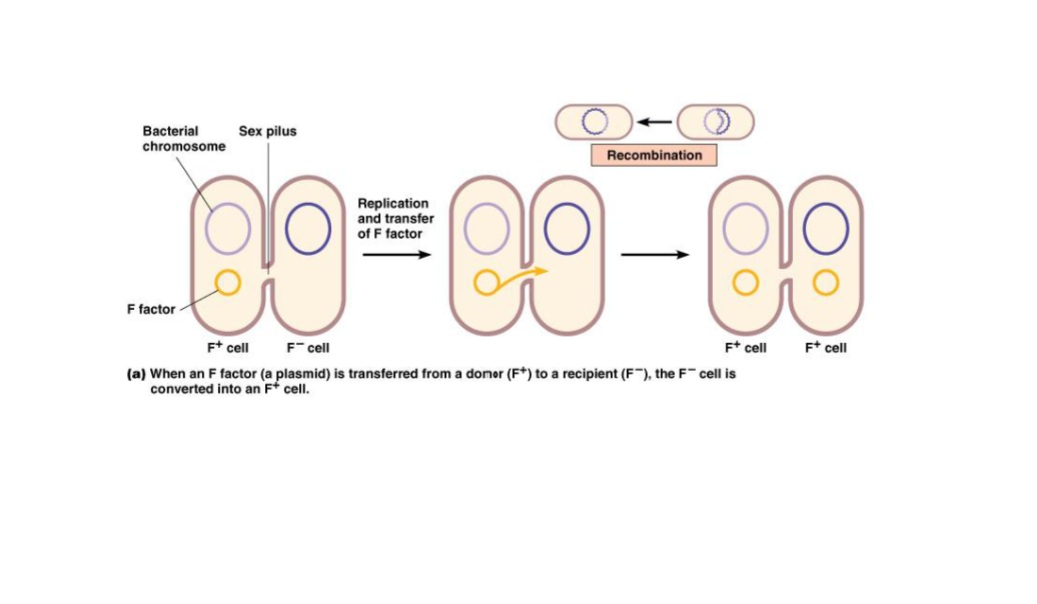
F factor
Plasmid because genes lie on it, meaning it can engage in conjugation
F+ cell
A cell carrying a plasmid for conjugation
F- cell
A cell without a plasmid
the plasmid is transferred to the recipient F- cell during conjugation, turning it into an F+ cell.
High frequency recombinant (Hfr) cell
Occurs when the F factor (plasmid) becomes integrated into the chromosome
Transduction
Utilizes a virus as the means to transfer DNA between cells
no cell to cell contact required
the infection process in a cell is required
Bacteriophage
a virus that targets only bacteria
Transduction process
Bacteriophage delivers its own genetic material into the cell
Codes for proteins that break the host chromosome down
Occasionally during phage assembly, pieces of bacterial DNA are packaged in a phase capsid.
the donor cell lyses and releases phage particles containing bacterial DNA
A phage carrying bacterial DNA infects a new host cell, the recipient cell.
Recombination can occur
produces a recombinant cell w/ genotype different from both the donor and recipient cells.