WPS 244 Extractives
 Call Kai
 Learn
Learn Practice Test
 Spaced Repetition
 Match
Match Flashcards
 Knowt Play
1/10

There's no tags or description
Looks like no tags are added yet.
Name | Mastery | Learn | Test | Matching | Spaced | Call with Kai | Chat |
|---|
No analytics yet
Send a link to your students to track their progress
11 Terms
Extractives & variance
Extractives are large group of different compouds which soluble in polar solvents, water & steam distillation
Quantities vary according to location in tree; higher in roots, branches, heartwood, damaged wood
Also varies according to species, geographical location & season; lower in temperate locations, higher in certain tropical & sub-tropical species
Concentrated in resin canals & parenchyma cells but also found in middle lamella, intercellular spaces, cells walls of tracheids & libriform fibres
Composition changed during seasoning of wood (drying), particularly fats & fatty acids are degraded
Extractive effects
Can cause colour reversion (yellowing) of pulp or yellow specks (pitch troubles) in paper making
Can cause metal corrosion, influence strength of refiner pulp, inhibit setting of concrete, glue & finishes
Several woods contain extractives which are toxic or deterrent to fungi & bacteria
Some extractives can add colour & odour to wood, accent grain pattern & enhance strength properties
Resin
Resin is mixture of different compounds which mutually inhibit crystallisation
Does not characterise chemical but rather physical condition
Composed of terpenes, lignans, stilbenes, flavonoids and other aromatic compounds
2 types of resin;
Pathological resin: found in resin canals & protects wood against biological damage
Physiological resin: found in ray parenchyma & server as reserve food. Rich in fats. Only found in HW.
Other compounds present in extractives
Fats, waxes, fatty acids, alcohols, steroids and higher hydrocarbons.
Terpenes & terpenoids (extractives in SW)
Terpenes & their derivatives are widespread in plant kingdom.
Many fragrant, odoriferous, & flavoured substances of flowers & spices belong in this group
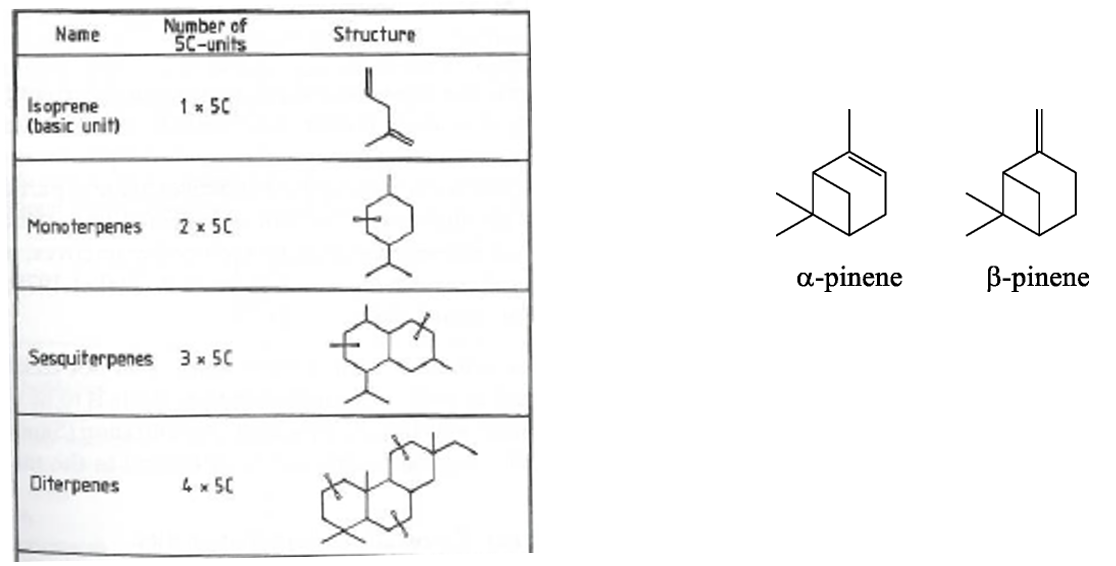
Terpenes classified according to number of building units as;
monoterpenes (2 units)
sesquiterpenes (3 units)
diterpenes (4 units)
seterterpenes (5 units)
Triterpenes (6 units)
Isoprene units linked according to isoprene rule; tail of one unit linked head of next
Most are linked intramolecularly to form 1< rings
Cyclisation causes removal and/or damage of double bonds
Terpenes & terpenoids contd.
Terpenes are pure hydrocarbons while terpenoids contain functional groups such as OH, C=O, COOH, ect.
Extractives of SW contain all classes of terpenes except sesquiterpenes, which are rare class
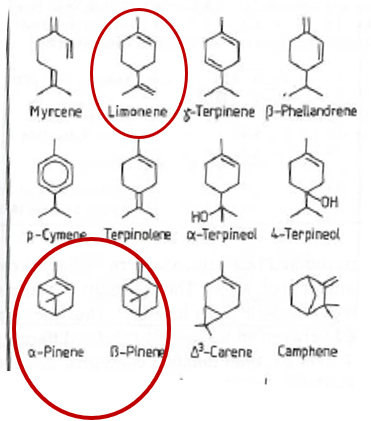
Monoterpenes exists as cyclic, monocyclic & bicyclic forms
All types found in volatile fraction of SW isolated by steam distillation
Turpentine; volatile wood oil consists mainly of monoterpenes
Most important are α & β-pinene & limonene
Terpenes & terpenoids contd. 2
Composistion of turpentine is characterisitic of each species, population & between trees.
Variation attributed to environmental factors & heredity
Monoterpenes with 7-member rings very scarce, also called tropolone derivatives
Thujic acid, thujaplicin & thujaplicinol have been found in Cupressaceae family
Sesquiterpenes present in Pinus, Piceae, Cupressus & Juniperus species
Fats, waxes & their components (SW extractives)
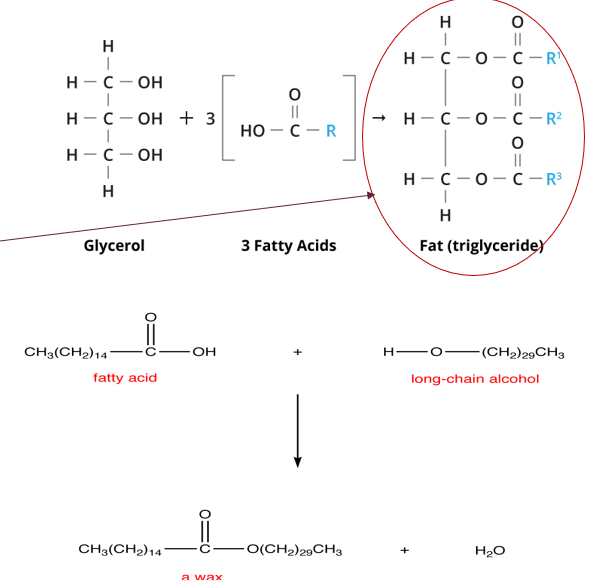
Fats defined as esters of higher carboxylic acids with glycerol
Waxes are esters of fatty acids with higher alcohols
Among glycerides (fats), the triglycerides are dominant compared to mono & diglycerides
Apart from fats & waxes, free fatty acids & alcohols are components of extractives
Freed fatty acids considerably higher in heartwood than sapwood
More than 20 fatty acids identified
Generally more saturated monoeric, dienic & trienic acids with 16-22 C atoms, but also lower acids (C10-C14), higher ones (C24-C30)
Phenolic compounds (SW extractives)
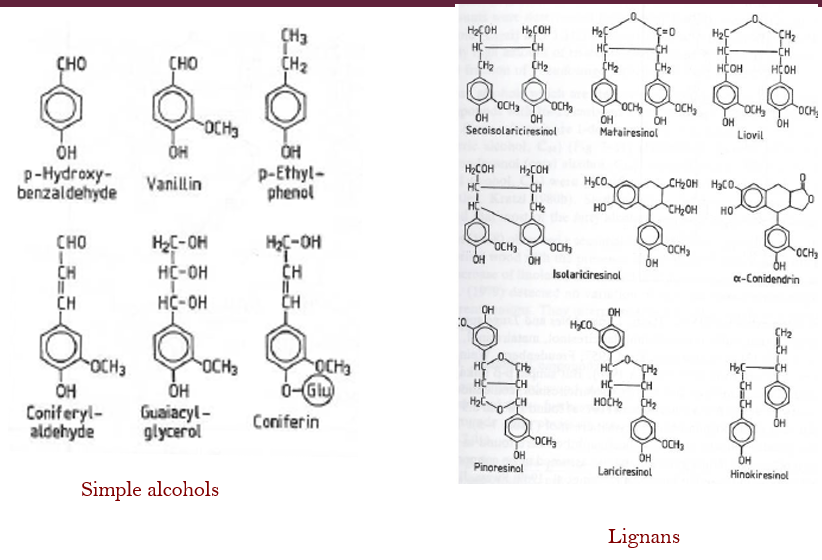
Extractives contain large component of phenolic compounds (residues & by-products formed during lignin biosynthesis)
Simple alcohols
Lignans; consist of two phenyl propane units linked in a different manner
Stilbenes; often present in heartwood of pines (difficult to remove during pulping)
Mainly 4-hydroxy stilbene, 4-methoxy stilbene, pinosylvin & pinosylvin mono & diether
Mainly responsible for light induced darkening of wood & problems during pulping
Used in manufacture of dyes & optical brighteners, and as phosphor & a scintillator.
Flavonoids; consist of sub-groups such as flavones, flavanes, flavanones & isoflavanes
Phlobaphene (condensed tannins)
Other SW extractives
n-alkanes; C11-C12
Ethene
Ethene derivatives; cause resistance to termites
Mono disaccharides; glucose, fructose & sucrose
Protiens; can influence development of wood destroying organisms