B4.1 Adaptation to Environments
 Call Kai
 Learn
Learn Practice Test
 Spaced Repetition
 Match
Match Flashcards
 Knowt Play
1/16

There's no tags or description
Looks like no tags are added yet.
Name | Mastery | Learn | Test | Matching | Spaced | Call with Kai | Chat |
|---|
No analytics yet
Send a link to your students to track their progress
17 Terms
Define habitat
The natural place where an organism, species, population, or community lives
What elements make up a habitat?
1) Geographical location - The physical area
2) Physical conditions (e.g. temperature, light, soil, water availability)
Describe the role of abiotic factors in an environment
Abiotic factors are non-living aspects of an environment that influence:
Where organisms can live
How they survive & reproduce
[CS] Lyme grass in sand dunes - describe their background & adaptation [5]
Sand dunes are dry, windy, & nutrient-poor habitats
Grasses, like lyme grass, have key adaptations to survive in such conditions
Adaptation | Function |
Rolled leaves with stomata | Reduce surface area → less water loss from strong winds |
Waxy cuticle | Acts as hydrophobic surface on leaves & stems → prevents evaporation |
Sunken stomata | Creates air pockets that traps humidity → reducing transpiration |
[CS] Mangrove trees in swamps - describe their background & adaptation [5]
Coastal swamps have waterlogged, salty, & anoxic
Mangrove trees have the following adaptations:
Adaptation | Function |
Salt glands | Excrete excess salt |
Pneumatophores (aerial roots) | Allows gas exchange (absorb O2) in low-oxygen soils |
Thick waxy cuticle | Prevents water loss & soil entry |
Explain the effects of abiotic factors on plants & animals [5×2]
Abiotic variable | Effect on plants | Effect on animals |
Light intensity | Affects photosynthesis → growth rate of plants | Affects behaviour (nocturnal/only active at certain levels) |
Water availability | Determines whether a plant is xerophytic (adapt to dry environment) or hydrophytic (adapt to aquatic environment) | Affects osmoregulation (hydration, excretion) & adaptations for water retention |
Temperature | Affects enzymatic activity & germination | Affects metabolism & enzyme function |
pH | Of soil - Influences nutrient availability & enzyme activity in roots | Of water - Affects aquatic animals & enzyme function |
Salinity |
| |
What is a range of tolerance?
Definition: The optimal range of abiotic conditions in which each species thrive best
Too much or too little of a factor can cause stress, reduced reproduction, or death
What are coral reefs?
Coral reefs are marine ecosystems built by colonies of tiny coral animals
They rely on a symbiotic relationship with zooxanthellae (algae that live inside coral tissues)
Coral provides shelter & nutrients
Zooxanthellae perform photosynthesis which supplies sugar to the coral
Describe the conditions required for coral reef survival & consequence if unmet [5×2]
Coral reefs are highly sensitive to changes & require specific environmental conditions:
Factor | Significance | Consequence if unmet |
Water depth | Reefs grow in shallow waters where sunlight can reach zooxanthellae for photosynthesis | Deep waters → sunlight cannot reach, limits zooxanthellae photosynthesis |
pH | Coral skeletons are made of calcium carbonate, which forms best under slightly alkaline conditions | Ocean acidification lowers pH → threatens formation |
Salinity | Stable salt levels required for osmoregulation | Sudden changes (freshwater runoff/evaporation) → stress/kill corals |
Water clarity | Clear water allows sunlight to penetrate | Sediment, algae blooms, pollution → reduce clarity & limit photosynthesis |
Temperature | Coral reefs form in warm tropical waters | Above 30°C → coral bleaching |
Define biome
Large groups of ecosystems sharing similar abiotic factors
What are the two main factors that determine type of terrestrial biome?
1) Average annual temperature
2) Average annual rainfall
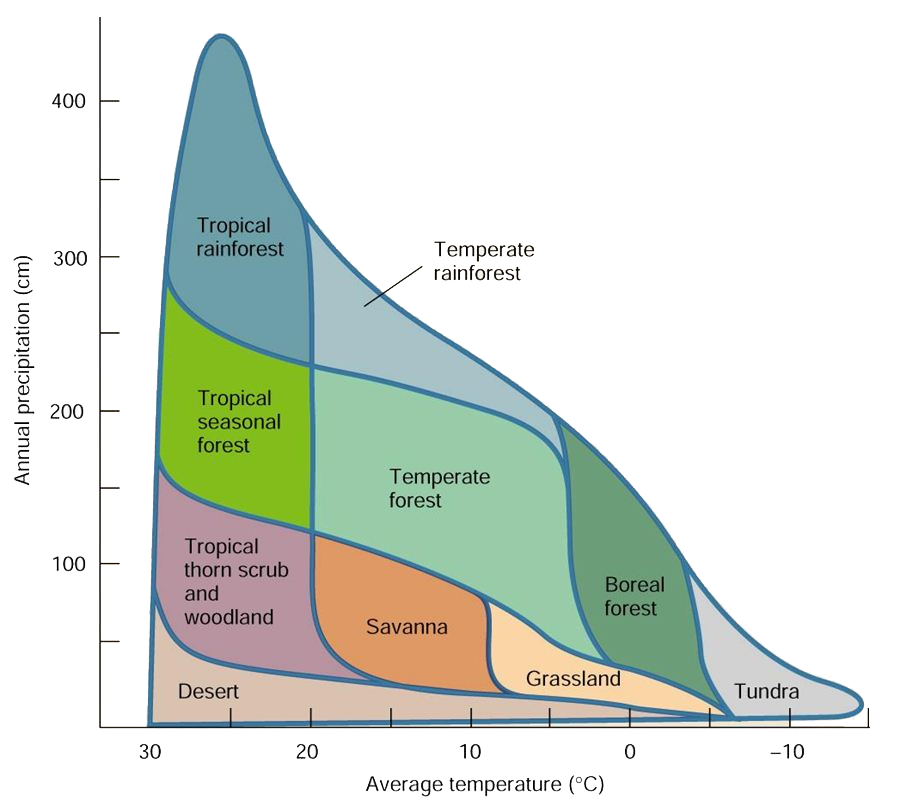
Explain why different biomes have similar communities [2]
Different biomes have organisms with similar adaptations due to common selection pressures (abiotic conditions)
Hence, they develop analogous structures via convergent evolution
Describe the climate conditions of major biomes [6×4]
Biome | Temperature | Precipitation | Light intensity |
Tropical Forest | High, no cold season | High rainfall | High |
Temperate Forest | Moderate (summers warm, winter cold) | Medium to high rainfall | Moderate |
Taiga (Boreal Forest) | Low w/ short summers | Medium to high rainfall | Low to medium |
Grassland | Medium to high in summer Medium to low in winter | Low rainfall | Medium to high |
Hot Desert | High daytime, low nighttime | Low rainfall | High |
Tundra | Very low w/ short summer | Low to medium (mostly snow) | Low |
[Example] Hot desert plant adaptation - Saguaro cactus (Carnegiea gigantea) [4]
Adaptation | Function |
Wide-spreading roots | Collect water from a wider area |
Thick, fleshy stems | Composed of tissue for voluminous water storage |
Spines | Lower surface area = less transpiration |
CAM photosynthesis | Stomata open at night to reduce water loss |
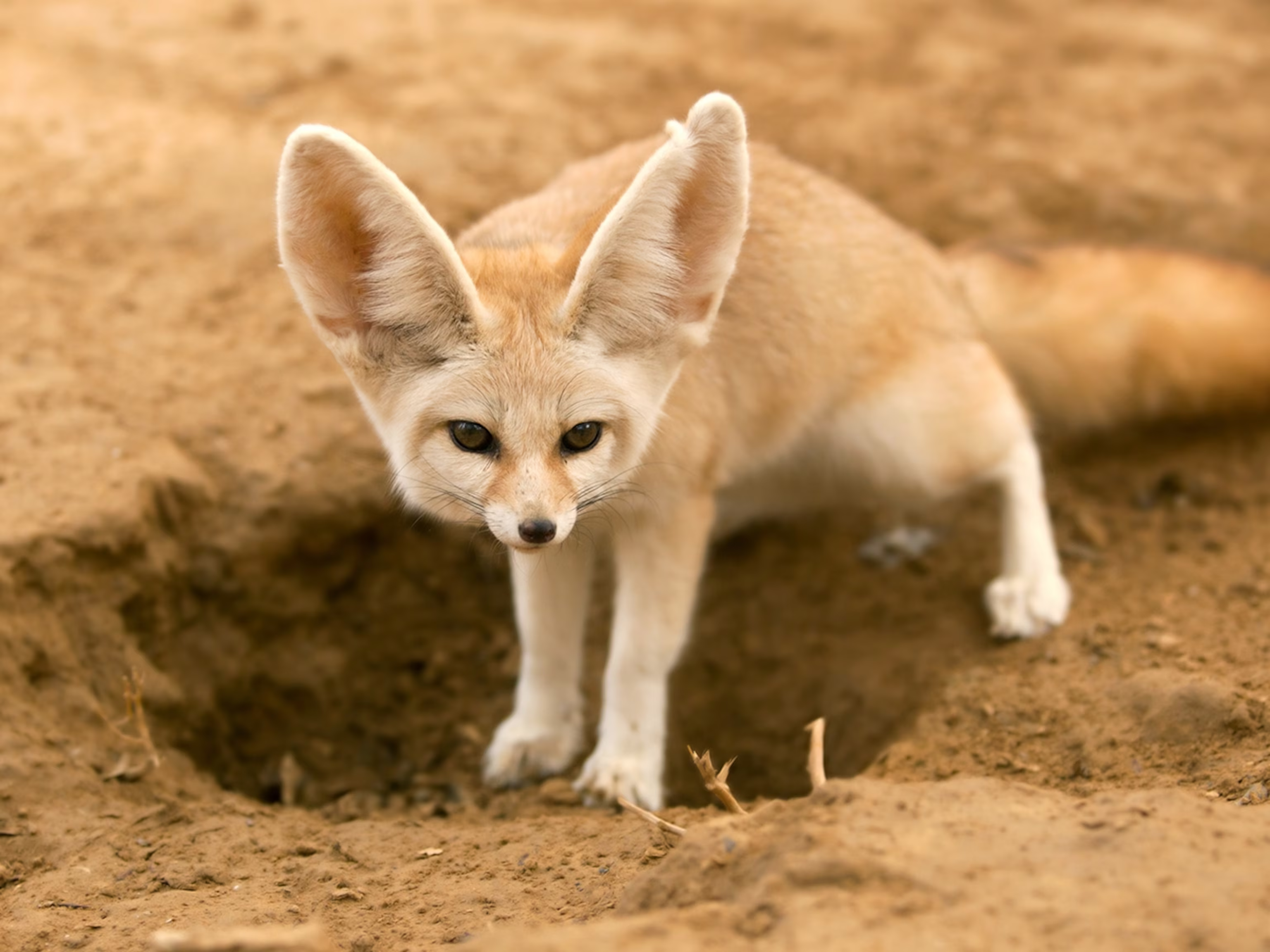
[Example] Hot desert animal adaptation - Fennec fox (Vulpes zerda) [5]
Adaptation | Function |
Large ears | Radiate excess body heat → keep body temperature down |
Light fur | Reflects sunlight + provides camouflage |
Thick fur on feet | Protects against hot sand |
Burrowing | Lives in underground dens to stay cool |
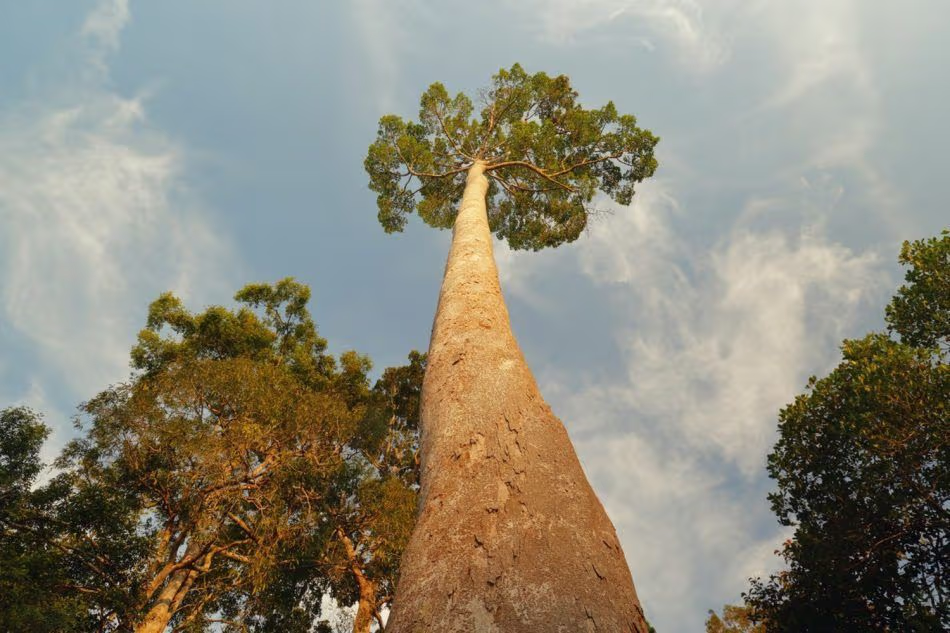
[Example] Tropical rainforest plant adaptation - Yellow meranti (Shorea faguetiana)
Adaptation | Function |
Grows over 80 metres tall | Away from competition → reaching full sunlight |
Buttress roots | Anchors tree in shallow soil |
Smooth trunk | Sheds rainwater rapidly to limit mould |
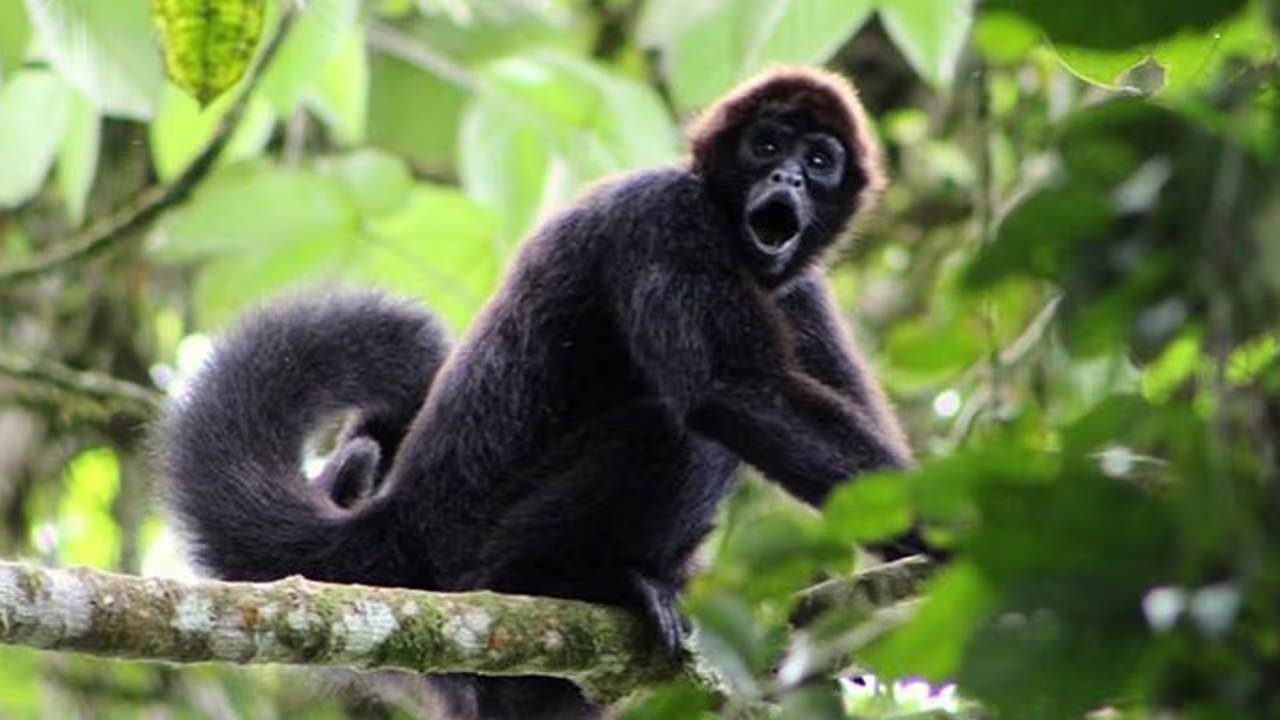
[Example] Tropical rainforest animal adaptation - Spider monkey (Ateles geoffroyi)
Adaptation | Function |
Long arms & legs | Climbing high trees |
Hook-like thumbless hands | Grasp branches & lianas + pick fruit |
Prehensile tail | Acts as a fifth limb for gripping & balance |