Epithelial Tissue
 Note
Note Call Kai
 Learn
Learn Practice Test
 Spaced Repetition
 Match
Match Flashcards
 Knowt Play
1/16

There's no tags or description
Looks like no tags are added yet.
Name | Mastery | Learn | Test | Matching | Spaced | Call with Kai | Chat |
|---|
No analytics yet
Send a link to your students to track their progress
17 Terms
Epithelial Tissue
A diverse group of tissues that covers body surfaces, lines cavities, and forms glands.
Apical Surface
The surface of epithelial cells that is exposed to a body cavity, internal organ, or the exterior of the body.
Lateral Surfaces
The surfaces of epithelial cells that face adjacent cells on either side.
Basal Surface
The deep surface of epithelial cells that is attached to underlying tissues.
Cuboidal Cells
Epithelial cells that are as tall as they are wide, often involved in secretion or absorption.
Columnar Cells
Tall epithelial cells that protect underlying tissues and may have cilia or microvilli for secretion and absorption.
Simple
A single layer of identical epithelial cells.
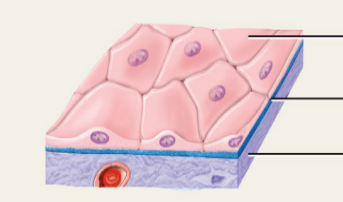
Simple Squamous
Flat epithelial cells found in areas like the heart and lungs, facilitating diffusion.
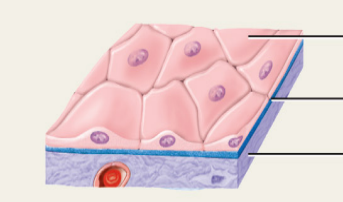
Simple Cuboidal
Cube-shaped epithelial cells involved in secretion and absorption.
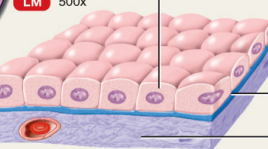
Simple Columnar
Rectangular-shaped epithelial cells found in the alimentary tract, specialized for absorption and secretion.
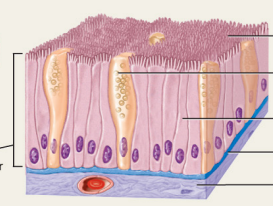
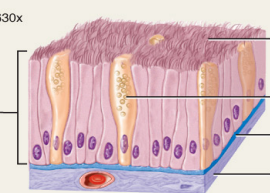
Simple Ciliated
Epithelial tissue with cilia that aids in movement, found in respiratory passages.
Stratified Epithelium
Epithelial tissue composed of multiple layers of cells.
Keratinized Stratified
Epithelial tissue that is dry and resistant to wear, found in skin, hair, and nails.
Non-Keratinized Stratified
Epithelial tissue that is moist, found in the lining of the mouth, pharynx, esophagus, and vagina.
Transitional
Epithelial tissue with pear-shaped cells that can stretch, found in the urinary system.
Endocrine Glands
Glands that secrete hormones directly into the bloodstream without using ducts.
Exocrine Glands
Glands that secrete substances into ducts that empty onto surfaces or into hollow organs, such as mucus and saliva.