Abio 175 exam 2
 Call Kai
 Learn
Learn Practice Test
 Spaced Repetition
 Match
Match Flashcards
 Knowt Play
1/109

There's no tags or description
Looks like no tags are added yet.
Name | Mastery | Learn | Test | Matching | Spaced | Call with Kai | Chat |
|---|
No analytics yet
Send a link to your students to track their progress
110 Terms
Coroner
Elected official who certifies death; no medical degree; does not perform autopsies
Medical Examiner (ME)
Appointed doctor who investigates deaths and performs autopsies
Forensic Pathologist
Medical specialist who performs autopsies and determines cause/manner/time of death
Autopsy Evidence
Clothing, nail scrapings, hairs, DNA swabs, bullets, GSR, trace evidence
Autopsy Documentation
Clothing damage, scars, tattoos, medical intervention signs, medical records
Injury Documentation
Classify wounds, photograph, measure, X-rays, projectile path, bone damage
Internal Examination
Y-incision, organ removal/weighing, microscopic exam, stomach contents, toxicology
Scene Investigation
Photograph body, collect evidence, estimate time of death, remove body properly
Time of Death Indicators
Body changes
decomposition
insects
overdose signs
weapon distance
Blunt Force Trauma
Injury from dull object causing
abrasions
contusions
lacerations

Contusion
Bruise from ruptured blood vessels under skin

Laceration (Blunt Force)
Irregular tear with tissue bridges and bruising

Fracture
Break or separation of bone
Dislocation
Bone forced out of normal joint position
Pattern Injuries
Seat belt marks
treadmarks
steering wheel patterns
photographed at 90°
Sharp Force Trauma
Well-defined cuts from knives or blades; stabs, chops, incisions
Defensive Wounds
Injuries on hands/arms from victim protecting themselves; good for DNA swabs
Asphyxiation
Anything interfering with oxygen intake; look for facial injuries and bruising
Strangulation
Ligature or manual; possible hyoid damage; defensive wounds
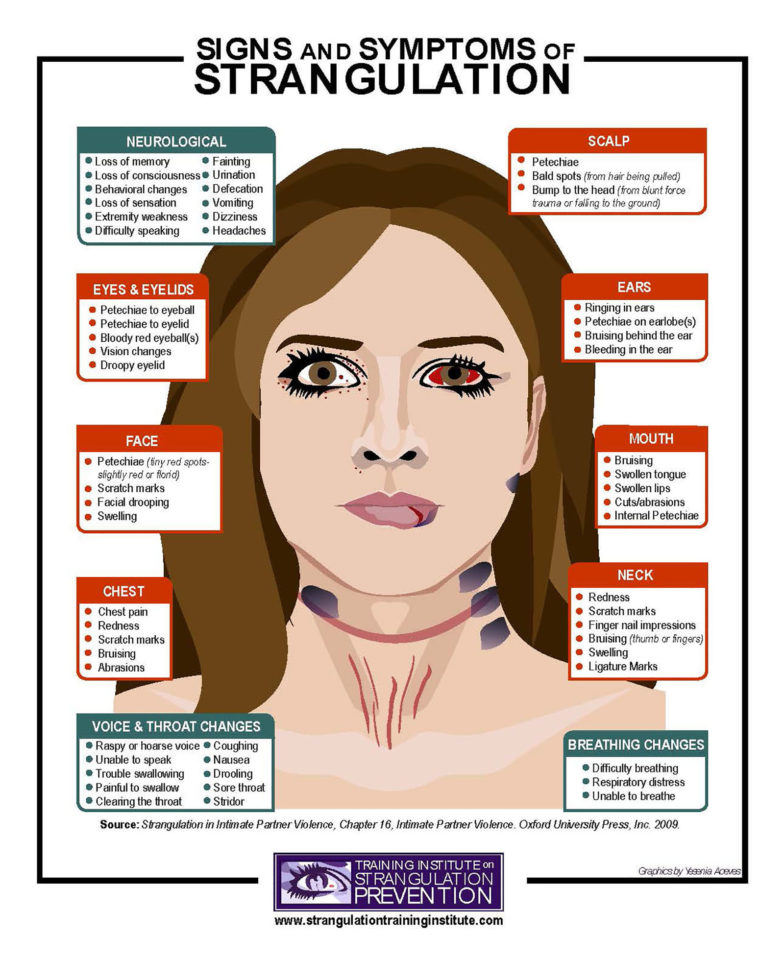
Entrance Wound Ranges
Distant, intermediate, close, contact

Tattooing/Stippling
Powder marks indicating distance of gunshot

Blood Spatter
Pattern created when blood is deposited on a surface
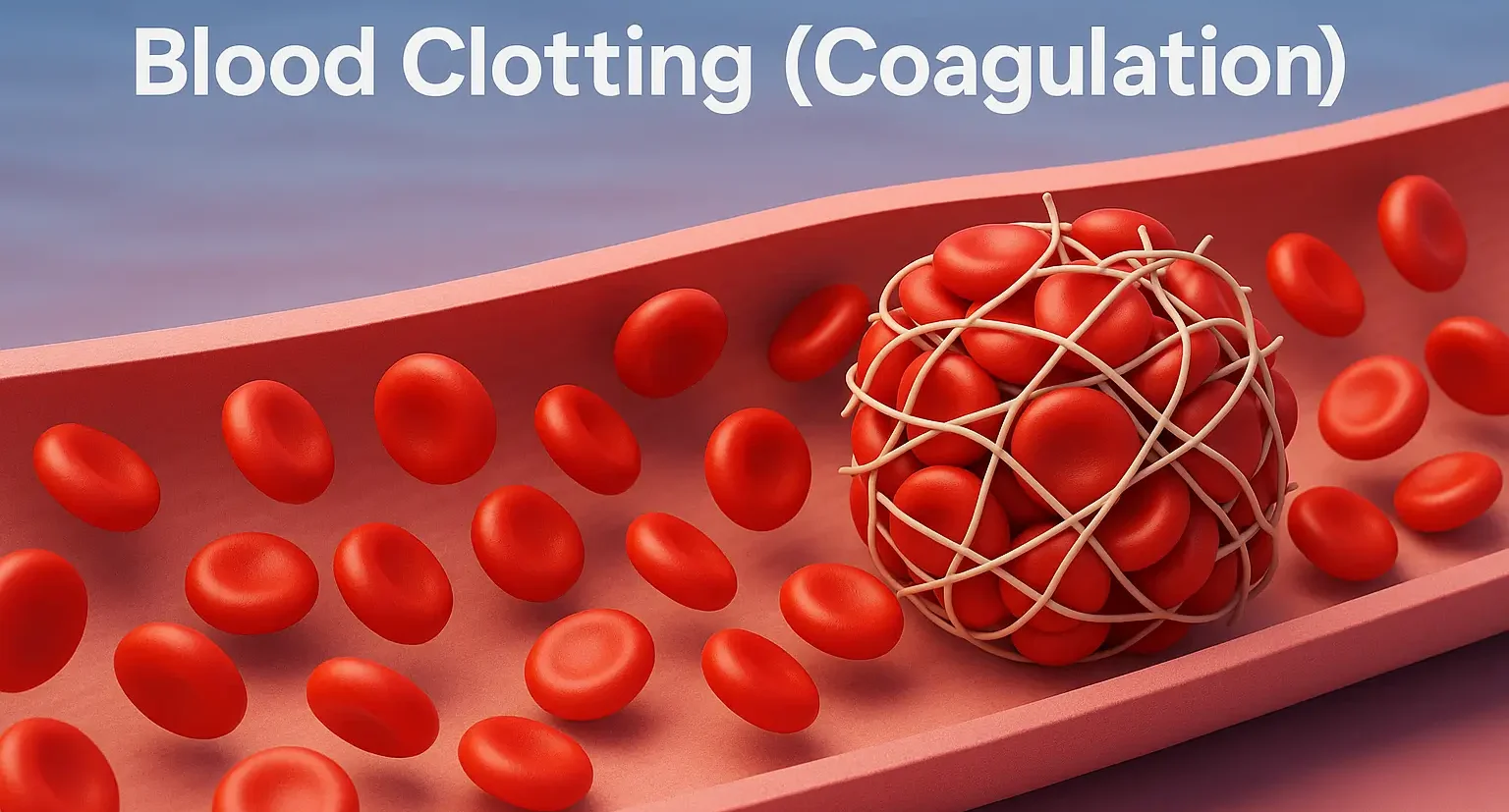
Coagulation
Blood clots in 15–20 minutes; serum separates
Satellite Spatter
Small droplets near main stain

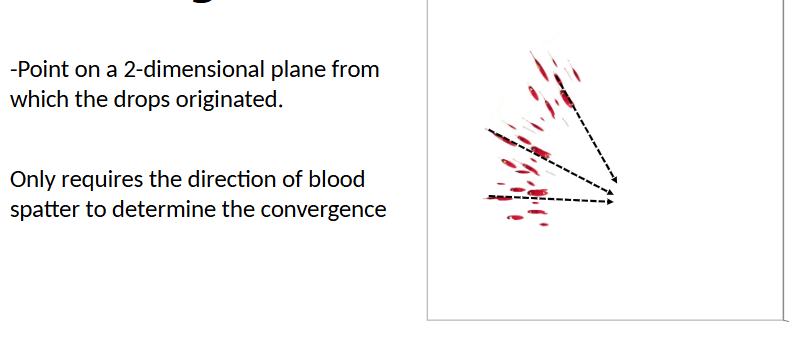
Convergence
2D point where blood drops originated
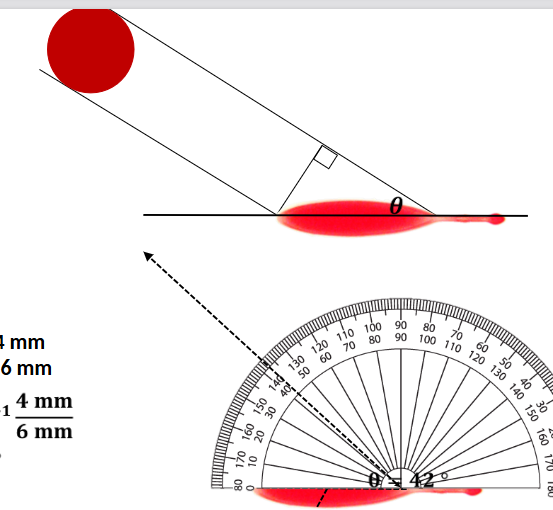
Angle of Impact
Determined by stain shape; shows direction of travel
Area of Origin
3D location of blood source using angle + convergence

Passive Blood Stains
Drops formed only by gravity
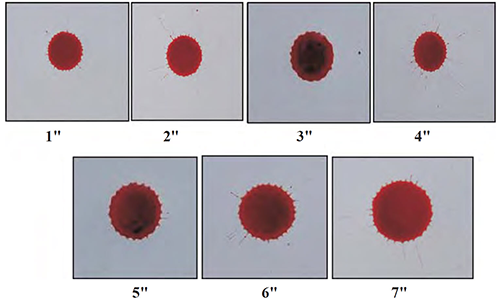
Transfer Blood Stains
Bloody object contacts another surface; may show patterns

Transfer Pattern
Shape of object visible in blood transfer
Projected Blood Stains
Impact, forward, back spatter

Low Velocity Spatter
Large drops; passive; <5 ft/sec

Medium Velocity Spatter
5–25 ft/sec; from blunt force
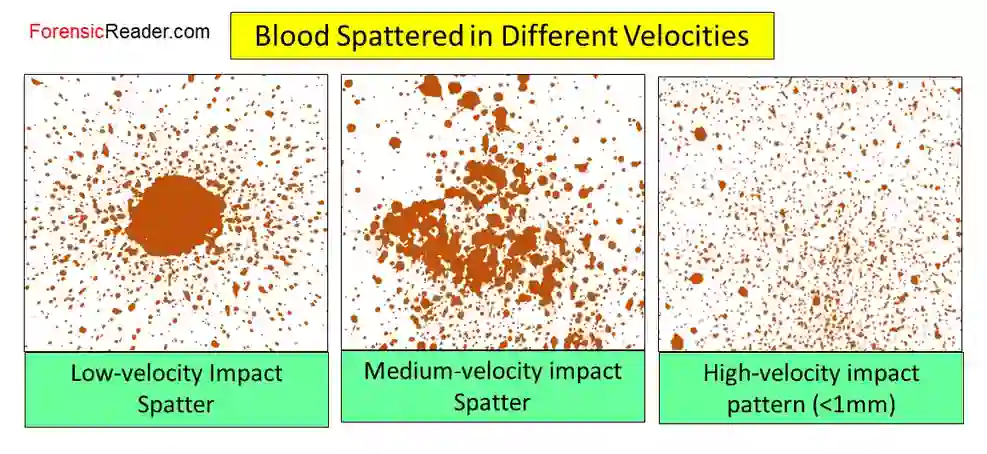
High Velocity Spatter
Mist-like; >100 ft/sec; often gunshots

Back Spatter
Blood from entrance wound traveling toward shooter

Void Pattern
Missing blood area where object blocked spatter

Skeletonization
Dried edges of stain; indicates movement or cleaning

Expirated Blood
Blood blown from mouth/nose; may contain bubbles

Neulander Case
N.Y. Ex-Doctor Who Claimed His Wife Died by Slipping in the Shower at Their Mansion - was later convicted of murder after a second trial - serving 20 years to life
Jodi Arias
convicted of first-degree murder in the slaying of her ex-boyfriend Travis Alexander
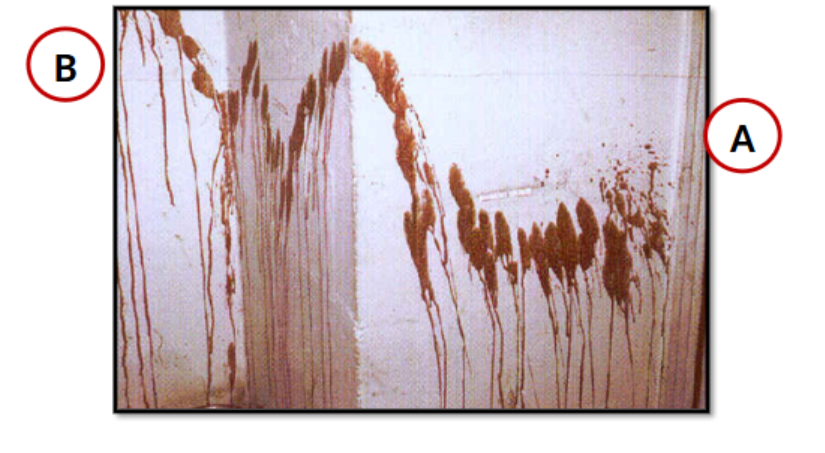
point A
where was this victim attacked? (point A or B)
Hard surfaces
smooth stains
textured surfaces
spines/satellites

How long has this woman been deceased?
rigir mortis
5-36 hours

How long has this man been deceased?
Decomposition
marbling of the skin
Deductive Reasoning
Process of drawing a conclusion
based on known facts or
premises
Be patient
Consider all evidence
Listen to your experts
Manner of Death
Circumstances that led to a fatal result; classified into 5 categories.
Homicide
Non-accidental death caused by another person through negligence, recklessness, or intent.
Suicide
Person intentionally causes their own death.
Accidental
Unintentional death such as traffic accidents, overdoses, or drownings.
Natural
Death caused by disease or internal medical conditions.
Estimating Time of Death
Pathologist uses body/scene characteristics to approximate time of death.
Time of Death Indicators
Witness accounts, temperature, scene conditions, mail dates, meal/dishes.
Algor Mortis
Body cooling after death until reaching room temperature.
Algor Mortis Rate
Loses ~2°F first hour, then 1–1.5°F per hour until ambient temperature.
Algor Mortis Factors
Ambient temperature, humidity, clothing.
Average Body Temp
Oral temperature ~98.6°F (37°C).
Livor Mortis
Settling of blood toward gravity; begins ~20 min, fixed by 16 hours.
Lividity
Skin discoloration from pooled blood (pink-red or deep purple).
Blanching Test
Pressing lividity area; blanches if within 16 hours, no blanching if past 16 hours.
Livor Mortis Movement Indicator
Different lividity patterns show body was moved.
Livor Mortis Impressions
Objects/clothing leave permanent blanching patterns after 16 hours.
Rigor Mortis Muscle stiffening starting
~5 hours postmortem; disappears ~36 hours.
Rigor Mortis Progression
Begins in head/neck, moves to extremities; occurs in all muscles.
Rigor Mortis Cause
ATP depletion prevents muscles from relaxing.
Rigor Mortis Sign
Skin may appear to have goosebumps.
Decomposition
Breakdown of body due to microorganisms after death.
Green Discoloration
Appears on abdomen after 24–36 hours.
Corneal Clouding
Cloudy eyes appearing early in decomposition.
Marbling
Vein patterning on skin from decomposition in lower abdomen.
Inductive Reasoning
Reaching a conclusion based on limited evidence.
Objectivity
Lack of bias; essential for accurate crime scene reconstruction.
Falsifiability
Attempting to disprove your theory rather than prove it.