Psych/Soc - more
 Call Kai
 Learn
Learn Practice Test
 Spaced Repetition
 Match
Match Flashcards
 Knowt Play
1/126

There's no tags or description
Looks like no tags are added yet.
Name | Mastery | Learn | Test | Matching | Spaced | Call with Kai |
|---|
No analytics yet
Send a link to your students to track their progress
127 Terms
meaning on the same side of the body, meaning senses from your right nasal cavity are processed by the right brain. All other senses are contralateral
Ipsilateral - olfaction
what is special about olfaction
it bypasses the thalamus
a type of mechanoreceptor that responds to muscles stretching, like when a doctor hits your knee, that causes a muscle spindle to detect a stretch and create a neural reflex response
spindle receptors
fast to slow vibers
a - beta (fastest), a delta, c fibers (slowest)
a thermoreceptor that has a conformational change in the presence of heat, but can also stimulate pain responses via the same mechanism, which is why extreme heat can be painful, or why spicy foods with capsaicin feel “hot”/painful
TrpV1 receptor-
a plate that separates the brain from the nasal cavity
Cribriform plat
nerves (mitral cells) that connects the olfactory epithelium, through the cribriform plate, getting messages from the olfactory receptors to the brain
olfactory bulb
each taste bud receptor has 5 different axons, each corresponding to a different taste (sweet/salty/etc.), each axon type going to a specific region of the primary gustatory cortex that corresponds to that type of taste
Ex. if you eat sugar (something sweet), we have sweet taste buds that are activated by that sugar molecule, which activates a certain part of the gustatory cortex that registers it as sweet
labeled line theory
mushroom shaped, at the front of your tongue
fungiform
visible bumps on your tongue that contain taste buds
papillae
taste buds on the sides of the tongue
foliate
Weber's stratification =
Class + Status + Power.
papillae that fill the middle portion of your tongue the only type of papillae that actually doesn’t carry any taste buds
filiform
What occurs whenever photoreceptors receive light?
They are hyperpolarized and produce less glutamate
occurs when we have large amounts of light, allowing cones to be very active
photopic vision
occurs at dawn or dusk, when we have less light than photopic vision, where both rods and cones are utilized
mesotopic vision
occurs when we have very low levels of light (like at night), mainly controlled by rods
scotopic vision
when the brain alternates between two different images presented to each eye, since each eye sees a slightly different image
Example- if your left eye was being shown a person, and the right eye a house, you’d rotate between seeing each picture instead of both at the same time
binocular rivalry

the illusion of motion from images that are rapidly alternating
Ex.
the loading wheel on websites isn’t actually a wheel that’s rotating, it’s just a pixel turning on and off in a way that makes it look like a circle that’s rotating
phi phenomenon
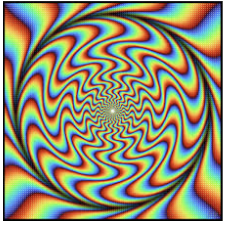
when a stationary objects appear to move in the despite it not actually moving
autokinetic effect

color vision is based on three types of cones, the color we perceive is based on how much each of the three cones is activated
Example- if you see Yellow, that means you probably have a lot of green and red being activated and not much blue
trichromatic theory
processes fine detail and color, such as reading text or identifying the color of a wall
Mostly controlled by cones
parvocellular pathway
- colors are processed by opposing pairs of colors
Example- if you stare at the image below for a long time, then look away, the flag will be different colors when you close your eyes, theorized to be because you’re tiring out the receptor combos for yellow and blue which causes their opposites to dominate when you close your eyes
Opponent-Process Theory
processes motion and the outlines of objects, such as tracking a moving train
Mostly controlled by rods
Magnocellular Pathway
if you have a song memorized, even if we delete some words/letters (small details) you still can read the lyrics just fine
top down processing
how you prioritize your attention in aims to complete a certain goal, such as having a project due tomorrow so you focus on that instead of cleaning your room
executive attention
form of selective attention where, despite receiving info from all 5 senses, we pick one at a time to be conscious of and can potentially shift to another (like shifting a spotlight)
Spotlight model of attention-
an example of the spotlight model of attention where exposure to one stimulus affects our ability to respond to other stimuli, where stimuli we have been primed to are more often shifted into our spotlight than others
Example- we are primed to hearing our name, so if you hear it, you put that person saying your name in your spotlight and then are only unconsciously aware of everything else
priming
inhibits processing of stimuli by suppressing or ignoring previous similar stimuli
Example- if you’re told to ignore the word red for task A, you’ll do worse if then asked to focus on the word red in task B
negative priming
because we have limited resources as individual humans (we only have one set of eyes, one set of ears, etc.), we can be overwhelmed and overtasked if presented with too many stimuli if we try to focus on many stimuli at once
Example- you may become more tired (and do worse) if you are listening to a podcast and studying at the same time rather than just studying, since doing both requires a larger use of energy
Resource Model of Attention-
aka hemispatial neglect, where a person fails to pay attention to or perceive one side of a space, usually due to damage to a lobe, even if their vision is intact
Example- Patients with this would only be able to draw one half of a picture, or only eat one half of food on their plate, almost as if they thought the other half didn’t even exist
Neglect syndrome
the tendency for tasks that are similar in nature to be easier to devote divided attention to, which explains why listening to classical music while studying is often easier than listening to a podcast about space while studying
task similarity
where your prior knowledge and expectations dictate how you interpret the smaller details
deductive reasoning
the act of bringing something to your attention without any physical movement
Example- listening to someone talk to you while you are watching TV, your attention is on them but you didn’t move to do it
covert orienting
when a person turns all or part of the body to maximize their ability to maintain their attention on that object
Example- turning your head to listen to someone talk to you, you are physically moving to better focus on the stimuli
overt orienting
the actual light, sound wave, etc. that hits your sensory receptors, creating a sensation that your body can respond to
proximal stimulu
objects and events out in the world around you that create proximal stimuli you can respond to
Example- a tree that you’re looking at is a distal stimuli, the light that hits your eye off that tree is proximal stimuli
distal stimulu
we have a selective filter that, after we sense the stimulus, the filter decides what is and isn’t worth our attention, followed by the perception of that stimuli, then to conscious thought
Sensory register → selective filter → perceptual process → conscious thought
Broadbent’s Early Selection Theory-
conversely to Broadbent’s theory, the selective filter that determines what will have our attention comes after we perceive it, not before, then ultimately leading to conscious thought, thus being why it’s called the late selection theory (since the selective filter is later)
Sensory register → perceptual process → selective filter → conscious thought
Deutsch and Deutsch’s Late Selection Theory
there is an attenuator that replaces the selective filter that simply weakens the input from unattended stimuli, rather than outright eliminating them or having them occupy our full attention, potentially allowing for later processing
Sensory register → attenuator → perceptual process → selective filter → conscious thought
An explanation of why sometimes you don’t understand what someone is saying at first but can then think about it and then you understand
Treisman’s Attenuation Theory
proposed by Johnson and Heinz, the idea that Treisman’s attenuator is flexible and can change its position of either being before or after the selective filters or perceptual processes (in other words, it can follow either early or late detection theories and the attenuator can change positions within each type of attention detection)
Multimodal Attenuator Theory-
the interpretation of new information into existing schemas, potentially incorrectly, like seeing an otter swimming and thinking it’s a fish, or seeing a green cookie and thinking it’s a vegetable
assimilation
the opposite of assimilation, where the schema changes to fit the new information, like seeing Corgi’s as baby dogs but then being told that Corgi’s are in fact just short adult dogs changes your view of what an adult dog is
accomadation
awareness and understanding of your own ability to think, such as the realization that you don’t understand a topic and need to swap to a different studying method to understand it
metacognition
when you have too many options that can make decision-making and cognition much harder, often also reducing satisfaction
Example- the insanely large menu at some restaurants like the Cheesecake Factory, having a large menu makes it harder to make a choice
tyranny of choice
if A relates to B, and B relates to C, A relates to C
Example- if Alex is taller than Ben, and Ben is taller than Chris, Alex is taller than Chris even though you didn’t directly measure the two against each other
Transitive Property
developed intelligence tests, used to detect giftedness or intellectual disabilities. IQ
binet
believed that intelligence is hereditary
Galton’s Hereditary Genius
the ability to reason quickly and abstractly, like solving new problems, decreases with age
fluid intelligence
accumulated knowledge and verbal skills, simply how good you are at retrieving knowledge rather than understanding new, increases with age
crystallized intelligence
breaking a problem into steps to better understand how to get from the start to the finish
Example- when trying to figure out how to get into medical school, chunking the pieces into your GPA, MCAT score, clinical hours, etc. rather than just looking at your application as a whole
means end analysis - type of heuristic
people take more risks with money they have won from someone or something else than with their own money because it doesn’t feel like theirs, it feels like it belongs “to the house”
Example- if you win $50 on Roulette, you’re more likely to spend that $50 since you don’t perceive it as your own, rather than walking away with a win
house money effect
belief that past random events affect future events, even if they have nothing to do with the past events
Example- if you have a 50% chance of getting into 3 different medical schools, getting rejected from one makes you think you’re more likely to get into the others
gambler’s fallacty
the error of believing that two events occurring together is more likely than them occurring alone
Example- which probability is more likely? It will rain tomorrow, or it will rain and there will be thunder? Most people pick B, despite it being more likely to just rain, rather than having both rain AND thunder.
conjuction fallacy
how people perceive and think things is relative to their language, your language influences how you think
Linguistic Relativity hypothesis (the Weak Hypothesis)
the Whorffian hypothesis, opposite of linguistic relativity, the language someone knows dictates how they think, if you don’t know the word, you don’t know how to think about it
Linguistic Determinism (the Strong Hypothesis)-
inability to produce the motor movements necessary for speech
apoxia
the patterns and rhythms of sounds, controlled by the right side of the brain
Example- “You’re going?” and “You’re going.” have different prosody and are understood differently
prosody
the actual vocabulary terme
lexicon
the actual sound of a language, like how British english sounds different than American english
phonolgy
the actual meaning of words and sentences, like how “he passed away” means something different than “he passed out”
semantics
the rules that dictate the order of words in sentences
Example- dog bites man means the exact opposite of man bites dog, so the order of words is important
syntax
how context affects the meaning of words
Example- if you say, “it’s cold in here”, you actually are saying that you’d like the window closed
pragmatics
the partial or complete loss of the sense of smell.
anosmia
better retrieval when the external environment (room, location) matches the encoding environment.
context dependent effects
better retrieval when the internal state (mood, drug influence) matches the encoding state.
state dependent effects
Temporal lobe for ____; Frontal lobe for ____
olfaction, gustation
a network of neurons in the brainstem responsible for regulating wakefulness, arousal, and transitions between sleep and wake states.
Reticular Activating System (RAS)
brief, vivid sensory hallucinations (like hearing a voice or seeing a flash of light) that occur right as a person is falling asleep (Stage 1).
Hypnagogic hallucinations-
developing a physical tolerance for one specific drug, which simultaneously causes you to develop a tolerance for entirely different drugs that happen to act on the exact same neurotransmitter pathways (usually the GABA pathway for depressants).
cross tolerance
happen when you are waking up from sleep, not falling asleep.
Hypnopompic hallucinations
prosopagnosia -
facial blindness
the reduction in time or effort required to relearn information a second time, proving that the information was never fully lost from long-term memory.
memory savings
linguistic determinism vs linguisitc relativism
linguistic determinism is more extreme
a mild, specific type of aphasia where the patient has completely intact comprehension and fluent speech, but suffers from a severe inability to retrieve specific words or name objects
anomic aphasia
a rare behavioral impairment caused by bilateral damage to the amygdala. Symptoms include a complete lack of fear, extreme docility, hyperorality (putting everything in the mouth), and hypersexuality.
Kluver-Bucy Syndrome
chronic, low-grade, environmental stressors that are often in the background and generally hard to control or change (like pollution, crowding, or noise).
ambient stressor
drives related to survival, reproduction, health, and building things up.
eros (life instinct
drives related to aggression, self destruction, thrill seeking, and tearing things down
thanatos (death instinct)
The theory that willpower and self-control are finite resources. If you use up all your willpower resisting one thing (like the urge to stop studying), you will have zero willpower left to resist later temptations.
ego depletion
“ you are so smart and brilliant can you help me with this “
altercasting
proactive -
thinking about future
An actor who secretly participates in a psychological experiment pretending to be a normal subject, but who is actually working directly for the researcher to manipulate the social environment of the true participant.
confederate
sweating
physioglocial
deals with how we attribute dispositional traits to unexpected behaviors.
correspondant interference
Individuals with similar phenotypes mate with one another more free
assortative mating
The attribution of human traits, complex human emotions, or human intentions to non-human entities, animals, or inanimate objects.
anthropomophorism
we dream of threatening situations in order to prepare for real world, problem solving scenarios
Example- if you’re running away from a bear in your dream, that is your brain preparing you to flee from danger if it ever does happen
evolutionary theory of dreaming
linking new information to an already memorized set of information that rhymes, such as one = bun, two = shoe, three = tree, etc. (you already have the order of numbers memorized, you’re tying the new words to those numbers based on rhyming)
peg word system
integrates information from different sources into a coherent memory, such as combining someone’s face, voice, and what restaurant you’re at in memorizing them long-term
episodic buffer
states that a psychological disorder results from the interaction between a biological vulnerability and an environmental stressor.
diathesis stress model
Two students receive the same failing grade, but one views it as devastating while the other sees it as a chance to improve.
psychological appraisal theory of stress
A society believes advanced education is morally superior and highly desirable. What cultural component is this?
cultural value
prioritize group and family needs over individual achievement.
Ex. An employee declines a promotion because it would separate them from family.
collectivist culture
innate, biologically based behavioral tendencies present early in life.
ex. A newborn is consistently fussy and irritable regardless of environment.
temperament
A person integrates their conscious ego with both personal and collective unconscious material.
viewed the Self as the achievement of psychological wholeness through individuation.
Jung's archetype of self
love/support depends on behavior.
Conditional
support regardless of performance.
unconditional
A father restricts allowance when his daughter drops out of medical school; a mother supports her son after he fails exams.
conditional vs unconditional suport