2.10 Tut's Chest & Painted Scroll of Hunefer
 Call Kai
 Learn
Learn Practice Test
 Spaced Repetition
 Match
Match Flashcards
 Knowt Play
1/4

There's no tags or description
Looks like no tags are added yet.
Name | Mastery | Learn | Test | Matching | Spaced | Call with Kai | Chat |
|---|
No analytics yet
Send a link to your students to track their progress
5 Terms
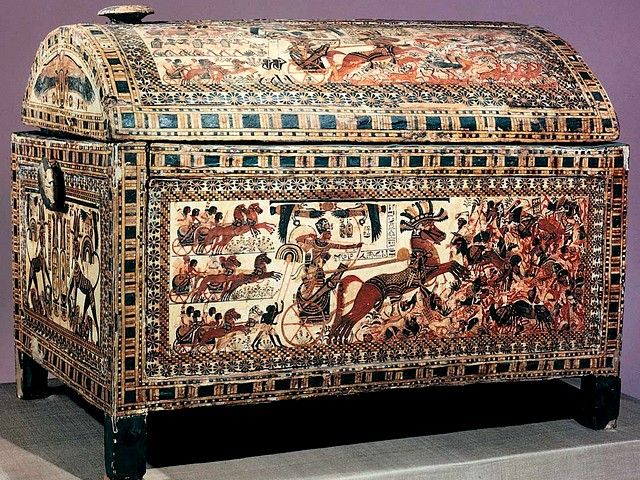
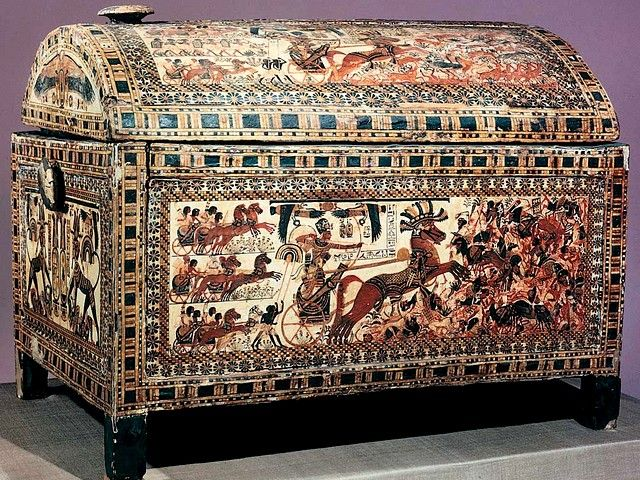
Painted chest from the tomb of Tutankhamen, ca. 1333-1323. Wood.
Analysis of the painted chest
-On the front panel, King Tut himself is depicted for emphasis through hierarchy of scale in a chariot in the role of a warrior, bow raised at his enemy.
-Behind him, three smaller registers show his organized army following his charge; while on the right, a messy rendition of the conquered enemy looks disorganized and in turmoil.
Same in Mesopotamia, themes of order over chaos, civilization over barbarity are common in Egypt.
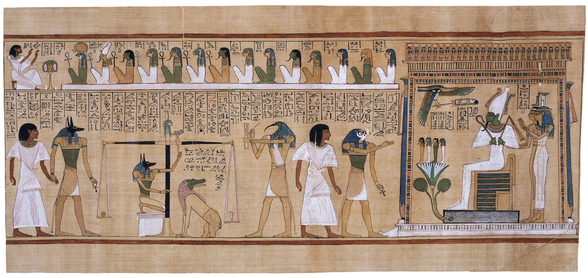
Last Judgment of Hunefer, ca. 1300 BCE; painted papyrus scroll. 1.6' high.
The Book of the Dead (from another tomb)
the spells and prayers illustrated and written out in the Egyptian's Book of the Dead. These weren't bound books, the format we use today, but long scrolls made of papyrus fibers pounded into paper, some reaching a length of 70 feet.
Story of the Last Judgment of Hunefer
a royal scribe of Seti I named "Hunefer." In one section of the scroll, Osiris (far right, enthroned), god of the dead and underworld, and most importantly granter of eternal life, appears seated in a throne.
However, begin following the scene from the left, then right. Anubis, the jackel-headed god of embalming, leads Hunefer to the Hall of Judgment. It's there that his heart is being weighed on a scale against a feather, overseen by by the goddess of truth and right. If Hunefer should fail this test, a monster--a fusion of crocodile-hippo-lion stands by, ready to devour him
Hunefer passes and can be seen again in his white robe proceeding in the direction Horus gestures, to a green-faced Osiris who stands with his goddess sisters where Hunefer will be granted eternal life.
In a smaller register on the very top has Hunefer appear once again before a group of Egyptian gods who witness the judgment.
Registers, composite view--these are all familiar ingredients to Egyptian art!