Ecology
 Call Kai
 Learn
Learn Practice Test
 Spaced Repetition
 Match
Match Flashcards
 Knowt Play
1/49

There's no tags or description
Looks like no tags are added yet.
Name | Mastery | Learn | Test | Matching | Spaced | Call with Kai | Chat |
|---|
No analytics yet
Send a link to your students to track their progress
50 Terms
A __________ consists of individuals of the same species living in a shared area.
A.
Ecosystem
B.
Population
C.
Biosphere
D.
Habitat
E.
Community
Population
Which of the following best describes the ecosystem of a crab?
A.
A rocky intertidal zone with saltwater, tide pools, and sunlight exposure
B.
A group of shore crabs living in the same tide pool and interacting with each other
C.
The Earth’s oceans, atmosphere, and all living organisms that interact within them
D.
A sandy beach with saltwater waves, rocks, shorebirds, crabs, and small fish
E.
A species of crab found in coastal habitats worldwide
A sandy beach with saltwater waves, rocks, shorebirds, crabs, and small fish
Which of the following best describes the difference between a fundamental niche and a realized niche?
A.
A fundamental niche includes only the biotic factors that influence an organism, while a realized niche includes both biotic and abiotic factors
B.
A fundamental niche represents where an organism actually lives, while a realized niche includes all possible environments the organism could inhabit
C.
A realized niche is usually larger than a fundamental niche because a species’ range expands with evolution
D.
A fundamental niche is where two species coexist indefinitely, while a realized niche is where only one species can persist due to competition
E.
A realized niche is the portion of the fundamental niche that an organism actually occupies
A realized niche is the portion of the fundamental niche that an organism actually occupies
All of the following are considered biotic factors EXCEPT one. Which one is the EXCEPTION?
A.
Microorganisms
B.
Fungi
C.
Plants
D.
Sunlight
E.
Animals
Sunlight
All of the following directly determine the geographic distribution of a population EXCEPT one. Which one is the EXCEPTION?
A.
Genetic variation
B.
Dispersal
C.
Behavior
D.
Biotic factors
E.
Abiotic factors
Genetic variation
All of the following are factors that influence biotic potential EXCEPT one. Which one is the EXCEPTION?
A.
Frequency of reproduction
B.
Survivorship of offspring
C.
Number of offspring per reproduction
D.
Environmental resistance
E.
Age of reproductive maturity and reproductive lifespan
Environmental resistance
Biotic potential refers to the maximum growth rate of a population under ideal conditions – where resources are unlimited, predators and competition are absent, and all individuals are healthy.
During the lag phase of bacterial growth, the population __________.
A.
Undergoes rapid exponential growth
B.
Maintains equilibrium with equal birth and death rates
C.
Remains constant as cells prepare for division
D.
Declines due to nutrient depletion and waste accumulation
E.
Increases but at a slower rate than the log phase
Remains constant as cells prepare for division growth rate = 0
All of the following are examples of density-dependent factors EXCEPT one. Which one is the EXCEPTION?
A.
Disease
B.
Competition for resources
C.
Predation
D.
Natural disasters
E.
Parasitism
Natural disasters
Density-independent factors limit population size regardless of how many individuals are present. The risk of these factors is not dependent on the density of the population. A natural disaster is a density-independent factor that can reduce a population's size, but its intensity does not increase with population density.
Which of the following exhibit a Type III survivorship curve?
A.
Elephants
B.
Insects
C.
Mice
D.
Birds
E.
Humans
Insects
A population living at its maximum biotic potential will exhibit which type of population growth curve?
A.
Logistic growth
B.
Linear growth
C.
Exponential growth
D.
Cyclic growth
E.
Density-dependent growth
Exponential growth
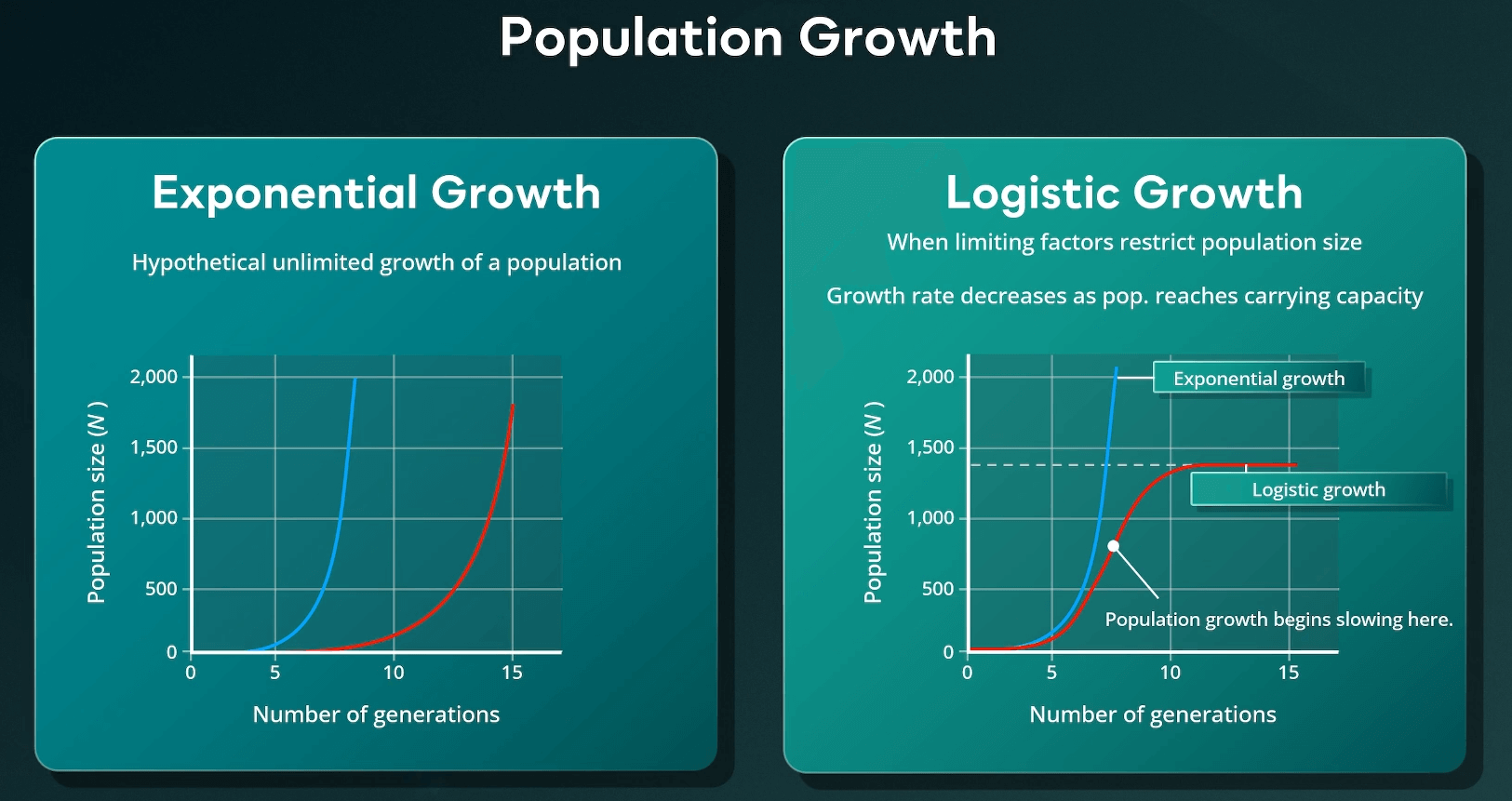
The population follows an exponential growth curve, as there is no carrying capacity restricting its growth. However, under natural conditions, populations typically exhibit a logistic growth curve, where growth slows as the population approaches carrying capacity due to resource limitations and other density-dependent factors.
In a population of 10,000 people, there are 5,000 births and 2,500 deaths per year. What is the annual per capita birth rate?
A.
0.10
B.
0.25
C.
0.30
D.
0.50
E.
0.75
0.5 per captia = total birth/total pop. size
5000/2500=0.5
All of the following are characteristics of a r-selected species EXCEPT one. Which one is the EXCEPTION?
A.
Stable population size
B.
Adapted to unstable environments
C.
High number of offspring
D.
Reach reproductive maturity quickly
E.
Provide low parental care
Stable population size
Which of the following best characterizes a species with a Type II survivorship curve?
A.
Most individuals survive to old age, with mortality increasing sharply in later life
B.
The population size remains stable with death and birth rates equaling each other
C.
Mortality is low in early life, increases in midlife, and then decreases in older age
D.
Mortality is highest in early life, with a few surviving to reproductive age
E.
Mortality remains constant throughout life, with individuals having an equal chance of dying at any age
Mortality remains constant throughout life, with individuals having an equal chance of dying at any age
Which two factors determine species diversity in a community?
A.
Abiotic and biotic factors
B.
Population size and genetic variation
C.
Niche availability and resource competition
D.
Behavioral preferences and dispersal ability
E.
Relative abundance and species richness
Relative abundance and species richness
Which of the following best defines species richness?
A.
The evenness of species distribution within a community
B.
The total number of different species in a given area
C.
The number of individuals in a single species within an ecosystem
D.
All of the genes present in a population
E.
The number of evolutionary adaptations a species undergoes over time
The total number of different species in a given area
Which of the following best describes relative abundance in a community?
A.
The proportion of individuals of each species relative to the total population
B.
The rate at which new species are introduced into a community
C.
The total number of species in a given area
D.
The number of individuals in the most dominant species within a community
E.
The difference between the death and birth rate in a population
The proportion of individuals of each species relative to the total population // The evenness of species distribution within a community
As the geographic area increases, the __________ increases.
A.
Population density
B.
Genetic variation
C.
Species richness
D.
Abiotic factor influence
E.
Relative abundance
Species richness
A community with the greatest species diversity has a __________ species richness and a __________ relative abundance.
A.
Low; low
B.
High; high
C.
High; low
D.
Low; high
High; high
Two oak trees of the same species are planted close together and begin competing for sunlight as they grow. Over time, one tree shades the other, limiting its access to light and slowing its growth. What type of competition is occurring in this scenario?
A.
Intraspecific competition
B.
Interference competition
C.
Parasitism
D.
Interspecific competition
E.
Commensalism
Intraspecific competition
Acacia trees provide food and shelter for certain species of ants. In return, the ants protect the tree from herbivores and other threats by aggressively defending it. What type of ecological relationship does this describe?
A.
Parasitism
B.
Commensalism
C.
Facilitation
D.
Competition
E.
Mutualism
Mutualism
A researcher introduces two fish species, A and B, into the same tank. Both species rely on the same type of algae as their primary food source. After several months, the population of species A increases, while the population of species B declines significantly. What is the most likely explanation for this outcome?
A.
A mutualistic relationship was formed between species
B.
Species B is undergoing resource partitioning to reduce competition
C.
Apparent competition is occurring between species A and B
D.
The competitive exclusion principle led to species A outcompeting species B
E.
Species B's population is declining because it has reached its carrying capacity
The competitive exclusion principle led to species A outcompeting species B
Several species of songbirds live in the same forest and feed on insects from the same trees. However, each species forages in a different section of the tree—one species feeds at the top, another in the middle, and another near the lower branches. What type of ecological interaction does this scenario illustrate?
A.
Competitive exclusion
B.
Character displacement
C.
Exploitation competition
D.
Resource partitioning
E.
Interference competition
Resource partitioning
Resource partitioning allows multiple species to coexist by utilizing different parts of a shared niche. According to the competitive exclusion principle, species that compete for the same resources cannot coexist indefinitely. To reduce competition, species adapt by using slightly different resources or obtaining them in different ways.
In a community, two species of squirrels (A and B) are both hunted by coyotes. Species B is weaker and gets picked off more easily, providing more food for the coyotes and leading to an increase in the coyote population. As a result, Species A’s population declines due to heightened predation pressure. What type of ecological interaction is occurring between Species A and Species B.
A.
Exploitative competition
B.
Apparent competition
C.
Intraspecific competition
D.
Interference competition
E.
Facilitation
Apparent competition
All of the following are true statements regarding pioneer species EXCEPT one. Which one is the EXCEPTION?
A.
They are first to colonize a barren or newly disturbed environment
B.
They thrive best in stable environments with low levels of disturbance
C.
They contribute to soil formation by breaking down rock and organic material
D.
They have fast reproductive and growth rates
E.
They are gradually replaced by intermediate species
They thrive best in stable environments with low levels of disturbance.
These species are highly adapted to harsh conditions as they have fast reproductive and growth rates, allowing them to quickly establish and modify the environment.
A grassland ecosystem experiences extreme overgrazing by cattle, stripping the land of vegetation and causing soil degradation. As the land becomes less habitable, the cattle migrate away, along with other species. Over time, grasses and small shrubs begin to regrow, leading to the gradual recovery of the ecosystem. Which ecological process does this scenario illustrate?
A.
Competitive exclusion
B.
Primary succession
C.
Secondary succession
D.
Character displacement
E.
Facilitation
Secondary succession
Which of the following best defines a climax community?
A.
An ecosystem dominated by pioneer species
B.
A rapidly changing ecosystem with high species turnover
C.
A community that forms after a widespread disturbance
D.
A stable community that has reached equilibrium with a consistent species composition
E.
A community that develops in a completely lifeless area with no prior ecosystem
A stable community that has reached equilibrium with a consistent species composition
A glacier retreats, exposing bare rock with no prior life. Over time, pioneer species colonize the area, leading to ecosystem development. Which ecological process does this illustrate?
A.
Primary succession
B.
Invasive species succession
C.
Parasitism
D.
Secondary succession
E.
Realized niche
Primary succession
All of the following are factors that influence ecological succession EXCEPT one. Which one is the EXCEPTION?
A.
Pioneer species
B.
Light availability
C.
Crowding of organisms
D.
Daily temperature fluctuations
E.
Soil composition
Daily temperature fluctuations
Which of the following is an example of a primary producer?
A.
Mushroom
B.
Algae
C.
Earthworm
D.
Rabbit
E.
Wolf
Algae
How much energy is transferred to the next trophic level?
A.
10%
B.
20%
C.
50%
D.
75%
E.
90%
10%
In an ecosystem, which of the following belongs to the trophic level that is the least stable and most sensitive to prey population fluctuations?
A.
Grasshopper
B.
Snake
C.
Small shrubs
D.
Hawk
E.
Frog
Hawk
Higher trophic levels are less stable and the most sensitive to population fluctuations, particularly in their prey populations. These higher levels are typically occupied by tertiary or apex consumers, such as hawks, which have few or no natural predators. Since they depend on lower trophic levels for survival, any change in prey availability directly impacts their population, making them the least stable and most vulnerable to ecosystem fluctuations.
All of the following are adaptations that herbivores have EXCEPT one. Which one is the EXCEPTION?
A.
Flat teeth
B.
Long digestive tracts
C.
Hooves
D.
Long tongue
E.
Sharp canines
Sharp canines
In the kelp forest ecosystem, sea otters feed on sea urchins, preventing them from overgrazing kelp. If sea otters were removed, unchecked sea urchin populations would devastate the kelp forest, ultimately collapsing the entire ecosystem.
What ecological role do sea otters play in this ecosystem?
A.
Foundation species
B.
Apex predator
C.
Keystone species
D.
Primary consumers
E.
Dominant species
Keystone species - without it, ecosystem collapses
In biogeochemical cycles, which of the following best describes the release process?
A.
The movement of energy through an ecosystem’s trophic levels
B.
The process by which elements are incorporated into living organisms
C.
The fixation of atmospheric gases into biologically usable forms
D.
The long-term storage of elements in abiotic components
E.
The breakdown of organic matter, returning elements to the environment
The breakdown of organic matter, returning elements to the environment
Which of the following is an example of assimilation in the carbon cycle?
A.
Decomposers breaking down dead organisms and releasing carbon dioxide into the atmosphere
B.
Nitrogen is absorbed by plants and used to support their growth and development
C.
Volcanic eruptions releasing carbon dioxide into the atmosphere
D.
Plants uptaking carbon dioxide from the atmosphere and converting it into glucose through photosynthesis
E.
Carbon stored in underground fossil fuels for millions of years
Plants uptaking carbon dioxide from the atmosphere and converting it into glucose through photosynthesis
Which of the following describes the process in which ammonium (NH4+) is converted into nitrate (NO3-), making it available for uptake by plants and animals?
A.
Nitrification
B.
Transpiration
C.
Denitrification
D.
Ammonification
E.
Nitrogen fixation
Nitrification
In the root nodules of legumes, symbiotic bacteria convert atmospheric nitrogen (N2) into __________.
A.
Nitrite (NO2⁻)
B.
Nitrate (NO3-)
C.
Ammonium (NH4+)
D.
Carbon dioxide (CO2)
E.
Oxygen (O2)
Ammonium (NH4+)
Which of the following best describes denitrification in the nitrogen cycle?
A.
The process in which animals excrete nitrogen in the form of ammonium, urea, or uric acid during decay
B.
The conversion of atmospheric nitrogen into nitrate by lightning
C.
The assimilation of nitrogen by plants uptaking of atmospheric nitrogen
D.
The decomposition of dead organisms and waste, returning nitrogen to the soil as ammonium
E.
The process by which bacteria convert nitrates in the soil into atmospheric nitrogen
The process by which bacteria convert nitrates in the soil into atmospheric nitrogen
Which biome contains the highest biodiversity?
A.
Taiga forest
B.
Temperate coniferous forest
C.
Chaparral
D.
Temperate grasslands
E.
Tropical rainforest
Tropical rainforest
Which biome is characterized by extremely low temperatures, minimal precipitation, permafrost, limited vegetation, and the fewest decomposers?
A.
Polar ice caps
B.
Tundra
C.
Desert
D.
Temperate coniferous forest
E.
Temperate broadleaf forest
Tundra
Which of the following biomes is characterized by warm summers, cold winters, and moderate precipitation? The trees in this biome, such as oak and maple, shed their leaves in the fall, enriching the soil with nutrients.
A.
Temperate broadleaf forest
B.
Savannas
C.
Temperate coniferous forest
D.
Chaparral
E.
Temperate grassland
Temperate broadleaf forest
In a forest ecosystem, different organisms are distributed across distinct vertical layers. Which of the following correctly lists the order of vertical stratification, starting from the ground?
A.
Forest Floor → Understory → Canopy → Emergent Layer
B.
Canopy → Forest Floor → Understory → Emergent Layer
C.
Forest Floor → Canopy → Understory → Emergent Layer
D.
Understory → Forest Floor → Emergent Layer → Canopy
E.
Forest Floor → Understory → Emergent Layer → Canopy
Forest Floor → Understory → Canopy → Emergent Layer
Which of the following best describes an estuary?
A.
The top layer of water that receives direct sunlight
B.
A freshwater ecosystem characterized by standing water
C.
A deep-sea region with extreme pressure and darkness, inhabited by specialized organisms and decomposers
D.
A highly diverse marine ecosystem, typically dominated by coral reefs
E.
An ecosystem where freshwater from rivers mixes with saltwater from the ocean
An ecosystem where freshwater from rivers mixes with saltwater from the ocean
Which of the following best explains why eutrophication ultimately leads to the collapse of an ecosystem?
A.
High nutrient levels increase fish populations beyond sustainable levels
B.
Sediment buildup from runoff reduces water clarity, limiting photosynthesis
C.
Elevated water temperatures cause a decline in dissolved oxygen levels
D.
The introduction of a non-native species disrupts the balance of the food web
E.
Excessive algal growth depletes oxygen, causing hypoxia in aquatic organisms
Excessive algal growth depletes oxygen, causing hypoxia in aquatic organisms
Which of the following absorbs UV radiation, protecting Earth from its harmful effects?
A.
CFCs
B.
O2
C.
CO2
D.
O3
E.
Methane
Ozone - O3
All of the following are possible effects of deforestation EXCEPT one. Which one is the EXCEPTION?
A.
Decrease in biodiversity within the affected area
B.
Changes in precipitation patterns
C.
Increased nutrients in the soil
D.
Increased risk of landslides
E.
Increase in climate change
Increased nutrients in the soil
Which organism is expected to have the highest concentration of a toxin due to biological magnification?
A.
Shrimp
B.
Fish
C.
Zooplankton
D.
Shark
E.
Algae
Shark - Biological magnification refers to the process by which toxins increase in concentration as they move up trophic levels in a food chain
For this question, the increasing concentration of toxins follows the order: Algae < Zooplankton < Shrimp < Fish < Shark
Which of the following best describes the primary ecological impact of introducing an invasive non-native species into an ecosystem?
A.
It creates a new ecological niche, further stabilizing the ecosystem
B.
It can outcompete native species for resources, leading to population declines
C.
It replaces predators at the top of the food chain and becomes the new apex predator
D.
It enhances food web stability by serving as an additional food source
E.
It increases genetic diversity, leading to a more resilient ecosystem
It can outcompete native species for resources, leading to population declines
Which of the following best explains the formation of a rain shadow?
A.
Cold air sinks on the windward side, limiting cloud formation and precipitation
B.
Air masses cool and condense as they move over oceans
C.
Moist air descends and warms on the windward side, then rises cool and wet on the leeward side
D.
High elevations cause moist air to collect and produce rain on both sides of a mountain
E.
Moist air rises and cools on the upward side, then descends warm and dry on the leeward side
Moist air rises and cools on the upward side, then descends warm and dry on the leeward side