⚡️ Electricity
 Call Kai
 Learn
Learn Practice Test
 Spaced Repetition
 Match
Match Flashcards
 Knowt Play
1/65

There's no tags or description
Looks like no tags are added yet.
Name | Mastery | Learn | Test | Matching | Spaced | Call with Kai | Chat |
|---|
No analytics yet
Send a link to your students to track their progress
66 Terms
What is your Electric current?
The rate of flow of charge (Amps)
I=ΔtΔQ
What is potential Difference?
The work done per unit charge (V)
(from electrical to other forms)
V=QW
W= work done/energy transfer
How to convert (J) to SI units?
Using any of the energy equations e,g
E=21mv2,kgm2s−2
What is resistance?
Potential difference across a conductor divided by current
What resistance does an ideal ammeter have?
Zero (So flow of current is not slowed)
What resistance does an ideal resistor have?
Infinite (So no current passes through it measuring exact potential difference)
What is Ohms Law?
For an ohmic conductor the current is directly proportional to the potential difference across it at constant temperature.
For an Ohmic conductor what will IV graph look like?
It will be a straight line through the origin

What IV characteristics of this resistor ?
The current is directly proportional to P.d
The resistors obeys ohms law under constant temperature
The resistance is constant
The resistance is the same regardless of polarity


What are IV characteristics of filament lamp?
Current not proportional to p.d
The lamp does not follow ohms law
The p.d is increasing faster than current
Resistance is increasing

Why is resistance increasing in filament lamp?
Because there is more current so more kinetic energy = more vibration = temperature increases and more collisions between positive metal ions and conducting electrons

What are IV characteristics of NTC thermistor?
The current is not proportional to p.d
Does not obey ohms law
Current increases at faster rate than p.d
Current decreases as V increases

What does resistance decrease in a NTC thermistor?
As current and increases so does temperature= more conducting electrons released from lattice (as made from semiconductor - thermal energy excite electrons so they break free)= increase current and decrease resistance
What does NTC stand for in NTC thermistor?
Negative temperature gradient
How must a semiconductor diode be connected?
Positive - Positive
Negative- Negative


What IV characteristics of this semiconductor diode?
p.d not proportional to current
Does not obey ohms law
Can’t work if polarity switched

Does a diode work independently of polarity?
No only conducts in 1 direction

What is happening at different points on graph?
1) Resistance is high/infinite, no current
2) This is threshold p.d when diode starts conducting
2-3) The resistance decreases as current increases at faster rate than p.d
3) After this resistance is very small

What does super conductivity mean?
Some materials have 0 resistance below a critical temperature dependent on material
What are uses of super conductors?
They produce strong magnific fields (Used in Large Hadron Collider)
They reduce energy loss in electrical power (no resistance)
What is a difficulty of superconductors?
Using them in transmission of electrical power over long differences is difficult as they must be kept at a very low temperature for a very long distance (which is difficult to maintain)
How to determine resistivity of material (practical)?
With micrometre measure diameter of wire taking multiple readings and calculate an average
measure length of a wire with a metre ruler multiple times and then do average
Calculate cross sectional area (A) using this
Vary the length of wire (by attaching voltmeter in different places)
Measure the PD and current
Then calculate resistance from each length by R=V/I
Plot graph of our against R against L
Should be straight line through origin
R=AρL+0

How does system area affect practical of determine resistivity of material?
It doesn’t as a systematic error would affect the y intercept not gradient
Rules: Resistor in series?
RT=R1+R2
Rules: Resistor in parallel?
RT1=R11+R21
How to derive resistor laws?

What is Kirchoff’s 1st Law?
The sum of total currents before a junction is equal to total current exiting a junction.
This is conservation of charge
What is Kirchoff’s 2nd Law?
The sum of e.m.f.s in a closed loop is equal to sum of p.ds
Conservation of energy
What is resistivity?
Resistivity is a property that describes the extent to which a material opposes the flow of electric current through it
And is dependent on temperature
What does the receptivity equation show?
As length increases, resistance increases (more collisions)
As cross sectional area increases, resistance decreases (less collisions)
What creates resistance?
Collision between conducting electrons and ions in there way where they transfer most/all their kinetic energy causing electrical heating
Do same materials at same temperature have same resistivity?
Yes as dependent on material and temperature
How to find the reading on voltmeter?
Find all p.d.s
Go on a complete loop around voltmeter


What conditions are required for no p.d?
R3R1=R4R2 For V=0

How do cells in series and parallel work?
+ - to + - the emf add
+ - to - + the emf subtract


What are potential dividers?
Resistors in series which cause pd to split (dividing the potential)
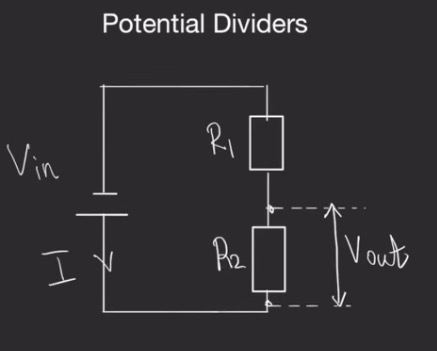
What is potential divider equation?
Vout=R1+R2R2×Vin
Or just use fractions :/

What is ratio between p.d and resistance in potential divider?
V2V1=R2R1
What is relationship between resistance and light intensity?
As L⬆= R⬇

What is relationship between resistance and Temperature ?
As T⬆= R⬇


A Resistor which obey Ohm’s Law is connected in series to an LDR. What will happen to reading of Voltmeter as light intensity increases?
R- Resistance of LDR decreases as light intensity increases. Resistance in circuit has decreased
I- Current in the current has increased
F- The p.d across the fixed resistor has increased as current increased, (if p.d across R increased then p.d across LDR must decrease to sum to fixed emf K 2nd Law)

What is a structure of answering questions relating to potential dividers and resistance?
R- Resistance
I- Current
F- Fixed resistor
What not to do when answering questions about non ohmic conductor?
Use Ohms Law
What is EMF?
The energy transferred per unit charge (passing through a cell- for cells) from other forms (chemical) energy to electrical energy
What is potentially difference?
The energy transferred per unit charge form electrical to other forms
A cell has an emf of 5V.
State what is meant by EMF if 5V
(1) 5J of energy converted from other forms to electrical energy per unit charge
(2) Work Done in moving 1C of charge through the cell
What is internal resistance?
Internal resistance is lost volts per unit of current
What is Terminal P.D?
The actual voltage measured across the terminals of a power source (like a battery or cell) in a closed circuit,
Less than EMF if internal resistance
What is the EMF equation?
ε=Vtermina,p.d+Vlost
ε=I(R+r)
R = external resistance
r = internal resistance
How to measure EMF of cell?
Connect a voltmeter in parallel with no external resistance (switch open)
How to determine internal resistance (practical)?
Vary resistance of variable resistor
Measure current in circuit with ammeter
Measure the terminal p.d with voltmeter
Take multiple readings and average to improve accuracy of experiment
Plot graph of V against I
V=−rI+ε
EMF being y intercept
r being internal resistance

What does practical cell mean in terms of internal resistance?
It can not be ignored (is present)
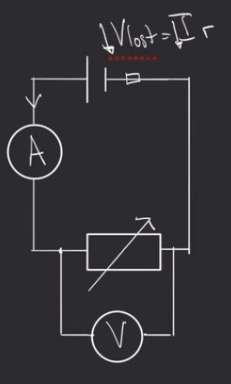
A practical cell with internal resistance is connected as shown.
The resistance of the variable resistor is increased.
State and explain what happens to the reading of the ammeter and the reading of the voltmeter?
The resistance in the circuit increases;
The current in the circuit decreases;
The amount of loss volts decreases;
The terminal p.d. must increase and hence the voltmeter reading increases as it needs to add up to the fixed emf with the lost volts.

How do cells sum if connected in parallel?
EMF is the same and Resistance is the sum of the internal resistance connected in parallel
What is circuit symbol of battery?

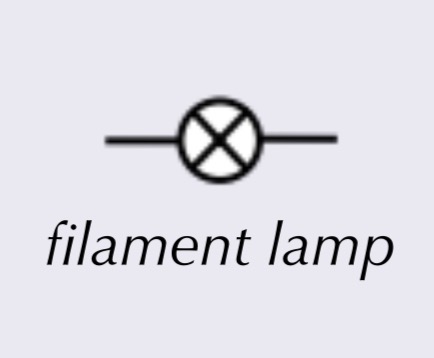
What is circuit symbol of filament lamp?
What is circuit symbol of resistor?

What is circuit symbol of Variable resistor?

What is circuit symbol of fuse?

What is circuit symbol of thermistor?

What is circuit symbol of diode?

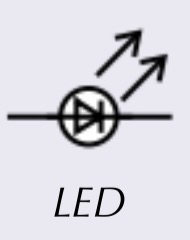
What is circuit symbol of LED?
What is circuit symbol of LDR?

How to convert from J to eV
1eV= 1.602 × 10^-19 J
What is a potentiometer?
It has variable resistor that replaces R1 and R2 in a potential divider and a knob can be spun to determine split of resistance