Bovine Repro problems
 Call Kai
 Learn
Learn Practice Test
 Spaced Repetition
 Match
Match Flashcards
 Knowt Play
1/19

There's no tags or description
Looks like no tags are added yet.
Name | Mastery | Learn | Test | Matching | Spaced | Call with Kai | Chat |
|---|
No analytics yet
Send a link to your students to track their progress
20 Terms
Bovine:What is the major mode of transmission of contagious mastitis causing organisms in cows?
The correct answer is transmission by milker's hands and milking equipment. This is the main factor in the spread of mastitis, and you must work closely with your client in training personnel to apply proper milking techniques.
Bovine:How soon after administration of a dose of dexamethasone for induction of parturition in a cow do you expect parturition?
~48 hours
Bovine:You are asked to evaluate the breeding soundness of a 1-year old, 675 lb Brown Swiss bull. Vital parameters and your general physical examination are unremarkable. You collect semen via electro-ejaculation and note an acceptable semen quantity and quality. Scrotal circumference is 33 cm. You note 2 small penile warts near the tip of the penis that have a broad head and narrow stalk. There are no warts detected elsewhere on the bull and no other abnormalities associated with the penis. What should you recommend to the owner?
You suggest surgical removal and sexual rest for 2-3 weeks.
Surgical damage to the warts frequently stimulates an immune response against BPV-1.
Healing is usually complete within 2-3 weeks.
Penile warts in young bulls are quite common and are caused by bovine papilloma virus-1 (BPV-1) which can also cause warts on the nose or teats.
Warts are very contagious and primarily spread by contamination of facility equipment but also spread directly from bull to bull.
It is not necessary to wait 6 months before breeding.
Scrotal circumference of a 1 year-old bull also varies by breed but >30 cm is typically recommended for breeding at this age.
Bovine:When do bulls reach sexual maturity typically
Bulls typically reach puberty at 9-11 months of age depending on breed.
Bovine:A beef cattle farm in the mountains of California is experiencing an abortion storm affecting about 50% of heifers.
The abortions in the last trimester.
The cows appear healthy
aborted fetuses have hepatosplenomegaly and generalized lymphadenopathy.
aborted fetuses shows lymphoid hyperplasia in the spleen and granulomatous inflammation in the liver.
In the thymus, extensive macrophage infiltration into the medulla was seen as well as loss of cortical thymoctes.
Fetal IgG was markedly elevated.
Based on the likely diagnosis, which of the following measures would decrease the future incidence of this problem?
A.Control of Ponderosa pine trees
B.Control of mosquitoes
C.Avoid feeding silage to heifers
D.Expose heifers to endemic areas before breeding age
E.Vaccinate heifers against bovine herpesvirus
Expose heifers to endemic areas before breeding age
This is the typical presentation for epizootic bovine abortion (EBA), also known as foothill abortion.
With EBA, cows usually do not experience abortions again in later pregnancies and exposure to endemic areas before breeding age can also prevent abortions.
Other control options may include control of the tick vector or prophylactic antibiotic use.
You can lower your index of suspicion for bovine herpesvirus (Infectious bovine rhinotracheitis virus) because there is no respiratory disease seen in this case; abortions from herpesvirus occur throughout pregnancy and fetuses are typically autolyzed with foci of necrosis in the liver or no gross lesions.
Ponderosa pine needle abortions occur in the last trimester but cows are often moribund after delivery and hemorrhage. There are usually no specific fetal lesions.
Bovine:
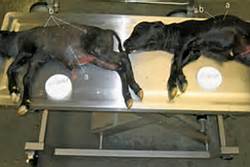
A beef ranch in the oak/brush foothills of California has experienced abortions in 40/200 of their new heifers, and the abortions are continuing. These heifers were purchased from Arizona. The fetuses appear to be about 6 to 7 months gestational age. You take several freshly-aborted fetuses (see image) to the diagnostic lab. The lesions they describe include enlarged superficial cervical lymph nodes, spleen, and liver. The thymus is slightly smaller than normal. Based on this information and the history that these animals were not locally raised, you make a tentative diagnosis of epizootic bovine abortion (EBA), also known as foothill abortion. The rancher asks you for information on how best to avoid this scenario again in the future. What is the best preventative strategy?
A.Provide hay periodically so that heifers do not eat oak
B.Feed tetracycline to pregnant heifers for 9 months
C.Raise heifers in the foothills and put pregnant heifers in the hills only when 6 months or more pregnant
D.Vaccinate heifers against Chlamydia psittaci
E.Put ear tags on all heifers to keep ticks off before putting the heifers in the foothills
After decades of research, a novel deltaproteobacterium was identified as the causative agent of EBA in 2005. The disease is transmitted by a ground-dwelling soft tick, Ornithodoros coriaceus. Abortion occurs more than 3 to 4 months after exposure, so keeping pregnant heifers out of the foothills until they are 6 months pregnant means they calve before fetal lesions occur. Raising heifers in the foothills until breeding does provide premunition immunity. Also, the rancher should keep these heifers that abort, as they will now be immune to EBA. Tick control is very difficult on cattle running in the hills, but the ticks do not inhabit irrigated pastures (they live in the dry ground duff of needles and leaves), so bred heifers can be kept in irrigated pastures for months 1-6 of pregnancy. Feeding tetracycline for 9 months is not practical. As of 2019, there is no commercially available vaccine. However, since 2009 the University of California at Davis has been doing field trials on a live bacteria vaccine that has shown promising efficacy.
Bovine:An owner wishes to abort a fetus in his cow which may be pregnant because it was bred by the neighbor's bull that had jumped over the fence 1 week previously. What is the best way to induce abortion?
A.Give PGF2-alpha
B.Give oxytocin
C.Give dexamethasone
D.Give estrogen
The correct answer is to give PGF2-alpha. Remember that PGF2-alpha will lyse the corpus luteum. If it has been less than 4 months (which it likely has) the corpus luteum is still the main contributor of progesterone and destroying it will induce abortion. After 4 months, the placenta helps contribute progesterone for a few months. However, during the last month of pregnancy the placenta does not contribute significantly to progesterone production. Therefore, just giving PGF2-alpha during the last month will also cause abortion. To induce abortion anywhere in between you will need PGF2-alpha and dexamethasone. Additionally, to induce parturition during the last month of pregnancy, dexamethasone can be used because it will mimic the fetal rise of cortisol, followed by parturition, including production of fetal pulmonary surfactant.
Bovine:How many injections and at what spacing is PGF2-alpha given to synchronize a dairy cow?
A.Only one injection is necessary
B.4 injections approximately 11-14 days apart
C.2 injections approximately 11-14 days apart
D.2 injections approximately 5 days apart
The correct answer is 2 injections approximately 11-14 days apart. This will assure that those that had an immature, unresponsive, corpus luteum during the first shot are synchronized on the second shot. Additionally, those that were synchronized on the first injection will have a corpus luteum that will be responsive to PGF2-alpha in 11-14 days. Giving 4 injections is not necessary. If you give the injections at 5 days apart you run the risk of having CLs that are unresponsive because they are not mature enough and they won't lyse.
Bovine:On a pregnancy check of a cow, crepitus can be felt upon palpation of the uterus, and there are no positive signs of pregnancy. What is the most likely diagnosis?
A.Mummified fetus
B.Ruptured uterus
C.Pyometra
D.Macerated fetus
The correct answer is macerated fetus. The key to making this diagnosis is in feeling the crepitus, which is caused by bacterial degradation of the fetus. A mummified fetus is a sterile fetus in which all fluids are resorbed, leaving a firm tarry mass. With pyometra, the uterus will be distended with pus. Pyometras are usually seen post-partum. If you see one post-coital, consider Tritrichomonas foetus.
Bovine:A dairyman's favorite cow was bred by a new bull a few weeks ago and now his cow has pyometra. What agent is most likely responsible for causing the cow's pyometra?
A.Brucellosis
B.Campylobacter fetus
C.Leptospirosis
D.Tritrichomonas foetus
The correct answer is tritrichomonas foetus. This organism is commonly associated with a post-coital pyometra in addition to causing early embryonic death. Campylobacter is a cause of early embryonic death but does not usually result in pyometra. Brucella will result in late term abortion. Leptospirosis is a cause of mid- to late-gestation abortions and not post-coital pyometras.
Bovine:
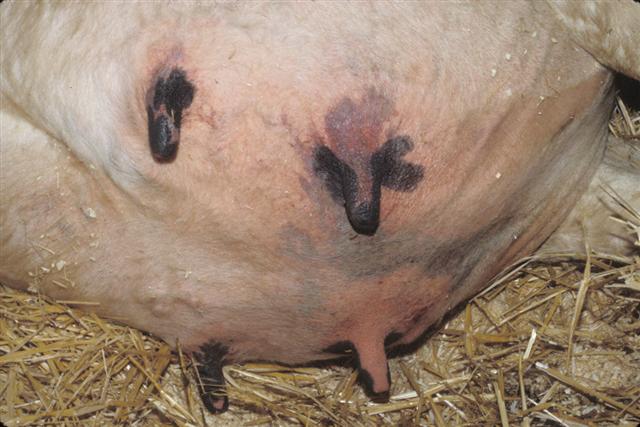
You examine a very ill 4-year old Holstein dairy cow on a large commercial dairy. She freshened one week ago and was producing well, until she was found down and unwilling to rise this morning when you were called. T=103F or 39.4 C, HR=90, and RR=35. The scleral vessels are dark are enlarged, her rumen is fairly empty and the motility is poor, and she appears too weak to rise. Rectal exam reveals an involuting uterus which can be retracted, discharging a brownish red mucoid non-odorous lochia through the vagina. The left rear quarter of her udder is swollen, hot, painful, and discolored (see image), and contains a serum-like secretion with clumps of fibrin in it. What is your diagnosis?
A.Hypocalcemia (milk fever)
B.Displaced abomasum
C.Metritis
D.Grain overload
E.Coliform mastitis
This is a case of severe acute coliform mastitis, and the absorbed endotoxin (LPS) is causing many of the systemic signs observed. The cow needs to be aggressively treated with IV fluids, NSAIDS, and supportive nursing. The gland should be frequently milked out. The use of both intramammary and systemic antimicrobial drugs to which most coliforms are susceptible is still controversial, but is often done in cows in a severe state of illness as in this case. While this cow may have secondary hypocalcemia, treatment with calcium needs to be approached cautiously, as endotoxic animals have very sensitive myocardium and arrest may occur if calcium is given IV. If given, preferred routes of calcium administration would be subcutaneous or oral.
Bovine:A California dairy herd has been experiencing repeat breeders, several abortions, weak calves and some congenital defects including cerebellar hypoplasia, cataracts, and thymic hypoplasia. Which of the following disease agents should you investigate as the most likely cause of these problems?
A.Bovine viral diarrhea virus (BVDV)
B.Vesicular stomatitis virus
C.Mycobacterium avium subsp paratuberculosis
D.Malignant catarrhal fever virus
E.Mycoplasma bovis
BVD virus causes all these problems, as well as persistently infected neonatal calves when the fetus is infected with the NCP biotype of BVD at 2 to 5 months gestational age.
Bovine: Important milesstones during bovine gestation
A beef cow presents for palpation at approximately 30 days of gestation. Which positive sign of pregnancy will be present?
The correct answer is chorioallantoic membrane slip. Placentomes will be palpable starting between 75-90 days of gestation. The fetus itself will be palpable beginning at approximately 60 days, but may be out of reach between months 4-7 of gestation. Uterine artery fremitus will be evident on the ipsilateral pregnant horn at about 120 days of gestation. From 7 months on, fremitus is palpable bilaterally. Fremitus does not necessarily indicate a viable pregnancy.
Bovine:At what point is the placenta of a cow considered retained?
A.2 hours post-partum
B.12 hours post-partum
C.48 hours post-partum
D.6 hours post-partum
The correct answer is after 12 hours. Usually, the fetal membranes are passed in 2 to 8 hours; after 12 hours, it is considered retained. Retained placenta appears to occur more commonly in dairy than beef cattle. The rates are reported to be in the range of 8 to 12 % of all single births in dairy cows.
Bovine:
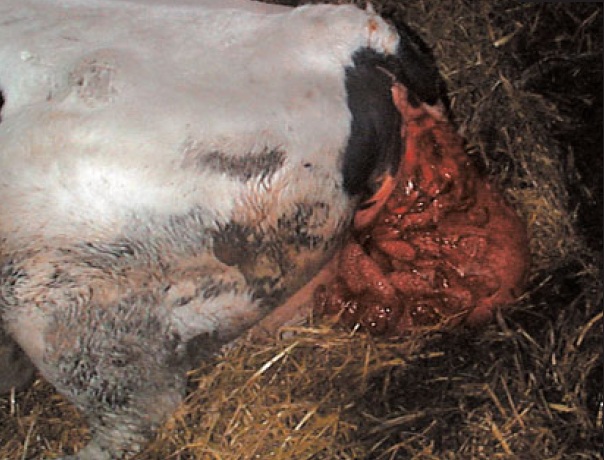
You are called out early in the morning to examine a recumbent 7-year-old Friesian cow which calved at some stage during the night and is now unable to rise with the abnormality seen in the picture. What should you do?
A.Administer epidural anesthetic and excise the extruded tissue
B.Administer epidural anesthetic, reduce and retain the rectum with a purse-string suture that is loose enough to allow 2 fingers into the opening, administer fecal softeners
C.Administer epidural anesthetic, remove attached fetal membranes, clean and lubricate the uterus and replace in normal position, then administer oxytocin and calcium gluconate
D.Administer epidural anesthetic, empty the bladder if necessary, lubricate the vagina and replace in normal position, place a Buhner suture around the vestibule at the point at which the initial eversion of the vaginal wall occurred
This is a case of uterine prolapse. Because images may sometimes be difficult to differentiate uterine versus other prolapses, the clinical history can be useful in helping differentiate which type of prolapse is likely. Uterine prolapse occurs immediately or within hours of parturition. Vaginal prolapse occurs primarily in late pregnancy. Rectal prolapse is typically associated with straining to defecate.
The uterus is more easily replaced if the cow is standing. If she remains recumbent it may help to put her sternal and pull both hind legs into a position behind her.
The oxytocin will help involute the uterus and expel fluids, and the calcium gluconate will help treat or prevent hypocalcemia. Do not give oxytocin before replacing the uterus because this makes it turgid and much more difficult to replace. Although not mentioned in any of the answer choices, administration of an antibiotic (i.e. oxytetracycline) may be useful to reduce metritis.
If the cow remains down and unable to rise, she should be lifted using a flotation tank. The sooner this is done, the more likely she is to recover
Bovine:You are at a dairy trying to solve a mastitis problem. You perform a physical exam on a cow with mastitis and notice serum-like secretion with clots from two of the teats, and the affected quarters are hot and swollen. The cow has a fever of 104 F , rapid HR of 100 bpm, and is not eating well. What can you tell the dairyman with a fair degree of confidence about the type of mastitis this is likely to be?
A.This cow is infected with a coliform
B.This cow is infected with Trueperella pyogenes
C.This cow is infected with Mycoplasma mycoides
D.This cow is infected with Staphylococcus aureus
The correct answer is this cow is infected with a coliform. This is a typical secretion and other clinical signs with coliform mastitis, although coliform mastitis can also present with mild clinical signs. Trueperella pyogenes mastitis is usually thick pus and the cow is not so ill. Staph aureus can also cause systemic signs of illness , or gangrenous mastitis when severe. It is usually found in a herd without a comprehensive mastitis prevention and control program. Mycoplasma bovis and a few other species can cause mastitis in cows, but M mycoides is mainly a problem of mastitis in does and systemic illness and arthritis in young goats.
Bovine:What is the normal presentation and position at birth of a calf?
Anterior presentation, dorso-sacral position, front limbs extended
Bovine:It is a cold November day when you are called out to a local cow-calf operation. A pregnant cow has aborted in its 6th month of gestation. On physical exam of the cow, you observe the following symptoms: fever, conjunctivitis, salivation, marked erythema of the nasal mucosa and muzzle, and copious nasal discharge. You perform a necropsy on the aborted fetus. Lesions discovered include renal edema, acute general necrosis in the liver, spleen, kidney, lungs, and adrenal glands, widespread hemorrhage, petechiae, and thickened amnion without signs of inflammation. What would be your next step to confirm a diagnosis?
A.Agar gel precipitation test
B.Blood smear examination
C.Bacterial culture and isolation
D.Histopathology and virus isolation
This cow has Infectious Bovine Rhinotracheitis (IBR). Bovine herpesvirus 1 (BHV-1) causes Infectious Pustular Vulvovaginitis (IPV) and IBR. The latter disease is a major cause of abortion. IBR manifests as upper respiratory tract disease and abortion. Naïve herds may experience abortion rates as high as 25% to 60%. Immune dams may not experience abortion.
In naïve animals, the virus is carried in the leukocyte and can become localized in placental tissues. Although other stages of pregnancy may be affected, 5 to 6 month's gestation is the most susceptible stage.
Diagnosis of IBR is made by virus isolation from the placenta, identification of intranuclear inclusion bodies in fetal tissues, immunohistochemistry or virus neutralization (VN) testing. If the latter is to be used, at least two samples must be taken days apart. The first must be negative and the second positive, or the first must be positive and the second titer must show a four-fold increase.
Serum testing may not be helpful because the dam may have been infected months before the abortion and the titer after abortion may actually be falling.
Bovine:A young bull presents for a breeding soundness exam. What is the minimum recommended percentage normal morphology of sperm?
The correct answer is 70% normal. To be a satisfactory potential breeder, a bull must meet certain requirements including a normal physical exam, adequate scrotal circumference, sperm motility of at least 30% motile, and sperm morphology of at least 70% normal.
Bovine:When formulating late gestation anionic diets for dairy cows to help prevent hypocalcemia in the last 2 to 3 weeks prior to calving, what formula is used?
DCAD = (Na + K) - (Cl + S)
DCAD stands for Dietary Cation Anion Difference. Na=sodium, K=potassium, Cl=chloride, and S=sulfur. These are the 4 most important strong ions to be considered. When the diet is optimal the urine pH of Holstein cows should range between 6.2 and 6.8 for cows on the ration.