learning and memory
 Studied by 0 people
 Call Kai
 Learn
Learn Practice Test
 Spaced Repetition
 Match
Match Flashcards
 Knowt Play
1/29

There's no tags or description
Looks like no tags are added yet.
Name | Mastery | Learn | Test | Matching | Spaced |
|---|
No study sessions yet.
30 Terms
patient EP cause of memory issues
acute viral infection that destroyed parts of his brain
destroyed temporal lobes → new items are not recorded but old are intact
patient EP memory issues and role of hippocampus
can copy complex diagrams, repeated items, repeats stories without realizing
cannot recall names, words in a few minutes
message
hippocampus does not store long term memory
creates new long-term memories (explicit)
engram
neural representation of memories
cortical lesions
impaired learning
cortical transections
failed to block learning
Lashley findings
1st researcher of brain mechanisms of learning/memory
examined learning in rats following transections and lesions of cortical regions
size determined impairment
larger lesions = bigger impairment
location does not matter
Lashley’s conclusions
equipotentiality: all areas of the cortex are equally involved in memory
mass action: ability to form memories depends only on the mass (amount) of brain
patient HM
epilepsy as a child, center at hippocampus
doctors removed hippocampus and adjacent structures
lost the ability to form new episodic memories (anterograde amnesia)
suffered temporarily from retrograde amnesia
patient HM and learning
could still learn skilled movements (such as tracing outlines of a star)
evidence of learning
hippocampus is involved in episodic memories NOT long-term storage site
amnesia types
anterograde: impairs abilities to form new memories
retrograde: impairs ability to recall old memories
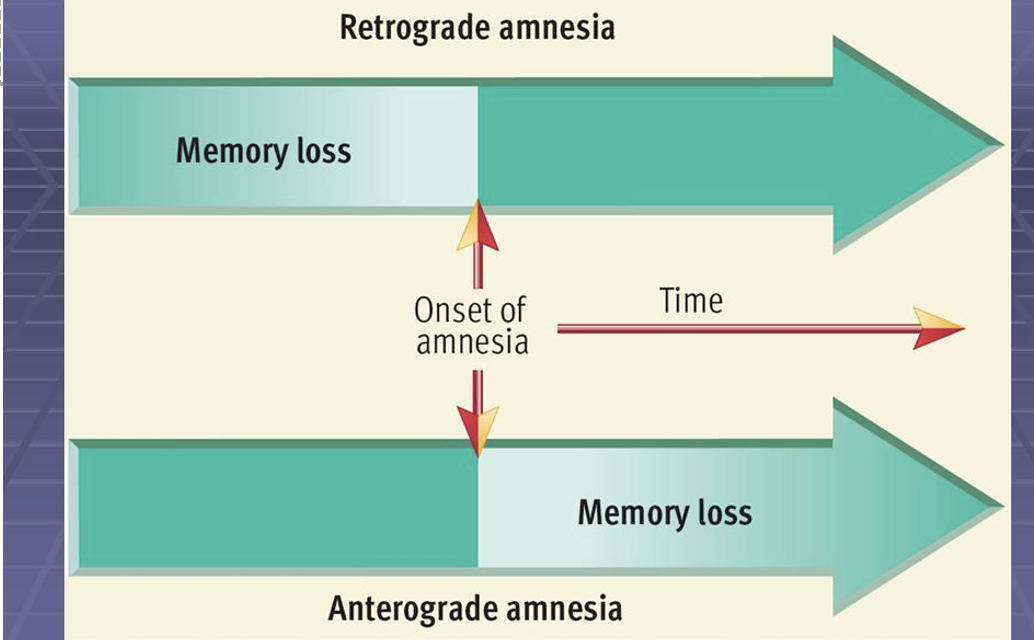
clive wearing
lost memory 20 years ago, can only remember his wife
30 second memory (gives the answer, but forgets the question)
lesions are not limited to just the hippocampus
mix of retrograde and anterograde amnesia
hippocampus in memory in rodents, Morris Water Maze
Morris Water Maze - Memory test
hidden platform
over time, the rat took less time to reach the platform
lesion of hippocampus showed no change HOWEVER the rat spent more time in the quadrant
without a hippocampus, the mice could not form memory of the location of the platform
synaptic plasticity hypothesis
experience can leave a memory trace by causing long-lasting changes in synaptic connections
synapse is not hardwired
strengthening of the synapse → increase neurotransmitter release
hebbian plasticity/learning
if cell A persistently and repeatedly excites cell B, the efficacy of the synapse between them will increase
efficacy of the synapse will increase (causing bigger EPSPs)
long-term potentiation (LTP)
potential mechanism for experience-dependent synaptic plasticity
neural circuit in the hippocampus (trisynaptic circuit)
pathway: entorhinal cortex → dentate gyrus → CA3 → CA1 → cortex
experiment
stimulating electrode in dentate gyrus
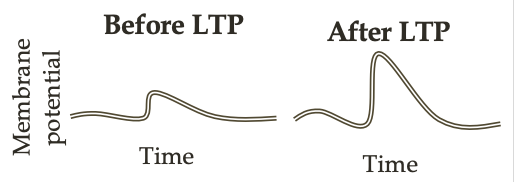
before LTP: weak EPSPs (mild depolarization)
inducing LTP: high-frequency stimulation produces repetitive EPSPs on post-synaptic cell
after LTP: stronger EPSPs; sensitive post-synaptic neuron
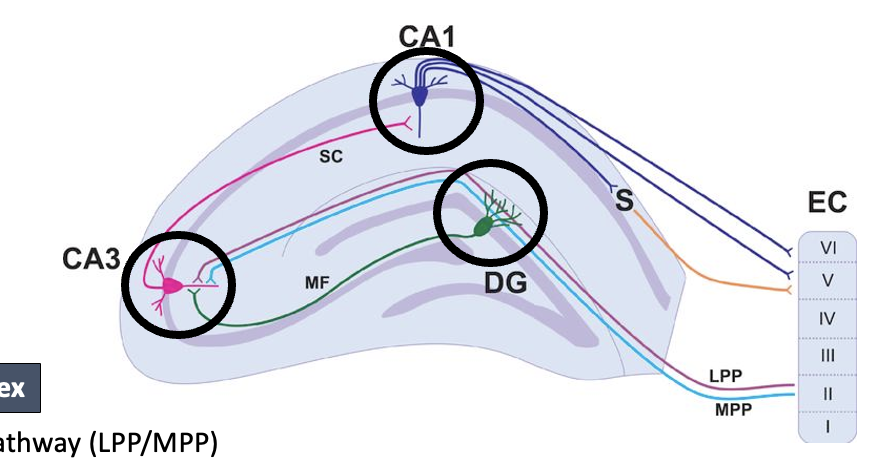
measuring LTPs
stimulating the presynaptic axon causes bigger EPSPs in the postsynaptic cell
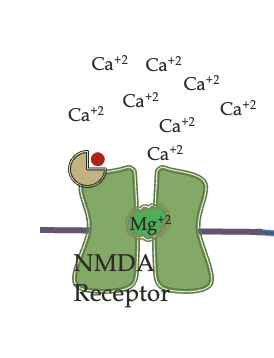
NMDA receptor
opens a calcium channel
at resting membrane potential, HOWEVER, the NMDA calcium channel is blocked by a magnesium ion
when glutamate binds to the NMDA receptor, the channel does not allow calcium to enter
AMPA receptor
binding of glutamate to an AMPA receptor causes sodium channels to open
results in depolarization/EPSP
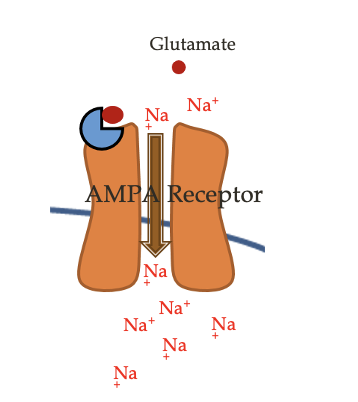
AMPA and NMDA receptors
glutamate binding to AMPA causes depolarization
strong and persistent depolarization repels the magnesium ion in the NMDA
calcium enters the cell
calcium activates second messenger cascades (long lasting changes)
calcium → second messenger cascades
transport of intracellular AMPA receptors to the membrane
changes in gene expression that results in production of more AMPA
how could LTP underline memory in a network of neurons?
example: viewing movies (pattern completion: reinstatement of memory with a partial cue)
you see a movie; LTP strengthens connections; you see an ad for that movie; reminded of the movie (activation of the same neurons)
activation over and over → increases LTP strength
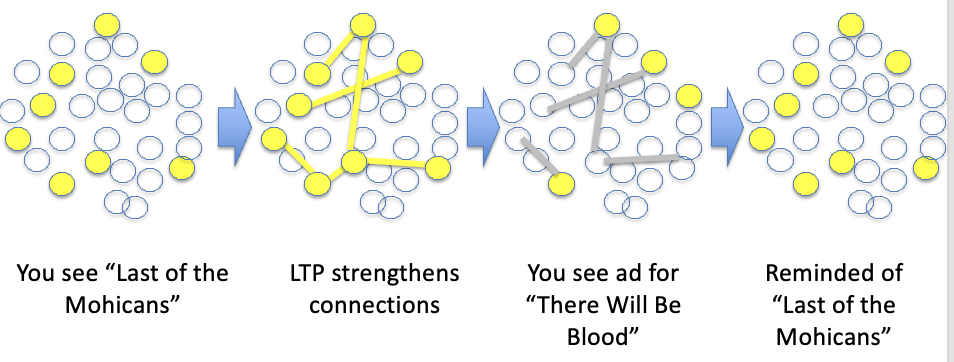
pattern completion
reinstatement of memory with a partial cue
during experience, activity patterns strengthen specific connections in local circuit
activation of the subset of original representation results in reinstatement of original experience
hippocampus and time-limited role in memory in rodents
experiment
mice trained to locate position of baited arm
either day 1 or 30 days, the hippocampus was inactivated and mice tested for memory activation
inactivation of memory
disrupted recent but not remote memory retrieval
after 30 days, memory depended on other brain areas
findings
hippocampus is biredirectionally connected to the cortex
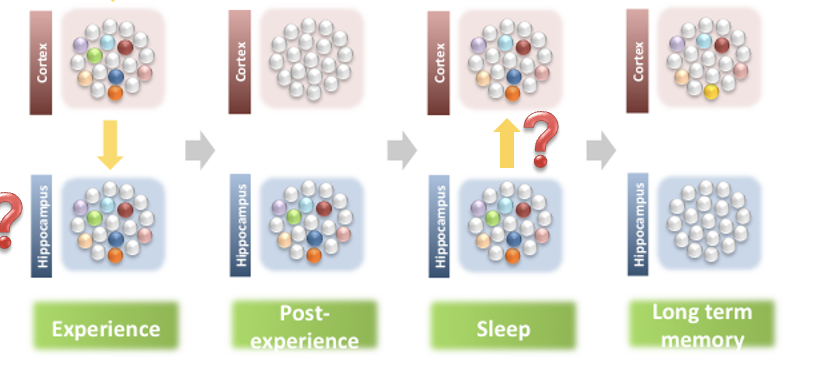
systems-level memory formation (memory encoding and consolidation)
during experience (online): info is temporarily stored in the hippocampus via LTP or similar (memory encoding)
after experience (offline): info is gradually transferred from the hippocampus to the cortex (memory consolidation)
when memory consolidation occurs
at times with no new experiences
sleep/rest
sleep
beneficial for memory formation
lack of sleep slows memory consolidation
2-stage model for memory formation in the hippocampal cortical circuit
information to cortex after experience to the hippocampus
representations in the hippocampus, not in the cortex
hippocampus → cortex repeatedly (1000 times)
remains in cortex after memory consolidation
electrophysiological recordings
experiment
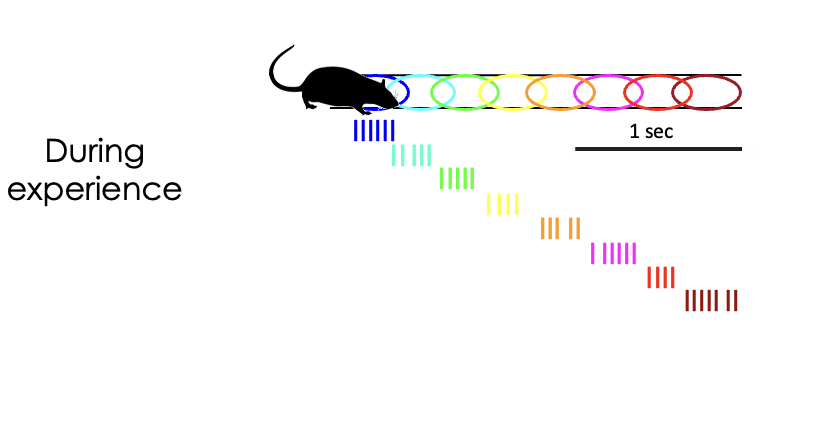
rodents traversing (experience)
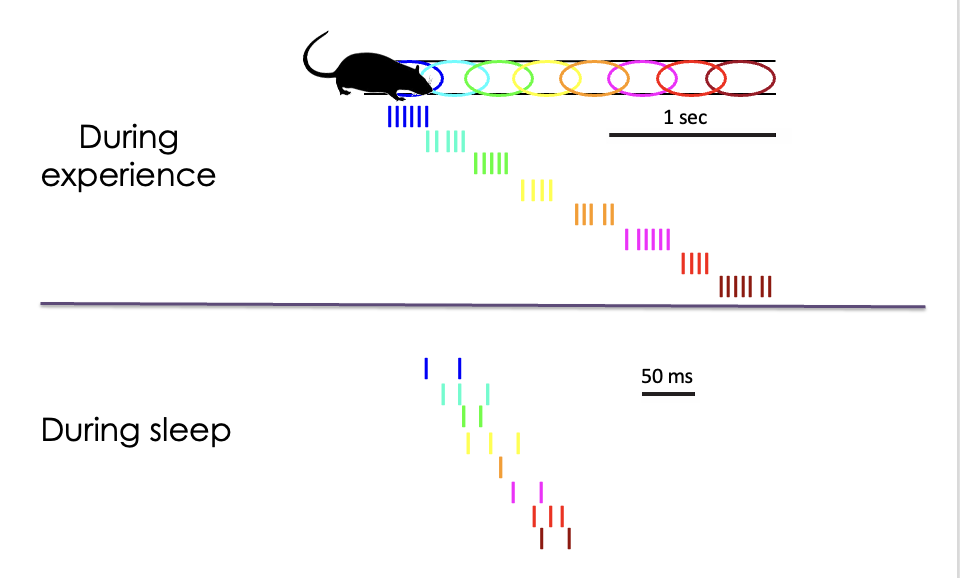
place cells (firing at specific places in the hippocampus)
trajectory (codes for location and path; left to right)
trajectories in space are encoded by sequences of hippocampal place cell spiking
DURING experiment: place and trajectories in space
hippocampus during sleep
hippocampal replay: time-compressed re-occurrence of same sequence of place-cell firing as during behavior
reflects recent experience
generated in hippocampus and prominent in sleep
coordinated with cortical regions
supports learning
space vs memory
hippocampus in rodents most strongly encodes/replays spatial locations
hippocampus in humans critical for episodic memory
episodic memory is a mental travel in time / space referenced to self
episodic memory may share evolutionary origin with navigation