oat bio unit 24
 Call Kai
 Learn
Learn Practice Test
 Spaced Repetition
 Match
Match Flashcards
 Knowt Play
1/35

Earn XP
Description and Tags
this is the one where i gave birth remember?
Name | Mastery | Learn | Test | Matching | Spaced | Call with Kai | Chat |
|---|
No analytics yet
Send a link to your students to track their progress
36 Terms
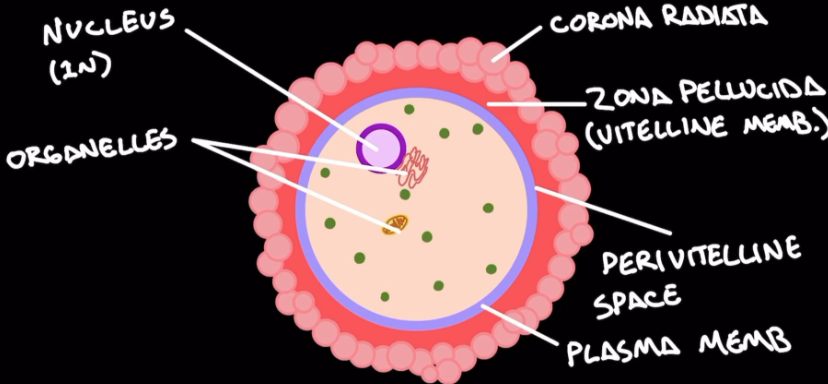
oocyte
immature egg inside ovary
ovum
mature egg outside of ovary
Corona radiata: superficial layer
Zona pellucida: protective glycoprotein layer
Perivitelline space: between zona pellucida and plasma membrane; prevents polyspermy.
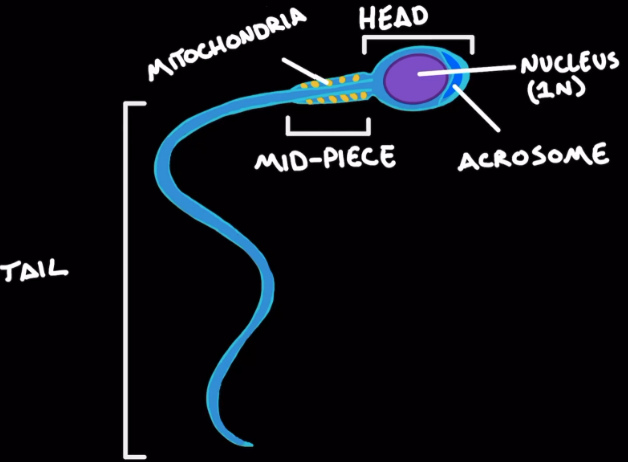
sperm
Head: contains acrosome to dissolve egg and also a 1n nucleus.
Midpiece: filled with mitochondria.
Tail: propellor
capacitation
a process to mature sperm when they enter the uterus and fallopian tubes, caused by acidic vaginal wall and basic seminal fluid.
A glycoprotein coat is added to each sperm in epididymus.
Enzymes in the uterus digest glycoprotein coat.
Also destabilizes the acrosome and induces tail hyperactivity.
fertilization
Haploid sperm fuses with haploid ovum to make a diploid zygote.
Only ~300 sperm make it to the egg.
The zona pellucida has 4 binding sites.
ZP3 makes sperm release acrosin, which breaks down the ZP, allowing a sperm inside.
The sperm equator fuses with the membrane, and releases nucleus into egg.
sex determination
Eggs only carry and X chromosome
Sperm can carry X or Y
This means a 50/50 chance of a boy or girl.
XX = girl, XY = boy
polyspermy
One egg fertilized by multiple sperm.
Fast block: egg immediately emits sodium ions upon being fertilized to depolarize the cell, preventing other sperm from fusing.
Slow block: calcium ions are sent towards the egg membrane for the cortical reaction, which flood the perivitelline space.
cleavage (yes please)
rapid cell division with no cell growth (1 parent to 2 daughter cells). A cleavage furrow divides the cells.
blastomeres
resulting cells formed by cleavage of a fertilized ovum.
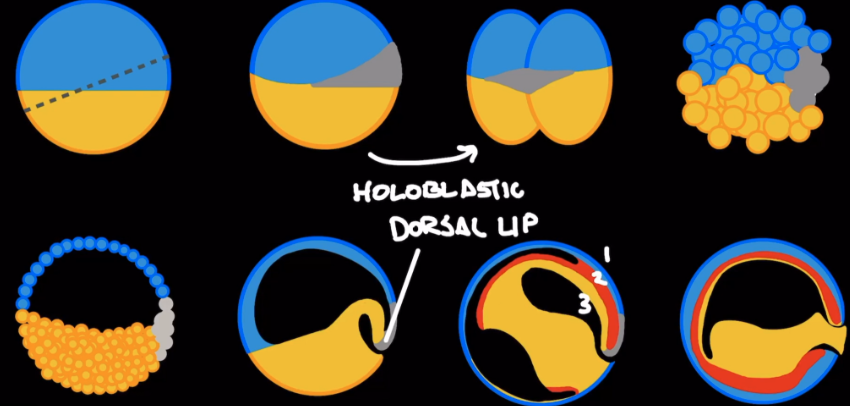
holoblastic cleavage
cleavage EQUALLY divides fertilized ovum in two pieces.
meroblastic cleavage
partial or unequal cleavage, leading to different sized blastomeres.
determination
cell decides which type of cell it will be in the future, and chooses which genes to express.
differentiation
Cell is expressing desired genes for whichever role it will fulfill (happens after determination)
indeterminant blastomeres
haven’t picked a role yet. They can separate from the rest of the zygote and form a new organism
radial cleavage
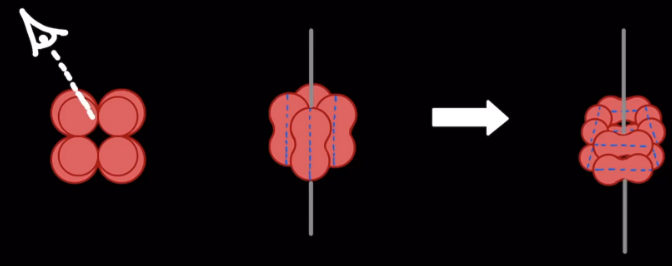
spiral cleavage
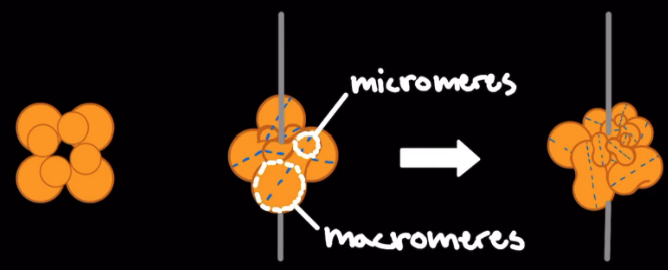
protosomes
determinant and undergo spiral cleavage.
deuterosomes
indeterminant and undergo radial cleavage.
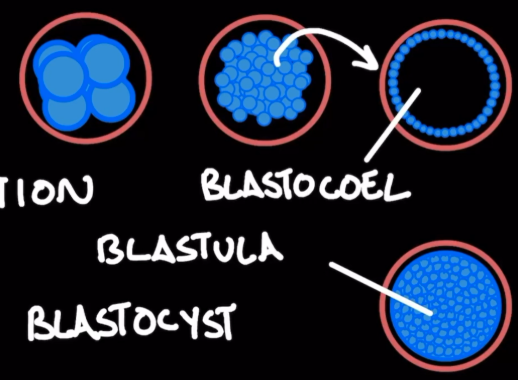
blastulation
Zygote → morula → blastula
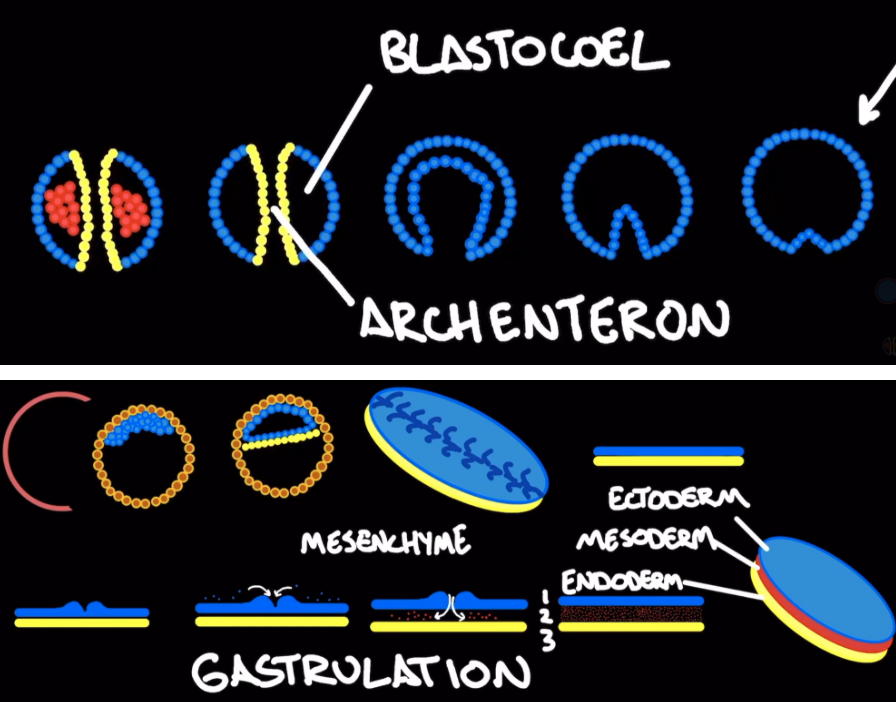
gastrulation
blastula becomes gastrula
Gives rise to germ layers (ectoderm, mesoderm, ectoderm)
trophoblast
gives rise to the placenta (chorion) and is responsible for implantation into the endometrium of the uterus.
Also produces human chorionic gonadotropin (HCG) which stops menstruation
inner cell mass
bilaminar disc made of epiblast and hyperblast. The epiblast has a cavity with amniotic fluid.
frog eggs
Very large in size, and are deposited in water.
Vegetal pole: slow rate of cleavage, lots of yolk
Animal pole: fast rate of cleavage, little yolk
Grey crescent is created by overlapping of poles.
bird eggs
Have a blastodisc instead of a blastula (tiny white circle on yolk).
Chalaza: white strings that anchor yolk to the rest of the egg.
Elongated blastopore.
amniotes
Birds, reptiles, mammals
anamniotes
Amphibians and fish
chorion
responsible for gas, nutrient, and waste exchange.
allantois
stores and later exchanges embryo waste products like uric acid, and later becomes the umbilical cord.
yolk sac
gives nutrients to the embryo.
amnion
membrane surrounding embryo with amniotic fluid.
induction
Cell influences the development of neighboring cells.
neurulation
Notochord thickens a structure called the neural plate, which later folds.
The folds pinch off to later become the brain and spinal cord.
ectoderm derivatives
Epidermis: hair, nails, sweat glands, mammary glands.
Neural tube (nervous system)
Adrenal medulla
Skull: bones, muscles, connective tissues
PNS: sensory neurons and glial cells
endoderm derivatives
Epithelial lining: GI, respiratory, and urinary tract
Excretory system
Liver, lungs, pancreas
Thyroid and thymus
mesoderm derivatives
Bones, cartilage, joints, muscles
Connective tissue
Circulatory system
Lymphatic system, kidneys, spleen
poop cleavage