Lecture 4: Cranial Nerves, Nuclei and Pathways - QUIZ 낱말 카드 | Quizlet
 Call Kai
 Learn
Learn Practice Test
 Spaced Repetition
 Match
Match Flashcards
 Knowt Play
1/184

There's no tags or description
Looks like no tags are added yet.
Name | Mastery | Learn | Test | Matching | Spaced | Call with Kai | Chat |
|---|
No analytics yet
Send a link to your students to track their progress
185 Terms
a
optic nerve II
a) sensory
b) motor
c) parasympathetic autonomic
d) b & c
e) a, b & c
b
oculomotor nerve III
a) sensory
b) motor
c) parasympathetic autonomic
d) b & c
e) a, b & c
e
Trigeminal nerve V
a) sensory
b) motor
c) parasympathetic autonomic
d) b & c
e) a, b & c
b
Trochlear nerve IV
a) sensory
b) motor
c) parasympathetic autonomic
d) b & c
e) a, b & c
b
Abducens nerve VI
a) sensory
b) motor
c) parasympathetic autonomic
d) b & c
e) a, b & c
e
Facial nerve VII
a) sensory
b) motor
c) parasympathetic autonomic
d) b & c
e) a, b & c
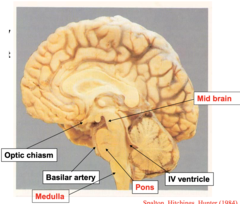
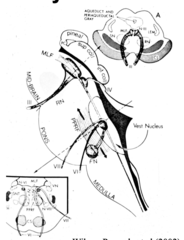
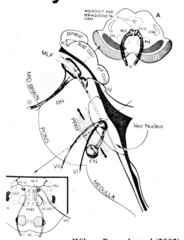
brain stem
The majority of the cranial nerves (except CNI and CNII) have nuclei that originate where?
Mesencephalic nucleus
What is 1?
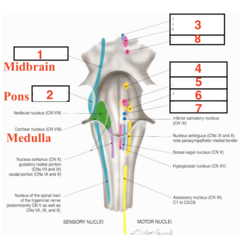
pontine sensory nucleus
What is 2?
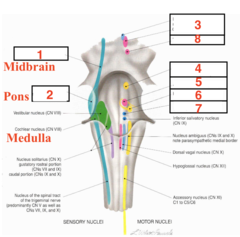
Edinger-Westphal nucleus (CN III)
What is 3?
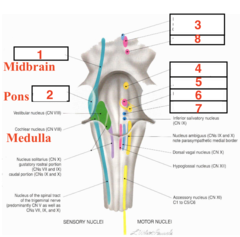
trigeminal motor nucleus (masticator) (V)
What is 4?
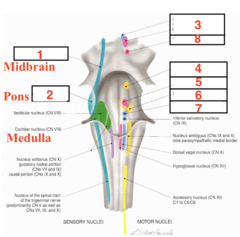
abducens nucleus (VI)
What is 5?
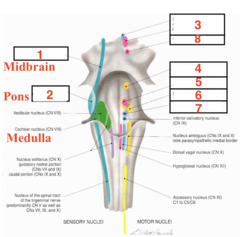
facial nucleus (VII)
What is 6?
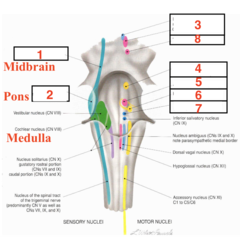
superior salivatory nucleus (VII)
What is 7?
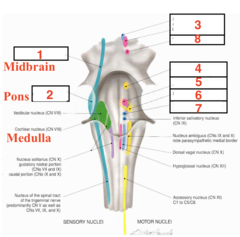
trochlear nucleus (IV)
What is 8?
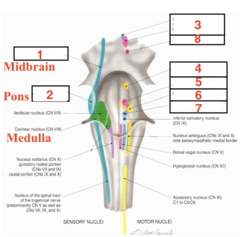
oculomotor nucleus (III)
Which nerve nucleus has the highest position in the brain stem?
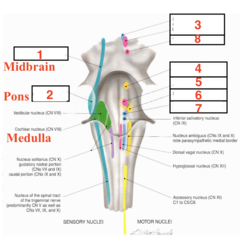
a
Which is true?
a) Sensory nuclei larger than motor nuclei
b) Motor nuclei larger than sensory nuclei
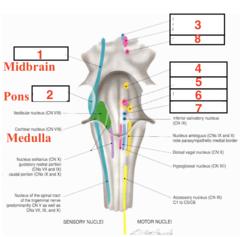
Medial Longitudinal Fasciculus Bundle
What is connecting between the brainstem nuclei?
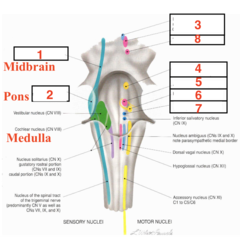
a
Special sensory: Retinal signals to brain (vision)
a) optic nerve (II)
b) oculomotor nerve (III)
c) trochlear nerve (IV)
d) Trigeminal nerve (V)
e) Abducens nerve (VI)
f) Facial nerve (VII)
b
Motor to SR, IR, MR, IO and levator;
Autonomic to iris and ciliary body
a) optic nerve (II)
b) oculomotor nerve (III)
c) trochlear nerve (IV)
d) Trigeminal nerve (V)
e) Abducens nerve (VI)
f) Facial nerve (VII)
b
Autonomic to iris and ciliary body
a) optic nerve (II)
b) oculomotor nerve (III)
c) trochlear nerve (IV)
d) Trigeminal nerve (V)
e) Abducens nerve (VI)
f) Facial nerve (VII)
b
Motor to SR, IR, MR, IO and levator;
a) optic nerve (II)
b) oculomotor nerve (III)
c) trochlear nerve (IV)
d) Trigeminal nerve (V)
e) Abducens nerve (VI)
f) Facial nerve (VII)
c
Motor to SO
a) optic nerve (II)
b) oculomotor nerve (III)
c) trochlear nerve (IV)
d) Trigeminal nerve (V)
e) Abducens nerve (VI)
f) Facial nerve (VII)
d
Motor: to lower jaw, muscles of mastication
Sensory: to cornea, surrounding ocular and other tissues including nose, face and scalp, mucous membranes, tongue and teeth
a) optic nerve (II)
b) oculomotor nerve (III)
c) trochlear nerve (IV)
d) Trigeminal nerve (V)
e) Abducens nerve (VI)
f) Facial nerve (VII)
d
Motor: to lower jaw, muscles of mastication
a) optic nerve (II)
b) oculomotor nerve (III)
c) trochlear nerve (IV)
d) Trigeminal nerve (V)
e) Abducens nerve (VI)
f) Facial nerve (VII)
d
Sensory: to cornea, surrounding ocular and other tissues including nose, face and scalp, mucous membranes, tongue and teeth
a) optic nerve (II)
b) oculomotor nerve (III)
c) trochlear nerve (IV)
d) Trigeminal nerve (V)
e) Abducens nerve (VI)
f) Facial nerve (VII)
e
Motor to LR
a) optic nerve (II)
b) oculomotor nerve (III)
c) trochlear nerve (IV)
d) Trigeminal nerve (V)
e) Abducens nerve (VI)
f) Facial nerve (VII)
f
Somatic motor: orbicularis, frontalis, muscles of facial expression; Autonomic motor: submaxillary, sublingual salivary glands, lacrimal gland;
Sensory: skin behind ear; Special sensory to tongue/palate
a) optic nerve (II)
b) oculomotor nerve (III)
c) trochlear nerve (IV)
d) Trigeminal nerve (V)
e) Abducens nerve (VI)
f) Facial nerve (VII)
f
Somatic motor: orbicularis, frontalis, muscles of facial expression;
a) optic nerve (II)
b) oculomotor nerve (III)
c) trochlear nerve (IV)
d) Trigeminal nerve (V)
e) Abducens nerve (VI)
f) Facial nerve (VII)
f
Autonomic motor: submaxillary, sublingual salivary glands, lacrimal gland;
a) optic nerve (II)
b) oculomotor nerve (III)
c) trochlear nerve (IV)
d) Trigeminal nerve (V)
e) Abducens nerve (VI)
f) Facial nerve (VII)
f
Sensory: skin behind ear; Special sensory to tongue/palate
a) optic nerve (II)
b) oculomotor nerve (III)
c) trochlear nerve (IV)
d) Trigeminal nerve (V)
e) Abducens nerve (VI)
f) Facial nerve (VII)
Trochlear Nerve (IV)
All except which nerve leave ventral surface of brain stem, up the surface to reach required height to advance forward to the orbit?
Facial Nerve (VII)
All pass through cavernous sinus on route to orbit, except for what nerve?
Oculomotor nerve (III), Trochlear (IV), Abducens (VI), Ophthalmic (V1), Maxillary (V2)
What nerves through cavernous sinus on route to orbit?
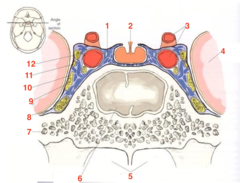
Cavernous sinus
A venous sinus located posterior to the orbit in middle cranial fossa.
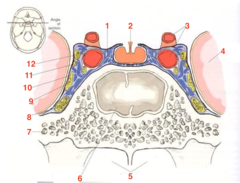
posterior to the orbit in middle cranial fossa
Cavernous sinus is a venous sinus located where?
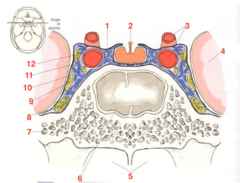
cavernous sinus
What is 1?
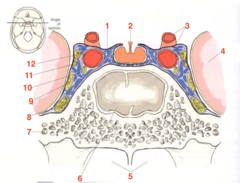
pituitary gland
What is 2?
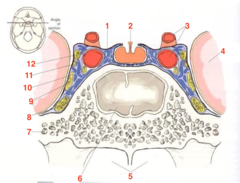
internal carotid artery
What is 3?
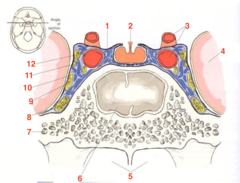
temporal lobe
What is 4?
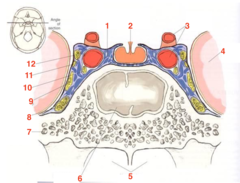
sphenoid sinus
What is 6?
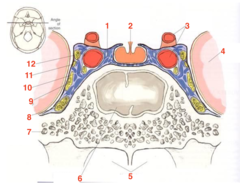
sphenoid bone
What is 7?
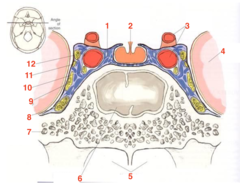
maxillary division of trigeminal nerve (V2)
What is 8?
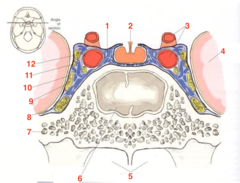
ophthalmic division of trigeminal nerve (V1)
What is 9?
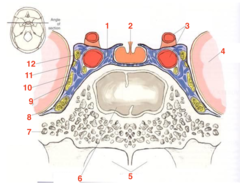
abducens nerve
What is 10?
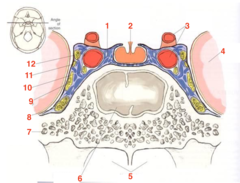
trochlear nerve
What is 11?
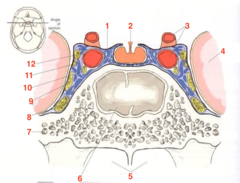
oculomotor nerve
What is 12?
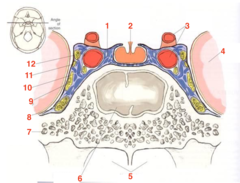
Oculomotor (CNIII) superior division, Nasociliary (V1), Abducens (CN VI), Oculomotor (CN III) inferior division
Organisation at Apex of Orbit:
What are the nerves inside the Annulus of Zinn?
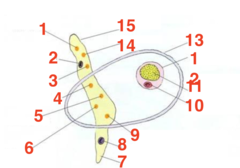
Lacrimal (V1), Frontal (V1), Trochlear (CN IV) nerve
Organisation at Apex of Orbit:
What are the nerves outside Annulus of Zinn (superior to it)?
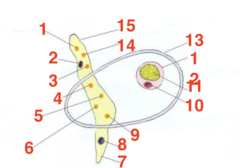
Infraorbital nerve (V2), Zygomatic (V2) nerve
Organisation at Apex of Orbit:
What are the nerves outside Annulus of Zinn (inferior to it), entrance via inferior orbital fissure?
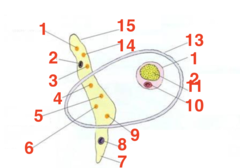
Optic Nerve (II)
What nerve carries the visual signal from the retina to the visual cortex?
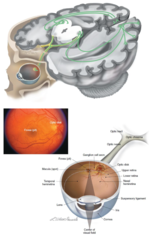
Optic Nerve (II)
What is visible with ophthalmoscopy is called the 'optic disc' or 'optic nerve head'
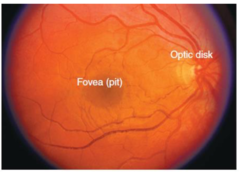
optic disc, optic nerve head
Optic nerve entering the globe and visible with ophthalmoscopy is called the?
a
Optic Nerve:
Objects from nasal visual field stimulate the...
a) temporal retina
b) inferior retina
c) nasal retina
d) superior retina
b
Optic Nerve:
Objects from superior visual field stimulate the...
a) temporal retina
b) inferior retina
c) nasal retina
d) superior retina
a
Optic Nerve:
occupy nasal portion of optic nerve head,
a) Nasal retinal fibres
b) temporal fibres
b
Optic Nerve:
occupy temporal portion of optic nerve head,
a) Nasal retinal fibres
b) temporal fibres
optic canal
Optic nerve travels through orbit and into middle cranial fossa through the?
middle cranial fossa
Optic nerve travels through orbit and into what through the optic canal?
optic chiasm
Posterior to the orbit the optic nerves from the two eyes converge and meet at the what?
a
Optic Nerve:
Which nerve fibres cross (decussate) to the contralateral nerve?
a) Nasal fibres
b) Temporal fibres
b
Optic Nerve:
Which nerve fibres continue on same side without crossing?
a) Nasal fibres
b) Temporal fibres
macula, retina
What is 5?
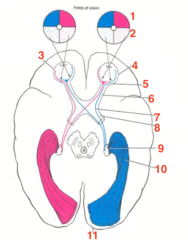
nasal retina of right eye, temporal retina of left eye
Optic Nerve:
Nerves on the left side of the brain contain the fibres from what?
optic nerve
What is 6?
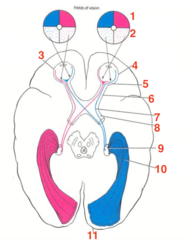
a
Optic Nerve:
Posterior to the optic chiasm, left nerve carries information from
a) right visual field in each eye
b) left visual field in each eye
optic chiasm
What is 7?
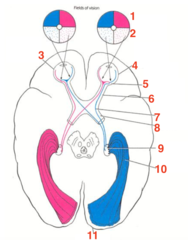
b
Optic Nerve:
Posterior to the optic chiasm, right nerve carries information from
a) right visual field in each eye
b) left visual field in each eye
optic tract
What is 8?
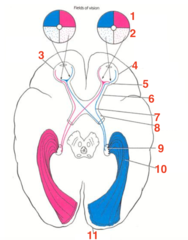
nasal retina of left eye, temporal retina of right eye
Optic Nerve:
Nerves on the right side of the brain contain the fibres from what?
lateral geniculate nucleus
What is 9?
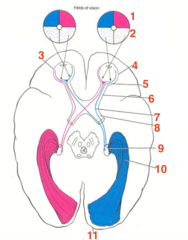
lateral geniculate body (LGB)
Optic Nerve:
After chiasm, fibres travel in optic tract, which synapses at the?
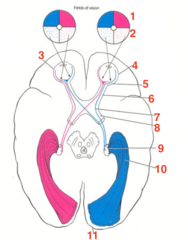
optic radiation
What is 10?
Superior rectus, levator
Superior division of the oculomotor nerve innervates what?
primary visual cortex
What is 11?
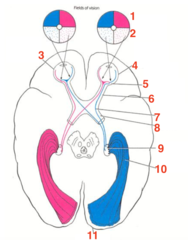
Inferior rectus, medial rectus, Inferior oblique, ciliary ganglion (parasympathetic ganglion, fibres to ciliary muscle & iris)
Inferior division of the oculomotor nerve innervates what?
Ciliary ganglion
What is the parasympathetic ganglion of the inferior division of the oculomotor nerve that has fibres to ciliary muscle & iris?
b
Superior rectus is innervated by...
a) Inferior division of oculomotor nerve
b) superior division of oculomotor nerve
b
Levator muscle is innervated by...
a) Inferior division of oculomotor nerve
b) superior division of oculomotor nerve
a
Inferior rectus is innervated by...
a) Inferior division of oculomotor nerve
b) superior division of oculomotor nerve
a
Medial rectus is innervated by...
a) Inferior division of oculomotor nerve
b) superior division of oculomotor nerve
a
interior oblique is innervated by...
a) Inferior division of oculomotor nerve
b) superior division of oculomotor nerve
a
ciliary ganglion (parasympathetic ganglion, fibres to ciliary muscle & iris) is innervated by...
a) Inferior division of oculomotor nerve
b) superior division of oculomotor nerve
ciliary muscle, iris
The ciliary ganglion of the oculomotor nerve is a parasympathetic ganglion that innervates what?
(autonomic)
oculomotor nerve
What is close proximity to posterior cerebral & communicating arteries; affected by vascular disease including aneurisms?
pupillary fibres of oculomotor nerve
What is located superiorly early in path; vulnerable to effects of compressive lesions?
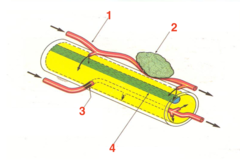
Compressive lesions
Pupil fibres of oculomotor nerve are located superiorly early in path; vulnerable to effects of what?
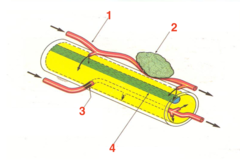
levator palpebrae superioris muscle
OCULOMOTOR:
What is 1?
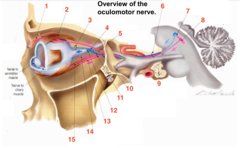
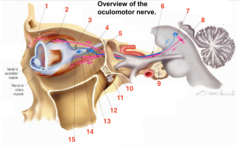
superior rectus muscle
OCULOMOTOR:
What is 2?
Short ciliary nerves
OCULOMOTOR:
What is 3?
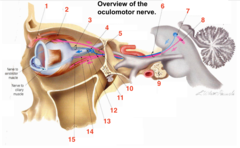
ciliary ganglion
OCULOMOTOR:
What is 4?
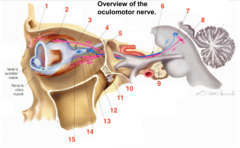
Superior division of oculomotor nerve
OCULOMOTOR:
What is 5?
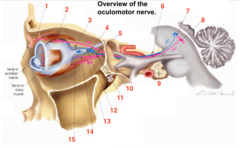
oculomotor nerve
OCULOMOTOR:
What is 6?
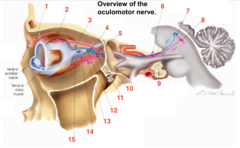
Edinger-Westphal nucleus
OCULOMOTOR:
What is 7?
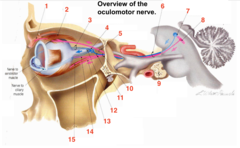
oculomotor nucleus
OCULOMOTOR:
What is 8?
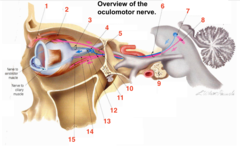
inferior division of oculomotor nerve
OCULOMOTOR:
What is 10?
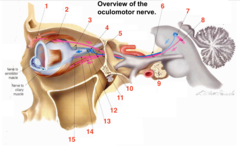
posterior cerebral artery
OCULOMOTOR:
What is 10?
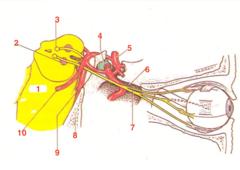
basilar artery
OCULOMOTOR:
What is 9?
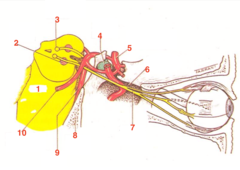
carotid artery
OCULOMOTOR:
What is 5?
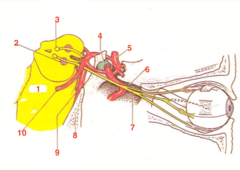
Oculomotor nerve palsy
Which nerve palsy has the following symptoms?
•Ptosis
•Pupil Dilated
•Eye depressed and abducted