Intro to Rad (Biomechanics and Ergonomics, and immobilization Techniques, Hand hygiene) )
 Call Kai
 Learn
Learn Practice Test
 Spaced Repetition
 Match
Match Flashcards
 Knowt Play
1/68

There's no tags or description
Looks like no tags are added yet.
Name | Mastery | Learn | Test | Matching | Spaced | Call with Kai | Chat |
|---|
No analytics yet
Send a link to your students to track their progress
69 Terms
What is Mobility Muscles?
It is called to be White muscles as it is found in the limbs. Typically these muscles have a long, white tendons and cross 2 or more joints.
What did the U.S Department and Labor Statistics think about the leading cause of disability in healthcare?
They have cited that sprains, strains, and other musculoskeletal problems as the leading cause of disabilities for people in healthcare
What is Stability muscle’s?
They are also called red muscles as it found in the torso. Typically they are large expanses of red belly muscle and provide postural support.
What is biomechanics?
It is a branch of physics’s that applies the laws of mechanics to living creatures. It examines the action of force on bodies at rest or in motion and can be used to design safer work eviroments. It is a fundamental to good patient handling techquines are the concept of the base support, center of gravity, and mobility and stability muscles.
What is the base of support?
Is the foundation on which the body rests. When standing, the feet and the space between the feet constitute the persons base of support. (SPACE IN BETWEEN THE LEGS) Wider the space, the more stable it is.
Standing with the feet far apart enlarges the base of support and it narrows bases of support characterized unstable and mobile systems.
What is the center of gravity?
A hypothetical point at which all the mass appears to be concentrated; gravtional forces appear to act on the entire body from this specific point. In humans the COG is apporx. at the sacral level two
Stabiliy can be achived when the center of gravity is over the base of support
When can you receive instability results?
When the center of gravity moves beyond the boundaries of the base of support
How can you be safe at stable lifiting?
The center of gravity MUST always be over the base of support
What is effective transfers?
Technolgists’s should use white mobility muscles for lifting and red postural muscles for support. Such as lift your legs, move your whole body when moving, and lifting should be done by bending and stragienting the knees. The back should be kept straight or in a postion of slightly increased lumbar lordosis (Curvature) REMEBER TO LIFT USING YOUR LEGS
What are the principle of lifting?
Let- Let the patient do as much of the work as possible
Ask- Always ask the pateint how they. transfer before attempting a transfer, check the chart for precautions, such as weight bearing status, surgery, etc
inform- always inform the pateint of what you are doing and how you intend to proceed
Apply- Apply proper body mechaincs
Keep- Keep your back stationary and do all of the lifiting with the legs. Avoid truck twisiting
Never- Never lift more than you can, ask for help
What is Orthostatic Hypotension?
Hypo means below and you need to watch the patient for orthostatic hypotension and take precatuion’s to minimize its effect. Orthostatic Hypotension is a condition caused by a drop in blood pressure that occurs when a person stands too quickly from a recumbent to an upright postion.
what are symtpom’s of Orthostatic Hypotension?
Dizziness, fainting, change in color of the face, blurred vision, and slurred speech. If this occurs have the pateint breath slowly and sit up slowly or lie down again
what should you never do to a Orthostatic Hypotension pateint?
NEVER SEND THEM HOME. Never allow a patient to attempt to get off the table without the assistance of yourself.
Pateint postions
For a desired body part to be examined, pateint’s needs to be moved into a variety of different postions. The patients must be transffered as a single unit, placed on the table in a safe/secure postion, and than moved segmentally into the desired body postions.
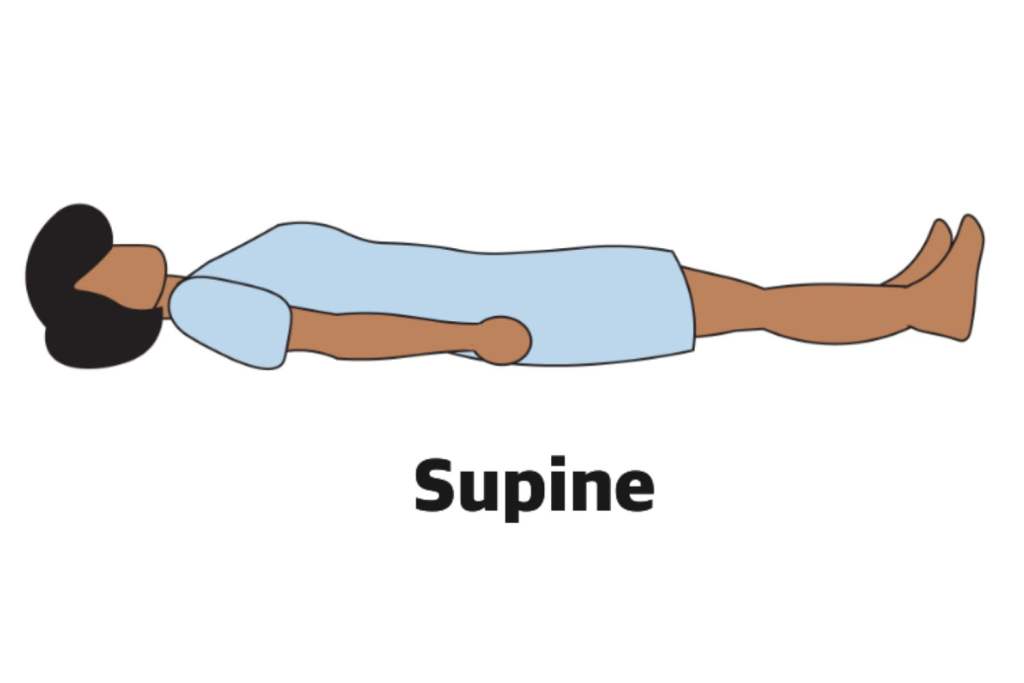
Supine
A pateint lying flat on the back

Prone
Patient lying facing down

Lateral
Patient lying on their side

Sims
Patient lying obliquely on their side with knee drawn upward

Trendelenburg
Lying with head lower than feet (Move the bed to the center of Gravity and then MOVE)

Fowler
Lying head higher than there feet. Helps with those pateints who are vomitting
What are four types of wheelchair transfers?
Stand by assist, Assisted standing pivot, two person lift, and hydraulic lift. KEEP IN MIND ALWAYS ASK THE PATIENT IF HE OR SHE HAS A STRONGER SIDE FOR TRANSFER
Wheelchair Transfers (Standby Assist)
Simply assit the patient from the chair to the table by staying near the patient.
Place the wheelchair at a 45 degree angle to the table.
Assited standing pivot Transfer
Transfer the patient with or without the galt belt, block knees and feet, stand pateint and pivot to sit on the table
Two person lift
Stronger person lifts torso and other lifts at the feet. The stronger person verbally coordinations, counting out loud
Hydraulic lift
Transfers have multiple steps and require some skill. Never use alone, without the assistance of a another tech. Utilized a swing type of apparatus
Cart Transfers
To move patients from cart to the radiographic table and back again. Three people usually perform a cart to table transfer. Use slider board and thin plastic sheets over board, called patrons. ONE TIME USE FOR THE SHEETS, keep in mind the cart should be higher than the table.
Log rolling
Is a technique used to turn a patient, whole body must always be kept in a straight alignment (like a log) This techquinie is used for the patient who has a spinal injury. Log rolling is used for the patient who must be turned in one movment, without twisting. THIS IS FOR NOT MOVING THIS SPINE FOR THOSE WHO HAVE AN INJURY. HAVE GOOD COMMUNICATION
Commonly attached medical equipement
Patients may arrive in the department with items clipped to their bodies to deliver or drain away fluids. KEEP in mind where they are and try to move it out the way, do not run it over. This could be oxygen tanks, urine bags, central lines, etc.
What is one thing students cannot touch when attemping to get the pateint?
NEVER TOUCH THE OXYGEN TANKS. GO BACK and get a technologist. When removin g urinary bags you need to move it by there feet
Immoblization
The act of rendering immoveable. Used to reduce pateints motion, reduce positioing inaccuacry, and reduces the amount of images repeated and there by reduces pateints exposure to radation.
Restraint
Hinderance of an action or movement. Restraint is only used and is requried by a Physican order
Do radiologic tech immbolize pt or restrain them?
IMMBOLIZED
What is a simple immbolization Techquinie?
The simplest tech involve the use of postioning sponge to supprto the anatomic area of interest or gently laying a sandbag across the patient.
Involved immobilization technique
More complex techquinie might involve completely wrapping an infant in a sheet or securing an infant to an immobilizer board
Protection from Radiation
If a patient move the images may need to be repeating cauising addtional expoxusre.
Voluntray motion
Can be controlled by the patient and most results from inadequate communication
Involuntary Motion
Cannot be controlled by the pateint. Such as there heart beating
What is one way to reduce the amount of motion with the patient?
Communication
Rapport
A realtionship of harmony and accord between two people, such as the pateint and the rt. CONFIDENCE IS KEY
Routine Applications (Positioning sponges)
Come in a variety of shapes and sizes and are designed to support the patient or anatomic area of interet
Routine applications (Stability bar)
Located on most upright bucky units to assit pateints when performing lateral chest x rays. Helps eliminate patient swaying or movement. ALWAYS HAVE CRITICAL THINKING
Routine Applications (Velcro straps)
Can be effective as an immobilization or positioning device. Can be used to immobilize only the area of interest, such as axial heel projection, to hold the part still
Routine applications (Sandbags)
Extremely helpful in reducing voluntary motions. Unlike sponges, sandbags are not radiolucent and can be obscure parts of interest.
Routine applications (Sandbags)
Common use as an aid in lateral cervical spine exams and AC joint exam. DO not use within 7 days of injury. Used to depress the shoulder and demonstrate the lower cervical vertebrae.
Routine Applications (Head clamps)
Can be attached to imaging devices and are designed strictly for use in positinoing carious projfectio’s of the skull. Also found in panorex units
Special applications (Cervical Collar, C- Collar)
Applied in cases of suspected neck/head tramua. Places traction on spine, inital flims done in collar only removed by medical doctor. Has to clear up by the CT before doing any form of x ra. never walk a pt with a collar
Spine Application (Backboard)
Also known as a spine board. Most are radiolucent, can be imaged through, always check for metal straps, buckles, used to immbolize and support he entire body.
What should rt do with a patient who has a skull trauma?
The patient has a c collar and has a skull trauma, therefore the rt needs to use critical thinking on the best way to obtain images as the head/neck wont be able to roate or tilt.
Specical Applications (Air splint)
Used for extremity trauma. Simply inflated plastic cuff that is slipped over the affected limb an inflated to provide stability. Generally radiolocent.
Speical applications (Traction splint)
Used for lower extermies. Exert steady force on the affected limb by applying pressure agasint the pevlis and grogin area. Some have parts that are not radioloucent. So it helps stablized a fracture.
Specical Applications (Anti shock garment)
Pair of inflaable trousers, so it helps those who have trauma to the abdomne, pelvis or lower exitermies, and internal hemorrhage is suspected. NEvER deflate them or remove them. (Helps with the bleeding in stopping)
What should you do with a pedatric pt?
Always explain what is going to happen to the parents, have respect/kindness, as it will help overall
Specical Applications (Sheet immbolization)
Also called mummy wrap, so it is for neonates and small childern. Can be used on childern up to 5 years old
Special applications (Pig-OStats)
Useful for upright chest and abdominal images. Can be accomdate childern up to approx 3-4 years old depending on the size of the baby. May have artifacts
Special applications (Octostop board)
Modification of velcro strap immbolizer board. Useful for spine images, disadvagtes is size. Only infants and small childern up to one year old
Noncommerical restraints
Pexi glass can be put on top of the hand to keep it still,
velcro straps, t
ape but be cautious when removing it,
stockinette as it is stretchable cotton fabric in the shape of a sleeve
Special Applications (Geriatric)
Pateints over the age of 65, communication and Rapport are needed to make sure the geriatric patient feels secure, ask pateint’s what assistance they need, dont talk down the patient like they dont understand.
What are the greatest concerns for Geriatric pateints?
Security- Fear of falling, give them extra time/support, dont rush
Warmth-Become chilled easily, give them a blanket to reduce shivering which can cuase motion,
Comfort-place a radiolucent pad on the table top, place sponge under knees or sore areas if possible
THIS is more common in orthostatic hypotension as you go from supinate to standing up.
What is Hand hygiene?
Cleansing your hands by either handwashing (Soap and water), antiseptic hand rub (ie. Alcohol based hand sanitizer , including foam or gel), or surgical hand antisepsis
Why practice hand hygiene?
Cleaning your hands reduce
The spread of potentially deadly germs to patient
The risk of healthcare provider colonization or infection caused by germs acquired from the patient
What is very important to understand about Hand hygeine?
Most important in the means of preventing the spread of infection or in other words hand washing is both a chemical and physical process. Hand hygiene MUST be done before and after tending to each patient. ESPICALLY IN ISOLATION OF A PATIENT.
What is the chemical process in hand hygiene?
The Soap
What is the physical process of hand hygiene?
Rubbing your hands togethere
What does hand hygiene do?
Washing your hands can keep you healthy and prevent the spread of respiratory and diarrheal infections. Germs can spread from person to person and from surface to people.
What are the key times to perform hand hygiene?
Before, during, after preparing food
Before eating food
Before and after caring for someone who sick, even if it a family member
Beofre and after treating a cut or wound
After using the toilet or helping another person use one
After blowing your nose, coughing, or sneezing
After touching the garbage
Before and after entering a pateint’s/exams room
Wear gloves, open wound
Make sure hands are dry before putting on gloves
What is the proper way in washing your hands?
Wet with cleaning running water, apply soap
Lather your hands by rubbing them togthere with the soap. BE sure to lather the back of your hands and between your fingers and under your nails.
Scrub your hands for at least 20 secounds. An exmaple would be to sing HBD song twice!
Rinse your hands under clean running water
Dry your hands using a clean towel or air dry them
What is the proper way in using hand sanitizer?
Apply- Apply the gel/foam product to the palm of one hand-read the label to know the correct amount needed
Rub-Rub your hands togthere
Dry- Rub the gel and foam over all surfaces of your hands and fingers until your hands are dry, this should take around 20 secounds.
KEEP IN MIND ANY HAND SANITIZER THAT IS UNDER 60% alcohol is not considered to work
Sanitizer
Use an alcohol based hand sanitizer
Immediately before touching a patient
Before performing an aseptic task (eg. placing an indwelling device or handling invasive medical devices
Before moving from work on a soiled body site to clean a body site on the same patient
After touching a patient or the pateints immediate environment
After contact with blood, body fluids or contaminated surfaces (Follow up with soap and water)
Immediately after glove removal
Soap and water
When are visible with soiled
After caring for patient with known or suspected infectious diarrhea
After known or suspected exposure to spores