Chapter 1 – Chemical Foundations
 Call Kai
 Learn
Learn Practice Test
 Spaced Repetition
 Match
Match Flashcards
 Knowt Play
1/12

There's no tags or description
Looks like no tags are added yet.
Name | Mastery | Learn | Test | Matching | Spaced | Call with Kai | Chat |
|---|
No analytics yet
Send a link to your students to track their progress
13 Terms
Two core ideas of chemistry
Matter is composed of various types of atoms.
One substance changes to another by reorganizing the way the atoms are attached to each other.
Steps in Scientific Method
Making observations, which can be qualitative (the sky is blue) or quantitative (water boils at 100 degrees).
Formulating hypotheses (possible explanation for an observation).
Performing experiments.
Theory (vs Observation) Model
Theory (model): Set of tested hypotheses that gives an overall explanation of some natural phenomenon.
Observation: Something that is witnessed and can be recorded.
Theory: An interpretation, or possible explanation of why nature behaves in a particular way.
Theories are constantly changing over time as we gain new information.
Scientists do this by using the theory to make a prediction and then performing an experiment (making a new observation) to see whether the results bear out this prediction.
Natural Law
Natural Law: Summary of observed behavior.
Law of conservation of mass: The observation that the total mass of materials is not affected by a chemical change in those materials.
Types of measurements
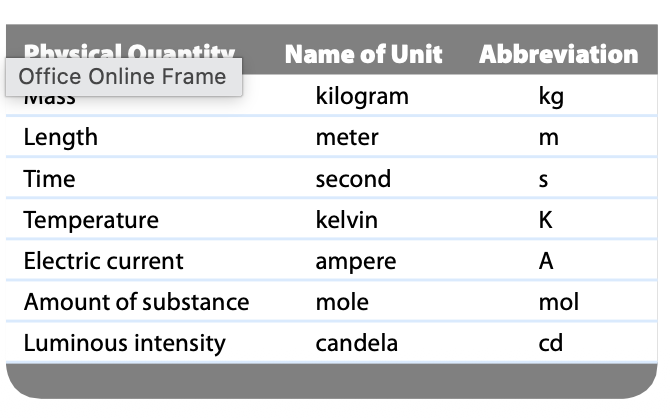
Measurement numbers
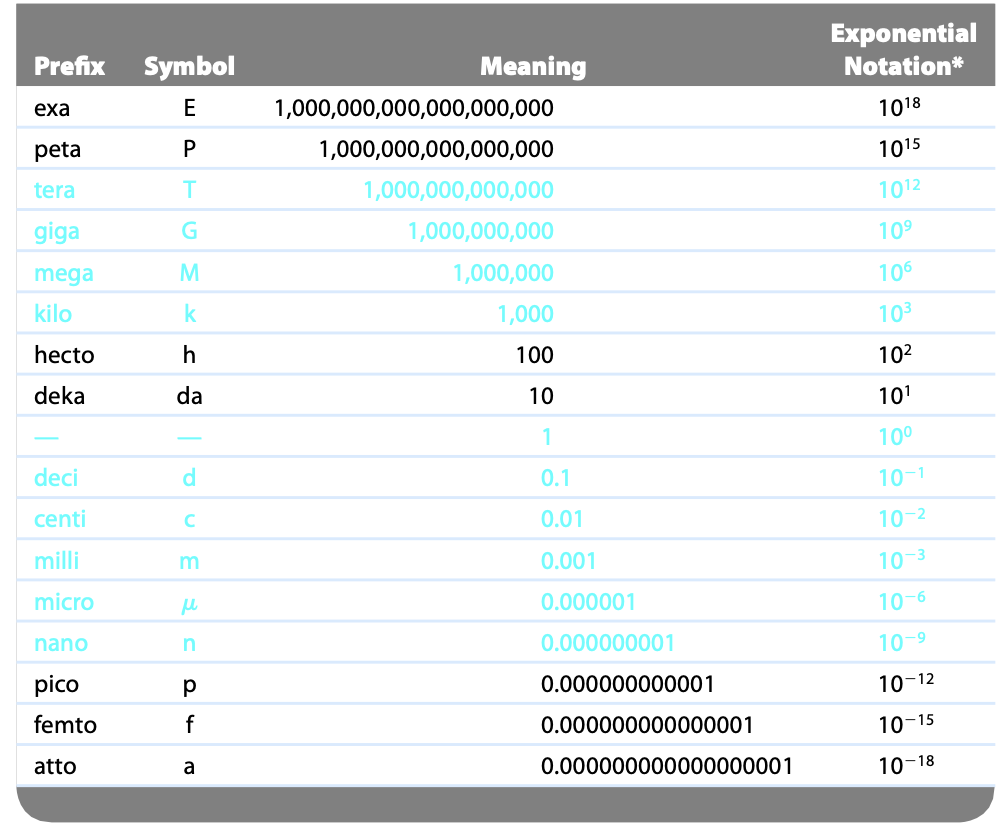
Volume to liters
A cubic decimeter (1 dm)^3, is commonly called a liter (L), which is a unit of volume slightly larger than a quart. (If you know the volume you can figure out the liters.)
Mass & Weight
Mass: A measure of resistance of an object to a change in its state of motion. Measured by the force necessary to give an object a certain acceleration.
Weight: The amount of force gravity that exerts on an object, response of mass to gravity. Varies depending on the gravitational field (earth vs moon).
Measuring when it comes to meniscus
Measurement may be changed due to the liquid’s meniscus, use the number at where the meniscus occurs (may depend on liquid, mercury that curves downward u should use top).
Significant Figures & Digits
Certain digits: Digits that stay the same.
Uncertain digits: Digits that change depending on the person recording the number.
A measurement always has some degree of uncertainty.
Significant figures: Contains all certain digits and one last uncertain digit.
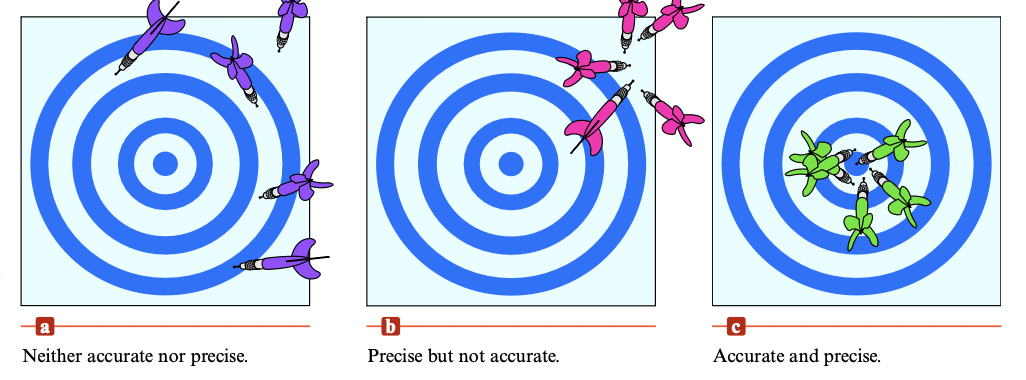
Accuracy & Precision
Accuracy: Agreement of a particular value with the true value.
Precision: Degree of agreement among several measurements of the same quantity. Reflects the reproducibility of a given type of measurement.
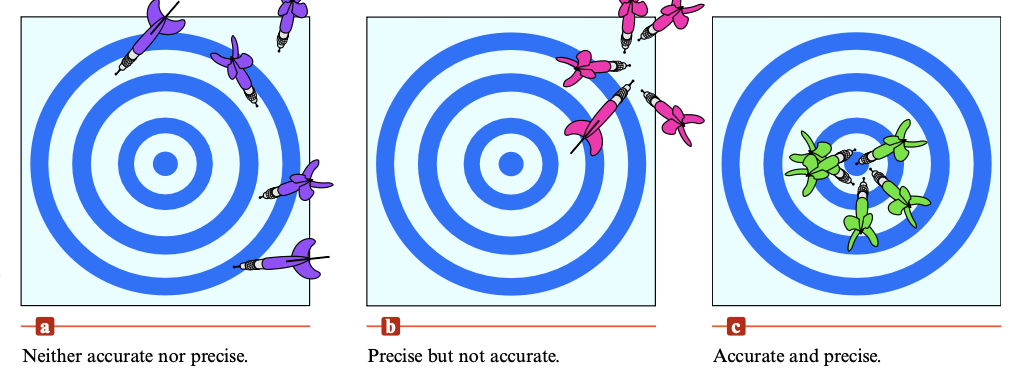
Types of Errors
Two types of errors: Random & Systematic Error
Random (Indeterminate) Error: Measurement has an equal probability of being high or low. This occurs in estimating the value of the last digit of a measurement.
Systematic (Determinate) Error: Occurs in the same direction each time, always high or always low.
Large random errors (poor technique)
Small random errors but a large systematic error
Small random errors and no systematic error
High precision among several measurements is an indication of accuracy only if systematic errors are absent.