Sono Physics Ch.6-7
 Call Kai
 Learn
Learn Practice Test
 Spaced Repetition
 Match
Match Flashcards
 Knowt Play
1/29

Earn XP
Description and Tags
Interactions of Sound and Media
Name | Mastery | Learn | Test | Matching | Spaced | Call with Kai | Chat |
|---|
No analytics yet
Send a link to your students to track their progress
30 Terms
What is Attenuation?
The gradual weakening of a sound wave as it travels through tissue.
Decibel Notation (dB)
◦ Measure a change in signal strength
◦ Based on a logarithmic scale
◦ Compare a starting value to a final value
Why dB uses Logs?
Because ultrasound Intensity changes over extremely large ranges.
What are Decibels - dB?
Measures how much a beam’s strength changes as it travels through the body.
Compares 2 Intensity Levels:
◦ Original intensity (before)
◦ New intensity (after)
Common dB Values:
+3dB = Intensity x 2
-3dB = Intensity/ 2
+10dB = I x 10
-10dB = I / 10
Decibels Measured as a Ratio
Ratio = New Intensity / Original Intensity
Ex: 100 → 10
Intensity decreased by a factor of 10
So, Change = -10dB Decibels measures a difference, not an actual Value
Components of Attenuation:
Reflection, Scattering and Absorption
What are two factors that Increase Attenuation?
-Distance (Path Length)
-Frequency
Higher Frequency = Greater Attenuation
Frequency
Higher Frequency = Greater Attenuation
Lower frequency = less attenuation and deeper penetration
Reflection
Occurs when sound encounters a boundary between two tissues
◦ Part of the sound wave returns to the transducer
◦ Reflection is the most important component of Attenuation because it creates the echoes used to form an image
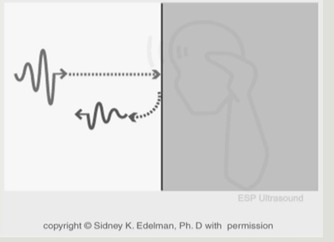
Specular Reflection
Occurs at smooth, flat boundaries
◦ Vessel walls
◦ Diaphragm
◦ Organ capsules
Echoes return in a single organized direction
Limitations of Specular Reflection
◦ Requires the beam to strike surface nearly perpendicular
◦ If beam is off-axis, echo may miss transducer
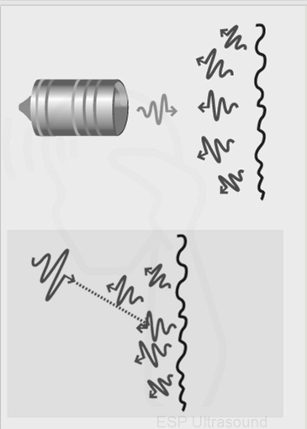
Diffuse Reflection (Back Scatter)
Occurs when sound strikes an irregular surface
◦ Echoes are scattered in many directions
◦ Most Images are created from Backscatter
Advantage:
◦ Produces echoes even when the beam is not perpendicular
Limitation of Diffuse Reflection (Backscatter):
Weaker echoes than specular reflection
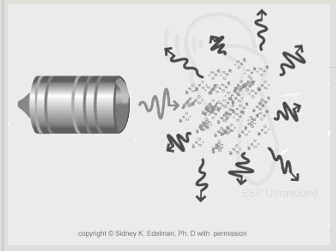
Scattering
Occurs when the reflecting surface is very small
◦Sound waves are redirected in many directions
◦About the same size or smaller than the sound's wavelength
◦Lung tissue scatters sound strongly because of the many tiny air-filled alveoli.
◦Higher frequency sound scatters more than lower frequency sound
Scattering Relationship with Frequency is what?
Directly Related
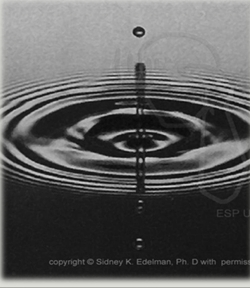
Rayleigh Scattering
Occurs when scatterer is much smaller than wavelength
◦ Sound is scattered equally in all directions
◦ Omnidirectional scattering
Ex: Red Blood Cells
Rayleigh Scattering Relationship with Frequency is what?
Inversely Proportional
Rayleigh Scattering ∝ Frequency⁴
◦ If frequency doubles:
2⁴ = 16
◦ Scattering increases 16-fold
Absorption
Occurs when sound energy is converted into another form of energy
◦ Most commonly converted into heat
Important Facts:
◦ Bone absorbs more sound than any other tissue
◦ Absorption is directly related to frequency
◦ Absorption is the largest contributor to attenuation
Absorption Relationship with Frequency is what?
Directly Related
Higher Frequency → More Absorption
Lower Frequency → Less Absorption
Attenuation Coefficient
The amount of sound energy lost per centimeter traveled
Units: dB/cm
In Soft Tissue:
Attenuation Coefficient Formula:
≈ Frequency ÷ 2
or 0.5 dB/cm/MHz
Attenuation Coefficient Relationship with Frequency is what?
Directly Related
Higher Frequency → Higher Attenuation per cm
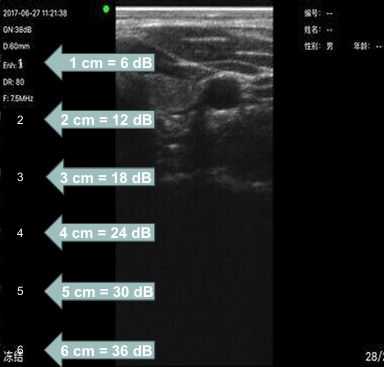
Attenuation Coefficient Example
12 Mhz ÷ 2 = 6 dB/cm
Total Attenuation Formula
Total Attenuation (dB) = Attenuation Coefficient (dB/cm) x distance (cm
Half-Value Layer Thickness (HVL)
The distance sound travels before its intensity is reduced by 50%
◦ 50% intensity loss = 3 dB decrease
Units:
◦Cm
◦ Any unit of length
Also Known As:
◦ Penetration Depth
◦ Depth of Penetration
◦ Half-Boundary Layer
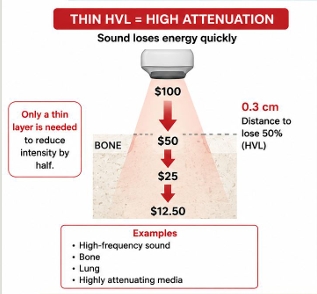
Thin Half-Value Layer:
More Attenuation
◦High-frequency sound
◦Highly attenuating media
◦Bone
◦Lung
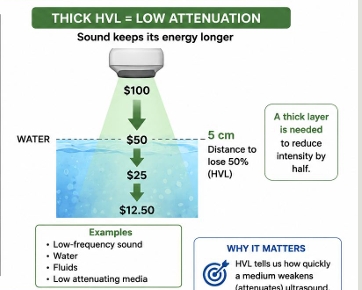
Thick Half-Value Layer:
Less Attenuation
◦Low-frequency sound
◦Low-attenuating media
◦Water
◦Fluids
Acoustic Impedance
Resistance a medium offers to the transmission of sound.
Key Facts:
Symbol = Z
Measured in Rayls (MRayls)
◦ Calculated, not directly measured
Typical Values in Soft Tissue = 1.25 – 1.75 MRayls
Impedance Formula
Z = Density × Propagation Speed
Tissue Impedance
◦ Dense tissues resist sound more
◦ Stiff tissues transmit sound faster & have higher impedance
Tissue Impedance is measured not calculated
Higher Density + Higher Speed = Higher Impedance
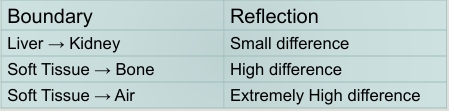
Why is Impedance Important?
Reflection occurs when sound encounters a boundary between tissues with different impedances.
Small Difference:
◦ Little reflection
◦ Most sound transmitted
Large Difference:
◦ Strong reflection
◦ Less transmission