BioChem Exam #1
 Call Kai
 Learn
Learn Practice Test
 Spaced Repetition
 Match
Match Flashcards
 Knowt Play
1/202

There's no tags or description
Looks like no tags are added yet.
Name | Mastery | Learn | Test | Matching | Spaced | Call with Kai | Chat |
|---|
No analytics yet
Send a link to your students to track their progress
203 Terms
What is biochemistry?
how biomolecules interact to maintain life
What are the universal structural features shared by all cells?
• Plasma membrane
• Cytoplasm
• Ribosomes and Proteasomes
• Cytosol
• Genome
Function of Cytoplasm?
Space enclosed in plasma membrane
Function of Cytosol?
Fluid in cell (aqueous solution in the cell.)
small organic molecules + inorganic ions are here
Function of Proteasomes?
degrades proteins
Function of Ribosomes?
protein synthesis
(make proteins)
Function of Genome?
Nucleus in Eukarya
Nucleoid in Archaea + Bacteria
What is the function of the plasma membrane?
Separates cell contents from the surroundings
Made of lipids and proteins
Thin, flexible and hydrophobic
Blocks and limits the movement of inorganic ions, charged, or polar molecules
Lipds + proteins interact can Change size and shape of cell
What are Transport Proteins?
allow specfic polar + charged molecules in
embedded in the plasma membrane
What are Receptor Proteins?
recives signal + transmit signals into the cell
embedded in the plasma membrane
What are Membrane Enzymes?
help with chemical reactions (GTP to GDP)
embedded in the plasma membrane
What do Enzymes do?
proteins that catalyze reactions
What do Plasmids do?
circular DNA in bacteria
What are Cell dimensions?

Why do animal cells have more folds?
They have folds on surface for more surface area and to compensate for volume also uptake nutrients
What is Bacteria?
Unicellular - prokaryote
inhabit soils, surface waters, and the tissues of other living or decaying organisms
Gram + Gram -
What is differnce between Gram + and Gram -?
Gram +: has the peptidoglycan layer as the outer layer
Gram -: as an outer membrane surrounding the peptidoglycan layer
What is Archaea?
Unicellular - prokaryote
inhabit extreme environments
What is Eukarya?
unicellular - yeast
multicellular - eukaryote
Which is eukarya more related?
Archea
What is phototrophs?
Energy from sunlight?
What is heterotrophs?
carbon from organic nutrients
What is chemotrophs?
energy from breakdown of chemicals
What is autotrophs?
Carbon from CO2
What is Mitochondria?
Energy (ATP) production of cell
in Eukaryotic Cells
What is Rough Endoplasmic Reticulum?
Protein synthesis, ribosomes in ER
in Eukaryotic Cells
What is Golgi Complex?
Packages protein for exports
in Eukaryotic Cells
What is Peroxisomes?
Oxidizes (breaks down) fatty acids
in Eukaryotic Cells
What is Lysosomes?
Degrades intracellular debris (waste)
in Eukaryotic Cells
What is Vacuoles
Breaks down + recycles macromolecules, stores metabolites
in Plant Eukaryotic Cells
What are Metabolites?
Small organic molecules made or used by the body.
What is Smooth Endoplasmic Reticulum?
Lipid synthesis + drug metabolism
What is Transport vesicle?
Transports lipids and proteins
What is a nuclear envelope?
Separate chromatin from cytoplasm
What is Chloroplasts?
Harvests light to make ATP and carbohydrates
in Plant Eukaryotic Cells

Know what each orgenelle looks like

What is Differential Centrifugation?
Used to separate organelles
gently disrupt cells or tissues by physical force to break plasma membrane
centrifuge the homogenate (mix of cell parts)
Smaller parts settle at bottom as speed increases
What is cytoskeleton?
3D network of protein filaments in eukaryotic cells
Filaments aren’t permanent and move
What are actin filaments?
they are for cell shape + movement
What are microtubules?
They are for organization + movement of material
What are intermediate filaments?
They are for strength + stability
What is the endomembrane system?
modifies, packages + transport proteins and lipids
What is exocytosis?
cellular fission
cells move stuff OUT of cell

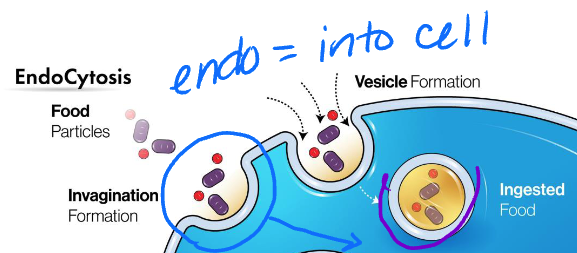
What is endocytosis?
cellular fission
creates vesicle to bring stuff IN cell
What are Non-Covalent interactions
hydrogen bonds- Attraction to partial + H
ionic interactions- attraction to + charge and - charge
van der Waals- weak interactions that come and go, very short-lived
hydrophobic effect- nonpolar molecules cluster together to avoid water
What are in vitro?
in glass, outside a living system
What in in vivo?
in the living, studying inside living organisms
Why can in vitro studies overlook important interactions?
Becuase they are taken out from from the living organism where they are interacting with differnt biomolecules which cant be seen in vitro
What is Biochemical Unity?
Organisms are differnet but the chemical and processes are the same
What are the four elements that make up 99% of the cell?
C, N, O, H
What are trace elements ?
Existing in small quantities, they are essential for the function of specific proteins
Which element of the four major elements is the most versatile?
Carbon
Why is carbon highly versatile?
Carbon can make 4 bonds
Tetrahedral 109.5⁰
Planar(3 bonds) (flat) 120⁰
Linear 180⁰
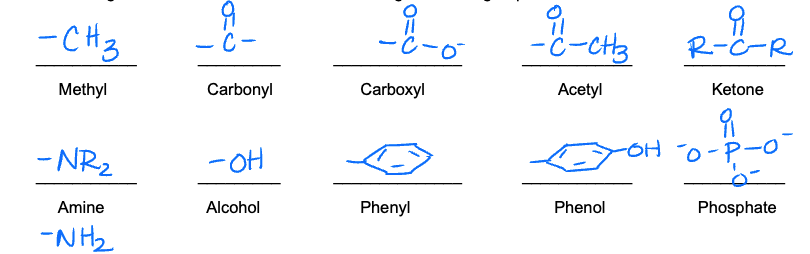
Functional Groups
What is the concentration of organic molecules in the cytosol?
nanomolar to > 10mM
What is a Metabolome?
collection of small molecules (metabolites) in the cell
What is Metabolomics?
study and characterization of metabolome in certain conditions
used for drug expirments
What is a Macromolecule?
Polymers with molecular weights above 5,000 made from small molecules
What is a monomer?
building block or unit of polymer
What is a polymer?
strand of monomers
What is Oligomer?
short polymer
What is monomer of Proteins?
amino acids
What is a Proteome?
all proteins of the cell
what is Proteomics?
characterization of proteome (all proteins) of cell
What is the monomers of Nucleic acids?
nucleotides
What is a Genome?
sequence of cell’s DNA
What is Genomics?
characterization of structure, function, evolution, and mapping of genomes
(study of genetic information)
What is monomer of Polysaccharides
Simple sugars
What is a Glycome?
all carbohydrate containing molecules
What do oligosaccharides attach to in order to serve as cellular signals at the cell surface
Proteins and Lipids
What are the 3 main functions of polysaccharides?
store energy in cell
Rigid and structural components
Extracellular recognition (signals)
What are Lipids?
water-insoluble hydrocarbons
Technically not a macromolecule
What is a Lipidome?
all lipid containing molecules in the cell
What are the 3 functions of lipids?
structural component of membranes
Energy-rich fuel stores
Intracellular signals
Why are lipds technically not a macromolecule?
they are to small and do not form polymers.
What are the two major “informational macromolecules”?
proteins
nucleic acids
What are Stereoisomers?
same molecule formula, same atoms, connect different 3-D arrangment
What are Geometric Isomers?
atoms arranged differently around double bond or ring
Cis + Trans
Cis more stable

What is Chirality?
4 different atoms, mirror image molecules
What are Enantiomers?
mirror image (D,L)
What are Diastereomers?
not mirror image
What is configuration?
how atoms are arranged in molecule
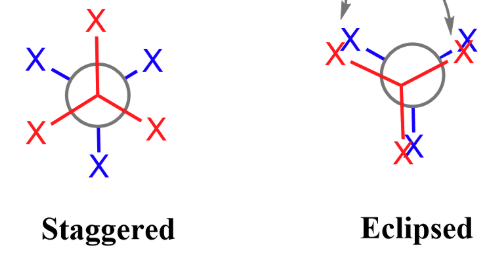
What is conformation?
how atoms rotate in a molecule
Which conformation is more stable Staggered v. Eclipsed?
Staggered, can not isolate these forms they change and move constantly
What limits the conformations?
Steric hinderence
What is sterospecfic?
Correct 3-D shape to interact with another molecule
Which form do Amino acids in proteins exist as?
L-isomers
Which form does Glucose exists as?
D-isomers
Do living cells produce one possible chiral form or both forms?
Living cells only produce one chiral form of a biomolecule because the enzymes that synthesize that molecule are also chiral
What is Stereospecificity?
the ability to a molecule/ biological system to distinguish between stereoisomers
Why do organisms eat?
Organisms need energy to fuel chemical reactions and stay orderly
Does nature prefer order or disorder?
Disorder
What processes in humans that require energy?
Storage expression of information
Synthetic chemical rxns : make molecules
What are coupling reactions used for?
coupling reactions are reactions paired together one gives energy (-G) and the other uses energy (+G)
What is an open system?
An open system is something that takes in and gives out matter and energy to its surroundings.
What is steady state?
Being maintained at constant level (homeostasis)
Ex. Body temp
What is Equilibrium?
No net change because system naturally settles into balance
ex. A hot cup of tea will release heat until it is the same temperature as the surroundings.
What is the first law of thermodynamics?
Energy is neither created nor destroyed
Why are cells excellent transducers?
they can easily convert one form of energy into a different form of energy.