EAns - General (Chap 1-6)
 Call Kai
 Learn
Learn Practice Test
 Spaced Repetition
 Match
Match Flashcards
 Knowt Play
1/13

There's no tags or description
Looks like no tags are added yet.
Name | Mastery | Learn | Test | Matching | Spaced | Call with Kai | Chat |
|---|
No analytics yet
Send a link to your students to track their progress
14 Terms
What is a commodity
Commodities: raw materials like oil, wheat = little close substitutes
State reason for YED inelastic in Japan for chicken
YED reason: Japan is very developed country and most households can already satisfy most of their needs for chicken at initial level of income -> YED inelastic
Policies to improve self-sufficiency (increase % of good produced domestically)
Subsidies for domestic food production technology (Eg. Development of vertical farming technology) -> increase yield from intensive production methods will increase firms ability + higher productivity will lower MCOP and increase profits -> increase firms willingness -> supply increase
PES factors
Availability of inventory (semi-finished goods) VS
Availability of spare capacity (idle resources)
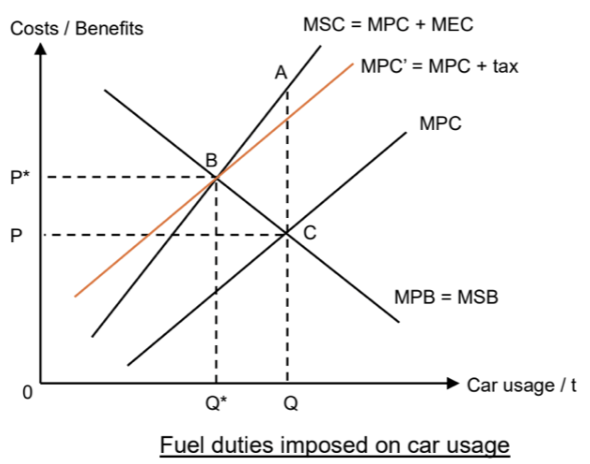
Describe Fuel duties (Petrol tax on producers) (Graph + eval)
Price of fuel increase -> fuel and usage of cars are complements -> MCOP of using cars increase -> MPC shift upwards for every unit of car usage = MEC at Q* -> usage of cars will now fall from Q to Q’, assuming the government has perfect information on MEC
Eval: Tax small % of TC of car -> sunk cost fallacy due to high COE price
Describe conclusion of fuel duties and high-quality public transport system
Both fuel duties and high-quality public transport system should be implemented in tandem
SR: Fuel duties can help to reduce car usage to by disincentivising consumers from driving
LR: High-quality public transport system could reduce the reliance on car usage -> lower car usage to the socially optimal level Q*.
BUT given how “consumers may prioritise convenience and comfort and prestige in owning a car”, additional measures such as higher parking fees and electronic road pricing (ERP) would also be needed to deter over-usage of cars
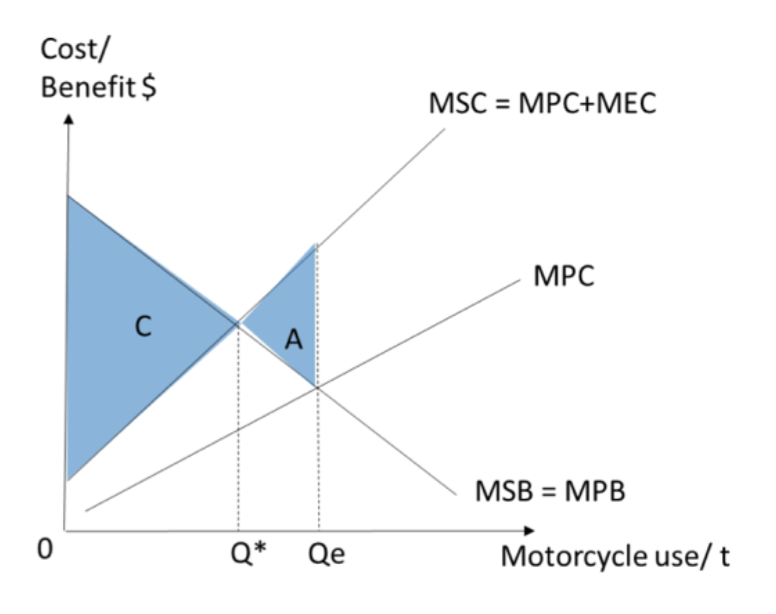
Explain why C larger than A
There is a net social benefit to society (Area C) from motorcycle use as some of Vietnam’s urban areas have narrow streets and long alleys which are inaccessible to cars and public transport -> C larger than A
Explain why market can be sustainable and unsustainable (When price floor is used)
Prices being kept at the agreed minimum price
Sustainable: If the Chinese government is able to remove the permanent surplus by choosing to buy up the surplus between Qs-Qd -> no incentive to sell at a lower black market price
Unsustainable: Market is in disequilibrium which might lead to the emergence of a black market -> producers selling the solar panels at a lower price below the price floor
Constraints VS costs
Costs = explicit - monetary, implicit - opportunity costs
Constraints (Def.): Factors that limit the ability of agent to make the decision
Fiscal reserves
If not enough, they may have to borrow, this depends on amount of financial institutions willing to lend funds to government
Larger market -> produce at larger scale -> Eg. Specialised machines -> lower unit cost -> products relatively cheaper
EOS: Fall in AC must be due to expansion of firm output or industry
Natural monopoly = MRT
Diversification = product innovation, integration
Profit-maximising output thing (missing stuff)
At this level of output, the firm is in equilibrium -> no tendency for the firm to want to change its output further since total profits are already maximised
Benefits of entering industry where Grab already has large market share = firm may experience supernormal profits
New entrant that can overcome high BOE can enter and steal market share can also earn supernormal profits
When a new competitor enters the industry, the size of the industry increases
Even if the new competitor's production scale may be small -> can enjoy external EOS built up by dominant players (Eg. Skilled labour)
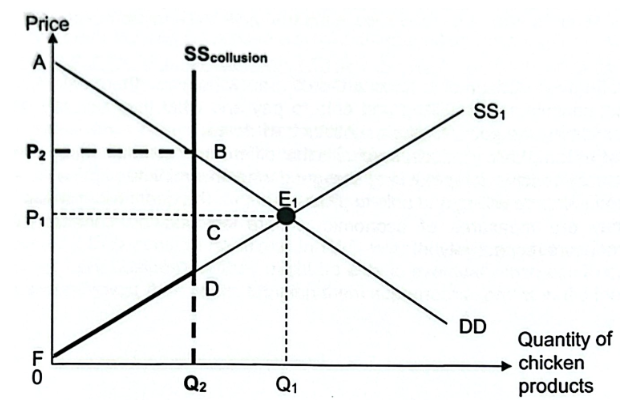
Collusion graph
PS changes from FE1P1 to FDBP2