Preparation for trial - crim pro
 Call Kai
 Learn
Learn Practice Test
 Spaced Repetition
 Match
Match Flashcards
 Knowt Play
1/20

Earn XP
Description and Tags
L3 Lecture topics; 1) Bail - remand in the community or remand in custody? 2) Disclosure of evidence Admissibility of evidence.
Name | Mastery | Learn | Test | Matching | Spaced | Call with Kai | Chat |
|---|
No analytics yet
Send a link to your students to track their progress
21 Terms
decisions on bail (rationale)
NZBORA s 24(b) ‘everyone who is charged with an offence shall be released on reasonable terms and conditions unless there is a just cause for continued detention’
why is a decison on bail significant?
it has significant consequences. Staying on remand = possible loss of employment, time with family, if there is a significant delay to trial could be lengthy remand in custody.
Severity of conditions matters too if granted bail, level of restriction (on rights) and surveillance.
conflicts with bail
individuals right to liberty vs interests of public security
why should there be a right to bail?

Bail Act 2000
mirrors s 24(b) NZBORA
Section 7(5) for those not “bailable as of right” the general position is that as set out in s 24(b) NZBORA, they must be released on reasonable terms and conditions unless the Court is satisfied there is just cause for continued detention
‘bailable as of right’
Bail Act 2000, s 7 a defendant is bailable as of right who:
• is charged with an offence not punishable by imprisonment; or
• is charged with an offence for which the maximum punishment is less than 3 years’ imprisonment (except for male assaults female, assault on a child and assault person family relationship)
what is just cause for continued detention? s 8 Bail Act 2000
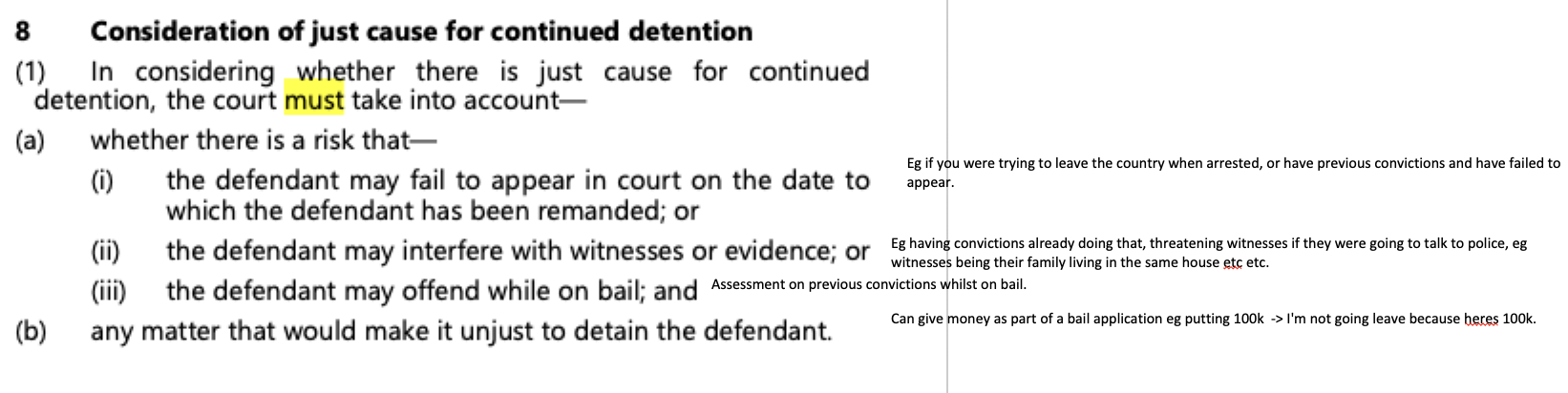
Court may take into account the following under s 8(2) when deciding if there is a just cause for continued detention.
nature of the offence (serious or not)
strength of evidence and probability of conviction
seriousness of punishment (severity of punishment)
charcter and past conduct (criminal behaviour) of the D
if D has a history of offending on bail, breaching court orders and including orders imposing bail conditions
likely length of time before the hearing/trial
possibility of prejudice to the defence in the preparation of the defence if defendant remains in custody
any special matter relevant in the particular circumstances
Additional considerations for bail
to protect victims of alleged family violence and those protected by a protection order. (s 8)
certain types of offences.
reverse onus provision s 10 for people charged with specified offence but who have a previous conviction for a specified offence AND
s 12 relating to further alleged serious offending carried out on bail for those who have previously received 14 or more sentences of imprisonment (onus shifted onto them to prove why they should be bailed)
Additional issues with bail
restrictive conditions, surveillance society (electronically monitored bail)
disruption to family (No rehabilitation stuff)
inequities caused by need for suitable address ( bad policies with Housing NZ saying wont house people on bail (even if the person living there would take them))
disclosure
Mostly refers to the provision of relevant evidence from the prosecution to the defence.
Some limited obligations of the defence in relation to alibi and expert witnesses.
Includes the obtaining of some information from third parties by defence (for example counselling, medical or Oranga Tamariki records).
Why is disclosure of evidence to the defence-counsel important (pros and cons)
efficiency (trials run smoothly when each side has notice of the evidence and the arguments that the opposing side will present at trial.
arguments for Cons:
non-disclosure of prosecution evidence = common factor in miscarriage of justice cases and comparable concerns remain not least given increase in communications and digital data.
NZBORA protections for disclosure
NZBORA, s 25(a) right to a fair trial. Equality of arms and fair warning important.
NZBORA, s 24(d) right to adequate time and facilities to prepare a defence.
NZBORA, s 25(f) right to examine witnesses for the prosecution.
These rights are given effect in part through the Criminal Disclosure Act 2008
what must the prosecutor disclose?
• In essence the prosecution must disclose all “relevant information”.
• Relevant is defined in s 8 as ”information or an exhibit that tends to support or rebut, or has a material bearing on, the case against the defendant”. ( It’s managed by prosecution (yk they may be biased and don't know what helps the defence), sometimes defence may have to ask for info based on x argument)
• There are some specific reasons relevant information can be withheld, but it is a high
standard and defence must be given the opportunity to challenge it.
• For example “likely to prejudice the maintenance of the law, including the prevention and
investigation of offences”, ”likely to endanger the safety of any person” or could identify
undercover police officers or informer.
risk of miscarriage of justice and consequences of not disclosing.
real risk;
Alan Hall case - Hall spent 10-20 years in prison for murder, found near a scene where someone was killed. Police deleted sentence that said alleged was of a darker complexion whereas Hall was pakeha.
risk of expense and delay - Bublitz case - Found out 2,000 docs hadn't been disclosed and had to restart. (lots of time and money wasted)
risk of serious breach of privacy or endangering lives by over-disclosure is also present.
Evidence Act 2006 s 7 (general principle for admissibility)
relevant evidence = admissible
relevant = ‘has the tendency to prove or disprove anything that is of consequence to the determination of the proceeding’ = has some probative value (even if very small)
BUT is subject to s 8 exclusionary rules
s 8 Evidence Act exclusionary rules
Judge must exclude evidence if its probative value is outweighed by the risk that the evidence will
Have an unfairly prejudicial effect on the proceeding
Needlessly prolong the proceeding
Propensity evidence (subject to different provisions)
‘evidence of a person’s propensity to act in a particular way or have a particular state of mind’ - s 40 - e.g. previous convictions for similar acts
Only admissible against D if ‘probative value outweighs the risk of unfairly prejudicial effect’ on the D.
Probative value largely rests on concept of ‘linkage and coincidence’ - what are the chances especially if found near where x has happened and they have previous convictions for something similar
other examples of targeted admissibility provisions
visual identification
voice identification evidence
propensity
hearsay - Statement made by someone other than a witness - extra rules due to reliability
admissibility of improperly obtained evidence e.g. unreasonable or unlawful search or in breach of rights
evidence is improperly obtained if
obtained in consequence of a breach of enactment or rule of law by a person to who s 3 NZBORA applies; or
unfairly
in deciding whether it is obtained unfairly judge must take into account guidelines set out in practice notes on that subject.
process Evidence Act s 30(2)(b) → judge finds evidence is or is not properly obtained + determines wether exclusion of evidence is proprtionate to the impropriety by means of balancing process that gives appropriate weight to the impropriety [and] takes proper account of the need for an effective and credible system of justice → s 30(4) EA judge must exclude any improperly obtained evidence if in accordance with sub-s 2 they determine its exclusion is proportionate to the impropriety
how do we decide when exclusion is proportionate to the impropriety s 30(3)
Judge must have regard to the following:
a) importance of any right breached by the impropriety and the seriousness of the intrusion on it
b) nature of the impropriety, in particular, whether it was deliberate, reckless or done in bad faith,
c) the nature and quality of the improperly obtained evidence
d) the seriousness of the offence with which the defendant is charged
e) any other investigatory techniques not involving any breach of rights that were known to be available but weren’t used
f) alternative remedies to exclusion of the evidence which can adequately provide redress to the defendant
g) whether the impropriety was necessary to avoid apprehended physical danger to the police or others
h) whether there was any urgency in obtaining the improperly obtained evidence