Basic Human Biochemistry
 Call Kai
 Learn
Learn Practice Test
 Spaced Repetition
 Match
Match Flashcards
 Knowt Play
1/148

There's no tags or description
Looks like no tags are added yet.
Name | Mastery | Learn | Test | Matching | Spaced | Call with Kai | Chat |
|---|
No analytics yet
Send a link to your students to track their progress
149 Terms
what is biochemistry
Biochemistry is the study of chemical composition and reactions of living matter
All chemicals either organic or inorganic
Inorganic compounds
Water, salts, gases, and many acids and bases
Do not contain carbon PLUS hydrogen
Water, salts, gases, and many acids and bases
Inorganic compounds
Do not contain carbon PLUS hydrogen
Inorganic compounds
Organic compounds
Carbohydrates, fats, proteins, and nucleic acids
Contain carbon PLUS hydrogen, are usually large, and are covalently bonded
Carbohydrates, fats, proteins, and nucleic acids
Organic compounds
Contain carbon PLUS hydrogen, are usually large, and are covalently bonded
Organic compounds
Most abundant inorganic compound
Accounts for 60%–80% of the volume of living cells
water
most important inorganic compound due to its properties
water
High heat capacity
Ability to absorb and release heat with little temperature change
Prevents sudden changes in temperature
what inorganic compound is this?
water
Ability to absorb and release heat with little temperature change
water
Prevents sudden changes in temperature
water
High heat of vaporization
Evaporation requires large amounts of heat
Useful cooling mechanism
what inorganic compound is this?
Water
Evaporation requires large amounts of heat
water
Useful cooling mechanism
water
Polar (charged) solvent properties
Dissolves and dissociates ionic substances
Forms hydration (water) layers around large charged molecules
Example: proteins
Body’s major transport medium - blood
water

Dissolves and dissociates ionic substances
water
Forms hydration (water) layers around large charged molecules
Example: proteins
Body’s major transport medium - blood
water
Necessary part of hydrolysis and dehydration synthesis reactions
waters reactivity
hydrolysis
water put into the reaction (catabolic)(exergonic)
dehydration
water is lost (anabolic)(endergonic)
Protects certain organs from physical trauma
Example: cerebrospinal fluid cushions nervous system organs
water is cushioning
ionic compounds that dissociate into separate ions in water
Salts
Separate into cations (positively charged molecules) and anions (negatively charged)
Not including H+ and OH- ions
salts
electrolytes
Chemical substances, such as salts, acids, and bases, that ionize and dissociate in water and are capable of conducting an electrical current in a solution
All ions are called ________ because they can conduct electrical currents in solution
electrolytes
____ play specialized roles in body functions
Example: sodium, potassium, calcium, and iron
Ions
Ionic balance is vital for ___________
homeostasis
_______ are proton donors: they release hydrogen ions (H+), bare protons (have no electrons) in solution
Example: HCl → H+ + Cl–
Acids
_______ Are Proton acceptors: they pick up H+ ions in solution
Example: NaOH → Na+ + OH–
Bases
When a _____ dissolves in solution, it releases a Hydroxyl ion (OH –)
Base
measurement of concentration of hydrogen ions [H+] in a solution
pH scale
The more hydrogen ions in a solution makes the solution what?
more hydrogen ions in a solution,more acidic that solution
Acidic solutions have high ____ but low ____
Acidic solutions have high [H+] but low pH
Acidic pH range is _____
Acidic pH range is 0–6.99

Neutral solutions have equal numbers of___ and ___ ions
Neutral solutions have equal numbers of H+ and OH– ions
All neutral solutions are pH __
All neutral solutions are pH 7
Pure _____ is pH neutral
Pure water is pH neutral
pH of pure water = pH 7: [H+] = 10–7 m
what is bloods pH range
Blood PH: 7.35 -7.45
Alkaline (basic) solutions have low ___ but high ___
Alkaline (basic) solutions have low [H+] but high pH
Alkaline (basic) pH range is ______?
Alkaline pH range is 7.01–14

Organic molecules contain ______ and _______
Organic molecules contain carbon and hydrogen
Organic molecules contain carbon and hydrogen but what are the exceptions?
exceptions: CO2 (carbon dioxide) and CO (carbon monoxide), which are inorganic
Carbon is ____________
Carbon is electroneutral
Shares electrons; never gains or loses them
Carbon is electroneutral
Forms four covalent bonds with other elements
Carbon is electroneutral
Major organic compounds: ______,_______,______, and______
Major organic compounds: carbohydrates, lipids, proteins, and nucleic acids
Many organic compounds are _______
polymers
polymers
polymers are large molecules made by bonding many monomers together in a repeating chain
monomers
Monomers are small, simple molecules that act as individual building blocks
Chains of similar units called ________ (building blocks)
monomers
monomers are synthesized by _________ __________
dehydration synthesis
Synthesized by dehydration synthesis: (building)
a water molecule is “lost” as two molecules bond together

use water to breakdown polymers into monomers
hydrolysis reactions

Broken down by hydrolysis reactions: (tearing apart)
a water molecule enters the reaction to “split” a larger molecule into two molecules, breaking the bond

Carbohydrates include ______ and _______
Carbohydrates include sugars and starches
Contain what 3 elements
Carbon
Hydrogen
Oxygen
what are the 3 classes of carbohydrates?
monosaccharides: one single sugar
Monomers: smallest unit of carbohydrate
Disaccharides: two sugars
Polysaccharides: many sugars
Polymers are made up of monomers of monosaccharides
Simple sugars containing three to seven carbon atoms
(CH2O)n: general formula
n = number of carbon atoms
Monosaccharides

Monomers of carbohydrates
Monosaccharides

what class of carbohydrate is Pentose sugars and Hexose sugars
Monosaccharides
Ribose (RNA) and deoxyribose(DNA) is a ________ sugar?
Pentose sugars
Glucose (blood sugar) is a ________ sugar?
Hexose sugars
Double sugars
Disaccharides
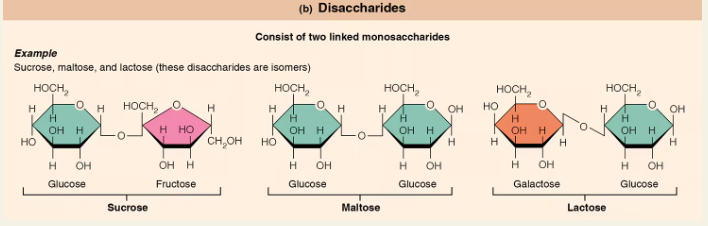
Too large to pass through cell membranes
disaccharides, and Polysaccharides
what are the 3 Important disaccharides?
Sucrose, maltose, lactose
Formed by dehydration synthesis of two monosaccharides
glucose + fructose → sucrose + water
Disaccharides
Polymers of monosaccharides
Polysaccharides

Formed by dehydration synthesis of many monomers
Polysaccharides
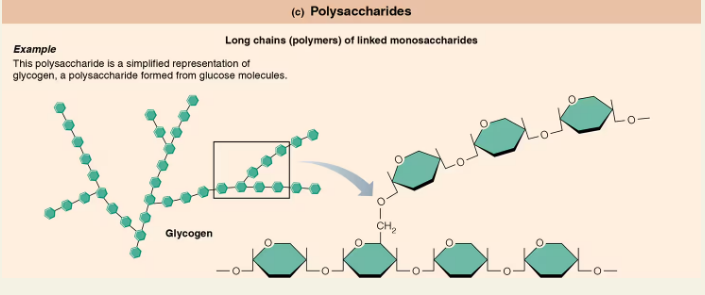
carbohydrate storage form used by plants
Starch
carbohydrate storage form used by animals
Glycogen
Important polysaccharides
Starch: carbohydrate storage form used by plants
Glycogen: carbohydrate storage form used by animals
Both Multiple glucoses ^
Contain C, H, O, but less than in carbohydrates, and sometimes contain P
Lipids (fats oils)
Insoluble in water
Lipids (fats oils)
what are the three main types of Lipids (fats oils)
Triglycerides or neutral fats
Phospholipids
Steroids (hormones)
Called fats when solid and oils when liquid
Triglycerides or neutral fats
Composed of three fatty acids bonded to a glycerol molecule
Triglycerides or neutral fats

Main functions
Energy storage, insulation, and protection
Triglycerides or neutral fats
Triglycerides can be constructed of:
Saturated fatty acids
Unsaturated fatty acids
Trans fats
Omega-3 fatty acids
All carbons are linked via single covalent bonds, resulting in a molecule with the maximum number of H atoms (saturated with H)
Saturated fatty acids

Solid at room temperature (Example: animal fats, butter, cheese, milk)
Saturated fatty acids
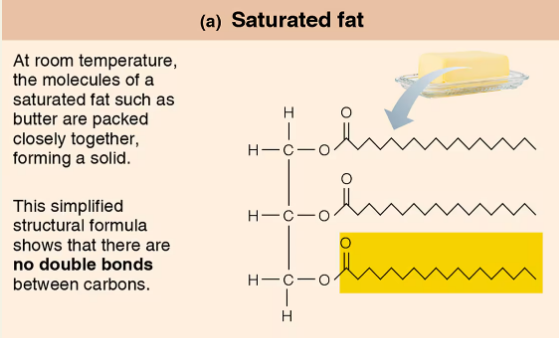
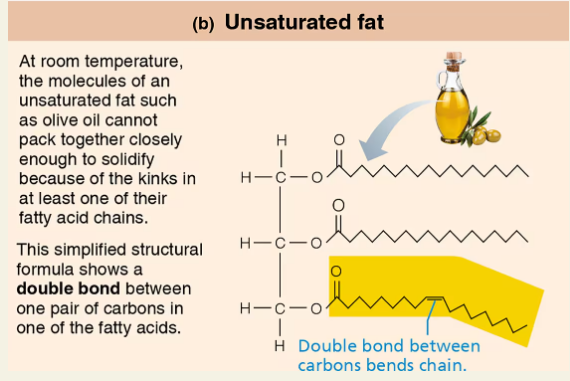
One or more carbons are linked via double bonds, resulting in reduced H atoms (unsaturated with H)
Unsaturated fatty acids

Liquid at room temperature (Example: plant oils, such as olive oil)
Unsaturated fatty acids

Trans fats – modified oils; unhealthy
Unsaturated fatty acids
Omega-3 fatty acids – “heart healthy”
Unsaturated fatty acids

consists of a glycerol backbone with two fatty acids, a phosphate group, and a nitrogen-containing group.
Phospholipids

“Head” and “tail” regions have different properties
Phospholipids
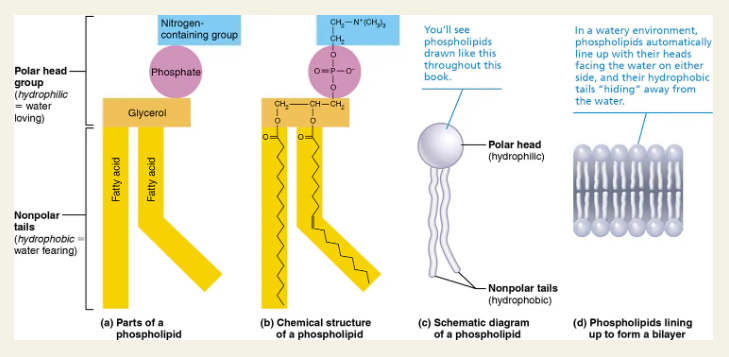
Head is a polar region and is attracted to water
Phospholipids
Tails are non-polar and are repelled by water
Phospholipids
Consist of four interlocking ring structures
Steroids
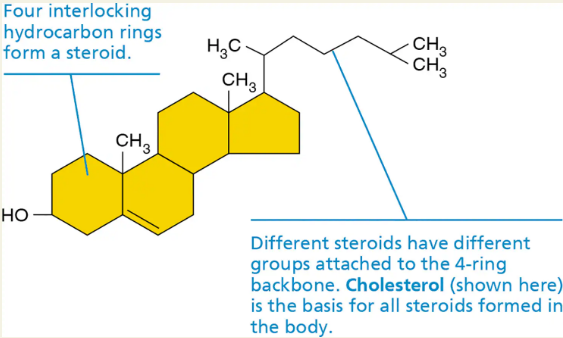
4 Common steroids
cholesterol, vitamin D, steroid hormones, and bile salts (made by liver)
Most important steroid is ________
Cholesterol
___________ Is a building block for vitamin D, steroid synthesis, and bile salt synthesis
and Important in cell plasma membrane structure
Cholesterol
Comprise 20–30% of cell mass
Proteins
Have most varied functions of any molecules
Structural, chemical (enzymes), contraction (muscles)
Proteins
Contain C, H, O, N, and sometimes S and P (sulfur, phosphorus)
Proteins
Polymers of amino acid monomers held together by peptide bonds (covalent bonds)
Proteins
Shape and function due to four structural levels
Proteins
All proteins are made from ___ types of amino acids
All proteins are made from 20 types of amino acids
what are the two important functional groups of amino acids that all amino acids have
Contain both an amine group and carboxylic acid group
Can act as either an acid or base