Relation Extraction and Sentiment Analysis
 Call Kai
 Learn
Learn Practice Test
 Spaced Repetition
 Match
Match Flashcards
 Knowt Play
1/20

There's no tags or description
Looks like no tags are added yet.
Name | Mastery | Learn | Test | Matching | Spaced | Call with Kai | Chat |
|---|
No analytics yet
Send a link to your students to track their progress
21 Terms
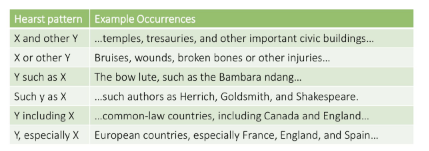
Rule-based Relation Extraction
If the mention of a hyponym and a hyperonym in a sentence are connected in a clearly distinguishable pattern, we can construct a rule to extract the relation.
Hand-written Rules Pros & Cons
+ Manually curated rules tend to have a high precision
+ Can be tailored to specific domains
-Manually curated rules often have low recall
-A lot of manual work is required to maintain rulesets
Bootstrap sampling
simulate having multiple different data sets (although you only have one) by repeatedly sub-sampling a single data set, for example to derive confidence intervals
Knowledge Base
In a knowledge base, relations are typically Encoded as triples
We can use such templates to identify patterns in which relations may occur in a corpus
Entity types can help us create pattern templates.
Distantly Supervised Relation Extraction
Starting with a few seed entities, find cooccurrences of these entities to identify patterns.
Use the patterns as templates for discovering new entities. Repeat.
Distantly Supervised Relation Extraction Pros and Cons
+ minimal manual input (a few seed entities or patterns) → semi-supervised approach (also called distant supervision)
+ System learns to extract new relations on its own
+ Improved recall
- A trade-off between precision and recall becomes necessary
- Recall is still not perfect - not all relations (always) occur in obvious patterns
Supervised Relation Extraction
Setup and design:
● Defining a set of relations for extraction
● Selecting a set of relevant named entities
Data:
● Compiling a representative training corpus
● Labeling named entities in the corpus
● Annotating relations between these entities (manually or pattern-based)
Training a classifier:
● Naïve Bayes
● SVM
Neural Language Models for Relation Extraction
Pre-trained contextual language models can be used to build relation extraction pipelines by leveraging what the model has learned about word relations (e.g. via attention).
● This is transfer learning. The model is
○ trained on an unsupervised task, and
○ fine-tuned for relation extraction.
● Adaptation of an annotation task:
○ Given a sentence with masked entities, the model is trained to label tokens with relation types.
● Adaptation of extractive question answering:
○ Given a sentence and the question the model outputs begin and end token indices of the relation in the sentence
Supervised Relation Extraction Pros and Cons
+high accuracy (both precision and recall) as long as we have sufficient labeled data
- Data hungry: requires a lot of labeled training data
- Often poor performance when adapting from one domain to another
Sentiment Analysis
Broadly speaking, sentiment analysis describes the tasks of identifying, extracting, quantifying, and studying affective states of the authors and expressed subjective information in text
Sentiment Analysis Applications
● Movies
● Products
● Public sentiment
● Politics
● Prediction
● Feedback:
Related detection / classification tasks for Sentiment Analysis
● Subjectivity
● Bias
● Stance
● Hate-speech
● Sarcasm
● Deception and betrayal
● Online trolling
● Polarization
● Politeness
● Linguistic alignment
Scherer Typology of Affective States
Emotion: brief organically synchronized [...] evaluation of a major event
Mood: diffuse non-caused low-intensity long-duration change in subjective feeling
Interpersonal stances: affective stance toward another person in a specific interaction
Attitudes: enduring, affectively colored beliefs, dispositions towards objects or persons
Personality traits: stable personality dispositions and typical behavior tendencies
Sentiment Analysis: Method Overview
● holder of the attitude
● target of the attitude
● type of attitude: From a set of types, More commonly: simple weighted polarity
● Text containing the attitude
Challenges in the extraction of features
● Tokenization
● Stemming
● Negation
● Subtleties
Tokenization
Punctuation is typically removed or collapsed in preprocessing. But for sentiment analysis, it may contain valuable signals.
● Repetition of punctuation for emphasis
● Masking of expletives
● Emoticons may carry more sentiment signal than most words
Stemming
Stemmers heuristically identify word suffixes and strip them, with some regularization of the endings. This runs the risk of merging tokens with positive or negative connotation.
Stemming can be helpful for pooling the signal
Negation
Negation reverses the polarity of certain words
Workaround: Simple negation marking: append a _NEG suffix to every word that occurs between a negation and the next punctuation mark at the level of the current clause.
Drawback: The vocabulary size just doubled.
Subtlety
sarcasm,
thwarted expectations
subtlety
Sentiment Lexica
Some words or phrases can be clearly identified as carriers of a strong sentiment signal: positive, negative, neutral.
They are typically compiled
● manually in a dictionary, or
● automatically from a corpus.
Sentiment Analysis with Neural Language Models
pre-trained contextual language models can be fine-tuned for sentiment analysis:
● This is transfer learning. The model is
○ trained on an unsupervised task, and
○ fine-tuned for sentiment analysis.
● Adaptation of a classification task:
○ Given a sentence determine to which sentiment class it belongs.
● Adaptation of a regression task:
○ Given a sentence output a sentiment score