Slide Deck 3: Chemotherapeutic Agents 1 Cytotoxic Chemo
 Call Kai
 Learn
Learn Practice Test
 Spaced Repetition
 Match
Match Flashcards
 Knowt Play
1/33

There's no tags or description
Looks like no tags are added yet.
Name | Mastery | Learn | Test | Matching | Spaced | Call with Kai | Chat |
|---|
No analytics yet
Send a link to your students to track their progress
34 Terms
Classes of Anticancer Agents
Categorize the following as either an alkylating agent or an antimetabolite.
Pyrimidines
Methylators
Antifolates
Nitrogen Mustards
Platinums
Purines
Alkylating Agent
Nitrogen mustard
Methylators
Platinums
Antimetabolite
Purines
Pyrimidines
Antifolates
Reminder: alkylating agents damage a cell’s DNA to stop cancer cells from growing and dividing
Antimetabolites trick cells into using a fake building block instead of real ones, which stop them from making new DNA and dividing
Alkylating Agents
Are alkylating agents cell-cycle non-specific or specific?
non-specific: they act at multiple phases of the cell cycle
Alkylating Agents
All alkylating agents are _____ (electrophilic or nucleophilic) molecules that ___ (ionically or covalently) modify nucleic acid bases on DNA.
electrophilic
covalently
Alkylating Agents
All alkylating agents are either monofunctional or bifunctional. What do these respective terms mean?
Monofunctional: cause single strand DNA breaks
Bifunctional: Inhibit DNA replication and transcription by cross-linking DNA
Alkylating Agents
Categorize the following drugs as either Nitrogen Mustards, Methylators, or Platinums.
Temozolomide
Cyclophosphamide
Cisplatin
Dacarbazine
Nitrogen Mustards
Cyclophosphamide (Cytoxan)
Methylators
Temozolomide
Dacarbazine
Platinums
Cisplatin
Alkylating Agents
How do nitrogen mustards, like cyclophosphamide, produce cytotoxicity?
By forming covalent inter-strand cross-links in DNA.
the nitrogen mustard cross-link has been demonstrated to occur in the G-C rich region of DNA
(cyclophosphamide) contains two reactive arms [is bifunctional]: as seen in the picture
![<p>By forming <span style="color: yellow;">covalent inter-strand cross-links</span> in DNA.</p><ul><li><p>the nitrogen mustard cross-link has been demonstrated to occur in the G-C rich region of DNA</p></li><li><p>(cyclophosphamide) contains two reactive arms [is bifunctional]: as seen in the picture</p></li></ul><p></p>](https://assets.knowt.com/user-attachments/eef4ad67-75e9-4a32-8466-f9aacbaf6ec1.png)
Alkylating Agents
Cyclophosphamide is an ORAL PRODRUG that forms active metabolites through first-pass hepatic metabolism. A byproduct of cyclophosphamide metabolism is a______, which is toxic to the bladder epithelium and can lead to hemorrhagic cystitis. What is given co-administratively or as prophylaxis for cyclo…?
Acrolein
MESNA [MESNEX] (a thiol drug): it scavenges acrolein
Alkylating Agents
List 5 common AEs of cyclophosphamide.
What condition is a risk but it mitigated with MESNA therapy?
What syndrome is is generally observed with high doses of cyclophosphamide?
Myelosuppression, Fever, Alopecia, CINV, Diarrhea
Hemorrhagic cystitis
Cardiotoxicity (potentially fatal): presents as severe cardiac failure ~10 days after drug admin.
Alkylating Agents: Temozolomide (Temodar)
Prodrug? Yes or No
What is its anti-tumor activity?
Indication?
Yes
Methylation of purines (adenine and guanine) on DNA
Glioblastoma multiforme (brain cancer)
Alkylating Agents
What leads to the development of acquired resistance to temozolomide, and what inhibition stops resistance mechanisms and increases cytotoxicity of TMZ?
Resistance Mechanisms:
MGMT enzyme repairing the O6-methylguanine
BER pathway alkylation repair of N7/N3 positions
Inhibits resistance + increases cytotoxicity:
PARP inhibitors (synthetic lethality): they block BER pathways
Alkylating Agents: Methylators
Dacarbazine:
Indications:
Part of the polychemotherapy regimen: _ _ _ _
Prodrug? Yes or No
melanoma and Hodgkin’s kymphoma
ABVD (Adriamycin, Bleomycin, Vinblastine, Dacarbazine) [first-line treatment of Hodgkin’s lymphoma
yes
Alkylating Agents
What drug is a platinum?
Cisplatin
have drastically improved outcomes of patients with testicular and bladder cancer

Alkylating Agents
What is the MOA of cisplatin (platinum)?
The platinum atom of cisplatin binds covalently to DNA bases to form crosslinks.
Cisplatin-DNA bonds cause various cellular responses (ex. replication arrest, transcription inhibition, cell-cycle arrest, DNA repair and apoptosis)
Cisplatin AEs
List 7 of cisplatin’s most common adverse effects.
Ototoxicity
Cardiotoxicity
Nephrotoxicity
Hematological toxicity
GI toxicity
Hepatotoxicity
Neurotoxicity
Summary: Ear, Heart, Kidney, Blood, GI, Liver, Neurons
Cisplatin Major Adverse Events (BOXED WARNINGS)
List the 4 boxed warnings associated with cisplatin.
Nephrotoxicity
Acute kidney injury (PTS NEED TO HYDRATE)
hypomagnesemia (MG SUPPLEMENTATION)
Peripheral Neuropathy
Nausea and Vomiting
Antiemetics
Myelosuppression
Antimetabolites
Drugs are used to ____ structures of normal precursor molecules used in DNA synthesis.
Act in the ___ phase and are non-cell specific or cell specific?
counterfeit
S phase; cell specific
Antimetabolites
Put the following drugs in their categories (dihydrofolate reductase [DHFR] inhibitors, pyrimidine analogs, purine analogs).
Capacetabine
Methotrexate (MTX)
6-mercaptopurine
5-fluorouracil (5-FU)
DHFR inhibitors
MTX
Pyrimidine analogs
5-FU
Capecitabine
Purine analogs
6-mercaptopurine
Antimetabolites: DHFR Inhibitors
Folate (folic acid) is essential for the synthesis of _____. It is converted to dihydrofolate (FH2) then tetrahydrofolate (FH4) which provides the single carbon groups for the synthesis of dTMP. Methotrexate is administered high dose and is approved for cancers like acute ____ ____.
Purines; acute lymphoblastic leukemia (ALL)
Methotrexate
The minimal effective and minimal toxic concentration of MTX is ___ and the therapeutic index is ___. There are 5 notable toxicities, which include:______. _____ can be managed.
small; narrow; mucositis, renal failure, liver injury, neurotoxicity, myelosuppression; nephrotoxicity
Rescue for the HD-MTX
What treatment is there to prevent toxicity from administering MTX at high doses? Why does it work?
Leucovorin (folinic acid); it works because it allows for some purine synthesis to happen in the presence of DHFR inhibition by MTX, so that DNA replication/RNA transcription processes can proceed in normal cells - this mitigates toxicity.
ADMINISTER LEUCOVORIN 24-42 HOURS AFTER ADMINISTERING MTX
HD-MTX - Supportive Care
What is a crucial aspect of MTX clearance and prevention of renal toxicity?
Urine alkalization (increases solubility and decreases precipitation within the renal tubuli)
With sodium bicarbonate
Hydration
Tx for Patients with MTX Toxicity due to Renal Impairment
This is indicated for the treatment of toxic plasma MTX concentrations (>1 uM) in patients with delayed MTX clearance due to impaired renal function.
Route: IV
MOA: recombinant carboxypeptidase G2 (CPDG2) enzyme which rapid lowers blood levels of MTX
Voraxaze (Glucarpidase)
Pyrimidines: Fluoropyrimidines
What is the prodrug of 5-FU?
Capecitabine (Xeloda)
5-FU
How does 5-FU exert its anti-tumor effects?
Through inhibiting thymidylate synthase
other sites of action comprise incorporation into RNA AND DNA
Capecitabine (Xeloda)
Which step is very critical in capecitabine becoming active 5-FU, and for what reason?
Thymidine Phosphorylase - some tumors express thymidine phosphorylase in higher concentrations than normal tissue; this is has 2 advantages over 5-FU, enhanced drug concentrations at the tumor and reduced drug levels in normal tissues, therefore decreasing systemic toxicity
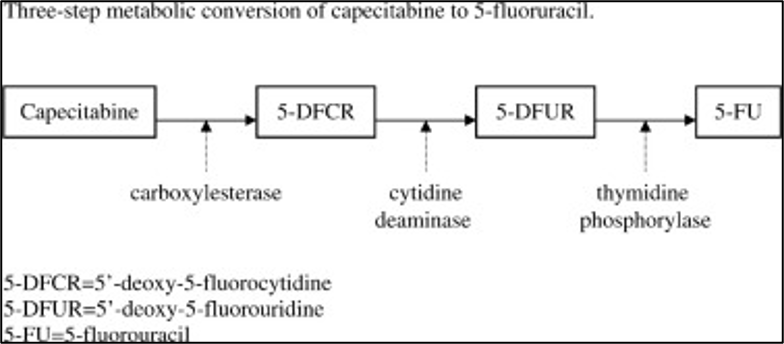
5-FU Metabolism and Anticancer Mechanism
The anticancer pathway of 5-FU is the formation of cytotoxic triphosphates. The metabolism is clearance pathways. What enzyme is the focus?
DPD Enzyme
5-FU PGX Issues and DPD
What fraction of 5-FU is converted into cytotoxic phosphorylated species required to kill cancer cells?
In what patients is administered 5-FU converted into the inactive metabolite (80%)?
What patients have a decreased metabolism of 5-FU, which leads to increasing levels of cytotoxic metabolites?
80%
patients with two copies of functional DPD
DPD deficient patients
Fluoropyrimidines and the DPYD Gene
What gene encodes for the enzyme dihydropyrimidine dehydrogenase (DPD)?
Which patients are at risk of 5-FU toxicity?
What does the FDA-approved drug label for 5-FU state?
DPYD
Poor metabolizer phenotypes
No dose has been proven safe in individuals with absent DPD activity
DPD Enzyme Activity Scores and Phenotype
What is the activity score for the DPD enzyme?
Each Normal function allele:
Each Reduced function allele:
Each CPIC LOF allele:
1
0.5
0

CPIC Guidelines for Fluoropyrimidines
Which activity score results in dose reductions of fluoropyrimidines? What about avoiding 5-FU or capecitabine altogether?
Dose reductions: 1 (50%) -1.5 (25-50%)
Avoiding: 0-0.5
Capecitabine
Capecitabine’s NEW Boxed Warning as of 2025:
DPYD (deficiency)
Gemcitabine (Gemzar)
What is the MOA?
What are the 3 most common adverse reactions?
Inhibits DNA synthesis; fraudulent nucleoside; converted to nucleotides by sequential phosphorylation to triphosphate.
Nausea/vomiting, myelosuppression
Generally well tolerated (can cause GI disturbances, renal impairment, pulmonary toxicity, and flu-like symptoms)
Purine Analog: Thiopurines
Examples: 6-mercapto, 6-thioguanine, azathioprine (ALL PRODRUGS)
Mainly used in ALL (acute lymphoblastic leukemia) treatment
Describe the therapeutic index, and a major toxicity associated with thiopurines.
What enzyme do thiopurines have an issue with regarding PGx (remember: these are prodrugs that require sequential ribosylation (sugar addition) and phosphorylation by kinases as part of the MOA against cancer cells)?
TI = very narrow; life-threatening myelosuppression
TPMT (thiopurinemethyltransferase)
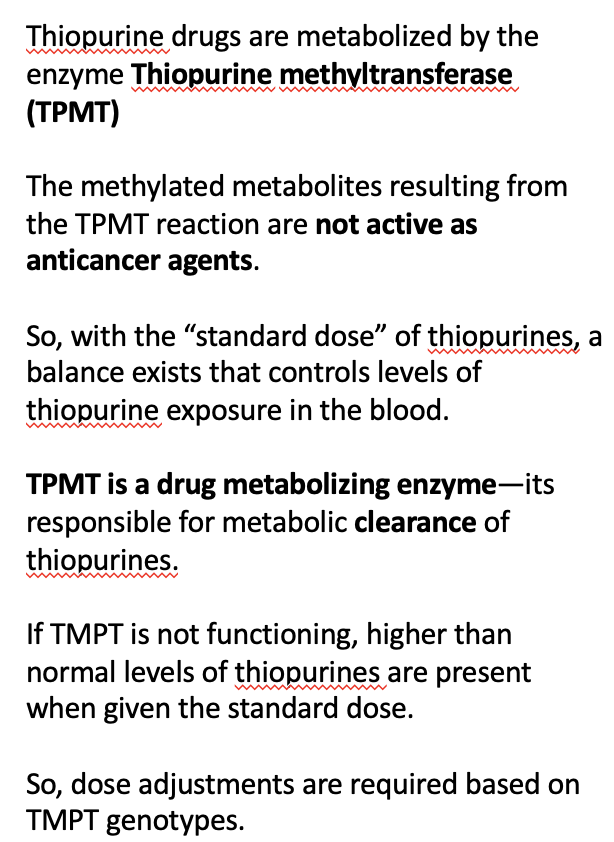
Not a question: Just about thiopurine dosing in those with TPMT deficiencies.
