energy and ecosystems
 Call Kai
 Learn
Learn Practice Test
 Spaced Repetition
 Match
Match Flashcards
 Knowt Play
1/40

There's no tags or description
Looks like no tags are added yet.
Name | Mastery | Learn | Test | Matching | Spaced | Call with Kai | Chat |
|---|
No analytics yet
Send a link to your students to track their progress
41 Terms
what do organisms in any ecosystem rely on?
a source of energy to carry out all their activities
what is the ultimate source for most organisms?
sunlight, which is conserved as chemical energy by plants
how do most plants use sunlight?
in making organic compounds from CO2 in the air/ water that surrounds them
what do these organic compounds include?
sugars, most of which are used by the plants as respiratory substrates
what happens to the remainder of the sugars?
they are used to make other groups of biological molecules. These form the biomass of plants that is the means by which energy is passed between other organisms
what can organisms be divided into?
3 groups according to how they obtain their energy and nutrients. These 3 groups are producers, consumers and saprobionts
producers:
photosynthetic organisms that manufacture organic substances using light energy, water, CO2 and mineral ions
consumers:
organisms that obtain their energy by feeding on other organisms rather than using the energy of sunlight directly. animals are consumers
primary consumers:
those that directly eat producers
secondary consumers:
those animals eating primary consumers
tertiary consumers:
those eating secondary consumers
what are secondary and tertiary consumers usually?
predators, but they may also be scavengers or parasites
saprobionts:
a group of organisms that break down the complex materials in dead organisms into simple ones. In doing so, they release valuable minerals and elements in as form that can be absorbed by plants and so contribute to recycling. the majority of this work is carried out by fungi and bacteria
food chain:
describes a feeding relationship in which the organisms get eaten by the organism higher up in the levels. Each stage in this chain is referred to as a trophic level. the arrows on food chain diagrams represent the direction of energy flow
food webs:
many food chains will be linked together to form a food web. the problem with food webs is their complexity. In practice, it is likely that all organisms within a habitat, even within an ecosystem, will be linked to others in the food web
biomass:
the total mass of living material in a specific area at a given time. the fresh mass is quite easy to access, but the presence or varying amounts of water makes it unreliable
what overcomes this problem?
measuring the mass of carbon or dry mass, but because the organisms must be killed, it is usually only made on a small sample, and this sample may not be representative
how is biomass measured?
using dry mass per given area, in a given time. gm^-2 or gm^-3
how can the chemical energy store in dry mass be estimated?
using calorimetry
how does bomb calorimetry work?
a sample of dry material is weighed and is then burnt in pure oxygen within a sealed chamber call a bomb
the bomb is surrounded by a water bath and the heat of combustion causes a small temp rise in the water
as we know how much heat/ energy is required to raise the temp of 1g of water by 1 degree, if we know the volume of water and the temp rise, we can calculate the energy released from the mass of burnt biomass in units like kJkg^-1
as little as what % of light energy may be captured by green plants and so made available to organisms in the food chain?
1%
what do the organisms in turn do?
pass on only a small fraction of the energy that they receive to each successive stage in the chain
what do plants normally convert?
between 1 and 3% of the suns energy available to them into organic matter
why is most of the suns energy not converted to organic matter by photosynthesis?
over 90% of the suns energy is reflected back into space by clouds and dust or absorbed by the atmosphere
not all wavelengths of light can be absorbed and used for photosynthesis
light may not fall on a chlorophyll molecule
a factor, such as low CO2 levels, may limit the rate of photosynthesis
what is the gross primary production? (GPP)
the total quantity of the chemical energy store in plant biomass, in a given area or volume, in a given time
how much of this energy is used in respiration?
20-50%
what is net primary production? (NPP)
the chemical energy store which is left when these losses to respiration have been taken into account
net primary production =?
gross primary production - respiratory losses
what is the NPP available for?
plant growth and reproduction, and to other trophic levels in the ecosystem such as consumers and decomposers
usually less than 10%…
of this NPP in plants can be used by primary consumers for growth
what about secondary and tertiary consumers?
they are more efficient, transferring up to about 20% of the energy available from their prey into their own bodies
the low % of energy transferred at each stage is due to:
some of the organisms is not consumed
some parts are consumed but cannot be digested and are therefore lost in faeces
some of the energy is lost in excretory materials, like urine
some energy losses occur as heat from respiration and lost to the environment. these losses are high in mammals and birds because of their high body temp. much energy is needed to maintain their body temp when heat is constantly being lost to the environment
what can the net production of consumers therefore be calculated as?
N= I - (F + R)
what do these units represent?
N = the net production
I = the chemical energy store of ingested food
F = the energy lost in faeces and urine
R = the energy lost in respiration
it is the relative inefficiency of energy transfer between trophic levels that explains why:
most food chains have only 4-5 trophic levels because insufficient energy is available to support a large enough breeding population at trophic levels higher than these
the total mass of organisms in a particular place (biomass) is less at higher trophic levels
the total amount of energy available is less at each level as one moves up a food chain
diagram to show energy flow through different trophic levels:

extra info: calculating the efficiency of energy transfers:
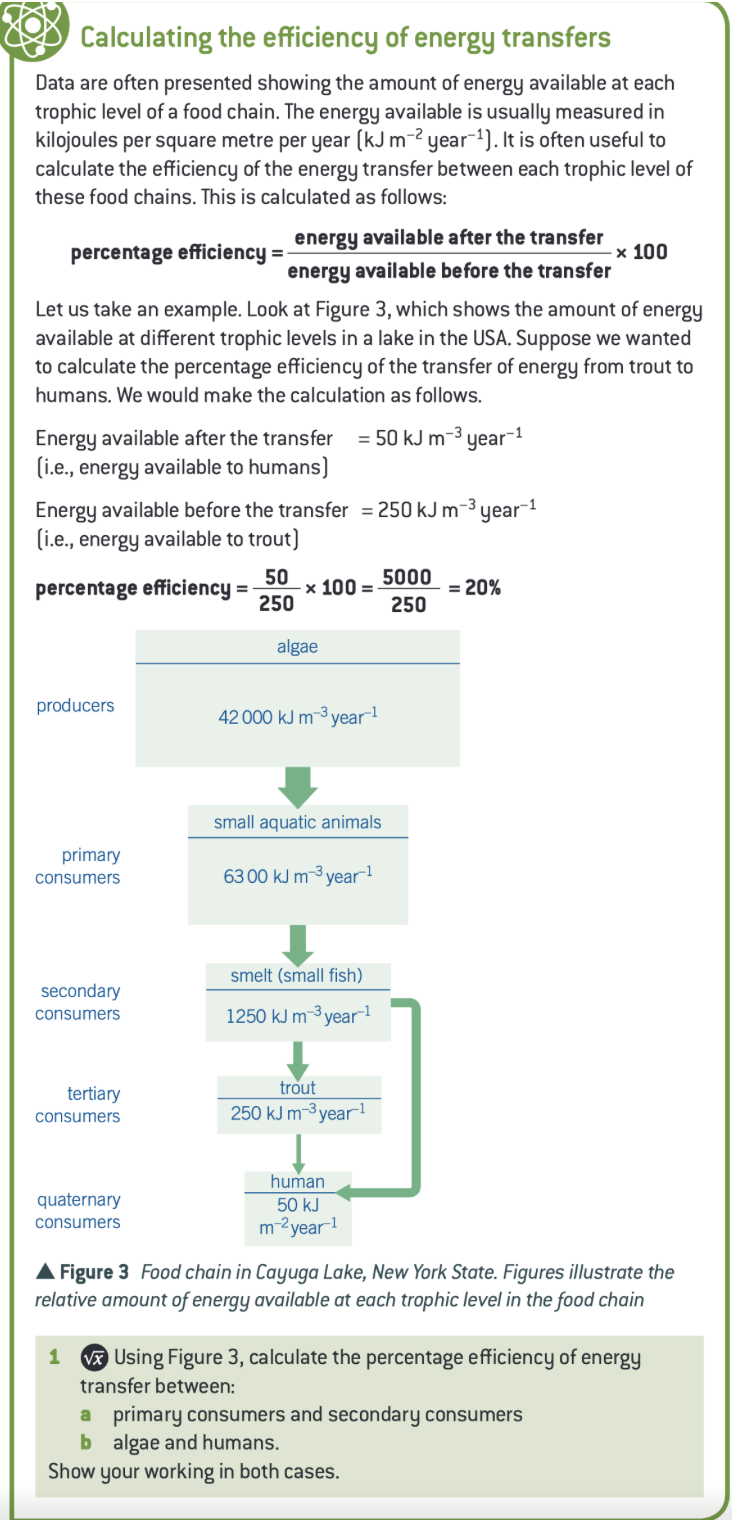
extra info: adding up totals:


extra info: productivity and farming practices:

extra info: a mighty problem:
