HTL 3.1-3.3
 Call Kai
 Learn
Learn Practice Test
 Spaced Repetition
 Match
Match Flashcards
 Knowt Play
1/39

There's no tags or description
Looks like no tags are added yet.
Name | Mastery | Learn | Test | Matching | Spaced | Call with Kai | Chat |
|---|
No analytics yet
Send a link to your students to track their progress
40 Terms
What is another term for 1 milliliter?
1 milliliter (mL) is also known as 1 cubic centimeter (cc)
Define:
1. milli
2. centi
3. micro
4. nano
1. milli- is one-thousandth part of
2. centi- is one-hundredth part of
3. micro- is one-millionth part of
4. nano- is one billionth part of
Give at least 2 other ways of writing 1 microliter other than 1µL.
1 µL may also be written as 1/1,000,000 L, 0.000001 L, or 10-8 L.
What is the ideal method for freezing skeletal muscle for enzyme studies?
1. in what liquid(s)?
2. at what temperature?
3. mounted on cork in what medium?
1. Isopentane (2-methylbutane) submerged in liquid nitrogen.
2. -150°C is the ideal freezing temperature.
3. gum tragacanth is used for mounting the muscle on cork.
What are enzymes?
Enzymes are proteins that catalyze chemical reactions in biologic systems. Enzymes temporarily combine with their specific substrate, or the compound, on which they act. Enzymes are then released unchanged, ready to combine with other substrate molecules.
How long can tissue for electron microscopy remain in osmium tetroxide without harm?
Tissue for electron microscopy should not remain in osmium tetroxide for more than 2 hours.
Define hydrolases and give examples of enzymes that fall into this class.
Hydrolases act on various substrates through the addition or removal of water. Esterases, which catalyze the hydrolyses of ester linkages and phosphatases, which hydrolyze esters of phosphoric acid are subclasses of the hydrolases.
What is the gravimetric factor?
The gravimetric factor is a calculated numerical value that is used to compensate for variances in the actual dye content of dry dyes used in the preparation of staining solutions. This calculation enables a greater consistency of staining solutions by maintaining the same dye content.
Define meniscus.
The meniscus is the curved surface of a liquid in a container such as a graduated cylinder. The bottom of the curved surface should ul be used to determine the volume measurement.
What is a dual purpose fixative? Give 2 examples.
A dual purpose fixative can be used to fix tissue for 2 different types of study. In histopathology it usually refers to a fixative that can be used for both light and electron microscopy. Paraformaldehyde, modified Millonig formalin, and Zamboni solution are examples of dual purpose fixatives.
How does the naphthol AS-D chloroacetate esterase stain (Leder stain) differ from most enzyme techniques?
Paraffin sections may be used for the naphthol AS-D chloroacetate esterase stain, and frozen sections are required for most other enzyme stains
What is the fixative of choice for all cytology specimens?
95% alcohol is the fixative of choice for all cytology specimens. Although Saccomanno is frequently referred to as a fixative, it is really a pre-fixative and 95% alcohol is used for final fixation of the smears.
If necessary to substitute alcoholic fixatives in cytology, why should 100% methanol or 80% isopropanol be substituted for 95% ethanol?
All alcohols do not cause the same amount of shrinkage, therefore it is necessary to understand the effects of the various alcohols so that the proper concentration can be chosen as a fixative. Methanol causes less shrinkage than ethanol; therefore 100% methanol is a substitute for 95% ethanol. Isopropanol causes more shrinkage; therefore 80% isopropanol can be substituted for 95% ethanol.
What happens to cytology specimens if they are allowed to air-dry before fixation? What is the maximum time limit between the time the smear is made and the time the slides are fixed?
Air-drying of cytologic specimens causes nuclear swelling, distortion, and loss of cytoplasmic density. Nuclear chromatin patterns are lost and the cytoplasm becomes eosinophilic, losing the metabolic differentiation. No more that 2 minutes should lapse between the making of the smear and the time of fixation.
What are Tzank smears and what is their purpose?
Tzank smears are direct scrapings for viral lesions.
What is the primary diagnostic reason for performing the phosphorylase stain on muscle?
Phosphorylase activity is absent in McArdle disease, a glycogen storage disease characterized by an abnormal accumulation of glycogen in muscle tissue. Symptoms are exercise intolerance - muscular pain, fatigability - and muscle cramping.
What are pre-fixatives used for in cytology? Give examples of pre-fixatives.
Pre-fixatives are generally solutions with lower alcohol content which partially fix the cells to protect them from autolysis and putrifaction. The use of pre-fixatives has become a common practice to accommodate cytology specimens which must be transported distances or held for periods of time before cytopreparation. This is not a substitute for final fixation in the appropriate strength alcohol. Common prefixatives include Saccomanno fluid (alcohol and Carbowax) and alcoholic saline
When is either Clark or Carnoy fixative indicated for cytology specimens?
Smears which are made from bloody fluids can be dropped into a Coplin jar containing Clark or Carnoy fixative solution to help remove obscuring red blood cells. The alcohol in these fixatives produces the necessary nuclear detail and the acetic acid lyses the RBCs. Fixation will occur in 2-4 minutes. Smears left in Carnoy or Clark solution for too long will lose chromatin detail. To prevent loss of nuclear detail, slides should be transferred to 95% ethyl alcohol (or equivalent) after 5 minutes in Clark or Carnoy solution.
Define:
1. gram molecular weight
2. molar solutio
1. Gram molecular weight (or formula weight) of a substance is the sum of the combined atomic weights of all atoms in the molecule expressed in grams.
2. A one molar (1M) solution contains 1 gram molecular weight of a substance dissolved in enough water to give a final volume of 1 L.
Define: normal solutionDefine: normal solution
A one normal (1N) solution contains one gramequivalent weight of solute per liter of solution. One gram-equivalent weight is that amount of a substance that will combine with or liberate one atom, or 1.008 g, of hydrogen. It can also be defined as the molecular weight divided by the number of dissociable or replaceable hydrogen ions.
The formula weight of CaSO, is 136.14 (Ca = 40, S = 32, O = 16).
1. How many grams would be required to prepare 1L of a 1M solution?
2. How many grams would be required to prepare 1L of a 1N solution?
1. 136.14
2. 68.07
Cellular fluids (eg, pleural, ascites, peritoneal) must be centrifuged prior to making a smear.What are the time and speed recommendations for centrifugation?
Centrifugation for cytology is best performed at 2000 RPM for approximately 10 minutes. The cells will be too tightly packed at higher speeds, making it difficult to separate the clumpy sediment and produce an even monolayer on the smear. The cells will not be forced to the bottom of the tube with lower speeds, decreasing the chance of getting a representative sampling of the cells.
Identify the 3 types of muscle and state whether each is voluntary or involuntary.
Skeletal muscle is voluntary, smooth muscle and cardiac muscle are both involuntary
List 4 methods of preparing cytology smears and give one use for each.
1. pull apart method - cellular fluids without mucus.
2. crosshatch method - cellular fluids especially with blood.
3. crush method – mucoid specimens.
4. cytocentrifuge - sparsely cellular fluids, such as spinal fluid.
Identify 2 artifacts that may be introduced during grossing
Both crush artifact (especially of small biopsies) and cross-contamination (tissue carry-over to another specimen) are artifacts that may be introduced during grossing.
In describing a specimen, what does homogenous mean?
Homogenous means uniform or without variation.
Of what tissue does a LEEP biopsy consist?
A LEEP (loop electrosurgical excision procedure) is a biopsy of the cervix.
When taking a section from a segment of colon removed for carcinoma, what does the term "proximal" margin mean?
A section from the "proximal" margin of the colon would be from the end closest to the tumor and the "distal" margin would be the end farthest from the tumor.
What are three things that may occur with biological oxidation?
The addition of oxygen, loss of hydrogen, or loss of electrons may occur with biological oxidation.
What stains are commonly used in the Papanicolaou method of staining cytology specimens?
OG6, an alcoholic solution of orange G (orange gelb) dye and the mordant phosphotungstic acid, and various formulations of EA are used in the Pap method of staining cytology specimens.
What is the composition of the EA stain?
EA is a polychrome cytoplasmic stain containing eosin Y, light green SF yellowish, Bismarck brown, and phosphotungstic acid. EA-36 contains a larger proportion of light green dye, approximately twice as much light green as EA-65. Commercial formulations of EA-50 are similar to EA-65, which is recommended for specimens with significant amounts of mucus present.
From what type of cells does each of the following most commonly arise:
a. carcinoma
b. lymphoma
c. sarcoma
d. lipoma
a. Carcinomas arise from epithelial or ductal cells.
b. Lymphomas arise from lymphoid cells.
c. Sarcomas commonly arise from connective tissue, but may arise from imperfectly differentiated cells.
d. Lipomas arise from adipose, or fat, cells
What is the primary reason that osmium is used as either the primary or secondary fixative for electron microscору?
Lipids are rendered insoluble by osmium fixation giving excellent membrane preservation. 93% of the lipids can be extracted after formaldehyde fixation, but only 7% can be extracted after fixation with osmium tetroxide. Cell membranes have phospholipids as a major component and will become electron-dense after fixation in osmium tetroxide.
List 4 factors that influence enzyme demonstration.
1. Treatment of tissue before and during the procedure; many enzymes are removed or destroyed by fixation, while others are sensitive to freezing and thawing.
2. Nonoptimal substrate. Sometimes optimal substrate concentration cannot be obtained because of poor substrate solubility.
3. Nonoptimal temperature. There is an optimal temperature for enzyme activity and sometimes, especially in azo dye simultaneous couple techniques, a different temperature must be used. Enzyme activity is usually destroyed at temperatures greater than 56°C.
4. Nonoptimal pH. Most enzymes are best demonstrated at a pH near 7.0; however, there are exceptions, as with acid and alkaline phosphatases.
5. Inhibitors. An excess of diazonium salts in the substrate, fixatives, heat, and some metallic ions may decrease or completely abolish enzyme activity.

1. Identify the tissue
2. Identify the stain
3. What is the significance of the different staining?
1. The tissue is skeletal muscle
2. The stain is an ATPase reaction; this stain was done at pH 4.6
3. Different fiber types are shown with this stain; at this pH, type I fibers are dark, type IIA fibers are very light, and type IIB fibers are intermediate. Normal muscle contains approximately one-third of each fiber typе distributed in a checkerboard pattern.
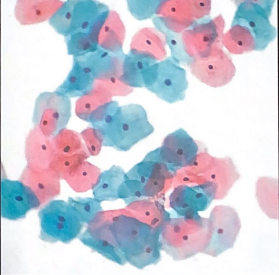
1. What stain is demonstrated in this image?
2. What type of cells are stained?
3. What reagent stains some cell cytoplasm pink?
1. A Papanicolaou-stained smear is demonstrated in this image.
2. Squamous epithelial cells are stained.
3. OG6 is the reagent that stains some cell cytoplasm pink.

1. Identify the tissue shown in this image
2. What stain is most often used to type the fibers?
1. The tissue is skeletal muscle.
2. ATPase is most often used to type the muscle fibers as to Type I or Type II.

What is the final reaction product of the method shown in this image?
The final reaction product in the ATPase method is cobalt sulfide.

1. Identify the tissue
2. What enzyme stain is most likely demonstrated?
3. Which fibers are stained dark?
1. The tissue is skeletal muscle.
2. The stain is most likely the NADH diaphorase, although succinic dehydrogenase would look similar.
3. Type I fibers are stained dark.

The final reaction product of the method seen in this image is:
a. an azo dye
b. a substituted naphthol
c. a formazan
d. an unbranched polysaccharide
C
A formazan is the end-product of a reaction between NADH and Nitro blue tetrazolium (NBT) in the presence of a flavoprotein enzyme (diaphorase). Azo dyes are the end-product in other techniques such as the acid phosphatase and a-naphthyl acetate esterase. Substituted naphthols are used in histochemical reactions but are not end-products. An unbranched polysaccharide is the end product in phosphorylase reactions.