Exam 1 Flashcards - BIOC 384
 Call Kai
 Learn
Learn Practice Test
 Spaced Repetition
 Match
Match Flashcards
 Knowt Play
1/98

There's no tags or description
Looks like no tags are added yet.
Name | Mastery | Learn | Test | Matching | Spaced | Call with Kai | Chat |
|---|
No analytics yet
Send a link to your students to track their progress
99 Terms
Define biochemistry.
hands-on experimental science that relies heavily on quantitative analysis of data
interested in understanding the structure & function of biological molecules
M1T1
Describe the contribution of Eduard Buchner to the birth of modern biochemistry.
demonstrated that carbon dioxide & ethanol could be produced from sugar using brewer’s yeast extracts in an in vitro reaction
*it showed that fermentation results from chemistry rather than a vital life force
M1T1
What are the five principles of modern biochemistry?
hierarchical organization of life
DNA is the chemical basis for heredity
bimolecular structure determines function (fine tuned by evolution via DNA mutations & natural selection)
biochemistry obeys thermodynamic laws
life on Earth depends on water
M1T1
Describe the hierarchical structure of nature.
living systems are organized around biomolecules that participate in interconnected metabolic pathways, signal transduction, and ecological networks
M1T2

What is a covalent bond?
chemical link when two atoms share one or more pairs of electrons
bond energies increase in going from single bonds to double bonds to triple bonds
M1T2
Draw the following functional groups: amino, hydroxyl, sulfhydryl, phosphoryl, carboxyl, and methyl,
M1T2

Name the four major classes of biomolecules and the primary functions of each.
amino acids: protein function, neurotransmission, nitrogen metabolism, energy conversion
nucleotides: nucleic acid function, energy conversion, cell signaling, enzyme catalysis
simple sugars: cell wall structure, energy conversion, cell recognition, nucleotide structure
fatty acids: cell membranes, energy conversion, cell signaling, energy storage
M1T2
Describe the functions of amino acids relating to proteins.
amino acids are the building blocks for proteins & differ in the side chains attached to the alpha carbon
glutamate & tyrosine derivates are important signaling molecules in neurotransmission
M1T2
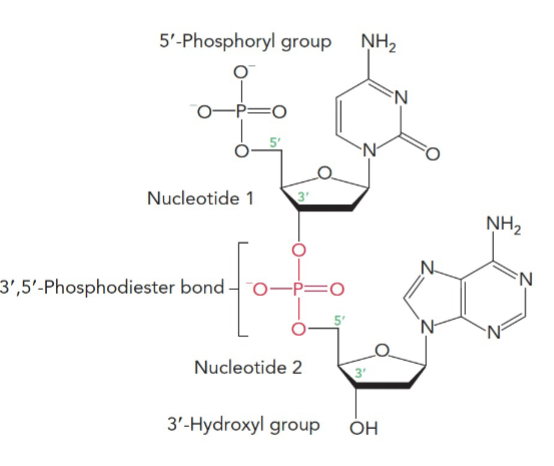
Describe the structure of nucleotides and nucleic acids.
nucleotides form nucleic acids
nucleotides are made up of: a nitrogenous base, 5-membered sugar, and phosphoryl groups
nucleotide bases in DNA AND RNA: adenine, guanine, cytosine
nucleotide base in DNA: thymine
nucleotide base in RNA: uracil
M1T2
Describe the functions of sugars and carbohydrates.
monosaccharides & polysaccharides are carbs used as energy sources & structural components of cells
simple sugars form carbohydrates
M1T2
Describe the functions of fatty acids and lipids.
fatty acids contain a carboxyl group (polar) attached to a hydrocarbon chain (nonpolar)
primary components of lipids in the plasma membrane
used as a storage form of energy in the form of triacylglycerols
M1T2
What are the six essential elements in living organisms?
H, O, C, N, P, S
M1T2
What are the building blocks of nucleic acids?
nucleotides
nucleotides consist of: a nitrogenous base (A, G, C, T, or U); 5-carbon sugar (ribose or deoxyribose); 1+ phosphoryl groups
M1T3
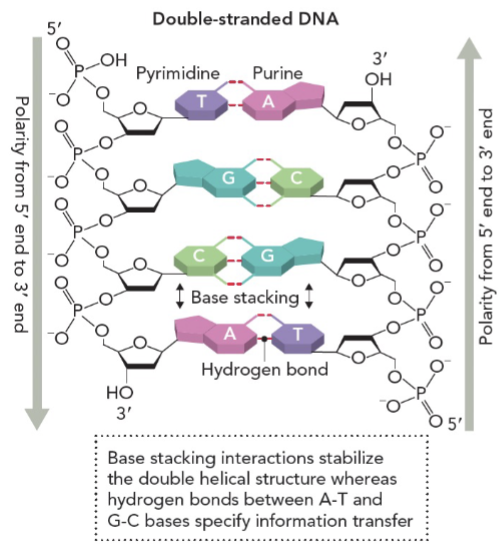
Why does base pairing involve hydrogen bonds?
hydrogen bonds form between nucleotide bases provide specificity in DNA replication and RNA transcription
base stacking provides helix stability
G-C pairs contain 3 hydrogen bonds
A-T pairs contain 2 hydrogen bonds (DNA)
A-U pairs contain 2 hydrogen bonds (DNA-RNA or RNA-RNA)
M1T3
How does base stacking stabilize the DNA helix?
deoxynucleotides are linked through a phosphodiester bond that connects the 5’-carbon to the 3’-carbon of the next nucleotide
2 DNA strands in the double helix are antiparallel to each other and run in the 5’ to 3’ direction
M1T3
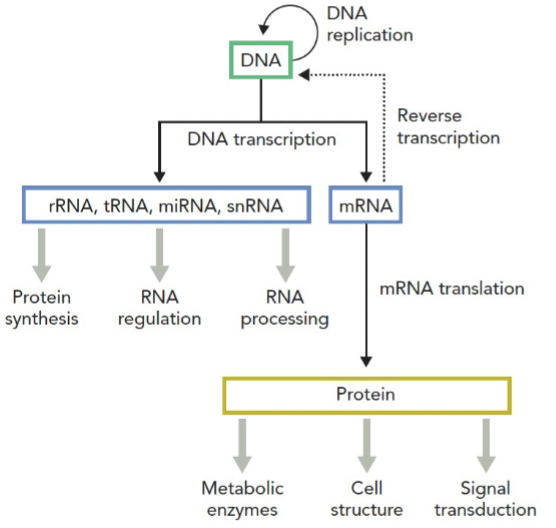
Describe the central dogma of molecular biology.
genetic info flows from DNA to RNA to protein
DNA replication: copies the genome
Transcription: produces RNA from DNA
occurs in nucleus & generates mRNA
Translation: uses mRNA to synthesize proteins
requires protein-synthesizing complex
charged tRNAs form base pairs with mRNA through codon-anticodon hydrogen bonds
M1T3
What is the main difference between prokaryotic and eukaryotic gene expression?
prokaryotic: gene expression consists of coupled transcription & translation
eukaryotic: gene transcription is separate from translation
M1T3
Is the coding strand of DNA identical or different to mRNA?
coding strand is identical to the mRNA sequence expect that uracil replaces thymine in RNA
M1T3

Based on the protein examples, match the analogy with the protein pair.
A. apple tree and pear tree
B. lemon and tennis ball
C. boat and submarine
Ribonucleotide reductase (bacteria) and ribonucleotide reductase (mouse) → apple tree and pear tree
same enzyme in two relared species mean same structure and function
Porin channel protein and green fluorescent protein → lemon and tennis ball
porin and GFP share a beta-barrel shape but do unrelated jobs
GR transcription factor and GCN$ transcription factor → boat and submarine
GR and GCN4 are both DNA-binding transcription factors that act through different structures
CS-01
Put the following hierarchical levels in the correct order representing the structured organization of life on Earth. 1 is the lowest hierarchical level (base) and 7 is the highest hierarchical level (top).
glucose, glycolysis, hydroxyl group, liver cell, Great Barrier Reef, manta ray, glycogen
hydroxyl group
glucose
glycogen
glycolysis
liver cell
manta ray
Great Barrier Reef
functional group → molecule → macromolecule → metabolic pathway → cell → organism → ecosystem
CS-01
Describe the First Law of Thermodynamics and provide examples.
energy cannot be created or destroyed, it can only be transformed or transferred from one form to another
ex 1: amount of energy available from the oxidation of 1 gram of glucose is exactly the same regardless of the physical or biological process required for oxidation to occur
ex 2: thermogenesis in a hibernating bear results from oxidizing fat stores that are required to keep the bear alive during winter
CS-01
Describe the Second Law of Thermodynamics and provide examples.
total entropy always increases over time during any spontaneous process
ex 1: unplugging an ice maker results in a puddle of water on the floor because the energy required to form ice crystals is not available
ex 2: staying as far away from the equilibrium with the environment as possible is the only way to stay alive, this requires a constant input of energy
CS-01
Describe Gibbs Free Energy.
the difference between the enthalpy (bond energy) and entropy (energy dispersion) of a reactant and product at a given reaction temp
positive value indicates that the reaction as written is spontaneous in the reverse direction
CS-01
Describe the equilibrium constant.
ratio of the concentration of products divided by the concentration of reactants when the rate of product formation is equal tot he rate of reactant formation
value greater than 1 indicates that the reaction as written is spontaneous in the forward direction
CS-01
A mutation changes the active site of an enzyme critical for metabolism. Which outcome is most likely?
the protein function changes due to altered molecular structure
structure determines function so changing the active site’s structure changes the enzyme’s function
CS-01
Why is the equilibrium with the environment equivalent to death in living organisms?
living organisms maintain order by resisting entropy through energy source
life maintains order by continuously spending energy to resist entropy
at equilibrium no free energy is available to do biological work, which is death
*life requires homeostasis not equilibrium
CS-01
Define divergent evolution.
two species with a common ancestor evolve specific traits to optimize life in their own unique environment which are very different
ex. the whale in the ocean & hippopotamus on land
M1T4
Define convergent evolution.
two species that are unrelated or very distantly related evolve similar traits because they live in the same environment and natural selection drives adaptation
ex. wings on bats & birds
M1T4
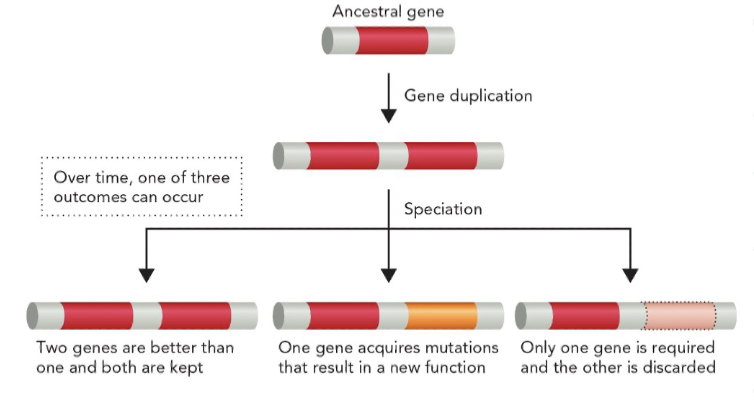
Duplication of an ancestral gene leads to three distinct outcomes. What are they?
the 2nd gene provides an evolutionary advantage
2nd gene diverges and acquires a new beneficial function
2nd gene diverges and acquires deleterious mutation
M1T4
What are the differences between paralogous and orthologous genes?
paralogous: genes that share similar sequences within a species are paralogous (within species)
ex. alpha-globin and beta-globin
orthologous: genes conserved across species (between speces)
ex. human & mouse alpha-globin and beta-globin
M1T4
What determines protein function and what are the different protein-structure function relationships?
*structure determines function
evolution through natural selection influences macromolecular structure & function
DNA mutations in protein coding genes can alter protein structure & function depending on type of mutation
same structure & function
similar structure & different function
similar function & different structure
M1T4
What are some similarities and differences between autotrophs and heterotrophs?
photosynthetic autotrophs use solar energy produced by sun for photosynthesis
both heterotrophs & autotrophs use O2 and glucose (C6H12O6) for aerobic respiration, which is a form of chemical energy conversion
*photosynthesis & aerobic respiration are redox-driven energy conversion processes that are required for life on Earth
M1T5
Define oxidation.
reduction reactions in photosynthetic autotrophs convert solar energy into chemical energy
chemical energy is transformed into osmotic work, chemical work, mechanical work
M1T5

Does life require homeostasis or equilibrium?
life requires homeostasis NOT equilibrium
organisms must maintain a steady state that is far from equilibrium with respect to temp, concentrations of biomolecules, etc.
when an organism cannot maintain a steady state using energy conversion, the concentrations of metabolites & macromolecules equilibrate with the environment & organism dies
*organisms require energy to perform osmotic, chemical, and mechanical work (energy ultimately comes from solar energy)
M1T5
Define redox reactions and identify their importance.
photosynthesis & aerobic respiration convert energy using oxidation & reduction reactions to transfer electrons since they cannot exist freely
reduction: gain of electrons
oxidation: loss of electrons
a compound cannot be reduced without another compound being oxidized
M1T5

What is the first law of thermodynamics?
reaction that gives off heat is exothermic & has negative delta H value
reaction that absorbs heat is endothermic & has positive delta H value
change in Gibbs free energy reveals if reaction is favorable (-deltaG) or unfavorable (+deltaG)
M1T5
What is the second law of thermodynamics?
solids (ex. ice) has lower entropy than liquid because water molecules in the ice have limited motion
gases (ex. steam) has the highest entropy because of increased motion of molecules
M1T5
Why is Gibbs free energy important?
Gibbs free energy changes predict if chemical reactions are thermodynamically favorable under standard (detlaG0’) and actual conditions (deltaG)
the difference between the change in enthalpy (detaH) and change in entropy (deltaS) at know temp in kelvin
deltaG0’ refers to constant pressure (1 atm), temp (298K) and the rxn is at pH 7 with water concentration fo 55.5M
M1T6

What is the equilibrium constant?
Keq is defined by the concentrations of A, B, C, & D when the rxn has reached equilibrium
Keq>1 then rxn favors C and D, proceeds left to right, deltaG0’<0 and is exergonic
Keq<1 then rxn favors A and B, proceeds right to left, deltaG0’>0 and is endergonic
M1T6

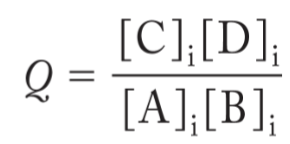
What is the mass action ratio?
under conditions where reactants and products are NOT at 1 M initial concentrations
Q is the ratio of initial concentrations of products over reactants
M1T6
Does delta G indicate thermodynamic favorability or rate of reaction?
thermodynamic favorability
M1T6
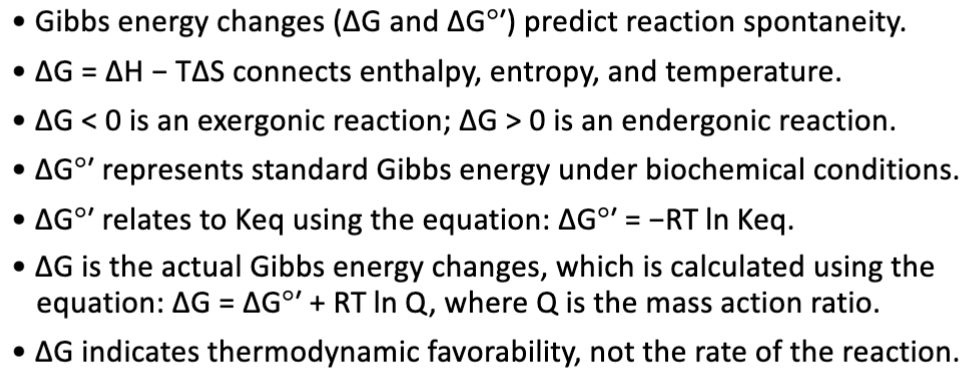
Calculate the delta G value (actual change in free energy) at 25 degrees C for the aldolase reaction, which converts F-1,6-BP to DHAP and GAP. Given the delta GO’ value of +23.8 kJ/mol and concentrations of these metabolites at a steady state:
F-1,6-BP = 15 mM
DHAP = 4×10^-5 M
GAP = 0.04 mM
-15.8 kJ/mol
MR-01
Write the equation that describes the equilibrium reaction: aA + bB ←→ cC + dD
MR-01


Identify the numbered compound functions as a hydrogen bond donor, acceptor, or neither.
1 is donor
2 is acceptor
3 is neither
4 is acceptor
MR-01
T/F: Heterotrophs depend on autotrophs for conversion of light energy to chemical energy.
True
MR-01
T/F: Heterotrophs are dependent on autotrophs to generate O2 from H2O in order to support aerobic respiration.
True
MR-01
Describe which of the four building block biomolecules this term belongs to:
palmitate
fatty acid
MR-01
Describe which of the four building block biomolecules this term belongs to:
cytidine monophosphate
nucleotide
MR-01
Describe which of the four building block biomolecules this term belongs to:
ribose
simple sugar
MR-01
Describe which of the four building block biomolecules this term belongs to:
aspartate
amino acid
MR-01
The enolase reaction has a positive ΔG°′ yet proceeds forward in the cell; what best explains this?
Cellular concentrations make the mass-action ratio low, giving a negative actual ΔG.
TopHat Sep 1
A reaction has a large negative ΔG; what does this tell you about how fast the reaction will occur?
Nothing, because ΔG indicates favorability but not the reaction rate
TopHat Sep 1
Why is reaching chemical equilibrium with the environment fatal for a living organism?
A living cell must use energy to maintain a steady state far from equilibrium
TopHat Sep 1
Why does oxidizing one gram of glucose release the same energy in a bomb calorimeter and in a living mouse?
The energy released depends only on the reactants and products, not the path
TopHat Sep 1
The porin channel and green fluorescent protein share a β barrel structure; what does this comparison demonstrate?
Similar structures can carry out different functions in different proteins
TopHat Sep 1
What element must a molecule contain to be considered organic? Why is the element critical to formation of organisms?
1 or more carbons
carbons can make up to 4 covalent bonds & provides stable structural backbones for complex organic molecules
Chapter 1
Name 4 important functions of nucleotides
energy conversion, coenzymes, information storage, signaling
Chapter 1
Name 5 types of RNA describe their functions
mRNA - template for protein synthesis
small nuclear RNA - role in RNA processing
micro RNA - regulates translation
rRNA - component of ribosomes
tRNA - provides amino acids to ribosome for translation
Chapter 1
How can DNA mutations have deleterious effects?
mutations in gene can change codons in mRNA transcript
leads to changes in AA and therefore protein
can lead to protein denaturation (unfolding) which could affect function
Chapter 1
What is the process in which ATP is formed by phosphorylation rxn using energy released from redox rnx in photosynthesis?
photophosphorylation
transforms light energy into usable chemical energy
ATP used to convert carbon dioxide into glucose which is consumed by plants or animals that eat plants
Chapter 2
What are amphipathic molecules? Why are they important?
contain hydrophobic & hydrophilic regions
form membranes that are impermeable to polar molecules
maintains separation of inside of cells from environment & allows compartmentalization ithin cells
In a redox reaction, when does a reduced compound become oxidized?
a reduced compound becomes oxidized only when it transfers an electron to an oxidized compound
SW 1
Sort the molecules into their oxidized and reduced forms.
NADP+, NADH, NADH, NAD+, Ubiquinone (Q), Ubiquinol (QH2)
Oxidized: NADP+, NAD+, ubiquinone (Q)
Reduced: NADH, NADPH, NADPH, ubiquinol (QH2)
SW 1
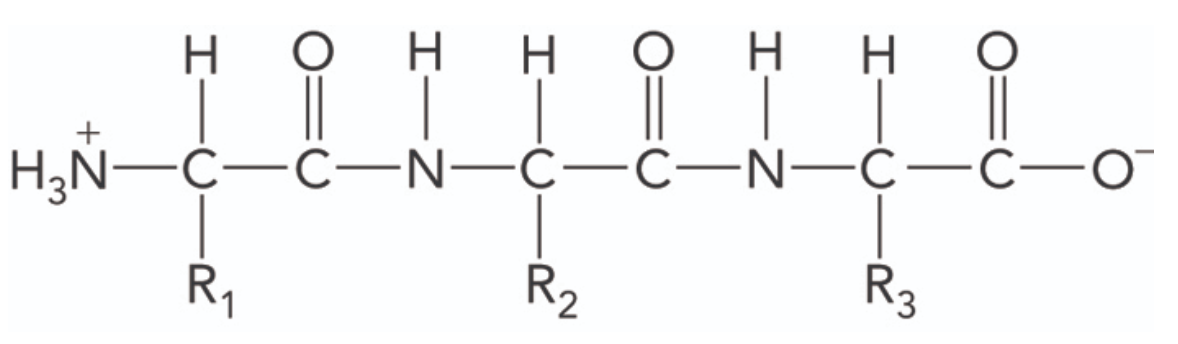
Within this molecule, identify the amount of peptide bonds and amino acids. Which bimolecular class does this structure belong to?
2 peptide bonds & 3 amino acids
protein
SW 1
Rank the list according to the hierarchical levels of organization. The most complex is 1 and least complex is 6.
elements & functional groups
cells
organisms
macromolecules
biomolecules
metabolism
organisms
cells
metabolism
macromolecules
biomolecules
elements & functional groups
SW 1
Sort the following terms into the appropriate hierarchical complexity level.
oxygen
DNA & RNA
proteins
carbon
amino acids
citrate cycle
glucose
glycolysis
nucleotides
Macromolecules: proteins, DNA & RNA
Elements: oxygen & carbon
Metabolism: glycolysis, citrate cycle
Biomolecules: amino acids, nucleotides, glucose
SW 1
Describe the pKa of a weak acid.
pKa is an intrinsic property of a molecule in question & depends on how tightly bound the acidic H+ is
SW 1
Given a solution is made up of equal volumes of 0.05M acetic acid & 0.1 sodium acetate, what statements are true?
doubling conc of acetic acid & sodium acetate will double the pH capacity
adding acetic acid will decrease the pH of a solution
SW 1

Match the letters to regions on the figure.
HA < A-
HA = A-
HA > A-
A. HA = A-
B. HA < A-
C. HA > A-
SW 1
Which statement about phospholipids is false?
A. phospholipids orient in lipid bilayers with the hydrophobic tails pointing inward, interacting with each other
B. polar head group of phospholipids is hydrophilic
C. polar head group of phosphatidylcholine cannot form hydrogen bonds
D. the hydrocarbon tail of phospholipids is hydrophobic
C
phosphatidylcholine is an amphipathic phospholipid
polar heads can form hydrogen bonds with water molecules & polar molecules
SW 1
When is a reaction thermodynamically favorable or unfavorable?
unfavorable: delta G > 0
favorable: delta G < 0
total delta G of couple reactions is additive (share intermediates)
M2T1
Is ATP hydrolysis exergonic or endergonic?
ATP hydrolysis is an exergonic rxn
energy is absorbed to break the phosphate bond = endergonic
the formation of new bonds releases more energy = exergonic
OVERALL exergonic rxn
M2T1
List some examples of ATP hydrolysis being used for protein conformational changes:
muscle contraction involving conformation changes in myosin protein
conformational changes in the Na+-K+ ATPase protein that mediate ion transport
M2T1

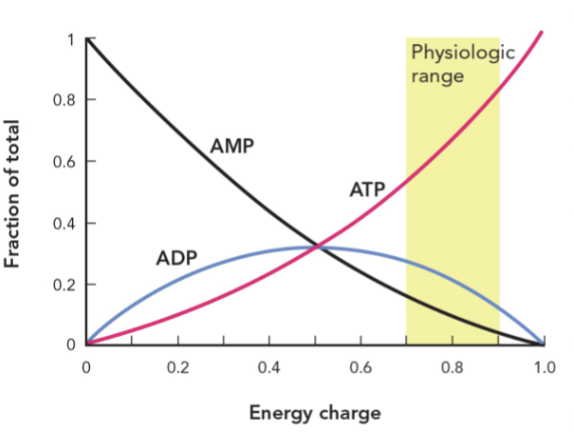
How does the cell maintain ATP levels? What is energy charge?
maintains ATP levels within a narrow range by interconverting ATP, ADP, and AMP using phosphoryl transfer rxns
use ratio of the concentration of ATP to conc of ADP and AMP to measure energy state of cell called energy charge (EC)
M2T1
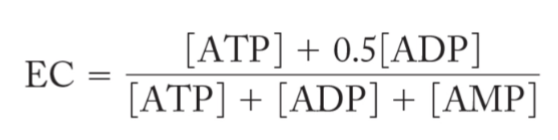
How do cells maintain energy charge (EC)?
by regulating metabolic flux through anabolic and catabolic pathways
when EC is near 0.7 = ATP levels are now & ADP levels are near max
when EC is at 0.9 = ATP levels are near max & AMP levels are very low
M2T1
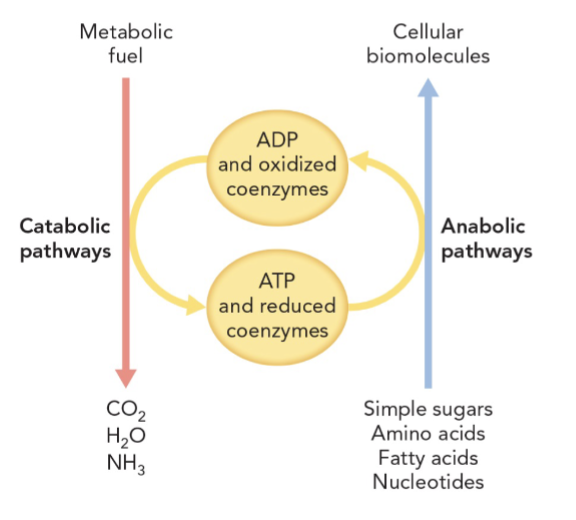
What is the difference between catabolic and anabolic pathways?
catabolic: extracting energy from metabolic fuels which convert fuel into high potential energy compounds ATP and NADH
anabolic: high potential energy compounds used for biosynthesis of biomolecules
under conditions of low nutrients/sunlight = catabolic pathways degrade stored metabolic fuels to generate ATP
when nutrients/sunlight are high = ATP used to replenish supplies of stored metabolic fuel
M2T1
Describe hydrogen bonding between water molecules.
each H2O can donate 2 hydrogens for hydrogen bonds with other molecules
flickering clusters: constant forming & breaking of hydrogen bonds between water molecules
^ short lifetime
proton hopping happens vert fast bc it relies on H bonds forming & breaking not actual movement of ion
M2T2
Describe osmosis.
diffusion of H2O molecules (solvent) across semipermeable membrane from a solution of high H2) conc to low H2O concentration
at equilibrium, conc of H2O on both sides will be equal
hypotonic solution: water molecules move into cell causing it to burst
hypertonic: water molecules rush out causing it to shrink
M2T2

What are the three types of noncovalent interactions.
permit unstable structures to briefly form which allows complexes to dissociate or reform as needed for regulation & catalysis
hydrogen bonds
ionic interactions
van der Waals
M2T2
Describe van der Waals interactions.
motions of electrons in nonpolar molecules that result in temporary dipoles
nearby dipoles that are aligned with opposite charges close together will attract
M2T2

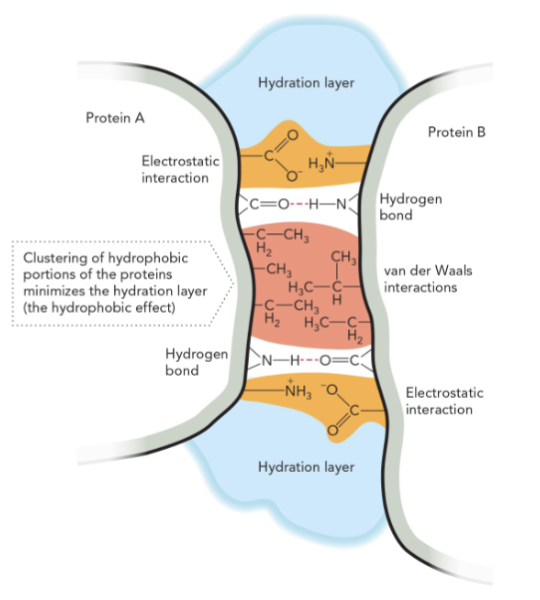
How do hydrophobic effects alter protein structure?
protein folding results from hydrophobic effect
hydrophobic effect = LACK of interaction
hydration layer around polypeptide is minimized by the hydrophobic nonpolar amino acids
hydrophobic molecules disrupt hydrogen bonding in water, lowering entropy so hydrophobic groups aggregate to reduce surface area
ex. leucine & isoleucine are hydrophobic
M2T2

Where are hydrogen bonds and ionic interactions most likely to occur?
H bonds are commonly found within & between proteins
ionic interactions occur near the surface
M2T2
What chemical properties of water make life possible on Earth?
solid water is less dense than liquid water
water is liquid over a wide range of temps
water is an excellent solvent bc of H-bonding abilities
high heat capacity water functions as temp buffer
H bonds account for high viscosity, boiling point, & melting point of water
M2T2
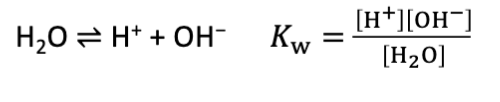
What is the water ionization constant?
Kw
water molecules self ionize in a reversible rxn to form H3O+ and OH-
H+ is never free in an aqueous environment & is always hydrated as H3O+
M2T3
How can we find the pH of a solution?
change in one pH unit is equivalent to a 10-fold change in H+ concentration
M2T3

When is a solution basic or acidic?
acidic: pH less than 6.5 (high H+)
neutral: between 6.5 and 7.5 (H+ = OH-)
basic: pH greater than 7.5 (low H+)
M2T3
Do strong acids have a high or low pKa? What about weak acids?
strong acids have a low pKa
strong acids hold onto hydrogen ion very weakly in presence of OH- and is easily dissociated
low amounts of OH_ are needed to remove H+ from acid to form H2O
weak acids have high pKa
hold onto H+ strongly
high amounts of OH- are needed to remove the H+ from acid to form H2O
M2T3

Although Watson and Crick could construct a DNA double helix with A-A and C-C base pairs, there were two reasons why this arrangement was unlikely to be valid. What are the reasons.
Erwin Chargaff showed that the abundance of A equaled T and G equaled C nucleotides, so A-A and C-C base pairs is inconsistent with these data
Distance between the ribose sugars in A-A and C-C base pairs are significantly different, whereas purine-pyrimidine base pairs are equally spaced
Chargaff’s rules (A=T, G=C) rule out like-with-like pairing
only a purine-pyrimidine pair gives uniform helix width (A-A is too wide, C-C is too narrow)
CS-02
Why was Franklin’s B-form DNA diffraction pattern so decisive in solving the DNA structure?
it revealed helical geometry with uniform spacing
the X-shaped B-form pattern with regular spacing is the signature of a uniform helix, which is what constrained the structure
M2T3
Linus Pauling proposed a triple helix structure for DNA that had the phosphate backbones of the three strands facing inward and the nucleotide bases facing outward. What are two reasons why this structure did not make sense based on the chemical properties of DNA?
the ring structures of nucleotide bases have hydrophobic properties and would more likely associate with each other in the interior of the helix
the charged polar phosphoryl groups will form hydrogen bonds with water in and be more stable facing outward toward the aqueous environment
The hydrophobic bases are more stable packed inside the helix and the charged, polar phosphates are more stable facing outward where they hydrogen bond with water — the opposite of Pauling's inside-out model
CS-02
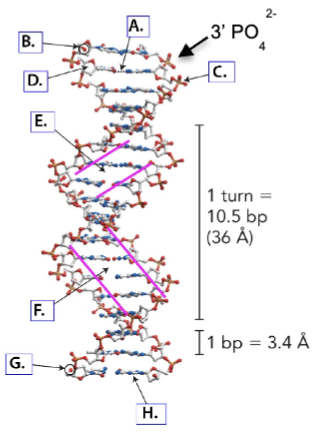
Match the letter corresponding to the figure below with the descriptions.
A = hydrogen bond
B = 5’ hydroxyl
C = phosphoryl group
D = ribose sugar
E = minor groove
F = major groove
G = 5’ hydroxyl
H = nucleotide base
CS-02
Why is SSB binding to single-stranded DNA considered sequence-independent?
it interacts primarily with the sugar-phosphate backbone
SSB binds the sugar-phosphate backbone, which is identical in every sequence, so its binding does not depend on base sequence
CS-02
Why is the hydrolysis of ATP an overall exergonic reaction even though breaking its phosphoanhydride bond requires energy?
forming new bonds with an acceptor releases more energy than breaking the phosphoanhydride bond absorbs
TopHat Sep 3
Why do nonpolar amino acids such as leucine and isoleucine cluster in the interior of a folded protein?
clustering minimizes the ordered water hydration layer around the nonpolar groups
TopHat Sep 3
What happens to a red blood cell placed in a hypotonic solution, and why?
it swells and may burst bc water moves into cell by osmosis
TopHat Sep 3
Why does adding a small amount of base to a buffered solution cause only a small change in pH?
conjugate acid donates a proton to the added hydroxide to form water
TopHat Sep 3
According to the Henderson-Hasselbalch relationship, when does the pH of a solution equal the pKa of the acid?
when the concentrations of the conjugate base and acid are equal
TopHat Sep 3