Practice Problems
 Call Kai
 Learn
Learn Practice Test
 Spaced Repetition
 Match
Match Flashcards
 Knowt Play
1/54

There's no tags or description
Looks like no tags are added yet.
Name | Mastery | Learn | Test | Matching | Spaced | Call with Kai | Chat |
|---|
No analytics yet
Send a link to your students to track their progress
55 Terms
Convert the following numbers from standard notation to scientific notation.
1450 mL
0.0000218 g
29,029
1.45 × 10³ mL
2.18 × 10⁻⁵ g
2.9029 × 10⁴
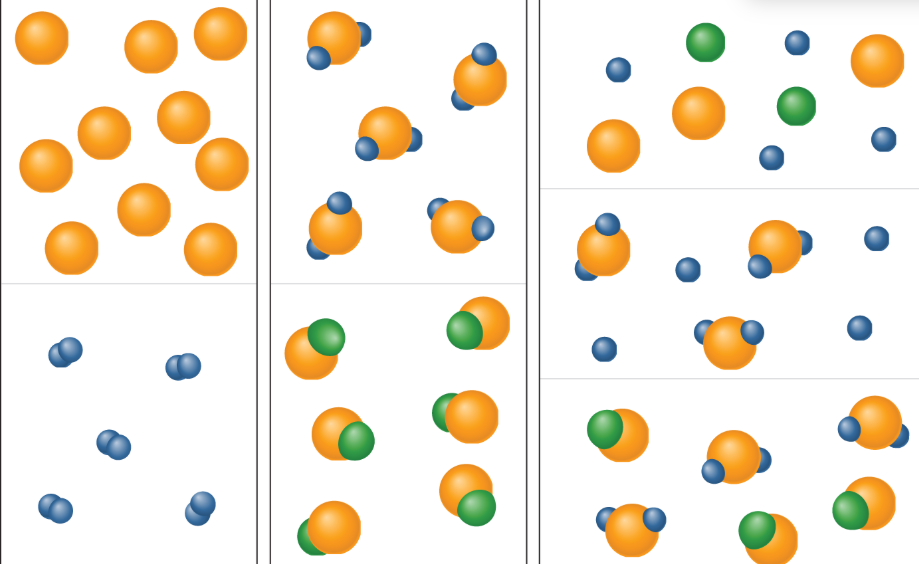
Identify the components of each of the three different mixtures in Figure 1.1 as elements or compounds.
two elements
two compounds
three mixtures
Determine whether the following mixtures are homogeneous or heterogeneous.
a. Mud (a mixture of dirt and water that settles out over time)
b. Carbonated water (a mixture of water and carbon dioxide) before the bottle is opened
c. Carbonated water (a mixture of water and carbon dioxide) immediately after the bottle is opened
a. Mud is heterogeneous. After mud settles over time into dirt and water, its nonuniform composition is revealed.
b. Before the bottle is opened, you cannot see the bubbles, which suggests a homogeneous mixture.
c. Immediately after opening the bottle, the gas bubbles can be seen within the liquid, which suggests a heterogeneous mixture.
Indicate whether each of the following statements is true or false.
Every compound is a pure substance.
Every compound contains two or more elements.
Every mixture contains two or more compounds.
Every pure substance is a compound.
All mixtures are homogeneous.
True
True
False: Mixtures may contain elements or compounds or both.
False: Some pure substances, such as oxygen gas, are elements.
False: Some mixtures, such as iron metal and solid sulfur, are heterogeneous.
Iodine is a purple solid. Ethyl alcohol is a colorless liquid. When iodine is added to ethyl alcohol, a uniform, transparent brown liquid mixture results. Is this mixture homogeneous or heterogeneous?
The mixture is homogeneous because it is uniform in composition.
Indicate whether each of the following statements is true or false.
a. Every mixture contains two or more elements.
b. All mixtures are heterogeneous.
c. Every pure substance contains two or more elements.
d. All homogeneous samples are solutions.
a. True, although the elements may be combined into compounds.
b. False: Some mixtures, such as table salt and water, are homogeneous.
c. False: A pure substance may be a single element, such as gold.
d. False: All homogeneous mixtures are solutions, but not all homogeneous samples are mixtures. Pure substances are homogeneous, but they are not solutions.
a. Ethanol is a colorless, flammable liquid. If you have two 1 gallon, gal, containers labeled sample A and sample B, and each is filled with a colorless liquid, is it possible to tell which sample is water and which is ethanol just by looking at them?
b. When liquid from sample A is splashed onto a small wood fire, the fire is extinguished. When liquid from sample B is splashed onto a small wood fire, the fire grows larger. Based on these observations, is it possible to tell which sample is water and which is ethanol?
a. No. The physical properties that are being compared—physical state and color—are the same for both water and ethanol, so they cannot be distinguished from one another based on this information alone.
b. Yes. The chemical property that is being compared—flammability—is different for water and ethanol, so they can be distinguished based on these observations. Water is nonflammable, and sample A extinguished the fire, so sample A is water. Ethanol is flammable, and sample B caused the fire to grow, so sample B is ethanol.
A sample of a shiny substance is heated in air, yielding a white powder with twice the mass. Is the change a chemical reaction? Is the powder an element?
A chemical reaction takes place, creating a new substance with definite properties of its own. The powder is not an element; it is a compound (a chemical combination of the shiny substance—a metal—and something else).
Which energy conversions are exhibited by
(a) a firework exploding and
(b) a loud motorcycle accelerating up a hill?
a. Chemical energy in the firework is converted to sound, light, heat, and kinetic energy as the paper shreds go flying.
b. Chemical energy in the gasoline that fuels the motorcycle is converted to potential energy as the motorcycle goes up the hill, to kinetic energy as it accelerates, and to heat and sound in the engine.
Is it possible for a scientific law to be proven incorrect or in need of refinement?
Scientific laws are observations that are always seen to be that way, with no exceptions. If an exception is found, the law must be revised accordingly. For example, the law of conservation of mass was originally thought to be universal, but the discovery of nuclear energy showed that mass could be converted to energy in nuclear reactions (Chapter 20). Therefore, the law of conservation of mass had to be refined to apply only to chemical and physical processes.
Which is smaller: 10 μg or 10 ng?
According to Table 1.4,
1 μg = 10⁻⁶ g
1 ng = 10⁻⁹ g
Since a nanogram is smaller than a microgram, 10 ng is smaller than 10 μg.
Determine which of the following values are given in SI base units, or English units.
a. 6.50 mol of iron
b. 16 oz of beer
c. 825 N of force
d. 250 A of current
a. The mole, mol, is an SI base unit (Table 1.3).
b. The ounce, oz, is an English unit (Table 1.6).
c. The newton, N, is an SI derived unit equal to 1 kg·m/s².
d. The ampere, A, is an SI base unit (Table 1.3).
a. Is it possible to obtain high precision without high accuracy?
b. Is it possible to obtain relatively high accuracy without high precision?
a. Figure 1.13(a) shows that it is possible to obtain high precision without high accuracy.
b. It is possible to obtain a reasonable degree of accuracy without high precision. An example would be the gunshots arranged in a circle around the bull’s eye as shown here. The gunshots are in different locations (low precision), but they are all somewhat close to the bull’s eye (relatively accurate). That said, high precision is generally required for high accuracy.
Approximately what fraction of measurements reported should be values ending in a zero?
About 1 time in 10, the last digit of a reported measurement should be a zero. There is an equal possibility of each digit, 0–9, being the last, so one-tenth of the time it should be a 0, one-tenth of the time it should be a 1, one-tenth of the time it should be a 2, and so on.
Underline the significant digits in each of the following measurements.
a. 35.00 cm
b. 23.050 cm
c. 0.02030 cm
d. 30 cm
a. 35.00 cm
b. 23.050 cm
c. 02030 cm
d. 30 cm
Calculate the answer to the proper precision:
62.44 cm − 7.145 cm + 27.7 cm
62.44 cm − 7.145 cm + 27.7 cm = 82.995 cm
82.995 cm ⟶ 83.0 cm
The value 27.7 cm has the least number of decimal places (one), so the final answer is rounded to one decimal place. The first digit to be dropped is 9, which is greater than 5, so the final digit is rounded up by one (82.9 becomes 83.0).
Perform the following calculations, and limit the answers to the correct number of significant digits.
a. 1.27 cm × 6.220 cm × 4.10 cm
b. 9.030 g / (3.01 cm × 1.414 cm × 7.500 cm)
c. (0.71 cm)³
a. 1.27 cm × 6.220 cm × 4.10 cm = 32.3875 cm³ → 32.4 cm³
b. 9.030 g / (3.01 cm × 1.414 cm × 7.500 cm) = 9.030 g / (31.921 cm³) = 0.282885 g/cm³ → 0.283 g/cm³
c. (0.71 cm)³ = 0.3579 cm³ → 0.36 cm³
Calculate the circumference of the circle in Example 1.16 to the correct number of significant digits. The circumference of a circle is equal to 2πr, where π=3.14159.
The circumference of the circle is calculated as follows:
c=2πr=2(3.14159)(13.7 cm)=86.1 cm
The measurement with the fewest significant digits is 13.7 cm. Pi was given with six significant digits, and 2 has infinite significant digits.
Convert 5445 min to seconds.
There are exactly 60 seconds in 1 minute, so the conversion factor is set up with minutes in the denominator and seconds in the numerator:
5445 min × (60 s / 1 min) = 326,700 s
Calculate the time required to travel 15.0 mi at 60.0 mph in units of (a) hours and (b) minutes.
a.
15.0 mi × (1 h / 60 mi) = 0.250 h
b.
0.250 h × (60 min / 1 h) = 15.0 min
Determine the number of meters in (a) 525 nm and (b) 175 dm.
a.
1 nm = 10⁻⁹ m
525 nm × (10⁻⁹ m / 1 nm) = 5.25 × 10⁻⁷ m
b.
1 dm = 10⁻¹ m
175 dm × (10⁻¹ m / 1 dm) = 1.75 × 10¹ m
A piece of lead has a mass of 5.55 g and occupies a volume of 0.491 mL. Calculate the density of lead.
d=m/V
=5.55 g/0.491 mL
=11.3 g/mL
Calculate the volume of 12.7 g of mercury. The density of mercury is 13.53 g/mL.
Hint: Use the inverse of density to convert mass to volume.
12.7 g × (1 mL / 13.53 g) = 0.939 mL
Calculate the density of a rectangular metal bar that is 7.00 cm long, 4.00 cm wide, and 1.00 cm thick and has a mass of 220.0 g. Identify the metal.
Volume:
(7.00 cm)(4.00 cm)(1.00 cm) = 28.0 cm³
Density:
d = 220.0 g / 28.0 mL = 7.86 g/mL
According to Table 1.7, this density corresponds to iron
The hottest reliably recorded air temperature on Earth was 134°F at Death Valley National Park in 1934. Convert this temperature to Kelvin.
Convert °F → °C:
TC=59(134−32)=57.0∘C
Convert °C → K:
TK=57.0+273.15=330.15 K=330 K
What are the symbols of the following elements?
a. manganese
b. arsenic
c. germanium
d. plutonium
a. Mn
b. As
c. Ge
d. Pu
Determine the relative number of each type of element in the following compounds:
a. Na₂S
b. B₂H₆
c. Ni(ClO₄)₂
a. Na₂S has two atoms of sodium (Na) for each atom of sulfur (S).
b. B₂H₆ has six atoms of hydrogen (H) for every two atoms of boron (B).
c. Ni(ClO₄)₂ has 1 × 2 = 2 atoms of chlorine (Cl) and 4 × 2 = 8 atoms of oxygen (O) for each atom of nickel (Ni).
A sample of 15.50 g of N₂O decomposes into 9.866 g of nitrogen and 5.634 g of oxygen.
A sample of 25.50 g of N₂O decomposes into 16.23 g of nitrogen and 9.269 g of oxygen.
Show that both follow the law of definite proportions.
Calculations:
For 15.50 g sample:
9.866 g N / 15.50 g N₂O × 100% = 63.65% N
5.634 g O / 15.50 g N₂O × 100% = 36.35% O
For 25.50 g sample:
16.23 g N / 25.50 g N₂O × 100% = 63.65% N
9.269 g O / 25.50 g N₂O × 100% = 36.35% O
Percentages match → consistent with the law of definite proportions.
Calculate the mass of NO that contains 100.0 g of nitrogen.
NO is 46.68% nitrogen by mass.
100.0 g N × (100.0 g NO / 46.68 g N) = 214.2 g NO
SO₂: 16.04 g S and 16.00 g O
SO₃: 16.04 g S and 24.00 g O
Show they follow the law of multiple proportions.
SO₂ ratio: 16.04 / 16.00 = 1.003
SO₃ ratio: 16.04 / 24.00 = 0.6683
1.003 / 0.6683 = 1.501 → ×2 = 3.002 → whole number ratio (3)
Therefore SO₂ and SO₃ follow the law of multiple proportions.
Write isotope symbols:
a. helium atom with mass number 3
b. oxygen atom with 7 neutrons
c. boron atom with equal protons and neutrons
d. carbon atom with one more neutron than protons
a. ³He
b. ¹⁵O
c. ¹⁰B
d. ¹³C
Write isotopic symbols:
a. hydrogen isotope with 2 neutrons
b. iodine isotope with 78 neutrons
c. polonium isotope with 42 more neutrons than protons
a. ³H or ³₁H
b. ¹³¹I or ¹³¹₅₃I
c. ²¹⁰Po or ²¹⁰₈₄Po
Two atoms with A = 119:
One has 69 neutrons → Z = 119 − 69 = 50 → tin (Sn)
One has 70 neutrons → Z = 119 − 70 = 49 → indium (In)
They are not isotopes of the same element.
How many electrons do the atoms in 2.9 have?
¹¹⁹₅₀Sn → 50 protons → 50 electrons
¹¹⁹₄₉In → 49 protons → 49 electrons
Write isotope symbols and determine protons, neutrons, electrons:
a. hydrogen atom, A = 3
b. oxygen ion, 7 neutrons, charge −2
c. selenium ion, A = 78, charge −2
d. manganese ion, 30 neutrons, charge +4
a. ³H → 1 p, 2 n, 1 e
b. ¹⁵O²⁻ → 8 p, 7 n, 10 e
c. ⁷⁸Se²⁻ → 34 p, 44 n, 36 e
d. ⁵⁵Mn⁴⁺ → 25 p, 30 n, 21 e
Suppose that you go on a road trip where your car averages a fuel economy of 37.2 miles per gallon, mpg, for 65% of the trip, 24.2 mpg for 23% of the trip, and 8.8 mpg for 12% of the trip.
Determine the car’s average fuel economy for the trip.
Fuel economy = 0.65(37.2 mpg) + 0.23(24.2 mpg) + 0.12(8.8 mpg)
Fuel economy = 24.18 mpg + 5.57 mpg + 1.06 mpg
Fuel economy = 30.8 mpg
Naturally occurring potassium consists of the following isotopes in the percentages listed:
³⁹K: 38.9637 u (93.258%)
⁴⁰K: 39.9640 u (0.0117%)
⁴¹K: 40.9618 u (6.7302%)
What is the atomic mass of potassium?
Atomic mass = (0.93258)(38.9637 u) + (0.000117)(39.9640 u) + (0.067302)(40.9618 u)
Atomic mass = 36.33677 u + 0.0046758 u + 2.75681 u
Atomic mass = 39.0983 u
The most abundant naturally occurring isotope of boron is ¹¹B, with a mass of 11.0093 u and an abundance of 80.1%. ¹⁰B is the only other isotope with measurable abundance. Given that the atomic mass of boron is 10.811 u, calculate the isotope mass of ¹⁰B.
Natural abundance of ¹⁰B = 100.00% − 80.1% = 19.9%
10.811 u = (0.801)(11.0093 u) + (0.199)(x)
10.811 u = 8.818 u + (0.199)(x)
1.993 = (0.199)(x)
x = 10.0 u
For a given element or isotope, which of these would have a different value on another planet?
a. atomic number
b. mass number
c. isotope mass
d. atomic mass
Answer: d, atomic mass.
Atomic mass depends on isotope abundances, which vary from planet to planet. Atomic number, mass number, and isotope mass do not change.
Are any elements in the periodic table out of order according to their atomic numbers?
Answer: No elements are out of order according to atomic number.
Which element begins the second period of the periodic table? Which element ends it? How many elements are in that period?
Lithium, Li (Z = 3), begins period 2; neon, Ne (Z = 10), ends it; and there are eight elements in the period.
Sodium reacts violently with water. Which element—fluorine (F), aluminum (Al), palladium (Pd), or potassium (K)—is likely to react violently with water, too?
Answer: Potassium, because both potassium and sodium are group 1 (1A) alkali metals.
In which period are the lanthanoid elements found? In which period are the actinoid elements found?
Lanthanoids: elements 58–71 → period 6
Actinoids: elements 90–103 → period 7
Classify each of the following as a metal or a nonmetal:
a. carbon (graphite), C
b. silver, Ag
a. Carbon is a nonmetal.
b. Silver is a metal.
Given the properties of the following elements, determine whether the element is most likely a metal, nonmetal, or metalloid.
a. Shiny, malleable, conducts electricity
b. Shiny, brittle, conducts electricity
c. Dull, brittle, does not conduct electricity
a. Shiny, malleable, conducts electricity → metal
b. Shiny, brittle, conducts electricity → metalloid
c. Dull, brittle, does not conduct electricity → nonmetal