AQA A Level Psychology - Paper 2
 Call Kai
 Learn
Learn Practice Test
 Spaced Repetition
 Match
Match Flashcards
 Knowt Play
1/48

Earn XP
Name | Mastery | Learn | Test | Matching | Spaced | Call with Kai | Chat |
|---|
No analytics yet
Send a link to your students to track their progress
49 Terms
Origins of Psychology (Approaches)
Wundt - father of psychology - opened first psych lab in Leipzig Germany (1870s) - produced first academic journal that published psych experiments
Emergence of psychology as a science - before Wundt, the study of the mind was limited to philosophy and medicine - he was the first to use controlled, empirical scientific research techniques to study the mind. his use of scientific methods established psychology as a science
in his structuralism research - used introspection - ppts focused inward and reported sensations, feelings and images.
Process: trained ppts to report conscious experiences → asked to focus on a sensory object → asked to systematically report experience, breaking down elements
Wundt used this to develop general theories of mental processes
AO3
🙂 highly scientific in his time - controlled experiments - large sample sizes - significant inspiration for subsequent scientific psychologists
🙂 highly influential - influenced cog psychologists - ppts complete tasks under controlled conditions - inference is made using IMP (memory)
☹ lack temporal validity - compared to modern techniques, his introspective methods are subjective and inference based - ppts cannot be relied on to report objectively
Behavourist Approach (Approaches)
Learning theory - behaviour is learned through own experiences and interactions with env - Classical and Operant Conditioning
Only possible to scientifically investigate what can be directly observed and measured - stimulus → response so mind is a black box to be unstudied
Classical - Pavlov - UCS (food) + NS (metronome) → UCR (salivation)
eventually associated because stimuli occurred at the same time so
CS (metronome) → CR (salivation) (in dogs)
Operant - Skinner - Skinner box - PR - pleasant stimulus (food) encouraged rats to pull the leaver (desired behaviour) - NR - removing an unpleasant stimulus (electric shock) encouraged behaviour (leaver pulling) - and extinction - no reinforcement? no behaviour
AO3
Nurture
Reductionist
Hard Env Determism
Prac app - sd and flooding
Scientific (lab exp)
SLT (Approaches)
SLT - behaviourist principles (learning from experience) but couldn’t be understood without the role of cognitive processes (between stimuli and response) - mediational processes are attention, retention, reproduction and motivation - must happen between observing a model perform a behaviour and imitating it.
Observing others creates a template for our actions - when we see someone rewarded for a behaviour - imitation is more likely (vicarious reinforcement - if someone is punished, we wont imitate (vicarious punishment).
Modelling - individuals observed are models (live - friends and symbolic - characters)
Identification - more likely to imitate people with similar characteristics or high status
Bandura - ppts aged 3-6, 1 group observed aggressive behaviour and 1 observed kind behaviour - children who saw an aggressive model imitated aggressive behaviour (imitation) with boys imitating aggressive males (identification)
AO3
Nurture
Soft env determinism
Prac app - social skills training
Scientific
Cognitive (Approaches)
Study IMP - how info is used in the mind conscious and unconsciously - areas include attention, perception and memory
IMP cannot be observed so inferences made - making assumptions about the IMP that produced the behaviour observed
Schema - units of knowledge - Role of schema is to work as mental shortcuts to quickly navigate the world HOWEVER - inaccurate memory and biased can be damaging
Theoretical models (MSM) → computer models, modelling is the rm
AO3
Both nature and nurture
Machine reductionist
Soft determinism
Prac app - CBT
Scientific (lab experiments) BUT unscientific (inferences)
Biological (Approaches)
Biological Structures - endocrine system influence behaviour because of hormones (fight or flight) and brain is centre of un/conscious though - localisation (frontal lobe decision making) and limbic system for emotions
Neurochemistry - synaptic transmission - serotonin 🙂 dopamine pleasure and glutamate memory
Genes - genotype - phenotype - SERT gene for OCD (serotonin transport)
Evolution - behaviour is innate and inherited - natural selection (attachment - babies survive blah blah)
AO3
Nature
Reductionism
Hard bio determinism
Prac app - drug therapy
Scientific
Psychodynamic (Approaches)
Freud - mind is a complex system with conscious, preconscious (COULD access) and unconscious
Tripartite personality - Id (birth) pleasure principle, ego (18m) reality principle and superego (3-5 yrs) morality principle)
Defence mechanisms - denial, displacement, repression
Psychosexual stages - Oral (0-1yr) Anal (1-3yr) Phallic (3-5yr) Oedipus complex, latency (6-12yr dispersed libido) and genital (12 yr+)
AO3
Both nature (id, libido) and nurture (life experiences shape us)
Hard psychic determinism
Prac app - talking therapy
Unscientific (unfasifiable methods)
Humanistic (Approaches)
Human beh too complex to study through reductionist scientific methods which ID causation - instead very holistic considering all influences
External causes don’t determine behaviour - free will
Focuses on personal growth not mental illness (self actualisation - realising full potential and performing best)
Maslow’s hierarchy of needs (foundational needs before self actualisation - physiological, safety, love and belonging, esteem and final self actualisation)
Carl Rogers - congruence is essential for self actualisation - alignment with self image and ideal self - gap is incongruence - enhance self image or develop realistic ideal self
CCF - importance of present and future over past, assist clients in becoming congruent by giving unconditional positive regard
AO3
Mostly nurture
Holistic
Free will
Prac app - CCF
Unscientific (can’t capture essence of human in a lab)
Cognitive Neuroscience (Approaches)
CN aims to scientifically identify and examine neurological structures and chemical processes in the brain that are linked to IMP - integrating neuroscience and cognitive psychology to understand thoughts and emotions
The emergence is due to developing brain scanning techniques like the FMRI
AO3
🙂 confirmed link between brain structures and mental processes - Tan case study - waited for Broca’s area to be confirmed after a PEM when he died but nowadays an fMRI of a healthy alive brain shows activity when Broca activated
Nervous System (Biopsychology)
Human Nervous System - nerve cells collect info and then take action via transmission of electro-chemical messages.
Central Nervous System - brain and spinal cord (processor)
Peripheral Nervous System - sensory (afferent) and motor (efferent) neurones
Somatic Nervous System - controls skeletal muscles
Autonomic Nervous System - controls actions of internal glands
Sympathetic System - fight or flight response
Parasympathetic System - rest and digest response
Homeostasis - balance of these for regulation
Types of Neurons (Biopsychology)
Sensory Neurone - detects sensations at sensory receptors → action potential → myelinated axon → electrical → chemical → synapse
Relay Neurone - new action potential (dendrites) → CNS + axon → motor neurone
Motor Neurone - detects signal (synaptic transmission) → myelinated axon → effector (muscle)
Synaptic Transmission (Biopsychology)
Presynaptic neurone → action potential → axon → vesicles (neurotransmitters) → cell membrane merge → neurotransmitters → synaptic cleft → receptors receive → postsynaptic neurone → dendrite’s membrane → passes threshold → new action potential forms → neurotransmitters detach and reuptake by presynaptic cell
Excitation - increases likelihood of neurone firing - positive electrical charge - depolarisation
Inhibition - decreases likelihood of firing - negative charge - hyperpolarisation
Summation - combined effect of inhibitory and excitatory influences
Uni-directional - info can only travel dendrite → axon
Endocrine System (Biopsychology)
Pituitary Gland - master gland - ACTH - controls other hormones
Hypothalamus - CRH - nervous system → endocrine system
Pineal Gland - Melatonin - sleep
Thyroid Gland - Thyroxine - metabolism
Thymus Gland - Thymosin - develops T cells (immunity)
Pancreas - Insulin - blood sugar levels
Adrenal Glands - Adrenaline - fight or flight
Ovaries - Oestrogen - secondary sexual characteristics in females
Test!cle - Testosterone - secondary sexual characteristics in males
Fight or Flight response (Biopsychology)
Definition - evolutionary survival mechanism in response to threat - primes the body and mind for extreme action - returns to homeostasis after.
Response: stressor → hypothalamus → HPA axis activated → pituitary gland releases ACTH → adrenal cortex detects → cortisol → sympathetic branch activated → adrenal medulla triggered → adrenaline.
Adrenaline - anxiety, attention, alertness, blood flow to brain/muscles, decreased blood flow to skin/digestion/immune system, dilated pupils, faster breathing
Not designed for modern world, maladaptive, frequently triggered from things we can’t escape (exams), acute stress - exhausting, chronic stress (illness affecting immune system).
Localisation (Biopsychology)
AO1 -
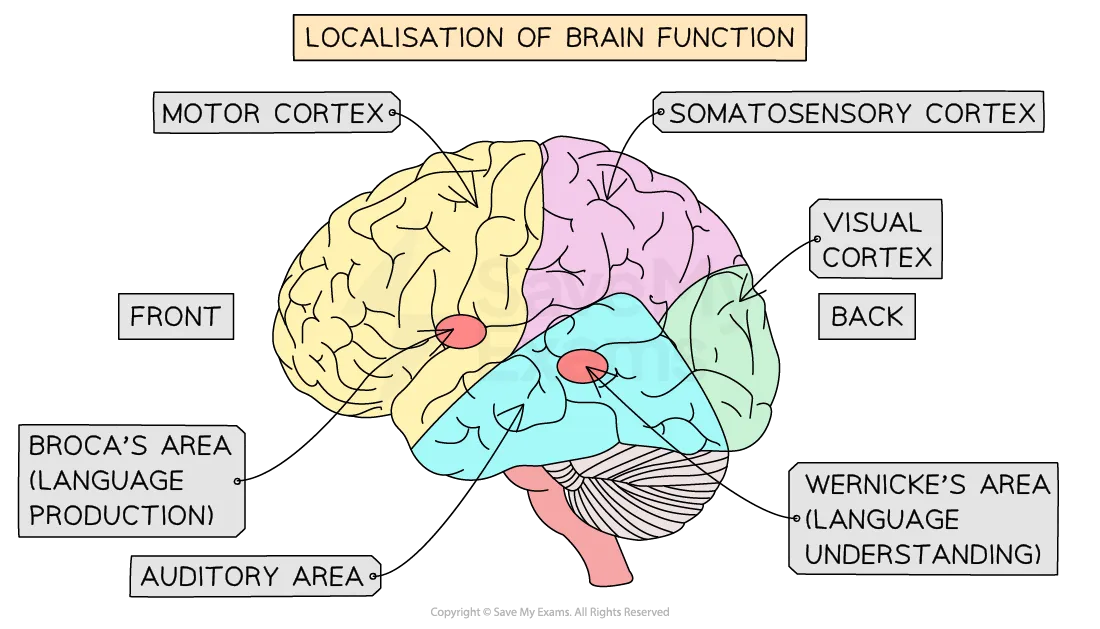
Motor Cortex - voluntary muscle movement (contralateral) / Damage - loss of muscle function or paralysis
Somatosensory Cortex - receiving sense impressions from body (contralateral) / Damage - loss of sensation or neglect syndrome
Broca’s Area - left frontal lobe, speech production / Damage - difficulty producing fluent speech
Wernicke’s Area - speech comprehension / Damage - difficulty understanding speech
Auditory Cortex - receives and processes sound info from ears
Visual Cortex - visual processing info from opposite visual field
AO3 -
🙂 Case study research demonstrates loss of functions when areas damaged - clive wearing (amnesia) - suggests localisation
🙂 Modern brain scanning techniques like FMRI support older research - especially on language areas - showing activation in regions associated
🙂 / ☹ Motor functions highly localised but language and consciousness maybe not? localisation is dependent on function - and due to high connectivity, no one area is truly independent
Lateralisation (Biopsychology) + Split Brain Research
Hemispheric Lateralisation - each hemisphere is specialised for different functions (language in left, visuospatial in right)
Contralateral - each hemisphere controls opposite side of body, however do communicate due to Corpus Callosum
Cutting the CC used to be done for epilepsy as it reduces it with little side effects (unusual behaviour and loss of agency)
Sperrys (1968) - quasi exp, 11 patients, all CC, projected info to each visual field (controlled which hemisphere accessed it), say what is seen OR draw it OR select it when hidden from view. Found that info presented to left hemisphere (right eye) could be spoken but not if from right, HOWEVER right could draw or select using left hand - hemispheres act independently (also language is left side of brain)
Gazzaniga (1983) - patients with CC, each hemisphere presented with faces, right did better at recognition - right responsible for recognition?
AO3 -
🙂 Has had fundamental impact on psycho+philo understanding of both unity of consciousness and identity - brain is separate intelligent processes working together
☹ experimental procedure very artificial, lacked mundane realism - these people led mostly normal lives moving head side to side to pass on info - low external validity
☹ extremely small sample size, ppts compared to non epileptics, varying amounts of CC connections cut, drug therapy. control used was healthy with no history of fits - some results could be ppt variables and ungeneralisable
Plasticity and Functional Recovery (Biopsychology)
Plasticity - brain adapts in function/structure as a result of change in env. these changes could be learning new skills, developmental changes, direct trauma or indirect effects like bleeding
Functional Recovery - damaged functions (neuronal cell death) performed by undamaged areas of brain (functional reorganisation)
Synaptic Pruning - synapses become stronger over time, so unused ones are lost - efficiency
Axonal Sprouting - existing neurones grow new axons to connect to adjacent ones - neural regeneration
Denervation Super Sensitivity - to compensate for loss of axons, the remaining ones become more sensitive - painful
Factors affecting this - age (children>) gender (women>) access to rehab and constraint induced therapy (don’t rely on healthy limbs)
AO3
🙂 Maguire (2000) MRI of 16 male taxi drivers vs 16 matched non taxi drivers - posterior hippocampi found to be larger than controls, physical structure of the brain is plastic, able to reconfigure itself to adapt
🙂 Research on plasticity and functional recovery prac benefits, rehab therapy (constraint induced therapy stops relying on other limbs and such to strengthen damaged ones) - people return to lives + economy
☹ Mathia Metanalysis demonstrated not everyone has high plasticity - IQ and education positively correlated with better outcomes after brain injury - some w greater cog reserve
FMRI (Biopsychology)
Def - detects blood flow - more active areas need more blood (oxygenated haemoglobin is magnetic) - these areas can be compared to low activation areas and displayed on FMRI image
AO3
🙂 good spatial resolution (1mm) precisely IDs active brain regions + patterns over time AND non-invasive + safe compared to radiation methods like PET scans
☹ poor temporal validity - one image every few seconds - many brain processes too quick to study PLUS expensive!!!
EEG (Biopsychology)
Def - collection of 22-34 electrodes attached to a cap and fitted to head with conductive gel - each electrode reads out sum total of activation of the brain cortex under electrode - displayed as a series of lines showing distinct patterns (amplitude - intensity, frequency - speed)
AO3
🙂 cheaper than FMRI and very good temporal accuracy - resolution in milliseconds
☹ poor spatial activity as pattern is just the sum of a large number of neurons in cortex
ERP (Biopsychology)
Event related potentials - same technique as EEG but with a stimulus presented creating a smooth curve of activation - this removes background electrical noise unrelated to stimulus - waveform’s peaks and dips show when cognitive processes happen after presentation
AO3
🙂 allows researches to isolate and study how individual cog processes take place in brain while EEGs are just general (plus very good temporal resolution)
☹ very poor spatial resolution AND some processes can’t be studied as they cannot be present a large number of times with the same response
PEM (Biopsychology)
Post-mortem exams - precisely cut after treatment to give a firmer texture - unusual brains dissected (trauma or mental illness) and compared with neurotypical brains. Broca’s area (language production) was discovered using PEM on Tan!
AO3
🙂 high spatial resolution - study microscopic brain structures down to neurones
☹ not conducted on living brain, so no temporal resolution and doesn’t show causation - only correlation
Circadian Rhythm (Biopsychology)
Def - bio rhythm that lasts 24 hours - it regulates our sleep and wake cycle, release of hormones and body temp cycle.
Endogenous Pacemakers - internal body clocks that regulate our rhythms
Exogeneous Zeitgebers - external cues that entrain internal body clocks to match environment
Sleep wake cycle is pattern of sleep and wakefulness every 24 hours - conflicts occur between EP and EZ’s light and social cues with jet lag. the EP is entrained by the EZ to the new time sone but it takes several days.
The Suprachiasmatic Nucleus (SCN) is the ep for the sleep wake cycle - master clock. it is part of the hypothalamus within the limbic system - located at the optic chiasm. the light is detected by the SCN and it sends a signal to the pineal gland - stopping melatonin
Light is the primary EZ in the sleep wake cycle but there are others like social cues of meal times and exercise etc
AO3
🙂 RS - Siffre - lived in a cave for 179 days - no natural light or any EZs, his EP maintained cycle of 25 hours. suggests the ep for sleep wake cycle is free running but not strictly entrained without EZs.
☹ Methodological flaws - psychologists criticised artificial lights in experiments like Siffres because they could have disrupted the free-running circadian rhythm like an EZ - other studies WITHOUT art light found a stricter 24 hour cycle
🙂 RS - Ralph surgically transplanted the SCN between 24 hour cycle hamsters and 20 hour mutated hamsters - upon transfer, their cycle shifted - suggesting SCN is the EP in the sleep wake cycle
🙂 prac app - heart attack in the morning - administer drugs at night to be effective in morning
Infradian Rhythm (Biopsychology)
Def - bio rhythm longer than 24 hours - SAD (seasonal affective disorder) mood lowers in winter BUT improves in summer and is suspected to connect to melatonin and lack of sunlight
Example: Menstrual Cycle - 28 day cycle with 6 days of fertility BUT can be longer or shorter (24-35 days). Releasing the egg (ovulation at 14 days), thickening of womb lining → menstruation. Biological changes are caused by hormones - oestrogen (pre ov) and progesterone (post ov) - both are EPs
EZ for this is the pheromones of other women - hence period synchrony
AO3
🙂 RS - McClintock - 135 women who lived in same dorms in UNI had synched cycles - menstrual cycle infradian rhythm syncs and EZ is pheromones
🙂 RS - Stern and McClintock - 20 women given pads from armpits of donor women to wipe on top lip each day - women would shorten or extend cycle to match donors - supports idea of EZ as pheromones
☹ RC - Trevathan - found cohabiting lesbian couples, under optimal conditions for syncing, didn’t sync cycles - countering McClintock
Ultradian Rhythm (Biopsychology)
Def - bio rhythm under 24 hours
Example - stages of sleep - 1-3 is non REM and 4 is REM (where most dreams occur). One cycle is 90 mins and repeated 4-5 times over a night’s sleep. Each cycle enlarges REM and shortens sleep stage 3.
Sleep stages ID’d using brain wave patterns under EEG - waves vary by frequency and amplitude.
Sleep stages:
N1 - falling asleep, light and may be sudden body movements
N2 - harder to wake, relaxed and heart rate lowered
N3 - deepest sleep - body most relaxed
REM - similar to wakefulness however body is paralysed + dreaming
AO3
🙂 RS - Dermot and Kleitman - EEG sleep study - brain waves followed a cyclic activation pattern with relaxation in slow wave sleep and REM in high wave sleep - supports stages of sleep as an ultradian rhythm
☹ While overall pattern consistent, individual differences occur - babies spend 80% in REM sleep compared to 20% in adults - stages of sleep not so simple and adapts
☹ Separate? Czeisler - longest period of REM coincides with lowest point in circadian body temp cycle - suggests these 2 are connected and shouldn’t be considered separate - both could use same EP - SCN
Types of Experiment (RM)
Lab exp - high control over all variables including env and experience (standardised proc) / 🙂 causation, internal validity, replicability / ☹ lack eco validity, artificial tasks, demand characteristics
Field exp - conducting exp in natural settings with manipulation of variables / 🙂 higher eco validity, mundane realism, no demand characteristics / ☹ extraneous variables, impossible random assignment
Natural exp - no influence on location or variables / 🙂 allow research into unethical areas, high external validity / ☹ extraneous variables, low replicability
Quasi exp - controlled env but can’t control IV (mental health etc) / 🙂 only way to experiment factors that pre-exist / ☹ confounding variables
Experimental Design (RM)
Repeated measures - same ppts complete both IVs (counterbalancing to control order effects) / 🙂 needs half the ppts, participant variables is not a problem / ☹ demand characteristics, order effects
Independent Groups - different ppts complete different IVs / 🙂 no demand characteristics , no order effects / ☹ double ppts and ppts variables
Matched pairs - ppts assessed on a trait and matched on answer and then split into the groups / 🙂 reduced ppt variables and no order effects / ☹ takes longer, needs double ppts, similar but not identical so still ppt variables
Variables and Control (RM)
Correlation - co variables (measuring strength)
Experiment - IV (manipulates) DV (measures) causation
Operationalised - clarity on what it is and how its measured
Extraneous - any v that could influence the DV and could cause an error:
Demand characteristics - alter behaviour to what researcher wants
Ppt variables - individual differences that could influence IG design
Situational variables - env factors present in 1 condition but not in another (temp, noise etc)
Order effects - RM design - ppt completed 1 condition and got bored or smth
Confounding - another IV that changes between levels of IV (any extraneous variable that HAS effected the results)
Hypotheses (RM)
Aim - clearly phrased general statement about intention
Hypothesis - precise testable statement including levels of IV and DV
Null hypothesis H0 - no change in the DV
Alternative H1 - there IS a change
Sampling Methods (RM)
Random - names into hat, sample amount pulled / 🙂 avoids researcher bias / ☹ could be unrepresentative sample
Systematic - chosen from list in intervals / 🙂 avoids researcher bias / ☹ unrepresentative sample
Opportunity - asks anyone they have access to within target pop / 🙂 fastest sampling method reducing costs / ☹ researcher bias, unrepresentative
Volunteer - advertisements / 🙂 very large number reached + easy / ☹ may not be generalisable - volunteer bias
Stratified - subgroups ID’s along with proportion to target pop → random sampling / 🙂 representative + no researcher bias / ☹ time consuming and as researcher decides which strata is important - bias
Observations (RM)
Controlled - 🙂 reduces extraneous variables and standardised / ☹ artificial tasks
Naturalistic - 🙂 high realism + external validity / ☹ uncontrolled extraneous variables
Overt - 🙂 ethical / ☹ demand characteristics
Covert - 🙂 free from social desirability bias / ☹ unethical
Participant - 🙂 may build rapport/trust / ☹ lose objectivity
Non-participant - 🙂 objective / ☹ lack of rapport - might miss important insights
Time sampling - records during intervals of time / 🙂 more flexibility to record unexpected behaviour / ☹ can miss behaviour
Event sampling - tallies every time a beh occurs from a list of operationalised behavioural categories / 🙂 records all insightful behaviour if its list / ☹ may miss relevant behaviour that isn’t on the list
Inter-rater reliability - agree the same tally of operationalised categories - conducted separately by each observer - compare 2 independent produced sets to asses relationship
Self-report Methods (RM)
Open qs - 🙂freedom so true responses / ☹qualitative data makes analysis harder
Closed qs - 🙂quantitative data so easy analysis / ☹limits responses to they are less true
Structured - 🙂 no trained interviewer + easy to compare / ☹responses can’t be followed up
Unstructured - 🙂rapport more likely and more detail with follow ups / ☹needs highly trained interviewer, less replicability
Semi-structured - 🙂rapport, interesting response, follow ups / ☹ high trained interviewer
Correlations (RM)
🙂 highlight potential causation, few ethical problems, correlation coefficient useful tool (represents strength and direction between co-variables)
☹ doesnt show causation!
Content Analysis (RM)
How to Content Analysis (qualitative → quantitative data)
decide research q
select sample
coding (operationalised categories)
work through data - tally
data analysis
Test-retest - run again on same sample
Inter-rater - second rater person it again with same data
🙂 - high external validity - finding should be generalisable - artefacts from real world, easy to gather sample and replicable
☹ - researcher bias (interpret subjective text), if data created for other purposes NOT research - may not lack validity (fictionalised)
Thematic Analysis (RM)
Researchers identify deeper meaning reading text first -
collect text / transcribe
read text FIRST to spot patterns to be coded and collected
re-read transcript to look for emergent themes
🙂 high external validity, easy sampling, easy replication
☹ subjective interpretation, data not created in controlled conditions
Case Studies
Clive Wearing, HM, Tan, Little Albert, Little Hans
🙂 - in depth so holism argues it is valuable / only way to examine unusual/extreme human behaviour that would be unethical otherwise / can upend an established theory
☹ - interviews (memory could invalidate or could lie - social desirability bias) / findings cannot be generalised / subjects are unique so no replicability / case studies can suffer from research bias and subjectivity
Reliability (RM)
External - the extent to which a measure is consistent when repeated
Internal - the extent to which different parts of a measure are consistent within itself (2 halves of an IQ test)
split test into 2 parts
participants complete both parts
test strength of correlation between 2 parts
strong correlation = internal reliability
Observation - improving training, pilot studies, operationalisation
Interviews - structured interviews>unstructured
Questionnaires - closed questions, established questionnaires
Experiment - standardised procedures, established tests
Validity (RM)
External - can it be generalised beyond the study
Internal - questions causation and extraneous variables
Face validity - appear to measure what it claims to be?
Criterion - do 2 different tests have a positive correlation for the same data
Concurrent - new test similar to established test
Predictive - does the performance on a test predict future performance
Features of a Science (RM)
Empirical Method - collecting data from direct psychological research (evidence)
Objectivity - systematic data collection, double-blind, peer review
Replicability - carefully record methods + standardisation
Falsifiability - we can never “prove” a theory - must be testable
Paradigm shift - widely accepted set of established assumptions (behaviourism → cog neuroscience)
Theory Construction
Indictive (observation, hypothesis, experiment, proposition)
Deductive (est. theory, hypothesis, experiment, support or contradict)
Data Analysis - Measures of Central Tendency (RM)
Mode - most freq score / 🙂not distorted by extremes, only way of giving a categorical average / ☹no modes if every value is different, doesn’t include all values in calculation
Median - 🙂 not affected by outliers, very easy to calculate / ☹doesn’t include all calculations, even number? median that isn’t actually in data set
Mean - 🙂all raw data used (represented) sensitive / ☹due to sensitivity - very easily distorted
Data Analysis - Measures of Dispersion (RM)
Range - 🙂 range is easy to calculate especially compared to standard deviation / ☹extreme scores distort, does not show cluster of scores
Standard deviation - higher = more variable, lower = more consistent - it is a complex calculation that produces a single value / 🙂includes all values, provides info about the spread of scores / ☹extreme scores distort, significantly more difficult to calculate than the range
Data Analysis - Presentation (RM)
Table - provides summary of large amounts of raw data
Bar chart - summarised frequency of nominal data BARS DON’T TOUCH
Pie chart - represents all data in the set and each wedge is a percent
Scattergram - displays relationship between co-variables
Histogram - frequency of continuous numerical data - freq on y axis, continuous variable on x axis - bars DO touch
Line graphs - line graphs allow for display and comparison of 2 sets of continuous data - freq on y axis, variable on x axis
Data Analysis - Normal and Skewed Distributions (RM)
Normal distribution (of a histogram) - symmetrical bell-shaped distribution curve - mode,median and mean at the highest together 68% fall within 1 SD of the mean, and 95% within 2 SDs
Positive skew (right skew) - more scores at the lower end - outliers higher end
Negative skew (left skew) - more scores at the higher end - outliers at lower end
Mode - most freq, median - 50% graph either side, mean shifted towards outliers
Types of Data (RM)
Quantitative
🙂 objective, summarised + displayed on charts, reliable
☹ lack of depth/detail, only focus on behaviours that can be mathematically measured
Qualitative
🙂 rich in detail - collects more info, higher validity
☹ open to interpretation (bias), challenging to summarise, reduced reliability - variable
Primary Data
🙂 increased validity - collected to answer q + control data collection process
☹ time-consuming + expensive
Secondary Data
🙂 already exists and analysed - dramatically reduce time and costs
☹ decreased validity as can’t measure affects of bias + might not fully apply to question
Meta-analysis
🙂 - large sample size, looks at overall pattern so minimises bias - trustworthy, studies testing variables cross culturally
☹ - all the weaknesses of secondary data, statistically significant data is more likely to be included in a meta-analysis so the studies that don’t show this won’t be included, the choice of which studies to include could be bias
Sign Test (RM)
subtract each ppts score in condition B from A (+ or -)
work out number of ppts (N)
work out (s) - least frequent sign
use critical value at 0.05
compare critical value to S (less than or equal to = significance)
Peer Review (RM)
Def - before publication, an author’s paper is assessed by experts in the relevant area.
Stage 1 - submit paper to an academic journal
Stage 2 - peers consider quality, extraneous variables and results
Stage 3 - accept, or reject for either no publication or resub
AO3
🙂 valuable constructive criticism unbiased, keeps up reputation of the scientific process + psychology, assesses quality of academic institutions (unis with good research ratings will get more funding)
☹ might not be a suitable peer, professional rivalry exists, peers may feel unable to challenge work of academic leaders (neg response)
Pilot Studies (RM)
Def - small scale preliminary study to identify an issues like flaws, ethicality, feasibility, reliability and validity.
Ethics in Research (RM)
BPS Code of ethics - respect for autonomy, privacy and dignity of people / scientific integrity / social responsibility / max benefit + min harm.
Ethical issues
informed consent
prior general consent - bunch of stuff that COULD be in it
retroactive - consent AFTER study
presumptive - asks a similar group if they would agree
right to withdraw
constantly reminding
protection from harm
risks harm? cost-benefit analysis, carried out by ethics committee (HOWEVER VALUE OFTEN OCCURS YEARS LATER)
confidentiality
debriefing
soften blow of deception
Reporting and Designing Research (RM)
Sections of a Scientific Report
Abstract - summary of report at start (aim, hypothesis, method, sample and results + conclusions)
Introduction - guide to academic background of current study - why?
Method - design, participants, materials, procedure (guide)
Results - summarises data - table and graph
Discussion - what does the data mean? support or contradict? eval?
References - alphabetical list of research studies used
How to write a reference
For BOOK: Surname, F. (Year) Name of book. Location, Country: Publisher.
start with surname and initials
publication date in brackets
name of book
location of publication
name of publisher
For ARTICLE: Surname, F. K., & Surname, M. H. (Year). Name of Article. Journal Name, Volume(issue), Page-page.
surname and initials
publication date in brackets
name of article
journal name
volume
issue
page numbers