Fundamentals of Cognition Test 1
 Call Kai
 Learn
Learn Practice Test
 Spaced Repetition
 Match
Match Flashcards
 Knowt Play
1/87

There's no tags or description
Looks like no tags are added yet.
Name | Mastery | Learn | Test | Matching | Spaced | Call with Kai | Chat |
|---|
No analytics yet
Send a link to your students to track their progress
88 Terms
structuralism
inspired by natural science, mental processes can be broken down and studied scientifically, William Wundt, studied using reaction time and introspection, brings standardized methods and repeated testing to modern psych
Gestalt Psychology
The mind is more than the sum of its parts, gestalt is german for whole, against reducing consciousness to elements
functionalism
comes from Darwin theory of evolution, how do dif aspects of human behavior help us survive and thrive (structuralism → functionalism) ID contents of mind to processes of the mind (what does the mind do and how does it help adapt to the environment) William James, also agiants reducing consciousness to elements, important to clinical psych- study where processes go wrong
Behaviorism
Movement to stop focusing on introspection and the internal mind, instead focuses on observable behavior rather than invisible internal events, John Watson (Little Albert) BF Skinner, Skinner Box
How does behavior change in response to stimuli?
Cons: limited to animal study, cannot explain complex cognition, overlooks complex human motivation
Classical Conditioning
Creates an association between 2 previously unconnected things in case of Pavlov’s dogs, unconditioned stimulus (food) with neutral stimulus (bell), over time, bell becomes associated with food, and the neutral stimulus (bell) creates same effect as unconditioned stimulus (food) like when TUPD feeds us
Operant Conditioning
forms association between behavior and good and bad outcomes
positive punishment: ADDING something bad, behavior decrease
negative punishment: TAKING something good, behavior decrease
positive reinforcement: ADDING something good (reward), behavior increase)
negative reinforcement: TAKING SOMETHING BAD, behavior increase
positive punishment
ADDING something bad (being tazed) decreases behavior
negative punishment
TAKING something good (no more phone), decreases behavior
Positive Reinforcement
ADDING something good (reward), increases behavior
negative reinforcement
TAKING AWAY something bad (tazer stops), decreases behavior
Skinner Box
Used for operant condition, reinforcement of behavior to shape it when animal press lever, reward, positive reinforcement
Cognitive Revolution
People realize that the mind is more complex than behaviorism would lead to believe- Ulric Neisser writes COgnitive Psychology, called father of cognitive psych
Tollman’s maze proves that behaviorism/ reward not the only explanation for learning
chomsky refutes skinner’s idea that language is solely a result of positive parental reinforcement, does not account for the creativity of language
Claude shannon pioneers info processing approach, looking at the mind as if a computer
Tollman’s maze
Rats in maze for 10 days, one group has a reward every day, one group has no reward, 3rd group had no reward until 10th day, navigated maze as fast as rats who had reward every day (learning isn’t solely facilitated by reward/ stim/resp pairing)
dualism
descartes-mind exists outside of the body (soul)
materialism
Mind is perfectly contained within the body
Hebb: “Behavior and neural function are perfectly correlated… one is completely caused by the other”
Marr’s Three levels of analysis
computational: What is the goal of the cognitive process being carried out?
algorithmic: What are the set of rules/ steps associated with the process?
implementation: How are the rules/ steps carried out in the brain?
Computational level of analysis
What is the goal of the cognitive process being carried out?
Algorithmic Level of Analysis
What are the set of rules/ steps associated with the process?
implementation Level of Analysis
How are the rules/ steps/ the whole process being carried out in the brain?
Functional Specialization
Specific areas of the brain have different functions
Hindbrain
houses stuff that is essential for basic life function keeps you legit alive
Midbrain
coordinates movement, pain regulation, relays auditory infor
Forebrain
high level cognition, motor control, sensory input and integration
Parts of the Forebrain
Cerebral cortex: wrinkly outer layer
2 hemipsheres, left and right
4 lobes- temporal, parietal, occipital, frontal (percepTion and memory, movement/motor control, vision, high level cognition)
Frontal Lobe
Thinking, planning, decision making
Parietal lobe
sensory integration, motor control
Temporal
Perception and memory
occipital lobe
vision
thalamus
sensory relay station, sleep, Lateral Geniculate Nucleus first stop for visual pathway
Hypothalamus
hormones, regulates behaviors related to essential biological needs
Limbic system
amygdala and hippocampus
Amygdala
emotional processing (emotions impact memory)
Hippocampus
Memory and learning (encoding)
Lateralization
certain aspects of cognition are more centralized on one side of brain than other left brain, languages, right brain, spatial reasoning) the two halves of the brain are connected by corpus callosum (commisure) and organized contralaterally
Primary Motor projection area
place where signals leave brain to tell muscles what to do ***departure points
posterior frontal lobe, more cortical coverage= more dexterity, our bodies are not evenly covered, some parts more dexterous than others
Primary Sensory Projection area
arrival point for sensory info to be processed
Somatosensory area: skin sensations
primary auditory cortex: audio sensation
Primary visual cortex: visual sensations \
organized spatially, contralaterally, and by function rather than anotomical proportion
association areas
take raw sensory data and put it into context so that we can understand it- damage may result in
APRAXIA: problems with voluntary motion
AGNOSIA: Problems IDing objects (like agriculture)
APHASIA: problems with language (broca’s= broken speech, wernicke’s= wack speech)
UNILATERAL NEGLECT SYNDROME: half of the visual world is ignored
APRAXIA
problems with voluntary motion due to damage of an association area
AGNOSIA
problems with identifying objects (like agriculture) due to damage of an association area
APHASIA
problems with language- BROCA’S- broken speech, WERNICKE”S- wack/ weird speech
Neurons
cell in the nervous system that relies on chemical and electrical signals to transmit information- comprimsed of soma, synapse, axon, axon terminal, send neurotransmitters, dendrites, cells made of myelin sheath
Glia
helper cells of neural system form myelin sheath
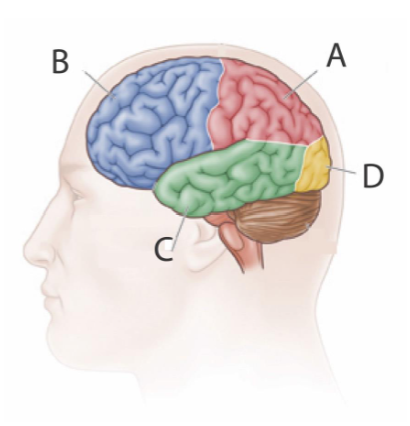
Name the lobes
A= parietal
B= frontal
C= temporal
D= occipital
synaptic plasticity
neurons that fire together wire together- connections can strengthen and weaken over time in response to activity
synaptic pruning
use it or lose it
Neuron coding
how the brain translates sensory info and thoughts into electrical impulses:
Temporal coding: speed of transmissions
Spatial coding: area of neurons that fire
certain neurons are specialzed only fire to express certain topics
Neuroimaging evaluation criteria
Spatial resolution: does its how where
Temporal resolution: does it show when
Invasive: does someone have to be hurt in the process
CT scan
Computed tomography- slices of x-ray taken at dif angles, good spatial, no temporal, slice of body/ brain
PET scan
positron emission tomography: radioactive glucose tracked in brain (goes towards areas that are at work) good spatial
MRI
Magnetic resonance imaging- uses magnetic properties of atom to create highly detailed images of the brain
fMRI
functional Magnetic Resonance Imaging- tracks flow of oxygen and blood in brain, good spatial, bad temporal
Single Cell Recording
implanted electrode tracks firing patterns of single neuron, awesome spatial and temporal resolution, buy on a unicellular level and very invasive
EEG
Electroencephalogram: electrodes placed all over skull, record changes in electric activity, good temporal, bad spatial (there is cheering in a stadium but we are outside and can’t see where or why)
HUMAN EYE
comprised of cornea, lens, iris, retina, fovea, optic nerve
VISUAL PATHWAY
LIGHT→ CORNEA AND LENS→ RETINA→ OPTIC NERVE→ LATERAL GENICULATE NUCLEUS (THALAMUS)→ PRIMARY VISUAL CORTEX (OCCIPITAL LOBE) ALSO, WHERE AND WHAT SYSTEMS (TEMP= WHAT, PARI=WHERE) LIKE WHERE’S PERRY\
from retina: photoreceptors→ bipolar cells → ganglion cells
CORNEA PLUS LENS
work like camera to focus image, muscles bulge the lens to zoom in like a camera, flatter for further away
iris
determines amount of light let in, dilates pupil etc
retina
where image is refracted onto, fovea in very center only has cones
photoreceptors
specialized neurons that respond to incoming light, 2 types, rods and conesro
rods
photoreceptor that picks up low light levels
cones
detect color, detail, do not work in low light situations
lateral inhibition
stimulated neurons will inhibit the neurons that are next to them, making the edges of these clusters of stimulated neurons the least inhibited, resulting in edge enhancement- brain’s version of a sharpening filter
receptive fields
region/ type of sensory input that a specific neuron can pick up on- many types, some pick up on vertical lines, some horizontal, some motion and direction, some corners
Center surround cells
fire strongest when stimulated in center and only center (if stimmed on center and outside, will fire at rate as if had not been simulated at all)
parallel processing in the visual system
Visual processing is divide and conquer, data begins being processed immediately from variety of different places, allows us to reinterpret what we see after gaining more info (think we see person, really just a shadow)
what system
temporal lobe- id’s what we are seeing- damage leads to visual agnosia, pathway connecting occipital lobe and inferotemporal cortex
where system
“where’s pari” parietal lobe, aids in perception of objects location (if damaged difficulties in reaching for things) occipital lobe and posterior parietal cortex
cognitively penetrable
what we sense can be influenced by our thoughts, beliefs, kmowledge, expectations
visual illusion
our brain makes compensations for size, brightness etc, sometimes unnecessarily, resulting in illusion
bottom up processing
data first, use raw sensory data to draw a conclusion
top down processing
driven by prior knowledge and experience to interpret new info
gestalt principles
assumptions we make about what we see- similarity, proximity, simplicity, good continuation, closure
similarity
WE group things that look similar together
proximity
we place objects that are close together in groups
good continuation
objects that are intersected by another and fall into the background are assumed to continue
closure
we prioritize seeing whole images over lines grouped together (our mins fill in the blank spaces to create the shape) simpl
simplicity
we would rather see two overlapping simple shapes than one weird one
object segmentation
how we separate an object form other objects/ foregound background
depth perception
guided by monocular and binocular cues
monocular depth cues
linear perspective (parallel lines appear to veer together) textual gradient (more detail plus texture close, less far away), interposition- objects in front closer, motion parallax- when moving head, closer objects will move more than ones that are further away
binocular depth cues
for things that are less than 20 feet away, brain can triangulate angles that both eyes see image at to figure out depth of objects
Color and wavelength
light is a form of electromagnetic energy that travels in waves, colors are determined by wavelength
perceptual constancy
our brain makes adjustment for brightness, size, and angle in order to perceive things consistently/ fairly
trichromatic theory of color
theory for how color is processed in the mind- 3 types of cones, red, green, blue, cones are activated by different frequencies, and activate in combinations that are interpreted as colors (for orange, red and green receptors would fire but not really blue) this theory is proved by color blindness (red-green color blind would make sense if you were missing red or green cones and therefore could not tell difference) di chromats plus monochromats
opponent process theory of color
we perceive colors in three opposing pairs: red vs. Green, blue vs. yellow, black vs. white, same neurons that activate when seeing blue will deactivate when seeing yellow, allowing the brain to figure out which color is being seen by look at activation and deactivation- proven by afterimage optical illusion- looking at one color for long time causes those neurons to fatigue, when shown a white screen (mix of all colors) the opposing pairs will send strong signals, in compared to their opposing pair’s weak ones
face inversion effect
we are significantly worse at recognizing faces when they are inverted because it messes with our ability to view them holistically
facial recognition
depends on orientation, inversion, ability to view them holistically, rather than how we can id an object based on a single part
object vs facial recognition
facial recognition relies on holistic processing, and is much more successful when not viewed at an angle, object recognition is far less holistic, objects can be recognized from their parts- more feature based. Facial recognition is more relationship based/ ratio based- how indiv features interact to make a whole